
The ongoing nakba: the destruction of the villages of Masafer Yatta

JVL Introduction
David Shulman from the Villages Group describes the history and the catastrophe being visited upon the villagers of Masafer Yatta in the South Hebron Hills, the southernmost part of the West Bank. Shulman’s calls for international opposition are increasingly urgent. On 11th May, a few days after this piece was written and just one week after the Israeli High Court declared that it was legal for the State to demolish 8 villages and evict the residents, the demolitions started with 19 structures destroyed, nine of which were family homes as you can see here in this Facebook video posted on that day by the Alliance for Human Rights..
Shulman’s article and plea is followed by a Twitter thread from Israeli Human Rights Lawyer Michael Sfard in which he derides the court’s decision, stating that “this rationale denying that the prohibition on forced transfer is customary law is nothing less than an embarrassing legal error.”
There are also links to further reading.

On May 4, 2022, the eve of Israel’s Independence Day, the Israeli Supreme Court, in session as the High Court of Justice, issued a ruling allowing the State to destroy eight Palestinian villages in the area of Masafer Yatta in the South Hebron hills, and to expel their inhabitants permanently. This ruling is a travesty of justice, an act of extreme judicial cruelty, and a severe blow to basic, universal human values and human rights. It also contravenes international law, including the laws of belligerent occupation as enshrined in the Geneva Convention of 1949 and the Rome Statue of 1998 defining crimes against humanity and war crimes. Israel is a signatory to both these treaties.
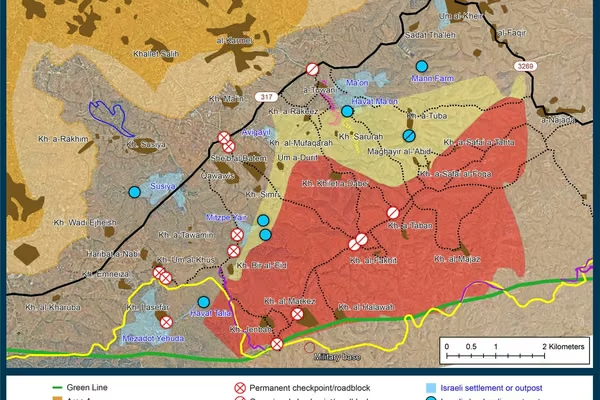
Some 1500 Palestinians (and possibly many more) in Masafer Yatta are now in imminent danger of dispossession. The ruling also has severe implications for the survival of another five villages situated in military training zone 918. Here are the names of all thirteen villages: Jinbah, Markaz, Fakhit,, Sfayi, Halawah, Khalat al-Dab’a, Taban, Majaz, Rakiz, Simri, Magha’ir al-‘Abid, Tuba, Mufagara-Sarura. These are real places where real families live, as their ancestors did in these same villages, for centuries. To eradicate them is to efface an entire traditional culture and a unique, historic way of life.
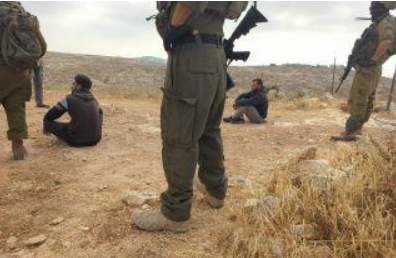
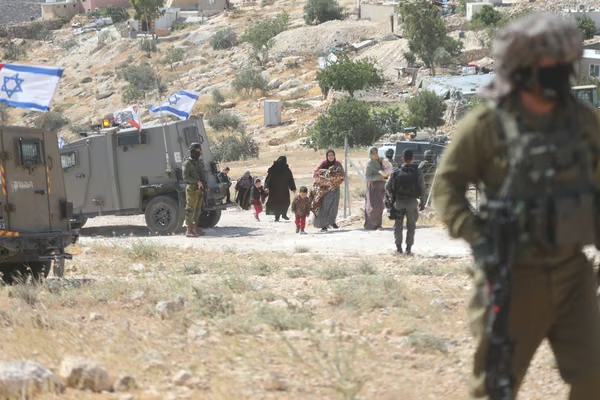
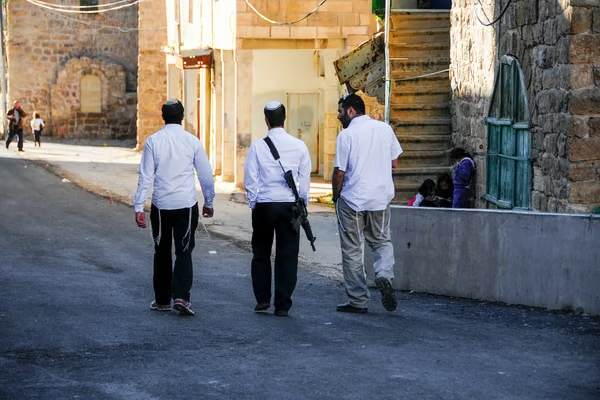
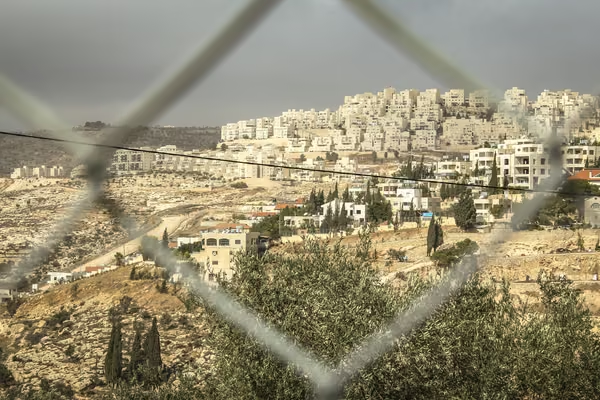
The training zone was arbitrarily established by the army in 1981, and the present High Court ruling reconfirms its legality. For over 20 years the Palestinian residents of this area have been struggling against eviction. The ruling of May 4th may mark the end of this legal process and thus the end of hope for these people. For the last many decades, the Israeli authorities have been systematically demolishing their homes, destroying the roads and wells, and confiscating their meager agricultural implements. During this same period, Israeli settlers were building and expanding illegal outposts within the same training zone, usually with the open support of the army; such settlements enjoy immunity from any threat of destruction, while the settlers engage in daily harassment and violence against their Palestinian neighbors.
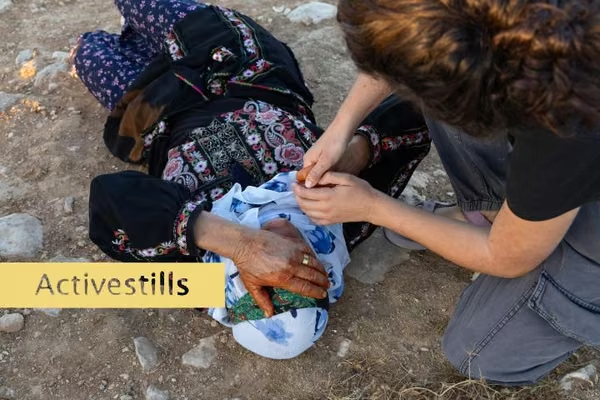
We know them well, from years of human rights activism in the South Hebron hills. Many of them are close friends. These are peace-loving people who wish only to live on their own lands, to graze their flocks, to plant and harvest wheat and barley, to celebrate their festivals, weddings, the birth of children and grandchildren, to educate these children—all this in the face of continuous encroachment on their lands by Israeli settlers and constant harassment by the army and police. In simple words, they have been living for the last several decades in a regime of ever more intense state terror. Not only their homes and way of life but their very lives are threatened by daily violent attacks by Israeli settlers, usually backed up by the army.
The judges, dismissing hard evidence submitted by the Palestinian plaintiffs, ruled that there were no permanent residences in these villages before 1981, when the firing zone was declared. There is ample evidence going back at least to the first half of the nineteenth century that the Palestinians were in residence in the villages of Masafer Yatta for at least eight to ten months each year (some families throughout the entire year). In the hot summer months, they would sometimes move with their herds to the cooler highlands, returning before the autumn rains. Most of the families lived in caves—a unique population in the Middle East—which explains the absence of stone houses or other homes in the aerial photographs of the area from the mid-twentieth century. Many of the caves have been destroyed, over the years, by the government; today, the families mainly live in simple stand-alone buildings. It is clear that the judges failed to take seriously the documented proof that these villages were long-standing sites of continuous residence, as is also confirmed beyond doubt by reliable oral histories from older members of the communities of Masafer Yatta.
All this may seem to outsiders to be a relatively minor, local problem. It is not. What is at stake is not only the survival of the Palestinians of Masafer Yatta. Humanity stands today at a historic point of crisis, in which the relatively few humane restrictions on brute military force—that is, the international laws of war anchored in the Geneva Convention and its more recent supplements—are in acute danger of being cast aside and forgotten, as we see at the present moment in Ukraine, among other places. The forcible expulsion of the Palestinian communities of Masafer Yatta will have implications for the whole of humanity. Israel’s Supreme Court has now brazenly claimed, in its ruling, that international laws of war and, specifically, the laws of belligerent occupation, are not binding on the State of Israel and can be overruled by legislation and the orders of senior military officers. This ruling is shameful and cannot be defended. Reputed experts on international law say that the court’s ruling on Masafer Yatta may well expose the State of Israel, and all those connected to implementing this decision, to investigation and possible prosecution in the International Criminal Court in the Hague.
But there is worse to come. The court’s ruling is another milestone in the process of remorseless annexation—that is, outright robbery—of Palestinian lands and the expulsion of the rightful owners of those lands. As Haaretz, Israel’s premier newspaper, has said in its editorial of May 8th, the court’s decision effectively confirms the charge that Israel’s rule in the occupied territories is a version of apartheid, based on domination by one privileged ethnic group over another population that is deprived of all elementary human rights. We are facing an ethnocratic hyper-nationalism that seeks to achieve its messianic goals (or profitable expansion) at the cost of Palestinian lives, language, culture, and history.
We are doing whatever we can to stop this inhuman crime, but the support of the international community is crucial to our struggle. You can help. You can make a real difference. Please make your voices heard, call your representatives and elected officials, spread the word, urgently–for the sake of the innocent people of Masafer Yatta.
David Shulman
For further information David Shulman suggests, for example:
, Israel’s legalization of forced population transfer in Masafer Yatta an “embarassing legal error”, 6th May 2022
Michael Sfard writes on twitter – מיכאל ספרד
May 5 • 11 tweets • 3 min read
Yesterday, on the eve of Memorial Day and almost secretly, the Israeli Supreme Court published its ruling regarding the legality of the eviction orders of thousands of Palestinians living in the south Hebron Hills in an area declared as a firing zone (No. 918).
/1

The court rejected the residents’ petition thus ending proceedings Lasting more than 20 years in which the danger of deportation hovers over thousands of Palestinians living in the declared “firing zone”.
/2
The ruling rejected the claim that the prohibition of forcible transfer set forth in international law is customary and binding. Judge Mintz ruled that this was a treaty norm, that is, one that expresses agreements between states but is not enforceable in a domestic court
/3
Beyond the fact that this is a cruel decision that could lead to a humanitarian catastrophe, this rationale denying that the prohibition on forced transfer is customary law is nothing less than an embarrassing legal error. So basic that it can be said that its equivalent
/4
in political science is to deny the claim that freedom of expression is a principle and characteristic of a democratic regime. The prohibition on forced transfer is perhaps one of the oldest in the prohibitions of modern war laws.
/5
In 1863, in the midst of the American Civil War, Professor Francis Lieber formulated at the request of President Lincoln a draft code codifying the principles of the laws of war of the period. Lincoln published it as a legally binding proclamation, known as the “Lieber Code .”
/6

Article 23 of the Code established the most basic prohibitions on the occupation army, alongside the prohibition of murder and enslavement of the citizens of the Occupied Territories, is the prohibition on “removal of civilians to remote areas”
/7
This principle developed into an explicit and clear prohibition of international law on both deportations (i.e. across the border) and forced transfer (i.e. within the country) and this prohibition was enshrined in the 1949 Geneva Convention
/8
and its violation was defined as a war crime the Nuremberg Military Court and a crime against humanity the Rome Statute of the International Criminal Court. The Red Cross also stated in a comprehensive study that the prohibition on forced transfer is a binding custom.
/9

And it makes so much sense. The world we live in is a world where slavery is forbidden, the murder of civilians is forbidden and deportation is forbidden. It seems to me that this is an intuitive moral principle.
/10
So beyond the fact that the Israeli High Court yesterday put thousands of Palestinians in danger of forced transfer and this is, of course, the most serious thing, it also failed in my opinion to apply relevant law and made a serious legal error.
/END
See also








































Where’s the BBC, silent again on any heinous behaviour by Israel against the Palestinians. Wall to wall on the war in Ukraine every day. I’ll be sharing this on Facebook and Twitter, with a question to the BBC.