
Jewish Journeys from Zionism (10): Leah Levane
JVL Introduction
This, the tenth in JVL’s “Journeys from Zionism” series is the story of Leah Levane, JVL’s Co chair. Leah outlines some of her family’s history which includes a grandfather who refused to comply with conscription in 1916 and being the only Jewish person in her primary school once her sister had gone to secondary school. Leah describes how she progressed from seeing Israel as a ‘bolt-hole’ and an enthusiastic supporter of Israel in the 1967 war to recognising Israel as a state rooted in racism. The racism underlined to her by her father who visited Israel as a supporter and returned horrified by the racism he saw towards Mitzrahim and even more towards ‘Arabs’.
Leah describes her work with JVL including how it has allowed her to work with anti-Zionist Jews from many countries.
Thanks, as always to Kitty Warnock who has produced this essay from a zoom conversation.
Index of all the personal stories
MC
Background and childhood
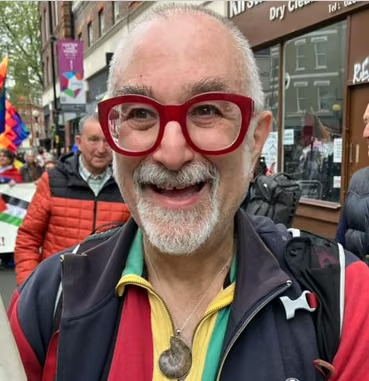
My name is Leah Levane, and I’m 70.
I was born in Hammersmith hospital, into a typical post-war life. Nine years after the end of the war and my parents had been living for six of those years in two rooms at the top of a multi-occupied house in Shepherds’ Bush, West London, with a shared bathroom, and the kitchen just a cooker and sink and cupboard on the landing. I don’t remember, but I can picture it – my mother having to carry me and my toddler sister and the groceries all the way up to the top of the big house.
When I was two we moved to Southall, in West London, which is one of the least Jewish areas you could imagine. My sister and I were the only Jewish children in our primary school: when I started, around 40% of the pupils were Sikhs from the Punjab region of India, whose families had come over to work in the rubber factory in the area. When my sister left the school I was the only child who didn’t go into assembly. I loved it, walking the corridors on my own. Rather than feeling excluded, I felt like somebody special. Later I realised that it was ironic that all the Sikh children went into what was at that time a very Christian assembly. I guess that’s what recent immigrants do, you want to fit in.
The only person who ever said anything antisemitic to me was the one Afro-Caribbean boy in the school, Michael. I was about nine when he said something about Jews, and I punched him on the nose. I was outraged that he ‘of all people’, had said it. I am sure he didn’t know what he was saying and when I said, “You can’t say things like that”, he stopped. After that we were good friends and did things like partner up for country dancing.
I went to Cheder, and we went to a synagogue about four miles away in Greenford, an area with only slightly more Jewish people than Southall. The synagogue was too small to have a rabbi, so the services were taken by Mr B____, who was a solicitor but very dedicated to his volunteer role and was there nearly every Sabbath – not that we went very often.
Index of all the personal stories
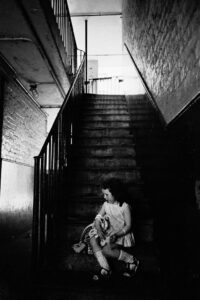
My family are quite long-established in this country. My grandparents on my mother’s side were both born in the UK. Their parents had come as part of the big wave of immigration in the late nineteenth century. Both sides of my mother’s family were Latvian, with wonderful names, Zeital and Flashtig. Four brothers in the Zeital family came as economic migrants from a village near Riga. My mother’s Zeital grandfather was very religious: he would sit in the corner studying the Torah, and the women went out to work. I know less about my father’s family. His mother was born in Latvia, and I suppose his father was from Poland, as my father had dual British-Polish nationality. That great-grandfather was a skilled joiner – he built the pews for the Great Garden Street Synagogue, in the East End. They lived in Wentworth Dwellings (very similar to Rothschild Buildings pictured, which was close to and demolished at the same time as Wentworth Dwellings). This was a slum tenement off Petticoat Lane, the heart of the East End Jewish community, and my grandfather became a presser in the rag trade. He died quite young, just over 60, perhaps from inhaling chemicals as well as bits of fluff[i], and my grandmother also died young.
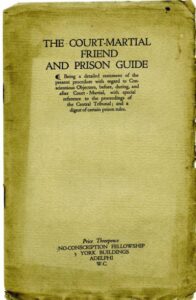
My mother’s father was called up to fight in 1916, but he was part of Fenner Brockway’s No-Conscription Fellowship[ii], and he refused. Unlike Quaker Conscientious Objectors who did non-combat tasks like driving ambulances, the No-Conscription Fellowship were absolutist: “All this is illegal, we’re not even going to help, it’s all part of the war effort.” My grandfather was tried and spent three and half months in Wormwood Scrubs prison and the rest of the war in a camp in Wakefield in Yorkshire, with hard labour throughout. He was very left-wing, very committed to the international working class. My grandmother was more religious, but she stuck by him and visited him in Wakefield, and they got married soon after he was released in 1919. But he was somewhat broken by those years of imprisonment and hard labour and while his views did not change, the fire had gone. He used to joke about being doubly beaten every day, once for being a conchie and once for being a Jew. It was never a secret that he had been to jail: we were proud of it, of standing firmly for his principles. It was a form of bravery but I did not realise how much until it was too late to ask him the questions I wish I had asked. Later, when I was a student and occasionally writing for Militant, he was the only person in the family who was interested. My father, a Labour Party member, was very against my left-wing politics.
What chance did my grandfather have of getting work after the war? He had a German-sounding name, he had been a conscientious objector, and he was a Jew. I assume his comrades helped him, and he got a lease on a corner grocery shop. Through the depression he let people have a lot of stuff on tick. His family never went hungry, but they just lived above the shop. When it was demolished with the redevelopment of Euston Station – when the Arch went – they moved into a tiny council flat in Euston. I remember my grandmother in the galley kitchen which was so minute, it was crazy, but still she would make us eat properly, “Sit with your back straight! Elbows off the table!” My other grandparents were also moved into a tiny flat on the Ocean Estate in Stepney, when their slum in Wentworth Street was demolished.
My mother worked from the second I started school aged four. Not full-time, but almost, so she wasn’t home when we got back from school and she’d often arrive to find me and my sister fighting. I think my mother felt a bit inferior to her sister, whose husband had a small business and a much more comfortable home. We didn’t have to count pennies, but we certainly had to count the shillings. I understood later that my father was very frustrated: he’d wanted to be a journalist but school had stopped when he was 13 because of the war. He got an apprenticeship at the Daily Mirror but in early 1944 he was called up, and when he was demobbed a year after the war ended he couldn’t go back to his training – perhaps he was too old by then.
My parents were fairly actively Jewish. My father was on the committee of our little synagogue. We didn’t quite keep kosher, but nor did we eat obvious “Treif” – pork, shellfish, bacon – nor have milk after meat. We didn’t really do Friday night rituals, but I was never allowed out on a Friday night – I had to stay home with the family. It didn’t make much sense, but that was the rule.
My parents were both Labour Party members, not councillors or anything, but I think they went to the branch meetings, it was just a given. In 1962-3 we had a TV, and I was quite politically aware. I remember watching reports about the civil rights movement in America. One demonstration sticks in my mind: dignified and well-dressed black men walking with big placards that said something like “I’m a man too”, and then being beaten, threatened with dogs or pummelled with water from hoses. Racism was also brewing nearer home as the Indian community in Southall was increasing. I wasn’t particularly aware of racism at school, perhaps because we had such a high proportion of Indian children and even an Indian teacher, but my parents were picking up on it, and I remember them saying, “Those are the sorts of things they used to say about us (Jews),and look where that led.”
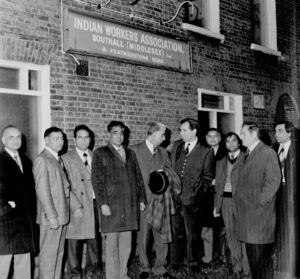 When I was 10 or 11, I remember that the Indian Workers’ Association[iii] in Southall organised a meeting, perhaps against the Southall Residents’ Association[iv]. My father went to them and said, “Would you like to get the Association of Jewish ex-Servicemen[v] to come and patrol your meeting?” He wasn’t active in it but must have had contacts. They said, “No, Sikh people don’t need that,” but it was a real gesture of solidarity. I remembered it ten years later, when some left-wing group I was in was organising a meeting in Conway Hall about the National Front: I said, “I wonder if AJEX would come and protect the meeting?” They did, and they were great. I remember they were all quite short guys, and they stood round the edge of the meeting in black bomber jackets. Somebody started heckling, trying to disturb the meeting, and while the rest of us were slightly panicking they just said, “Out of the way,” and marched the hecklers to the door, and then regrouped to block the entrance.
Israel in the background
I was never a conscious Zionist. I didn’t even know the word when I was a child. I was aware of the Holocaust, though no one we knew of in the family had been caught up in it, except the husband of one of my mother’s cousins who came from Berlin and had lost all his family. I was aware of Israel, and I was aware of people who were fervent about it – a cousin has lived there since the 1980s – but from my parents I just got a sense that it was good that it existed; they had no great desire to go, even to visit, certainly not to live, but, “We need a bolthole,” that was the sense of it. And of course at every major Jewish festival, every Bar Mitzvah, every wedding, you toast the Queen and then you toast the President of Israel, you play the British national anthem and you play the Hatikvah[vi]. It was just there, accepted, obvious and I did not question it.
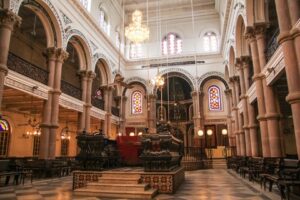
My father didn’t talk a lot about his war experiences, but he did tell us about Rosh Hashanah in 1945. He was in India at the end of the war. News about what had happened to the Jews in Europe had been coming through, and the allied armies allowed all Jewish soldiers time off to go to the big synagogue in Calcutta (now Kolkota). My father said it was amazing: they knew how much European Jewry had been destroyed, and yet there they were in this huge synagogue packed to the gunnels with British, American, ANZAC and Canadian Jewish soldiers, with a Chazan singing beautifully. They felt, ‘We as a people are going to go on. Look how many of us are here. Hitler did not win.’ That must have been so moving, incredible. It’s not surprising that people celebrated when the UN agreed to the creation of Israel. It’s not surprising that they thought, ‘We’re all committed to Never Again, but if it happens we have somewhere to go.’
When I turned 13 in 1967, I joined the Ealing Jewish youth club, which met in the basement of a synagogue, with amazing 1960s psychedelic murals. My parents were working to try and get a Jewish youth centre built, and this was the interim place. Not long after I joined, the Six-day war broke out. We were all fantastically gung-ho. The boys were all hoping to volunteer, though none of them were old enough, and of course it was over before anyone had even got to a travel agent. But they were that keen, and so was I. “Now we’ve shown them!” I thought – but I understood nothing,
In my gap year, I wanted to go to Israel to a kibbutz, but my parents put a lot of pressure on me not to go. They were worried that there would be another war – and of course not much more than a year later, there was. Interesting that they discouraged me from going.
Internationalist and local politics
When I was 14 or 15, I got more interested in organised politics. I’d talk about Biafra, or what was happening in the southern states of the US, and my father would say, “Don’t think about that. You should join the local Labour party and help get the potholes mended.” Not much understanding of how to enthuse a teenager! What did I care about potholes?
At university I joined the Labour club. It was dominated by Militant, which I didn’t realise initially, but I do remember their stand for a single democratic state where Jews and Arabs would live together. The line was: a United Socialist states of the Middle East. I thought it made sense, and I started to find out how oppressed the Arabs were. I didn’t call them Palestinians then. I started to realise how limited my education had been: my O-level history even stopped at the causes of the first world war, not even the war itself.
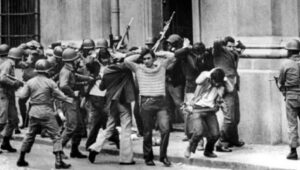
I didn’t do a lot of reading about Palestine when I was a student, only what was in the media. In my small socialist group in Wales, everyone had to develop an in-depth knowledge about something, and I chose Spain. Franco was still alive, and it seemed important to try to learn the lessons of the Civil War and popular frontism. I had started university two weeks after the coup in Chile, which both distressed and also influenced me enormously. I was attracted to revolutionary politics and decided to major in politics; Israel-Palestine was just one of the places that needed sorting out through revolutionary change. I didn’t feel that being Jewish meant I had to take a particular interest in what was happening there.
After university, I moved to London and was very politically active for some years but left the Labour Party because of Kinnock’s lack of support for the miners in 1984 – that was also the year that I had my daughter. My political activism took a back seat for some years: I was a single parent, I had a full-time small-p political job. I was a community worker in working class communities in south-east London; I was trying to help people understand how political systems don’t work in their interest, but I couldn’t be saying to them, “What we need is a Marxist revolution! Let’s spend our women’s group time on this!” But it was political education nonetheless. Also when you have a small child, in the little spare time you have you’re asking, “How do we make things better for my child and others around us?” I did, however, take her on some marches and even one Christmas Day was spent singing with the anti apartheid choir “until Mandela is free” as part of the “non stop picket of the Embassy”.
Seeing Israel
My father was sort of Zionist. He used to have a go at me for reading the Guardian, which he felt was “pro Arab”. However, he didn’t say it was antisemitic, he just said it was “putting the Arab point of view”, which wasn’t a good thing from his perspective because ‘we’re the victims’. In 1984, he went to Israel. My mother had died and he’d lost his job at the same time, and he didn’t want to stay in the house where my mother had been so ill. He thought, ‘Where can I go? Who wants an unfit, fat, 58-year-old with no qualifications? I know! Israel will have me!’ Friends in Netanya invited him to stay with them, and he was gone for seven weeks, the longest he had ever been anywhere apart from when he was in the army.
When he came back, I asked him what he was going to do, and he said,
“I’m going to have to find somewhere else to live, I couldn’t possibly live in such a racist society. we’d be alright, we’re Ashkenazi, we’re top of the ladder; a bit lower you’ve got the Sephardim, and much lower you’ve got the Mizrahim,” – and that was what really shocked him as he thought that in a Jewish state, the bolthole to keep Jews safe, all Jews would be treated with respect, dignity and equality and it was clear that this was not the case. The Black Jews from Ethiopia had just been rescued from the famine, and he said angrily that, obviously, they were right at the bottom of the ladder. I asked: “What about the Arabs?”
“Don’t be ridiculous, they’re not even allowed on the ladder.”
He never said anything about Israel after that. He lived for another twelve years, but he never once criticised what I was reading, or what I was doing. He didn’t say, “Great!”, that was a step too far, but he definitely stopped thinking that Israel was in the right.
A couple of years after my father’s trip I went to Israel myself, to see my cousin. It wasn’t that I felt I had to go, that Israel belonged to me. It was because I love my cousin, and I regretted not having been to his wedding, which my mother had wanted, shortly before she died. I chose to go while my daughter was still under two and could travel for free.
There were things about being at my religiously observant cousin’s that I loved – the love of family and some of the Sabbath rituals that I’d not known at home. But some aspects of Israel were very negative. My daughter has mixed heritage and people in Israel would stop me in the street and ask me if she was adopted: a lot of Jewish families in Israel had adopted Latin American children at that time. When I said, “No, she’s mine, her father’s from the Caribbean,” Jewish people would usually mumble, “Oh,” and walk on. Adopting a dark-skinned child is one thing, but having one yourself is different – that’s how I felt about their reaction. Palestinians I met, such as several street cleaners, would ask me the same question, and their response would be, “Oh it’s very good to mix, isn’t that lovely.”
I also remember how racist one or two people I met were. One man was outraged that during her military service his grand-daughter was doing some sort of social work role with Druze[vii] soldiers: “Why are you wasting your time with these Arabs?”, and she couldn’t convince him that they were Israeli soldiers and so deserved the same support that other soldiers received.
The first intifada, which began in 1987, was a largely peaceful uprising and was very brutally repressed. I started to read more, but my daughter was still small, so I didn’t do anything – but new ideas were dripping into my mind. I was moving away from the idea that Jews need a place of their own. There’s that awful moment when you start looking back at what happened in 1948 and what happened to Palestinians, and you realise what distortions and even lies you had absorbed. “We agreed to partition though it was less than we wanted, but the Arabs didn’t agree,” “They want to drive us into the sea,” and so on, the Arabs always presented as the ones who blocked peace. Once you see that all of that justification is a big lie, then it makes no sense.
I think I was in my 40s when I learned more, and decided that the state of Israel is awful, that I had to reject Zionism, and that I did have to stand up as a Jewish person about it. Even though I do not agree with Zionism, given our history, I do have compassion for people who think a state where Jews not only have rights (that can be taken away) but are in control is a good idea in principle; but we are talking about the actual Jewish state, and what it is like.
Committed to Palestine at home …….
As my daughter grew up I started getting back into active politics. I signed up to Jews for Justice for Palestinians. I also joined the Strawberry Thieves Socialist choir[viii], and another of the singers was in the International Solidarity Movement. I listened to her a lot, and she recommended reading that took me a bit deeper. It was the time of the second intifada, and though I didn’t agree with some of the actions I was really trying to understand.
Through the choir I came across an American singer, David Rovics, whose song “Jenin” tells the story of a boy in Jenin[ix]: “Oh, child, what will you remember/ When you recall your sixteenth year/ The horrid sound of helicopter gunships/ The rumble of the tanks as they drew near/ As the world went about its business/ And I burned another tank of gasoline/……You were so far from the thoughts of so many/ Huddled in the city of Jenin.” The story continues through several verses – his teacher crumples by the door when the school is attacked, his mother is killed – and at the end he gets on a bus wearing a suicide belt, and the song asks, “What were you thinking as you went off to war, were you thinking of your mother’s vacant eyes, were you thinking of the city of Jenin?” He’s not saying, “It’s great that you blew up a bus with ordinary Israelis on it”, but he is saying there was a reason, a context for this act. (you can listen here)
The choir sang a number of songs about Palestine. One had the line “A secular state for Palestine”, and it resurrected my earlier, Marxist ideas that what we need is working class equality. I rewrote one of our songs to make it about Palestine – I was so horrified at the separation wall going up[x]. I knew from my cousin that before the wall there were exchanges – nothing deep, a mosque-synagogue connection, football games, shopping across the Green line – but there was a feeling, ‘This is the Jewish state but we share the land with other people.’ The wall stopped all that. It turned everyone into an enemy on both sides.
In 2005 or 2006, an email reached me from someone working with the Yaffa arts centre in Balata camp, near Nablus, seeking support to bring a theatre group of young Palestinians to the UK to perform a play they had written about about the grimness of the waiting at a checkpoint. I didn’t have time to do anything, but I went to see the show’s last night in London after touring the UK including Northern Ireland where they got the best reception. After the play, they followed with Dabke dancing, full of joy and excitement. I congratulated the producer, apologised for not helping and asked whether the performers had met any British young people. He said, “No. Would you be able to arrange that?” I confidently said, “Yes, I’m sure I could, if they can come again.” “Why not, if we can raise the money?” So I got cracking, with the choir, on raising funds to bring them. Some potential partners found it too political, or couldn’t engage because it was too dangerous to send British young people over there as an exchange. But “New Generation”, a group of refugees from Colombia in their 20s and 30s, got on board and they raised £2000 from Lambeth Council. We had a fundraising event at the Rivoli ballroom, (with the aforementioned David Rovics one of the performers) and found that we had raised enough to bring them to the UK. The young Colombians arranged for a few days in Wales and the photos of the young people paddling in the sea was very emotional. (Most in Balata camp come from Jaffa which they can now see from the hills above Nablus but they can’t go to it.) Everything worked very quickly, they came, and they loved it. When I went to visit them the following year, I had to do a double take to recognise the three young women who’d stayed in my flat, once their lovely curly hair was covered by their elegant hijabs.
….and in Palestine – monitoring human rights violations
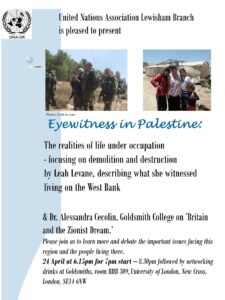 In 2012, I spent three months in Palestine with the Ecumenical Accompaniment in Palestine and Israel programme, and I was based in the South Hebron Hills[xi]. When you go home you are supposed to give ten public talks about what you saw: I gave at least 120, partly because a friend organised two tours in the North West for me. I even did three talks in France, in French, which I felt rather proud of. It’s an international programme, but the UK and Ireland programme, which is run by the Quakers here, probably has the best training and support for the volunteers than other countries do.
… and internationally
I am one of those who represent Jewish Voice for Labour in an international group of Jews from across the world. The similarities and differences between different countries are fascinating. We are all having to fight the IHRA, across the world. Americans have the sheer numbers: Jewish Voice for Peace is big enough to have chapters and workers, and they can do big things like occupying Grand Central station, all dressed in black T-shirts with white lettering. On the other hand tiny communities in smaller countries like New Zealand and Ireland can sometimes make considerable progress. I remember working with an Irish woman in a small voluntary organisation in this country, and she said, “Why don’t you talk to the Minister?” We said, “Don’t be ridiculous, how can we do that?” but for her at home it would have been just a matter of making a phone call: “I work for a women’s development charity and I would really like to talk to you about our women’s experiences,” and they’d say, “Let’s meet for a coffee,” or “Please bring two of the women to a formal meeting.” It’s seems easier to get heard than here.
Speaking out as a Jew
I was also involved in Jews for Justice for Palestinians. I started speaking as a Jewish woman. I don’t go around saying, “Jewish woman against welfare cuts, Jewish woman for refugees’ rights”, but on this issue you have to. I often say, “Have compassion for people who want a Jewish state. Their fears are real, whether they’re rational and justified or not.” For me, one of the most wicked things the Zionists did through the Jeremy Corbyn business was to whip up that real fear, when there was nothing to fear. To me that was malevolent and cruel.
It’s so important to make the distinction between Jews and Zionism, Jews and what the state of Israel is doing. I went to a march the mosque here in Hastings organised after October 7th. The first speaker from the Mosque said, “This is not about Jews, the problem is Zionism. We have no anger towards Jews or Judaism. We left Spain together,” – that’s a lovely long view of history – “and we lived together for many many years, in Andalus, and in the Middle East.” After I’d spoken a little later he came over to me and said, “I’m so glad you spoke. It’s really important that people make that clear distinction.”
But I also resent the fact that since 2017 I’ve had to put so much energy into fighting the weaponisation of antisemitism rather than fighting for justice and equality for Palestinians. It’s essential work, but it’s a distraction – and I’m sure that’s a deliberate tactic. We hear more about it than we do about what’s happening in Gaza. Take Jonathan Glazer’s acceptance speech at the Oscars: critics (mis)quoted what they wanted to hear – that he was rejecting Judaism, which wasn’t what he was saying at all. And why do some Jewish people’s feelings (important as they are) get so much attention while, eg more children have been killed in three months in Gaza than were killed during ten terrible years in Syria. And we’ve got used to hundreds of deaths every day, whereas we were rightly horrified by four or five deaths a day in Bosnia in 1992-5. But if you keep highlighting that, you are branded as an antisemite. The narrative that the pro-Palestine demonstrations are hate marches persists and is taken seriously. Three or four people may be arrested in a march of hundreds of thousands, and yet the mainstream media don’t say, “This is a load of rubbish. In whose interest is it to whip up this? Why is the government not listening?”
The future of Israel and of Palestine
In the short to medium term I’m very pessimistic. In 2014 I thought Israel had gone too far, but that is nothing compared to now. But two things give me hope for the future: first, the numbers of people, not just young people, who are saying, “What on earth?” and can hardly believe the failure of our political leaders to do even the minimum such as making arms sales conditional and calling for the killing to stop. Second, the huge mobilisation across the world in support of Palestine. The way it has been sustained over more than seven months is quite amazing, and I think there is a possibility of building on that. It’s happening at all levels. Recently I was on holiday in Devon, and I joined a friend who lives there for the weekly vigil in Barnstaple. There were about 30 people, with their dogs and kids in strollers, though it was drizzling with rain. They have a gong: the first stroke is for the Israelis killed on October 7th, and after that, one stroke for every 1000 Palestinians killed. It’s very powerful, silence and then every few seconds the gong. I spoke, introducing myself as a visitor and a Jewish woman. Several people came up and thanked me, saying “It’s so great to know that these things are happening everywhere.”

I went to Palestine again in 2017 – 50 years after 1967 – with the Center for Jewish Nonviolence[xii]. I was with a group working in Silwan[xiii] with Palestinian children from a community centre, to make some murals and clean the streets. It’s a classic case: Palestinians pay their municipal taxes but don’t get the most basic services, and then Israelis say they are dirty. In Silwan, which is being taken over by settlers, it wasn’t easy for Palestinians to be seen working with a group of Jews, mostly American. At the party at the end of our visit, one of the community leaders held his little girl’s hand as he made a speech: “It’s been wonderful to be able to show our children Jewish people who support us.” His little girl tugged his shirt tail and asked “Yehudi?”, looking at us, astonished. And I thought, ‘In the midst of what they’re going through, they still think it’s important to bring their children up not to hate Jews.’ I’ve seen so little hate towards Jewish people there despite the horrors that are being inflicted on them by the Jewish State.
Index of all the personal stories
Notes
[i] There was high rate of TB among garment-trade workers in the East End.
[ii] A British pacifist organisation founded in November 1914 by Fenner Brockway (socialist politician, anti-imperialist, humanist, joint founder of War on Want) and Clifford Allen (leading member of the Independent Labour Party).
[iii] The Indian Workers’ Association (GB) was set up in 1958, though with origins from the 1930s in workers’ movements in India and the UK. Many branches in the UK were close to the Communist Party, but the Southall branch was closer to the Labour Party, and broke away from the national movement in 1961.
[iv] Southall Residents’ Association, set up in the early 1960s in Southall, was a racist white organisation with links to the British National Party.
[v] The Association of Jewish ex-Servicemen and women (AJEX) was established in London’s East End in 1929 in response to the rise of antisemitism and fascism. Its activities include remembrance of the Jewish contribution to the British military, welfare of veterans and their families, and combating antisemitism including providing security for meetings etc.
[vi] Hatikvah (“Hope”), the unofficial national anthem of Israel until it was adopted as the official national anthem in 2004.
[vii] The Druze are an Arab ethno-religious minority, which separated from Islam in the 11th century. In Israel and the Occupied Territories they are mainly based in the Golan Heights. They are mostly loyal to Israel and have served in the Israeli military since 1957, sometimes controversially.
[viii] A choir formed in 1996 in south-east London to perform songs of socialist political struggle and protest, historical and contemporary.
[ix] The Second Intifada began in 2000. In the “Battle of Jenin” 1-11 April 2002, Israeli troops entered Jenin refugee camp, seen as a centre of resistance against the occupation. Deaths are estimated at over 50 Palestinians, and 23 IDF soldiers.
[x] The Separation Wall is a 708 km barrier, some stretches consisting of a concrete wall up to 9 m high, separating the West Bank from pre-1967 Israel, though its route is well inside the West Bank in many places. Long-mooted plans were approved and construction began in June 2002.
[xi] The Ecumenical Accompaniment Programme in Palestine and Israel is an international, ecumenical programme that recruits and despatches observers (known as Ecumenical Accompaniers – EAs) to several Palestinian towns and villages to monitor the interaction between the Palestinian inhabitants and the Israeli military. The presence of EAs is intended to offer protection and to moderate friction. Abuses of authority are monitored and reported and EAs speak publicly of their experiences. The EAPPI was founded in 2002 under the auspices of the World Council of Churches, in response to requests from Heads of Churches in Jerusalem.
[xii] The Center for Jewish Nonviolence works to use its volunteers’ privilege as diaspora Jews to support Palestinians resisting occupation. It began in 2015 with a week-long delegation to replant olive trees uprooted by the Israeli army on a farm and education centre near Bethlehem.
[xiii] Silwan is a Palestinian district of East Jerusalem, the site through the 21st century of persistent, illegal but often successful, efforts by right-wing Jewish settlers to evict Palestinian residents.

This is a wonderful account Leah. Very strong. Your family history and your journey.
I was born in Kolkata and lived there until I was 13. I was interested to see the photo of the Great Synagogue there and read about it. We had Jewish neighbours and friends. My aunt was a teacher in a school in the Himalayas and the family of two of her pupils, sisters, that had a flat in our building would invite her to their Shabbat meal when she was staying with my family in school holidays. Sometimes I would accompany her.
I remember those evenings, the serious, deep sense of the importance of tradition, of prayer, family and love. And much warmth and laughter too!
There is so much to learn from sharing and understanding.
I learned a lot.
Your father’s reaction to the racism he saw in Israel.
The wall.
The different Jewish groups around the world that support Palestine.
And much more.
Thank you.
Thank you Leah for sharing your story xx
Inspiring life time of socialist conviction, the Labour Party fools cast out a diamond.
Thank you Leah for this fascinating account of your personal history. Utterly engrossing. I am a supporter of Jewish Voice for Labour and read as many of the articles as I can. This one is superlative.
In your 70th year those who know you should have written in your honour. Leah your life as your write it here bears witness to a life of giving and of helping others where you have tried to lead people to the truth while always open to learning yourself and always devoted to selfless socialist ideals. There has I know been pain on the journey but the personal has not clouded your clear-eyed account of your family’s experiences and the respect and love shines through. I recall the journey we took to Poland together – and how you walked the Jewish quarter and visited Auschwitz. Israel has betrayed all those by what they have done and are doing in Gaza, and its leaders don’t care. The irony is, in so doing they have destroyed Israel’s position in the world and in the history books yet to be written, if the world survives that long. I thanks the stars that there are humane, keenly intelligent Jews like you who have loudly proclaimed ‘Not In My Name’ time and again. On the side of the angels.
Another very interesting article. I liked the part where Leah’s conventional father went to Israel for the first time and came back horrified by the racism of various forms and tiers which is embedded within Israeli society.
I am impressed by Kitty Warnock’s ability to transcribe these detailed and referenced write-ups out of discussions through zoom interviews.
Inspiring story Leah, thanks.
As Neil Hunt says above : “Inspiring life time of socialist conviction, the Labour Party fools cast out a diamond.”
I could literally weep reading Leah’s story, and then thinking back to last week Starmer accepting one of the most right wing Tories into the Labour Party and had the absolute gall to talk about ‘shared values’.
I know there are fine and honourable people still in the Labour Party hoping to be able to effect change, but I fear it is now utterly beyond redemption.
This is a brilliant addition to a really useful series. we can point people to these stories when they lump everyone together and say Jewish people think this, or feel that.
Excellent addition to this important series.