
Jewish Journeys from Zionism 13 – Nira Yuval-Davis
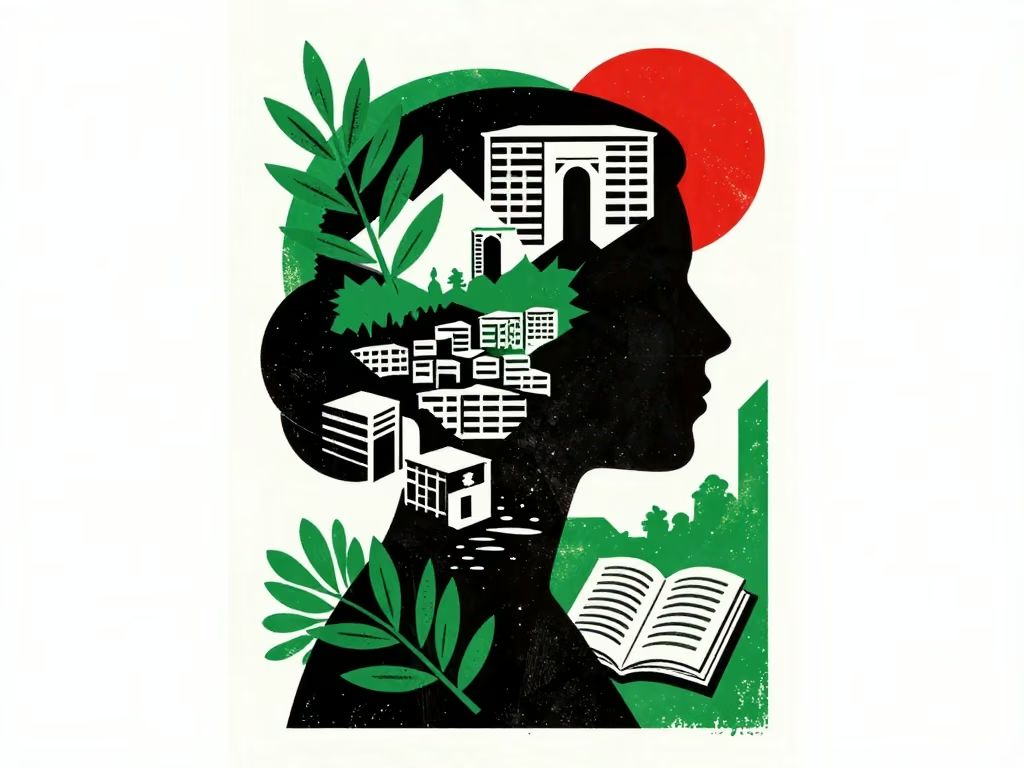
This is the 13th in the occasional series “Jewish Journeys from Zionism”, this time featuring Nira Yuval-Davis, born in Palestine before the founding of the State of Israel. As such her experience is somewhat unique within our series and is still uncommon within disapora communities. Her failure to conform had her questioning Israel’s treatment of Palestinians by the time she was drafted into the army. Nira has made huge contributions in academia and in campaigning, for example for justice for women, for Palestinians and refugees.
Our thanks, as always to Kitty Warnock for her hard work and commitment to this project.
Index of all the personal stories
LL
_______________________
Nira Yuval-Davis
Interviewed at her home in London, 9 Sept 2024
My name is Nira Yuval-Davis, and I’ve just turned 81. I was born and grew up in Israel – though of course in 1943 it was still Palestine.
Childhood
My father was the son of a rabbi, a whole line of rabbis, and he was expected to become one too. But independent Lithuania had kept the compulsory secular education that Germany had introduced when it occupied part of Lithuania during the first world war, so instead of just going to Cheder my father went to a secular high school with a Zionist orientation in Kaunas. He rebelled against his family and became socialist Zionist.
When my parents came to Palestine from Lithuania in the early 1930s they went to Kibbutz Givat Brenner[1], but my mother didn’t like the conformity of life in the Kibbutz so they moved to Tel Aviv. That’s where I grew up, at the heart of the Yishuv, in a Labour Zionist housing estate, housing only members of the Histadrut.
Index of all the personal stories
In the socialist Israeli economy the Histadrut was probably a bigger employer than the government, and my father was head of the accounting department in a Histadrut cooperative enterprise. When socialist Israel started becoming capitalist, in the 1960s, the cooperatives created corporate companies, and he became an accountant. The party and everyone went through the same change. My father for me symbolised the development of the Israeli state – he was so much in the mainstream of labour Zionism, and they all moved together.
My father and I didn’t talk politics from soon after the 1967 war until his death in 1982, because we realised that the shouting matches would damage our relationship too much. But then he had a stroke, just a week before Israel invaded Lebanon for the first time. He could hardly talk and he died a couple of weeks later, but he whispered to me – I will never forget it – “I never dreamt that the Utopia I came to build here would become such a nightmare.” It was so important for me that he was able to see it. But these days I am thinking, ‘What would he be thinking now? Would he have been able to see beyond all the brainwashing?’ He had left Mapai and moved to another party with Ben-Gurion at the end of his life, but though he started to lose his basic trust in the system, he never went beyond it. When I started being interested in the Palestinian issue, he said, “Your politics is not real, because it doesn’t include socialism and class and all that.” I pooh-poohed him at the time, but of course later I became socialist – so I think we could have had a bit of a rapprochement. But it’s too late, I can only talk to him in my head.
Teenage rebellion
The homogeneous social and political environment I grew up in was absolutely identified with the government and the state of Israel, and as a young teenager I joined the Labour Zionist youth movement[2]. But, ironically, I discovered Ayn Rand when I was fourteen: not Atlas shrugged but The Fountainhead[3], which was not so much about the new liberal economy but about the libertarian ethos. The idea that you can be non-conformist called to me very strongly. This was one of several times in my life that books were more important than people in enabling me to move forward. At that age I did not understand the political economy of the kibbutz as based on land expropriated from the Palestinians, but I saw its homogeneity and social conformity. I thought, ‘I’m not going to join a kibbutz’, and I left the youth movement. This was my first step in distancing myself.
With another organisation, Youth for Youth, I visited a Druze village in the Galilee. There I met a Palestinian girl my age, and her cousin became my boyfriend for a while, to the horror of some of my relatives. I was what would later be called a beatnik or hippy – experimenting, rebelling against the conformist pressure of my neighbourhood and class-mates.
Then came the time to go to the army. My sister, ten years older than me, was one of the first women officers in the media corps, and as I’d been a good pupil I was supposed to go on the officer course. But in the month before the course began I was sent to work in the office of the military government[4]. People said, “Such a privilege, you can work near home, go home every night.” It was nice and friendly, you didn’t even have to wear uniform. But on my first day, the head of the office asked, “By the way, what do you think about the military government?” and in all the innocence of eighteen years old, remembering when I’d visited Palestinian villages and heard their stories, I said “You know what? I think it’s not really just” – using my Ayn Rand libertarian thing -“It’s like a kind of collective punishment. If you think some of them are spies, why don’t you focus on them? Why do you have to block the movement of everybody?” He looked at me and said, “Ah, that’s very interesting”. The next morning he told me, “The field security office says they didn’t finish their investigation. Why don’t you go there.”
And that began a whole month of them trying to find out how dangerous I was – with my communist and Druze friends – as well as trying to convince me that I was wrong. Of course that made me think about it seriously! And I decided I was right. So at the end of that month, a low security rating and no officer course. I could only be a private, and I was sent to be a typist in a garage! I was the only one there who had finished high school, and I was almost the only Ashkenazi. I was exposed to the most extreme sexism, racism, violence and petty authoritarianism, and I think this experience formed the basis for my politics for the rest of my life.
I thought I would compensate by starting university: Tel Aviv University was an extension of the Hebrew University at that time, and most of the courses were in the evenings, so I could go after work. But my officer – one day he would send me to class with a driver, the next day he’d touch a glass shelf and say, “Nira, you didn’t dust. You must stay after hours until you’ve done it.” This was symptomatic of his petty authoritarianism.
As an alternative to military National Service girls could go and live in a border settlement, and I decided that for my second year of National Service, University could wait, and I would work on a co-operative farm (not a kibbutz!) by the Dead Sea. I’d loved the Dead Sea desert since I was a child. My officer said, “Why are you doing this?” I was at the end of my tether, and had no tact, and I said, “I am fed up of getting stupid orders.” It was the day before my high school graduation ceremony. In the lunchbreak I went to a hairdresser and was ten minutes late back to work. The officer accused me of desertion, in order to keep me imprisoned at night so that I’d miss the graduation. But at that time all the women in the army were under the command of the women’s corps, and my woman officer was a classmate from high school. She escorted me to the graduation, supposedly as my guard, and then kept me safely out of the way in the women’s corps office for the month until my transfer.
I had an amazing year in that farm full of beatniks. It was the first time I had met people who were neither Jewish nor Arab, but I had more in common with them than the people I grew up with. It was a cooperative farm, run by people who used to be in the army. Some of the workers were Druze ex-soldiers, and some were adventurers keen to explore the desert. I thought I would become a beatnik like them myself – I wanted to travel, and I was realising how suffocated I was in the society I grew up in. But then my mother got cancer, so I had to stay at home. I went to the Hebrew University, and came home every weekend.
University, and meeting non-Zionism
In those days the Americans were giving all their profits from dumping surplus butter in Israel to support research. Even undergraduate students could be recruited, and I fell in love with interviewing and doing research. It was a great privilege. I was studying sociology and psychology, and I had expected to continue in psychology. But I discovered that psychology contracts your world into being a child or mad or a mouse in a maze, while sociology expands it. You had to pass an entrance exam for psychology but not for sociology, and when I said I wanted to continue in sociology – O my god, what a betrayal of the status ranking order!
The first research project I worked in was about the Jewish identity of Israeli Jewish teenagers; and then I was recruited for the first ever sociological research about the national identity of Palestinian citizens of Israel (Israeli Arabs, as they were called then) in high school. The research was possible because we were working politically with Palestinian students at the university, and they facilitated our access to high school students in their villages, telling people they could trust us. We did the pilot before the ‘67 war, and the research after ’67: of course the difference was amazing.
Doing this research, I met for the first time Israeli Jewish intellectuals who didn’t grow up in Zionist homes, definitely not Labour Zionist homes. I started to learn that there is a non-Zionist point of view. One couple hosted Uri Davis, a peace activist who was doing a hunger strike in front of the government office to protest against the confiscation of Palestinian lands in the Galilee to build the Jewish town of Karmiel. They tried to convince me about him, but I wasn’t convinced, then they said, “Come to the tent and maybe he will persuade you.” And he did. I was starting to be active against religious coercion, and Uri persuaded me that you have to focus on one thing. This was never me, all my life I had many things going on.
Uri and I started a relationship when he went to prison – for breaching some military government rules (probably the first Jew to be convicted under this legislation) – and when he came out he moved in with me in Jerusalem and some months later we got married.
My MA dissertation was on Matzpen[5], the only anti-Zionist organisation in Israel at the time. It was an eclectic collection of ex-Communists who had rejected Stalinism, and various kinds of Trotskyite and other New Left socialists. The Matzpen people knew that I was non-Zionist like them but unlike them, I was not a socialist at that time: in terms of research this gave me a good balance between distance and closeness. I attended their open meetings, taking notes as an ethnographer but also hearing them as a person.
Some of these meetings were on the history of Zionism from an anti-Zionist perspective. They talked about the whole settler colonial aspect, though they didn’t call it that. This was a narrative I had never ever heard in my life because we were so embedded in the nationalist ethic of Labour Zionism. I don’t think Uri knew much of it at the time either. He had not been brought up as a Zionist, nor as a socialist. He came from a family with a sort of universalist ethics, influenced by Gandhi, and pacifism, which I hadn’t met growing up either. For me this period was absolutely crucial in my political development.
Radical Jewish identities in the US
Uri was invited to do a lecture tour in the US, and we decided to do our PhDs there, because we were fed up with what was happening in Israel. In the US I met wonderful radical Jews, and for the first time understood that you can be Jewish without being Zionist or Orthodox. One I met was the head of the Jewish Peace Fellowship[6]. He was a Reform Rabbi, he didn’t eat kosher, he didn’t have a beard. I couldn’t understand it. “Are you really a rabbi?” “Yes,” he said. “For me, to fight against the Vietnam war according to the ethics of the prophets, that’s being Jewish.” And I thought, ‘This is the kind of Jew I want to be!’
In fact I did my PhD about different kinds of radical Jewish identity, both religious and secular, in the US in 1967-73. I’m unlike most other anti-Zionist Israelis, in that my Jewish identity – my radical Jewish identity – has remained important for me. Growing up in Israel, we internalised Ben-Gurion’s view that Diaspora Jews were “human dust”. It was in the US that I learned to respect what it is to be the Jewish Diaspora.
Like everything else in my life, doing a PhD wasn’t simple. Uri and I had both been accepted at Brandeis[7], but because we were married only one of us could have a scholarship. We decided that as I had a good relationship with the Hebrew University while Uri’s was very bad, he would take the scholarship and I would do my PhD by distance study with the Hebrew University. But the minute the department registered Uri formally, the administration got in a panic because he was a known anti-Zionist. On the lecture tour Dershovitz[8] and others had been protesting and leafleting against him. The university administration were afraid Jewish donors would withdraw, which had happened a year before when some Brandeis students were in the Weathermen[9]. They vetoed Uri’s study there, so I asked if I could take the scholarship instead. Of course not. In the end he did his PhD at the New School for Social Research[10], commuting to New York, and I started mine with the Hebrew University.
Key moments
While we were in the States, several important things happened for me. I became an anti-Zionist, a socialist, and a feminist. First: we had a close friend, Fouzi el Asmar[11], a Palestinian poet and journalist. He was staying with us once and accompanied me and Uri who were speaking at some Jewish Students Union event about the two-state solution and that kind of thing. I felt quite pleased with myself, but afterwards I noticed that Fouzi was very quiet. I asked what was the matter, and he said, “Nira, I didn’t know until today that you don’t want me to be your neighbour.” “What do you mean?” “You just talked about two states – we Palestinians should be one and the Israeli Jews should be another one.” I looked at him and said, “You’re right.” This is the moment I transformed from a non-Zionist to an anti-Zionist, and started to fully understand the scale of the racism that is inherent in the Zionist project, even in the supposedly Liberal, progressive, peacenik kind of Zionism.
The second important moment came out of a very interesting group we were part of which included Noam Chomsky, Edward Said, other Palestinians and Arabs, and Israeli anti-Zionists. One day Carol Chomsky[12] phoned me, as she knew I was looking for work, and said, “How about going for a month to Japan to learn a Japanese method for teaching Hebrew to American Jewish kids?” In Japan, I was part of a corporation, and I saw the combination of feudalism and capitalism and how they exploited the workers. If somebody tried to suggest something, the boss said, “You’ve been here only three years, how dare you have an opinion?” Suddenly what we had talked about in Matzpen became real to me, and I became a socialist. The third thing was that through my PhD field work I was exposed to feminism. In Israel they say, “The Kibbutz was the pioneer of feminism,” but that’s not true; real feminist analysis was only just starting then.
Another key moment came several years later, after Uri and I had separated. When I was a child, we used to go every year to the coastal village of Tantura for a summer holiday. Now only the mosque is left, but at that time most of the buildings of the old village were still there – some Roman elements and the rest Palestinian. Sometimes we stayed in a Moshav nearby, sometimes in Palestinian buildings with their gardens…….To me it was absolutely wonderful, a Paradise. That was where I learned to swim, and I called my son Gul because of the seagulls there. Even after I became ideologically anti-Zionist, it remained as a perfect childhood memory. We didn’t know anything about its history; we saw the Palestinian houses and thought, ‘They probably went away…’ In the 1970s I met a wonderful Palestinian guy and we became lovers, but the relationship was not sustainable because he didn’t relate to my son. I asked him why, and he said, “I’m never going to have a child, this is why I can’t relate to children.” Then he told me his story: he grew up in a Palestinian village near the beach, there was a pogrom, his mother ran away and left him, he was saved by some relatives, who took him to a different camp, and he saw his mother only once again, as an adult. Innocently I asked him, “What’s the name of the village?” “Tantura”. It hit me. It took me time to absorb and realise that this …. what I had known but didn’t know, and suddenly emotionally I knew. I’ve written an autobiographical article about this, The Contaminated Paradise[13]. In terms of my ideas about anti-Zionism, this is the moment in which emotionally I knew that there cannot be two histories that are separate. You cannot get away with having this idyllic childhood without understanding the impact on the other side.
Coming to the UK
Going back to my life in the US: after two miscarriages our son was born, but my relationship with Uri was starting to break down. He wanted to move to a refugee camp in Lebanon and become a leader for Palestinians, but I said, “I didn’t give up the nationalism of my side to move to the other one.” The compromise was that we came to England, in 1973. We were part of organising a conference with Israelis and PLO activists (which was illegal at the time – the Palestinians sat at one table, the Israelis at another.) We produced an anthology about this, and the day we finished it I told Uri that our relationship was over. After years of demanding never to go back to Israel, Uri now decided he wanted to go back, so he went and Gul and I stayed here.
I got a lectureship at Thames Polytechnic[14] and became involved in various socialist feminist things, and also in Khamsin[15], the journal that Matzpen people had established outside Israel. I was part of a group of socialists, Jews and Palestinians and other Arabs. The political project we supported was that the solution cannot be just in Israel-Palestine. It has to be in the context of a socialist Middle East, or it will not work. We stopped producing Khamsin in the late 1980s: there were fewer Arab socialists around, because of the change in political climate and UK migration laws. But the small group of anti-Zionist Israelis continued to meet, and we still do – us against the world! I used to know all the anti-Zionist Israeli Jews in the world, and now I am so happy that I don’t, there are so many of them! Still a tiny minority, of course, but a significant and important one.
Analyses of the Zionist project
In the late 1980s I started to study the gendered character of the labour Zionism project. I think I was the first person to do this. I focused on national reproduction and the role of women in the military. But I didn’t want to be just an exile, just focused on Israel-Palestine, so I worked on ethnic and gender studies and racial boundaries more widely. I always had at least two strands of work going on.
Then I went on an academic and political lecture tour in Australia. Australia seemed very familiar to me. I’d always known that racism in Israel was different from racism in Europe, and I realised that Australia was like Israel: it was there that I recognised settler colonialism. I met Daiva Stasiulis, a socialist feminist from Canada who had had the same experience of seeing Australia in relation to Canada. We worked together to edit an important book called Unsettling Settler Societies (published in 1995)[16], which presents intersectional analyses[17] of ten different settler societies to understand their unique and their common features. I wrote a chapter on the Zionist settler project with Nahla Abdo, a Palestinian feminist in Canada.
Many people still don’t accept the idea of Israel as a colonial settler state. The first person to use the term to describe Israel was Maxime Rodinson in 1967[18], but when I used it in the mid- 90s it was still not widely accepted. Tony Lerman, a prominent non-Zionist Jew in the UK now, describes in his book The making and unmaking of a Zionist how long the process of becoming critical of Zionism can take.[19] A few years ago I organised two conferences, in LSE and SOAS, about anti-Jewish and anti-Muslim racism and the effect on them of the Palestine-Israel conflict. Many prominent non-Zionists came. In the introduction to the first one, I said that one of the things everyone today has in common is that we understand that the Zionist project is settler colonialism. And the next thing I knew, some people withdrew – Brian Klug for one.[20] Tony Lerman didn’t withdraw formally, but he argued with me: “Subjectively, early settlers were for liberation.” I said, “Yes, subjectively my parents were Utopian socialists, but you have to look at it as a settler colonial project.”
Look at how people arrive at rejecting Zionism: it’s often just the occupation that concerns them, for many years. The crucial point for them is 1967, not 1948. But the occupation is a phase in the whole settler colonial project, which started at the end of the 19th century. People don’t know very much, it’s a complex history, and there’s all the brainwashing and normalisation. They ask “How come there are all these people in Israel? What’s happening in Gaza?” They look at the present situation only from the point of view of the kidnapped people. Often you cannot penetrate into the mind of people with a differently-situated gaze; you just have to encompass it in your understanding of the situation.
Current activities, and antisemitism
I joined but was not active in Jews For Justice For Palestinians: I was relieved that so many socialist feminists and others on the left, who had been completely uninterested or still had a remnant of their Zionist education, suddenly took up fighting against the occupation. I was a founder member of Women against Fundamentalism[21] after the Rushdie affair. I’d always been interested in that, as there’d been religious coercion in Israel since its establishment, affecting especially women, because of the need to appease orthodox Jews and persuade them to accept Zionism as representing all Jews. After the last EU elections before Brexit and the rise of the right in Britain, I felt for the first time in my life that I must join the Labour Party. There was no space not to, though I thought Corbyn was not critical enough of fundamentalism in the global south. Then I joined Jewish Voice for Labour, which became an important organisation. I’m mainly active now in three organisations: JVL, the journal Feminist Dissent which has succeeded Women against Fundamentalism, and I coordinate Social Scientists against the Hostile Environment.
When I started to teach the sociology of racism, people thought racism was just against blacks, but I said, “No, it is against many racialised groups such as Jews, Roma, the Irish…” Of course antisemitism was always important to me, and a lot of my family were murdered in Lithuania. The contestation, political and emotional, around the issue of antisemitism, contestation between those who define it as a form of racism and those who define it as a zero-sum game, and the role of the so-called New Antisemitism which plays with it – these brought together my work on anti-Zionism and my work with my students, so I wrote an article in the Sociology journal, Antisemitism is a form of Racism, or is it?[22] I talked about the contestation, academic disciplines, debates about modernity in the global north and south, intersectionality. I was asked by a prestigious publisher to expand it into a book, and I am starting on that now with a colleague – and of course we’re adding a chapter about the effects of the Gaza war. So that’s where I am now.
After October 7th: the future of Israel?
Ilan Pappé has agreed to come and speak at a JVL event, and his title is Is this the beginning of the End of the Zionist project? He may be right, but socialists have been talking about the end of capitalism for so long…. In some ways I’ve predicted something like October 7th and Israel’s response since the mid-60s, but in other ways it’s so shocking. Anything can happen. In some settler colonial societies, like South Africa and Algeria, the local population are the majority; in the US and Australia, they are the minority. The problem in Israel-Palestine is that the two populations are more or less equal in size, and neither side accepts that they might be defeated. The demographic effect is very important in national conflict, the role of women to reproduce the nation and so on. And there’s also the role of religion. So all logical predictions are that it is going to be a very long and very bloody conflict. And it is happening. I am very depressed. Unlike in South Africa, for instance, there have never been strong alternative ideologies of living together in Israel.
I have just been at a European Sociological Association conference in Porto. A Palestinian citizen of Israel gave a paper on a study she’d done in Gaza on the effect of living under constant bombing. It is beyond imagination if you are not there. Who can remain sane under these conditions?
I have been writing a lot of blogs, and not knowing where to put them, just putting them on Facebook, because I couldn’t bear not to write.
Index of all the personal stories
[1] Kibbutz Givat Brenner is an agricultural and industrial kibbutz in central Israel founded in 1928 by immigrants from Lithuania, Poland and Germany. In 2024 it is the largest kibbutz in Israel.
[2] Two secular Zionist kibbutz movements merged in 1980 to form the United Kibbutz Movements, and in 1982 their youth movements also merged, to become Habonim Dror.
[3] Ayn Rand, 1905-1982, Russian-American writer and philosopher. Her commercially successful novels promoting individualism and laissez-faire capitalism, The Fountainhead, 1943 and Atlas Shrugged, 1957, were influential among conservatives and libertarians and popular among generations of young people from the mid-20th century.
[4] From 1948-66, Palestinians living inside Israel were under military government, which restricted their movement, pressurised community leaders, prevented the formation of independent political parties, etc.
[5] Matzpen was a small revolutionary socialist anti-Zionist organisation, founded in Israel in 1962 by former members of the Israeli Communist Party. It had Arab as well as Jewish members, and was active in Israel and abroad until the 1980s. Matzpen believed in the right of Palestinians to resist occupation, but also the right of Jews to self-determination. They saw the development of the Israeli state in terms of colonialism and imperialism, and aimed for a multi-national socialist Middle East.
[6] The Jewish Peace Fellowship is a non-profit, non-denominational organisation set up to provide a Jewish voice in the peace movement, currently based in New York. It was founded in 1941 to support Jewish conscientious objectors seeking exemption from combatant military service.
[7] Brandeis University, near Boston USA, founded in 1948 by the American Jewish Community.
[8] Alan Dershovitz, b 1938, distinguished US lawyer and law professor, known for taking on high-profile and unpopular cases (such as Donald Trump, Harvey Weinstein). He is an ardent supporter of Israel and a two-state solution.
[9] The Weathermen, 1969-77, a revolutionary underground group in the US that used violent direct actions to call for the overthrow of the US government and an end to US imperialism.
[10] New School for Social Research, a graduate-level educational institution founded in New York in 1919. Known for providing a haven for scholars fleeing fascism in Europe in the 1930s and 40s.
[11] Fouzi El Asmar, born Haifa 1937, died US 2013, was a poet, journalist and political activist whose work focused on Palestinian citizens of Israel. Eg his autobiographical account To be an Arab in Israel, 1975.
[12] Carol Chomsky, 1930-2008, American linguist specialising in children’s language acquisition. She and Noam Chomsky married in 1949.
[13] The Contaminated Paradise, published as a chapter in Women and the Politics of Military Confrontation, eds Nahla Abdo and Ronit Lentin, Berghahn Books 2002; and available online through Matzpen.org
[14] Thames Polytechnic, in south-east London, became the University of Greenwich in 1993
[15] The journal Khamsin was founded by Matzpen members in Paris in 1975. After four issues in French, it moved to England for a further nine issues, in English, the last in 1989.
[16] Unsettling Settler Societies: articulations of Gender, Race, Ethnicity and Class, ed Daiva Stasiulis and Nira Yuval-Davis, Sage 1995
[17] Intersectionality is a sociological analytical approach to understand how groups’ and individuals’ various identities (gender, ethnicity, class etc) overlap and intersect to produce varying combinations of discrimination or privilege.
[18] French historian Maxime Rodinson wrote an article in 1967, later translated and published in English as Israel: A Colonial Settler-State?
[19] Antony Lerman, b 1946, British writer on Israel-Palestine, antisemitism and “new antisemitism”. 2006-9 he was Director of the Institute for Jewish Policy Research in London. The making and unmaking of a Zionist, Pluto Press, 2012
[20] Brian Klug, philosophy faculty at Oxford University, Parkes Institute for the Study of Jewish/non-Jewish Relations, University of Southampton, associate editor of Patterns of Prejudice, a peer-reviewed journal examining social exclusion and stigmatization, and founder member of the Jewish Forum for Justice and Human Rights.
[21] Women Against Fundamentalism, a feminist anti-racist and anti-fundamentalist organisation, was established in London in 1989, by Southall Black Sisters and other groups, at the heart of the furore about Salman Rushdie’s Satanic Verses
[22] Antisemitism is a form of racism – or is it? Sociology, the journal of the British Sociological Association, Nov 2023
Thank you for this. Like most of these blogs about how people transition I found it deeply moving. It’s only when you look back that things really make sense. Don’t despair. What you’ve learned is a triumph.
What a powerful and emotional story of the practice of socialist-feminist politics and against Zionism.
Thank you so much for sharing your history—it is unusual and important. The antisemitism fever has affected American campuses such that only Jewish loss and victimhood is acknowledged.