
Jewish Journeys from Zionism (12) David Rosenberg
JVL Introduction
The twelfth in the Jewish Journeys from Zionism features David Rosenberg, an antiracist and antifascist campaigner; we learn something of his history his deep and longstanding involvement in the Jewish Socialists Group and the struggles to promote equality and justice for Palestinian people.
Our thanks again to Kitty Warnock who is still busy interviewing people and we look forward to the stories still to come.
Index of all the personal stories
LL
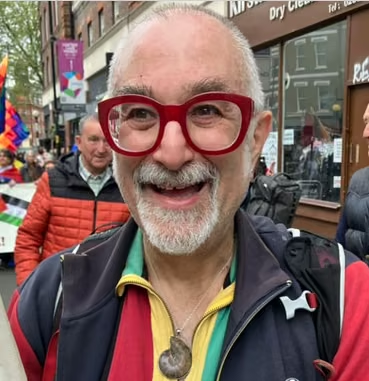
I’m David Rosenberg, 66 years old.
Background
My grandparents on both sides emigrated from Poland and Ukraine in the late 1890s, early 1900s. My father was born in Toronto, in Kensington Market, which is like the East End of London, a cosmopolitan immigrant area. I never knew his parents – his mother died when he was a teenager and his father died in Toronto the year I was born in London. His father had a truck that opened up as a market stall, and he used to go out early in the morning to farms to collect fruit and vegetables and come back to Kensington Market to sell them.
My father was a pharmacist. His graduation photo from Toronto is full of poor Jews and poor Italians whose way out of the ghetto was to be a pharmacist – you could pay your way through college by working in a pharmacy. I’ve been to Canada twice, visiting my Canadian cousins. Most of them had higher education, unlike many of their equivalents on my mum’s side. My Canadian cousins that I’ve met are mainly left of centre, some of them very left, I’m pleased to say.
Index of all the personal stories
My mother grew up in the East End of London, in an ordinary working-class family. Her dad worked until he was 81 but I don’t think ever had a skilled job. He was ducking and diving, and doing a bit of amateur boxing. In the 1960s he was delivering smoked salmon from Forman’s East End smokehouse to shops round London. Her mother worked as a cap-maker, as a felling hand doing the cuffs and turn-ups in a tailoring workshop, as a cigarette-maker at one point, and in her sixties she worked part-time as an assistant in a grocery shop.
My father started his life in London working as a locum pharmacist, and we moved around a lot, living in flats and above shops. Then in the early 1970s he was able to buy the chemist shop in Dagenham he was working in, when the owner retired. So our sixth move was to Ilford, to our first house. Ilford at that time had a large Jewish community, people who had moved out from the East End to Hackney and then to the outskirts of London, taking either “the north-east passage”, as we did, or “the north-west passage”.
Through all our moves I went to one school, a Jewish primary school. It happened by accident. We were in Stoke Newington when my brother, two years older than me, was starting school. My mother knew one of the teachers at the nearest school, who told her that the school was going through difficulties coping with language demands after an influx of immigrants from Cyprus, and she said, “If you’ve got the chance, maybe try to get your son in somewhere else.” So my brother went to the Jewish school in the area, and I followed. My parents were affiliated to mainstream Orthodox Judaism, but beyond eating only kosher food and going to shul on the high holy days, they were not strict about it, and it was not a very religious school. I realise now that it was one of the breed of Jewish schools that grew up in the 1950s, shortly after the state of Israel was created, with some funding from the World Zionist Organisation. We had more Hebrew lessons than English, but I only know individual words, I can’t string them together into a sentence. I knew some Yiddish words and phrases from my parents and grandparents but can’t recall a single mention of Yiddish at the school. There was talk about Israel, Israeli flags on display, occasionally guests in assembly, some of whom would rabbit on in Hebrew which we couldn’t understand! I suppose I absorbed the school’s pro-Israel ethos: for me there wasn’t any clear division between being Jewish, knowing some Hebrew, and having a generally positive attitude to a country called Israel, though we didn’t really know what it was. One striking thing about the teachers, all but one of whom were Jewish, was that they came from so many different places – France, Hungary, Italy, Burma, India, Israel, Germany… maybe ten different countries. I was interested in “the world” when I was quite young. I was aware of coming from a family with a strong immigrant background, and the first political idea I had was questioning the idea of borders. I used to think, ‘What’s the point, why do we have borders?’
My secondary education was in a grammar school in Ilford with a 20% Jewish population – and an antisemitic head teacher! Every so often he had to make a public apology in the local newspaper for something he had said.
Anti-racism
Both my parents were strongly anti-racist. In their different places, both had experienced the 1930s in troublesome ways. My dad was born in 1924, and in the 1930s there was a strong and active Nazi group in Toronto. There was a park where the Jewish kids would come in at one end and the fascist kids at the other and they would fight; my dad always said he was more scared of the leader of the Jewish gang than he was of the fascists. My mum was living then with her parents in Bethnal Green, on the edge of the ‘Jewish East End’. She was the only Jewish girl in her class, and every day the other girls reminded her of that and threatened to beat her up. Near where they lived was the local headquarters of Mosley’s British Union of Fascists, who held weekly marches. I’ve written a book about fascism and anti-fascism in the 1930s East End, and I know that Bethnal Green had a particularly menacing branch of the fascist movement.
So both my parents had a strong sense of what antisemitism was, and I think their reaction to 1948 is based in that. They had both felt helpless during the Holocaust. My dad was stuck in Canadian air-force bases in Canada, my mum was evacuated from London and felt she wasn’t able to do anything to help as the news of the mass murder of Jews was filtering out at the end of the war. Then she worked as a secretary in a Jewish hospital in Stepney in the late 1940s, and she’s told me about Holocaust survivors she saw coming through the hospital – with numbers tattooed on their arms. From conversations with both my parents I know that they saw the creation of Israel as a blow against antisemitism in the world. But they felt that antisemitism was far from being a spent force: it was still a threat, and Jews had to be on their guard against it.
They were defensive about Israel. If anyone criticised it they would think, ‘Maybe they have some antisemitic motivation.’ Israel was seen in a different light in the 1960s. People on the left often had a pro-Israel position, like Tony Benn, who in that period was very friendly towards Israel. Historians writing from the 1970s onwards have given us a much better sense of the real history. A brilliant book that influenced me a lot was Edward Said’s The Question of Palestine (1979).
My parents always voted Labour. They saw Labour as the party of ordinary working people, the party that would support the poor. I inherited their ideas of social justice and standing up for the underdog, but in my teens I started to look at political questions and with my friends at school started to read Marx and Lenin and other Marxist theorists. We called ourselves Marxists, and were also antiracist and antifascist, and went on antifascist demonstrations.
Teenage visits to Israel and a shifting perspective
I went to Israel five times as a teenager. The first time, when I was about sixteen, was on a trip for forty young people from Jewish youth clubs around London. It was a two or three-week tour, mostly sight-seeing, and it was fascinating in all sorts of ways, very different to anything I had experienced. I had only been abroad once before, for a family holiday in Belgium when I was eight: Jerusalem, and the desert, were well beyond my experience. I enjoyed the trip, but the people I identified with were not the young Israelis but older people. They seemed familiar to me, like my friends’ parents.
At this time some of my Jewish friends started going to a Jewish youth movement, HaNoar HaTzioni (= The Zionist Youth), and soon I went along too. It was secular, and to the extent that it had an ideology it was around Kibbutzim, the idea of going out to Israel to live in a collective communal way and working the land. Two consecutive summers I went with them to a Kibbutz not far from Nazareth. I really enjoyed the kibbutz life and found it very attractive, but I came back with a number of questions. They started with our awareness that Nazareth had two parts to it – the Arab part which was very busy and interesting but run-down, and then the shiny white flats in the distance, Nazaret Illit, a Jewish town overlooking Nazareth.
I was getting very involved in antiracist and antifascist politics here. There was a slogan that emerged from the Asian youth movement, “Here to stay, here to fight”. Previously, most immigrants from the Indian sub-continent had hoped to come for a few years, send part of their earnings to support family members at home, then return with an improved economic standing. But by 1978, younger Asians were saying, “We’re not going to leave, we have the right to full equality here, this is our home, why should we be discriminated against?” It was a very important shift in perspective. I asked myself, “What does my Zionist youth movement tell me to do? Does it tell me I’m here to stay? No. Here to fight? No. It’s telling me that you can’t defeat antisemitism, you can only run away from it into your own state.” These contradictions were becoming more and more obvious.
Some of my friends in the youth movement were also turning these things over. One of them found a different way of visiting Israel – a very left wing kibbutz that was outside the main kibbutz movements. It had functioned as a branch of the Israeli Communist Party, but in the ‘60s the party split and its members went in different directions politically. Among the kibbutz residents – mainly refugees from Hungary or Germany – there was a sort of continuity Communist Party, though at least one member of the kibbutz had joined a Trotskyist organisation, and others had fallen away from the political parties but still held non- or anti-zionist views. Some of us spent a couple of summers there, and on our visits they facilitated us to spend time in Jerusalem, in Nazareth, and in Nablus, meeting people they put us in contact with. In what remained of the Communist Party a large majority of members were Palestinian, and we spent a day in a communist youth camp where most of the participants were Palestinian. So that experience was quite different – we were in Israel, but transitioning away from Zionism.
Discovering the Jewish Socialists’ Group
In my first year at University in Leeds I discovered the Jewish Socialists’ Group, of which I’m currently the longest-standing member. Before that I had joined the student branch of the IMG[i], whose politics I felt close to, but I’d had an unpleasant experience with them. I used to wear a star of David around my neck as a symbol of Jewish identity. The IMG said to me, “When you’re on our bookstall please don’t wear the star of David; it might offend Palestinian comrades.” That did not impress me. One weekend soon after that I went to Manchester to visit friends, and at a party I got talking to somebody who was wearing similar political badges to me – one we both wore said “Chile fights”. When I told her about my problem with the IMG, she said, “You should talk to my mum, she’s in the Jewish Socialists’ Group.” I did, and a few weeks later I started going over to Manchester to their meetings.
The Jewish Socialists’ Group was founded in 1974 by people who were or had been Communist Party members or leftists in Labour. Several among its central group had grown up in the working class Cheetham Hill area of Manchester and had joined the Young Communist League in the 1930s to struggle against poverty and fascism. In the late 1970s they had two main concerns. The first was to re-engage Jews in the struggle against racism and fascism. The National Front[ii] was growing at this time, but the JSG felt that the Jewish community had backed away from being involved. The identification of Jewishness with Conservatism would come later, but even people who still voted Labour had the attitude, “Other people are in the front line of fascist attacks now, we can back off a bit.” It’s true that the National Front’s street activity was against black people and people from the Indian subcontinent, but if you went into the inner circles of those fascist groups, you would find a lot of very antisemitic literature, beliefs in a world Jewish conspiracy and so on.
The other main concern of the JSG was to promote a more sophisticated and questioning discussion of the politics around Israel-Palestine and the Arab world. JSG members were largely non-Zionists, espousing universal socialist values. They felt the left in Britain had collapsed into an unsophisticated kind of pan-Arab nationalism, and one of their questions was what this would mean for the future of Jewish people in Israel, as well as for the Palestinians?
By 1978-9 a number of new people had joined JSG, younger people at different universities. We would meet up in London during vacations, and we started a London branch of the group. Other people who had been experiencing antisemitism (perhaps unconscious) in non-Jewish left-wing groups and had started thinking about their secular Jewishness also gravitated towards the JSG.
Rediscovering Bundism
The most significant influx of new members was a group of students and former students based in Cambridge who came in from a different Jewish radical tradition – partly anarchism but more importantly Bundism (diasporist Jewish socialism). They had rediscovered Bundism and conveyed it very persuasively, so I would say that by 1981-82 Bundism was the overriding political philosophy of the JSG. We expanded our thinking beyond the two issues of racism-fascism and Israel-Palestine, to a much more holistic consideration of ethnic minorities and socialist movements within them, but it was also about acknowledging Zionism’s other victims – Jews, as well as Palestinians. Zionism had had very negative impacts on diaspora Jews, trying to impose a new identity and in doing that erasing all sorts of things. Among other things, Zionists terribly mistreated Bundists and others who were not Zionists in the Displaced Persons camps in Europe after the war – they denied them food, beat them up, did terrible things to them.
Our JSG view has always been very supportive of Jewish cultural expression but we also wanted to have permeable borders around cultures, to appreciate and share one another’s culture. We have a very positive view of Jewish identity – that’s more or less the Bundist view. The Bund was very pro-Yiddish. Most of its history was in Eastern Europe from 1897 – the same year as the Zionist movement was set up, but with completely opposite values – until the Holocaust, and most of its activities were conducted in Yiddish. But they also worked closely with non-Jewish socialist organisations. In Warsaw and Lodz in the 1930s, a lot of their closest contacts were with Lithuanian and German socialists there, and also with the left wing of the Polish Socialist Party.

In JSG we recognised that in promoting Yiddish we were developing our own interest in it but also developing access to our history, which has been cut off. When Israel was created, there was a lot of repression against Yiddish. Yiddish newspapers were published there but kiosks selling them were attacked and set on fire; the state was encouraging that kind of hooliganism. But Yiddish was the language of the fighters in the Warsaw ghetto, it was the main language of most of the people killed in the death camps. And it was very much the language of Jewish radicals and revolutionaries. A lot of that experience is still not translated, there is such a volume of it. I’ve been trying to improve my Yiddish for the last 40 years. At the moment I go to a very good twice weekly online class which comes through a Yiddish institution in New York, while the teacher – a daughter of Polish Jewish Holocaust survivors who went as refugees to Australia – lives and works in Belgium.
Conflicts with the UK Jewish establishment
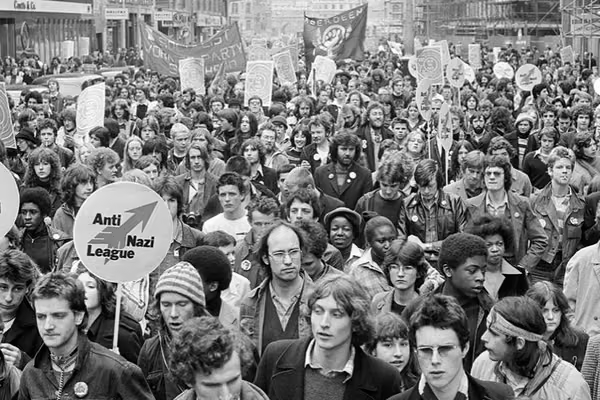
The JSG had its fights with the Jewish establishment in the 1980s and ‘90s. In the late 1970s the Anti-Nazi League[iii] was formed, the biggest mass movement against fascism in Britain since the war. In the JSG we thought it was a very necessary movement that Jews should be part of. The Jewish establishment, particularly the Board of Deputies, was opposed to this because some of the ANL’s central members were in the Socialist Workers’ Party, which was opposed to Israel. You can find pages of letters about this in the Jewish Chronicle of the time. In fact a lot of Jewish people did join the ANL, in defiance of the Board of Deputies: on the first of the two big Rock Against Racism/ANL carnivals in 1978, we marched from Trafalgar Square to Victoria Park with a JSG banner, and there were other groups marching close to us, like Habonim (young socialist Zionists).
Our next blow-up with the Board of Deputies was about antisemitism. Hard as it is to believe, given how they see antisemitism everywhere now, in the early 1980s the BOD didn’t want to acknowledge that real antisemitism could happen in this glorious land of Britain! One day we saw something we weren’t supposed to see – a list of antisemitic incidents in the previous few months, that came from the Association of Jewish ex-Servicemen (AJEX), who did a lot of security work for the BOD at that time. In London there were 25-30 serious incidents a month – desecration of cemeteries, synagogues, swastikas, assaults, all that. We’d been hearing about incidents but this list put them into a pattern. We started to make some noise about this, linking it to how the Jewish community needed to be much more publicly antiracist and antifascist, and more closely aligned with the other minorities who were getting it in the neck from the National Front. The BOD saw this as very threatening. They didn’t want to rock the boat, they didn’t want any criticism of the police. The way to deal with any antisemitism, they thought, was to have a quiet word with the Home Office.
When Ken Livingstone became the leader of the GLC (May 1981), he turned the formula for funding community groups upside down. Instead of the previous top-down approach, Ken said any group in London could apply for project funding. The JSG got two years of funding for a Jewish Cultural and Antiracist Project: cultural work around Yiddish culture, and antiracist work linking with other minorities. I was the project’s sole paid worker. We put together a touring exhibition about the history of immigration legislation, from the 1905 Aliens Act to the present day, and we put on conferences – at one we had veterans of the battle of Cable Street – and local meetings where we’d bring together a Jewish Socialist speaker and one from another minority group, to discuss what were the points in common and how we could help each other.
When the BOD heard about Ken Livingstone’s plans for the funding, they wrote to him saying, “If you get any applications from Jewish Groups, we need to vet them.” He told them to get lost – this was democratic, and anyone must have the right to apply. They were angry with him for undermining their claimed authority in the Jewish world. A bit later they decided to cut off all relations with the GLC’s Ethnic Minorities unit, although the Unit was really advancing equalities in those years. One BOD member slipped us the private minutes of the meeting where this was decided. Five crimes and misdemeanours of the GLC were listed: serious things like making premises available to ‘terrorists’. The last one was “E) The grant to the Jewish Socialist Group”. And then it said, “In the light of E it was decided to break off relations with the Unit.”
The BOD’s security outfit – the Community Security Organisation, which later became the Community Security Trust – used to harass us and block us from attending events. We still don’t really have a relationship with it.
Britain’s first public meeting with a PLO speaker
In 1983, in the wake of the Lebanon War, we had the first public meeting in Britain with a PLO speaker and an Israeli peace activist. This was a very formative experience for me. The Israeli was Uri Avnery[iv], the PLO speaker was Issam Sartawi[v] – he became famous because he was assassinated six weeks later, as he came out of a meeting of the Socialist International in Portugal.
The Jewish establishment were very opposed to this meeting: they considered any Jewish person who had any contact with the PLO a security risk. But we knew it was the right thing to do. We were encouraged by Maxim Ghilan[vi], an Israeli who in the late 1970s was organising a lot of back-channel secret discussions between PLO members and Israeli leftists. He said to us, “The time has come to do something public.” I was one of four JSG members of the dozen-strong organising committee.
The meeting was in County Hall, and I was one of the stewards. Of the 300 or so people there, about 200 had come to listen, 50 were ultra-right-wing Zionists trying to break it up, and a similar number were rejectionist Palestinians who didn’t want Sartawi to share a platform with an Israeli. There were armed police too, because Sartawi had known for several months that the Abu Nidal[vii] group wanted to assassinate him.
The meeting had an impact. Even within the BOD there were a few people wanting to find ways to have dialogue, though the leadership denounced it. A couple of years later they started to build some dialogue with Palestinians, secretive and quiet.
Support for Zionism in the UK
I would say the heyday of Zionism in Britain was from the late ‘40s through to the early ‘80s. In those years most people assumed that the Holocaust had been a break in everything, and the creation of Israel was needed as something new in Jewish life. After the Holocaust, many Jewish people who had not been keen on Zionism before came to have a positive view of it.
Support for Zionism was spread across the community in the UK. Class differences were narrowing a bit: after the war lots of Jewish people who had been living in very poor circumstances, working in the tailoring trade for instance, were able to become self-employed, with a small shop or a taxi – if you got a taxi in London in the 1970s there was a one in three chance the driver would be Jewish. With this narrowing of class distinctions, Jewish people could unite around the new Zionist Jewish identity.
My parents were not keen on my move away from Zionism, but came to accept that we saw things differently without relations being too strained. They were interested in aspects of what we were doing through the JSG that was not to do with Zionism/Israel/Palestine: for example our cultural work on Yiddish, our anti-racist endeavours, and our work on Jewish history, such as commemorating the Warsaw Ghetto uprising annually.
The 1982 Lebanon war was a sea-change in people’s perception of Zionism, and there’s been a slow-burning decline in support since then. Zionists could try to justify previous wars as defensive, but not that one. The refusenik movement started in Israel then – Yesh Gvul – “There is a limit”[viii]. And now we have October 7th and the response to it.
The future of Israel
I think there’s no return to “normal” for Israel-Palestine relations. In the last few years, before October 7th, there had already been a couple of key moments. First, the Nation State Law in 2018 that enshrined apartheid in Israel, formalising many kinds of discrimination that were already happening, saying explicitly, “Only Jews have the right of self-determination in Israel”. The second was the Israeli elections in November 2022, when Netanyahu got the far-right parties to make a temporary alliance so that they would pass the election threshold in alliance, and enable him to govern with a majority. The quid pro quo was that they had to be given some ministries. Some of these far-right parties are descendants of groups that are banned in Israel, some are self-declared Fascists. But an Israeli leftist that I’m in touch with says that the lines between the far right and the hard right are now very hard to draw.
What I see in the near future is civil war in Israel, even if they come to some conclusion over Gaza. There are several fault-lines within Israeli society. Religious versus secular is a very significant one; another is between the far right and anyone who’s a democrat. A lot of people are leaving Israel, for good.
What will happen on the Palestinian street I don’t know. Fatah and Hamas are very much at odds. The Western powers want to remove Hamas and put the PA in control in a way that’s going to draw the ire of a lot of people. Hamas has lost some of its military capability but a lot of Palestinians will still identify with it, and how is that going to play out in any ‘normal’ relations between Palestinians and Israel? Even five years ago, there was a sort of normality, unbalanced obviously, but compared with what’s happened in the last few months ……… The last time I felt at all hopeful was during the first intifada, in the late 80s. I was cynical about Oslo, but people did think there was going to be some kind of arrangement.
But some positive things are emerging. The pro-Palestine movement in Britain is enormous. For the 75th anniversary of the Nakba in May 2023, there were only about 5,000 people in the march, but now hundreds of 1000s come out on demos, and in the middle of them is the amazing Jewish Bloc. There were always little Jewish blocs on demos but now about twelve different organisations take part, with people from their twenties to their eighties. I’ve seen people on demonstrations who I didn’t think I would see. A lot of the marchers are first-time protestors about Israel; and a lot of them are asking big questions about Zionism as an ideology.
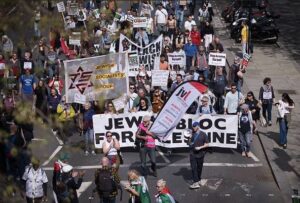
There were already significant cracks in the edifice of the Jewish community, but it’s being blown further apart. I think that’s healthy. People are jumping to either side, some to stronger support for Israel, some away. Apart from those who come out on demonstrations, a lot of people who are more in the mainstream are also stepping away from Israel and Zionism. They may be reluctant to do anything public – they think, ‘If I give up on Israel, what’s left of my Jewish identity?’ But in JSG we have always pushed the idea of our long radical history; there was Jewish life before Zionism and there will be Jewish life after it.
Both antisemitism and islamophobia have increased in the last few months, but you don’t see them on marches. In fact the marches are a good place for dialogue between Jews and Muslims: you find yourself walking along beside somebody and you get chatting. The Jewish bloc sometimes move to the side to stand with our placards, so that more people can see us as they march past. We have fantastic conversations, and people come and hug us and thank us. I’ve also done lots of speaking, to sixth form colleges and other groups. Lots of young people don’t have a sophisticated view, but I talk about how we can work together to fight racism, and I tell them about young people in Israel who are refusing army service. I’m very inspired by the Human Rights activists in Israel, and some mixed Palestinian and Israeli organisations like +972[ix] and Green Olive tours[x].
Index of all the personal stories
[i] International Marxist Group, a Trotskyist group in Britain 1968-82. It was active among students and trade unions, and in international solidarity campaigns.
[ii] The National Front is a racist far-right political party in the UK, founded in 1967 from a coalition of earlier pro-fascist groups. It reached its peak of electoral support in general elections in the early 1970s, capitalising on concern about South Asian immigration, and was briefly the UK’s fourth-largest party in terms of vote share. In the GLC elections in 1977 it won nearly 120,000 votes across London and pushed the Liberals into 4th place in a significant number of seats. It still exists, but very small, eclipsed by the BNP.
[iii] The Anti-Nazi League was set up in 1977, at the initiative of the Socialist Workers’ Party, but with broad support including from the Indian Workers’ Association, some Trade Unions, and some Labour Party figures including Neil Kinnock. It was wound down in 1981 but relaunched in 1992 before merging into Unite Against Fascism in 2003.
[iv] Uri Avnery 1923-2018, German-born Israeli journalist, politician and peace activist.
[v] Issam Sartawi, 1935-1983, senior PLO official but more in favour of peace negotiations with Israel than Arafat. He was assassinated by the Abu Nidal group, a violent group that had broken away from Fatah, rejecting any moves towards peace with Israel.
[vi] Maxim Ghilan, 1931-2005, Israeli poet and peace activist (after membership of Stern Gang in his youth). Founder of the International Jewish Peace Union, the first Jewish organisation to recognise the PLO.
[vii] See note (iii) above.
[viii] Yesh Gvul, founded in 1982 at the start of the Lebanon war, is a movement of Israeli veterans who refused to serve in Lebanon. 3,000 signed the initial petition to PM Menachem Begin and Defense Minister Ariel Sharon – of whom some were court-martialled and jailed.
[ix] +972 Magazine is an independent, nonprofit media organization of Israeli and Palestinian journalists, established in 2010 by four journalists and bloggers in Tel Aviv, publishing online and mostly in English.
[x] Green Olive Tours, part of the Green Olive collective, a group of Palestinian and Israeli partners committed to education and advocacy for a democratic future and an end to the displacement of Palestinians. Tours began in 2007.


Thanks again Kitty – and David for another fascinating autobiography. Are there any plans for a book based on this series of interviews? There clearly should be!
I appreciate David’s writings and talks very much and I can see how much he values Jewish culture, but much of that belongs to a time now gone.
I assume David isn’t religious, which some of my Jewish family are (or pretend to be), and that forms much of any current Jewish cultural involvement for me.
Otherwise it seems like our culture is simply socialist, and internationalist, but with varied historical backdrops.
What a fascinating story from David! I had no idea that the Community Security Trust grew out of the BOD’s security outfit – the Community Security Organisation. How shameful that it harassed members of the Jewish Socialist Group.