
Jewish Journeys from Zionism – Miriam David (3)
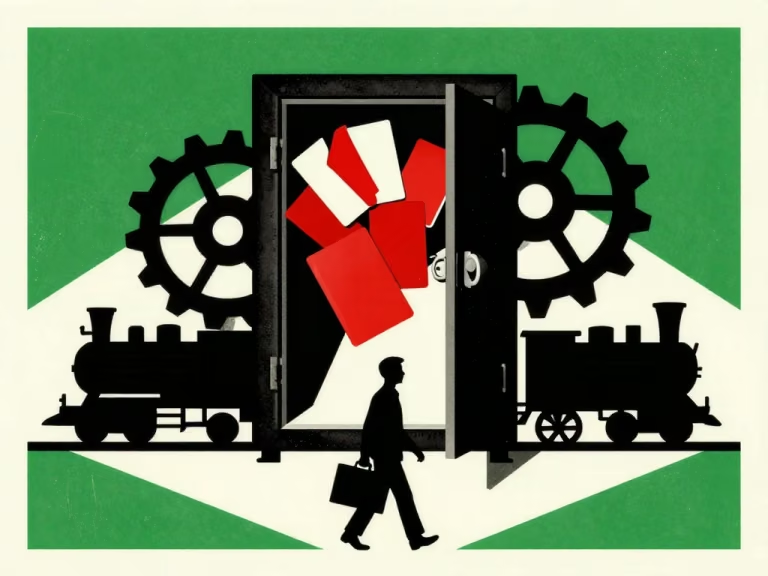
Our third in the Jewish Journeys from Zionism series features Miriam David; a key member of JVL’s Education Team and with a fascinating back story as have all our interviewees. Kitty Warnock’s skillful interviews have, once again, produced a moving and fascinating testimony.
Miriam David
My name is Professor Miriam David, and I’m 78.
My father was a German Jewish professional engineer. He had been in Berlin doing a PhD before the war, but he left Germany in 1936 because of the rise of Hitler and came to England. He used to tell us that he had wanted to go to Palestine but he couldn’t afford the cost: you had to pay something like £2000 at the time to go and live in Palestine, and he hadn’t got that kind of money. We only found out about the details of my father’s journey after my mother died in 1996 when we found a locked safe that contained 5 German passports. That set me and my two sisters on a journey to find out about my parents’ backgrounds. I have just written a book about this[i].
Index of all the personal stories
My father arrived in England on his 28th birthday. He came to Manchester to a job as a professional engineer in a machine tools company called Kendall and Gent. The manager of the company met him at the station and showed him round the works. He worked there for the next four years. During that time, before war broke out, he met my mother – I think they met at a Zionist organisation in Manchester.
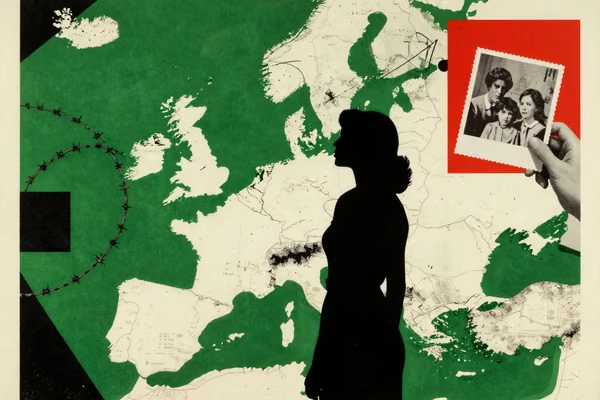
His elder brother arrived in England in April 1939. After Kristallnacht in 1938 he had been sent to Dachau concentration camp, but at that time if you had a financial guarantor the Nazis would allow you to leave Germany. So he arrived, quite scarred by the experience. Their father came on July 31st, 1939 with their mother, grandmother and aunt. When war broke out they became known as ‘enemy aliens’. Then on June 26th 1940, all three of the men were interned as “enemy aliens” by the British government. They were sent to Huyton, a council housing estate on the edge of Liverpool that was turned into an internment camp. They were there for four or five months. My grandfather was allowed to leave in September, because he was old and ill, but my father and uncle were sent to the Isle of Man, to a camp called Mooragh in Ramsey.
Most people don’t know how awful this detention was, but there are lots of books written about it now. All the internment camps on the Isle of Man were originally Victorian boarding houses and where about 3-4000 men were interned surrounded by barbed wire. Conditions were terrible, militaristic – the term “living with the wire” entered the language. My uncle suffered badly from all of that: he got Parkinson’s, because of his anxiety, having been in two camps.
My husband and I went to see the camps. We had found out quite a lot about my father and his family (he died in 1980), but we only found out much about the camps after 2020. The authorities had destroyed or burned or lost the records about which camps people were in – so although the National Archives keep some information about ‘enemy aliens’, we only found out which camp it was because by chance there were some tiny business cards in a diary we found in my mother’s writing case after she died. She was going to visit my father. There were a few postcards as well. This has all been a huge journey for me.
My uncle was released in 1941, a month before my father, to do farm work, but my father wanted a professional engineering job – he was in machine tools, which was equipment for the war. He got out of internment in the end by getting a job, but it was as a machine operator, not an engineer, in Ware. He was extremely distraught about this because he was planning to get married in June. We found letters he wrote to my mother, when he was getting more and more anxious about the whole process of getting a permit and a better job – I think it was called an Auxiliary War Service permit. The officials in the government department were extremely slow and reluctant, and they couldn’t understand why my father wanted to change jobs no sooner than he had got one. I suppose this was happening to a lot of people.
My father eventually got a better job and my parents married, as they’d planned, on June 22nd 1941 – a proper wedding, with lots of guests. That was also the day that Hitler launched Operation Barbarossa[ii], but I don’t suppose my parents knew about that at the time because they were getting married.
On my mother’s side, all four of her grandparents had fled to England from pogroms in Russia in the late 1890s. They were part of the beginning phases of Zionism. My mother’s maternal uncle, Uncle Phinny[iii], wrote two books about the need for a Jewish state. The second one, Jews, the War and after, was published just after my parents got married. His wife, our aunt Rose, was not a Zionist. I used to know her quite well because we used to visit her a lot. Around the time he wrote that book Uncle Phinny toured America arguing for a Jewish state. I don’t know whether it was the Jewish Agency or some other Zionist organisation that sent him. He was a very jolly man, and we have a very jocular letter he wrote to my mother and another uncle, telling them that he had just got back to England, and that he was going to be sent back again to the States and then to Argentina, Brazil, all over Latin America. This is all to tell you I was brought up a Pukka Zionist.
My oldest sister was born in 1942, I in 1945. We were born in the small town of Keighley in West Yorkshire, where my father had got his job. Because of all the things that had happened to him, I think, he didn’t want to move, so he stayed there to bring up his family, but for both my parents this was a hardship. My father had come from Frankfurt, which was known as ‘the smallest metropolis in the world’, and my mother was brought up in Manchester. Keighley was pretty tough for them. We were just about the only Jewish family there, and we were the only Jewish children at our school. Being Jewish for me was a secret, and my family did all sorts of things that we didn’t tell our friends about. My parents were religious, but not very deeply: my father had to work on a Saturday, which was common practice in the 1940s. We used to go to synagogue in Bradford for the high holy days, sometimes taking the day off school, even if my father couldn’t always go. My sisters and I went to Hebrew classes on a Sunday morning from quite a young age; my father drove us to Bradford, once he got a car. When I was 13 we moved to Bradford to be nearer the Jewish community. My parents were very very keen to be part of the Jewish community.
My parents were very supportive of Israel, and there was a lot of discussion – positive, not negative. In the wider family, there was some ambivalence about Zionism. Uncle Phinny’s son married a Sabra who was a bit ambivalent. He met her when he was a pilot in the war of independence. She’d been born and brought up in the Old City of Jerusalem – we were always vaguely told that she grew up next door to the Mufti. They came to England, and brought their children up in London.
But in my immediate family, there was the commitment to being Jewish, because we were in a non-Jewish community, and also to Zionism. In the Bradford Jewish community that was quite unusual. Zionism was not a commitment of most Jews I knew when I was growing up. It was a minority commitment, I would say, in the 40s and 50s – until 1967, which was a turning point for a lot of Jews. I have two close friends who I’m still friendly with – we were part of the Bradford Jewish community, and went to Hebrew classes together. One of them was like me: we joined Habonim, the socialist Zionist youth movement, when we were 12 or so, and were very active in it and used to go to their camps. The commitment was to go and live on a Kibbutz. The other friend, Pam, was from a very English Jewish family. Her father was a doctor. Both her parents came from Leeds and were very well-established in the Jewish community there, and they had no interest at all in Zionism. Interestingly Pam and I have rather reversed now: she’s only become involved in debates about Israel and Zionism now, because she married somebody whose sister went to live in Israel with her family and retired there.
Of the people I knew who were Zionist, all were socialist Zionist. Even if they belonged to the synagogue, they were not right-wing, like much of the Jewish community has become. My father had had socialist leanings since he was young, but my mother was less left-wing, more liberal-minded. It was normal to be committed to the State of Israel, because it was such a small state and so on. There were quite a lot of Israelis around: they came to Bradford for the textile industry, and to college there, and there were a lot at Leeds University. My parents had an open house for Israelis. The wife of one of them gave me and my younger sister extra Hebrew lessons at home. So I was totally immersed in Zionism, and I did find it extremely difficult to come out of it later.
Over the last ten or fifteen years, I’ve got in touch again with some of my school friends, and they have reminded me of things I had forgotten. For example, through Habonim I met someone who was reading sociology at university; he was studying political theory, and he used to give me and some of my school friends seminars on Hobbes and Locke, in our house. He influenced me to read sociology myself. There was a very vibrant sense of the importance of intellectual ideas, and I suppose of the importance of the intellectual political project of Zionism. It’s taken a long time for that to leave me. A lot of people I knew in Habonim became important figures in the social and cultural life of England. It had a ripple effect on the wider community. One is the playwright Mike Leigh. Much later he wrote a play critical of Zionism – was it called “2000 years”? He was very critical of the establishment of Israel but it was a critique from within, an insider’s point of view[iv]. I felt quite comfortable with that.
I went to a Habonim Israel camp the year I did my A-levels. Then I went as a volunteer to Israel in 1967, because there was a huge wave of worry. The British media were exactly the same then as they are now: enormous sympathy for Israel and fear that it would be wiped out. By this point I was living in London.
My parents had foolishly rigid ideas about who their daughters should marry. I never thought of marrying out, because it would have upset my father too much. My younger sister had already had a relationship with somebody not Jewish, and though my mother had said she would support her, in the end she chickened out – so it was all rather sad. My elder sister had also got burned by a relationship. The man was very keen to marry her and whisk her off to Newfoundland where he was going for his PhD. He came to our house – and he lit his cigarette from the Sabbath candles. My parents were horrified – she can’t marry someone like this!
I married Robert, who was from an Orthodox background, much more religious than I was. I don’t think he saw himself as a Zionist. I never felt he was that interested when I met him and we had our children – but our children did go to Israel in their gap year. (There was by then a scheme for them to spend six months at the Hebrew University). Robert was born in Hungary at the end of the war. His father had been in camps in Russia for a lot of the war, and both his parents were very traumatised. They lived in France for a bit, and came to this country when Robert was three. His father was increasingly Orthodox, though his mother wasn’t, and Robert had a love-hate relationship with Orthodox Judaism. The more he and I disagreed about things the more Orthodox he became, which was quite problematic. We divorced, but now we are relatively good friends. Since he’s been very ill with long Covid, he spends his time sending his family articles about how awful Israel is.
After the divorce, I wanted to mix more, to be less Jewish and more socialist. Before I married I had become a feminist. I see myself as a socialist feminist. A lot of my feminism I got from the collectivity which was part of the socialism I’d experienced in my teenage years, what I’d learned from the socialism of kibbutzim in those days. Coming from a religious background, I still have a love of Jewish traditions and customs – we used to have a feminist Seder, from 1996. But around the late 1990s, among the people who were at South Bank University with me (where I was head of the Social Sciences Department at South Bank University for a while), I had a close friend, Irene Bruegel[v]. We used to go swimming on a Sunday morning. She was from a refugee background, and was always trying to find out her parents’ story. She had the idea to form a group of left-wing Jews who were opposed to what was going on between Israel and Palestine. We discussed it a lot in my kitchen. It started in 2002, with a meeting of about fifteen Jewish women and one or two men. It was mainly a feminist group, with supportive men, including Irene’s partner Richard Kuper[vi]. I become the group’s treasurer. We argued a lot about a name, in the pub, and eventually we came up with Jews for Justice for Palestinians.
The group has carried on, but I left after a while, and have just started being a bit involved again in the last couple of years.
I guess that was my first real public expression of criticism of the Israeli state or government. The group was a mixture of non-Zionists and anti-Zionists, I suppose. We didn’t discuss that. I don’t call myself an anti-Zionist. I don’t think that’s helpful in the political situation in which we are. I think some potential critics of Israel find the term threatening; they understand it as wanting to destroy the state of Israel. Now that the state exists we can’t end it; what we can do is change its form and how it operates. I have been very critical of Israel and its policies, especially as it has moved to the right, and I’ve read a lot about it. But I don’t think the abolition of Israel would serve anyone’s purpose. And I don’t want to get engrossed in historic arguments about whether it should have come into existence, I want to move forward to try to find a better way of Israelis and Palestinians living together in that tiny strip of land “from the River to the Sea”.
As part of Jews for Justice for Palestine six of us set up a charitable arm, the British Shalom Salaam trust[vii]. We did allocate money to wonderful projects, in Israel and Palestine and it is still active, but I gave up my involvement, as I couldn’t bear the fights. Jewish politics being what it is, everyone thinks they know best. I got tired of all that. I was part of it and JfJfP for ten years, and then I joined Jewish Voice for Labour. Again I didn’t want to be on the Executive, because I fear that similar kinds of non-productive arguments go on.
Recently I’ve fallen out with a second cousin who lives in Israel, a double second cousin because a cousin of my father’s married a cousin of my mother’s, introduced by my parents at the end of the war. It’s very painful to me. Until August she was very helpful with my research for the family memoir, making family trees and finding stuff I would never have found on my own. What happened was this. My son is a political theorist, in the US at the moment, specialising in just war – he wrote his thesis on Michael Walzer, a distinguished Just War scholar. He’d been agonising about wanting to write something. Eventually he did, and it was published last week. I thought it was wonderful, and posted about it on Facebook. Whereupon my cousin wrote the most horrific diatribe against me. I don’t want my son to see it, because it will confirm all his anxieties about writing. I knew I had turned her off already, but this stuff she put on my facebook page, it’s so hostile, it’s as if it’s Netanyahu speaking. She argues against any scholarly approach in universities now – I think she’s thinking of all the debates about antisemitism on campus in America.
I used to be a supporter of a two-state solution. At the moment I can’t see any solution of even that kind. I left the Labour Party two years ago, but my branch invited me to stay in the reading group. I’ve enjoyed the things that we’ve been reading, and I’ve read a lot more to try to keep up with what’s happening in the world. Two books in particular have made me much more aware of Britain’s huge responsibility for what went wrong in the 30s and 40s[viii]. They left Palestine in 1948 without doing anything about creating a state for the Palestinians. Israel was carved out, and there was the Partition Plan that was meant to create two countries. The British mandate authorities did have difficulty managing, there were Arab uprisings, and Jewish ones, and the extent of Jewish settlement was a problem, especially during the war. The British should have been bolder about which part of the land should go to which community.
I do still think it would be a good idea to have a federation – of two countries or three, Gaza as one. Belgium, to some extent Germany, the US – these are Federated countries. But another historian whose work I love, Tony Judt, who spent quite a long time in Israel, argues for a state for all the citizens.
I’ve read Tory writers as well as more left-wing ones: Daniel Finkelstein (Lord Finkelstein) wrote a family memoir, Hitler, Stalin, Mum and Dad. His mother was the daughter of Albert Wiener, who set up the Wiener library. I always thought the library was a wonderful thing – It collected evidence of what Hitler did in the war – but as a human being he was a rather an obnoxious character, more dedicated to public work than to his family. They left Germany to live in Holland, but as the Nazis closed in on Holland he left for England, and never saw his wife again because she and his three daughters were sent to Bergen-Belsen in 1941 or 42. This just shows the stuff I’ve been reading.
Everyone was traumatised by what happened on October 7th and afterwards. My former therapist said, “I’ve never felt more Jewish than I did on October 7th”. And I thought that was a really interesting comment, as he sees himself as an anti-Zionist, though his grandmother was chair of the national Women’s Zionist Organisation.
[i] To be called “The locked safe”
[ii] Invasion of the Soviet Union by Nazi Germany and its allies.
[iii] Phineas Horowitz, a leading Zionist in Britain. Publications include “The Jewish Question and Zionism”, 1927, and “The Jews, the War and after”, 1943
[iv] In 2005, Leigh produced a new stage play, Two Thousand Years, at the Royal National Theatre. The play deals with divisions within a left-wing secular Jewish family when one of the younger members finds religion. It was the first time Leigh had drawn on his Jewish background for material.
[v] Irene Bruegel, 1945-2008, socialist, feminist, Professor of Urban Policy at South Bank University 2000-2006, co-founder of Jews for Justice for Palestinians.
[vi] Richard Kuper, founder of Pluto Press in 1969, “to support and promote political debate and activism”.
[vii] The British Shalom Salaam Trust, established in 2004 “to foster positive relations between Jews, Palestinians and other communities living in Israel and Palestine”.
[viii] Ian Black, Enemies and Neighbours: Arabs and Jews in Palestine and Israel 1917 – 2017; Norman Bentwich (1883-1971) and Helen Bentwich (1892 -1972), Mandate Memories, Hogarth Press 1965.
Thank you for this lovely and moving post.
Thank you for this testimony. It is enlightening. I don’t think people can fully imagine just how complex and traumatic the situation is for Jewish people who feel estranged in some ways. Thank you for your support for Palestine.
Thank you JVL for publishing
Miriam David’s journey.
I internalised the idea that many Jewish people tended to be socialists, and in the 1970s, was delighted to find that a new, and lifelong (non-political) friend was Jewish. My friend, who was not political, and while retaining a strong sense of her Jewishness did not deliberately seek out jews and was often impatient with the culture. All her significant friendships were gentiles. We explored politics and feminism together.
In the 90s, she decided to live in Israel and her (adult) children followed in the next few years. I visited her several times but did not like being in Israel. Being in, say France or Ghana, or America, part of the pleasure of visiting is experiencing people and life of another culture. This curiosity and interest is frequently reciprocated and I was never made me feel ‘an outsider’ or someone less worthy, both of which I always felt when visiting Israel to see my friend.
Even at the start of a journey to Israel (within London’s airport) I was looked upon with suspicion; questioned by young Israelis as to my motives for visiting, checking out my attitudes; and given a feeling that it was a privilege to be allowed into Israel.
My old friend stepped instantly into the shoes of being Israeli, her English life no longer pertaining at all. It was as if she had joined a cult in which she took on all the ideas, beliefs and prejudices of the Jewish state, including a deep mistrust, contempt of, and dislike of Arabs, none of which she had had any reason to share.
Thank you Miriam for this memoir. It spoke to me though my parents had an altogether different experience to yours. I have cousins, whom I love and worry about, living in Israel and my politics are very different to theirs. But still we get on and share loving relationships. Love to you D
thank you, an interesting and informing read.
Terrific interview. Well done Miki
Such a fascinating story, from every angle. Thanks, Miki.
Your autobiography is incredibly interesting. I was brought up in an orthodox home and when I was young I remember being told frequently by my mother that ‘Israel was land the Arabs didn’t want’. My orthodox upbringing stopped when I was 9 as my father passed away at the age of 37. At the time me and my younger sister were sent to Norwood. My mother was in the Communist Party during the war and for a time after the war. She was a lifelong member of the Labour Party. She passed away around 8 years ago and in her later years she had dementia. Goodness knows what she would think of Israel and politics in general now. I myself have not believed in a two state solution for some time. Although I am a member of a shul (that considers itself progressive), I don’t know what they would make of my views. I do not attend shul very often. I wish I had the courage to join the Jewish contingent that attends the pro-Palestinian marches but I am.a little scared to take thst step.