
Inside out: reflections on genocide
JVL Introduction
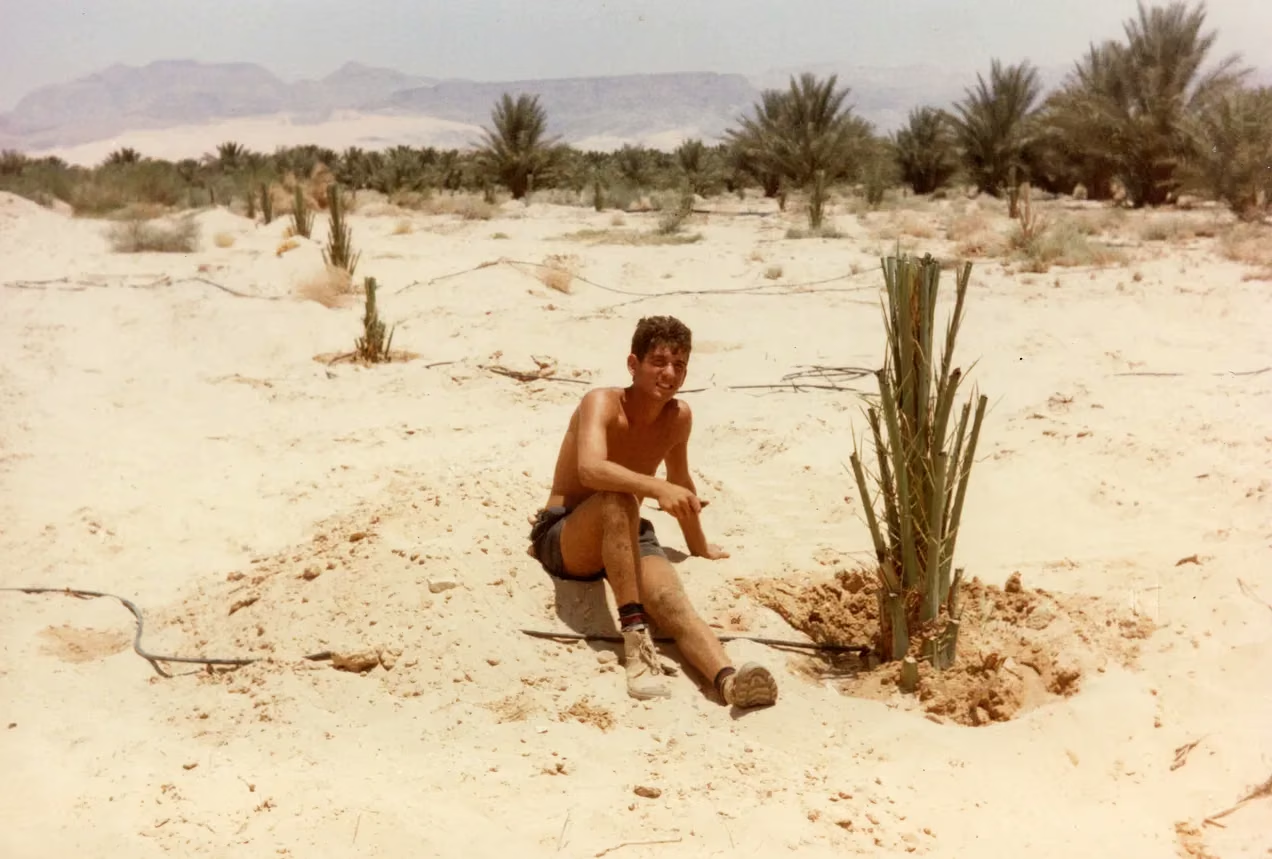
Tim Lawrence, son of a Kindertransport escapee, writes about his upbringing and his activities in Reform Synagogue Youth in Britain.
Like others in Zionist youth movements, the experience was all-encompassing, with regular meetings, weekends away and trips to Israel, shaping the entirety of people’s lives.
He describes its sophisticated “blending of ideological thinking with emotional and social experiences, and its generation of a deep sense of affiliation around Israel, as if nothing else in the world mattered”.
This post is in two parts. The first, originally published on Facebook, serves as a long introduction to a more in depth article. Both are attempting to make sense of Lawrence’s experience as a Zionist: of “the grip of Zionism” not only on Jews but on so many others, something that “runs deep and needs to be reversed through education, activism and boycotting”.
This reminiscence complements our Journeys from Zionism series
RK
This article was originally published by Tim Lawrence's blog on Thu 25 Sep 2025. Read the original here.
Inside out: reflections on genocide
My 180-degree journey from Zionist youth movement immersion to antizionist solidarity campaigner
Loading article text…




We all have our stories about how we escaped from the indoctrination and programming and Tim Lawrence’s experiences are interesting but not exceptional. See e.g. Tony Lermans.
What I found most interesting was his interaction with a Habonim leader who asked Tim what he valued more – his Jewishness or his socialism. When Tim replied that it was his socialism he was told that in that case he couldn’t join Habonim.
This is the story of ‘socialist’ Zionism, at least in Palestine. Jewish colonial solidarity always came before notions of internationalism and solidarity with the oppressed. In practice it was the ‘left’ Zionists who forged an alliance with British imperialism to defeat the Arab Revolt 1936-9.
We see this today as the Labour Zionist President of Israel Isaac Herzog is as much of a war criminal as Netanyahu. In a settler colonial state, the divisions amongst the settlers are always less important than the things that unite them, ie hostility to the natives.
In the Diaspora and in Poland in particular this was not the case as Poale Zion split in 1919 with Left PZ much the stronger and in the process moving away from Zionism.
Today we can see clearly that Zionism has nothing in common with socialism and Socialist Zionism is an oxymoron
Interesting that the author advocates a one state solution to the problem of Israel and Palestine – and I agree. A two state solution”solution” is inherently problematic. How secure would a new Palestine feel alongside a heavily armed and deeply subversive Israel? Equally, how secure would Israel feel? Sooner or later (probably sooner) another Netanyahu or similar fanatic would come along in the new Israeli or Palestinian state and decide to attack the other. It is not a matter of “if” but “when”. There would be almost continuous suspicion and undermining of one country for the other. Equally, the individual countries would be under influence/pressure from malign outside influences to act against the other. The only answer is a one state solution, a mixed state of Jews, Muslims, Christians and others, each having an equal vote in a democratic state. A mixed state is historically what Palestine has always been. That, in fact, is its strength, if it should choose to use it. One state, mix them up together – and see them flourish.
Most people would feel it was unreasonable to expect the victim of domestic abuse, murder of family members or whatever to share the same living space as the individual who did them so much harm.
The victims wouldn’t feel safe. Seeing the victims’ fear and hatred of them might well trigger the abuse perpetrators into repeating their previous behaviour.
A “2 state” solution backed up with really good security guarantees for the weaker party seems to me to offer the best chance for Palestine and Israel to repair the horrors of the past 100 years and for the hatreds to lessen. It’s also the simpler, more efficient path towards justice and closure (eg it’s easier for a state to pay reparations to another state than for multiple groups of victims to place multiple demands for compensation to a single state).
My personal hope would be that 3 generations or so down the line, both “Israelis” and “Palestinians” might form some kind of confederation with each other. Trying to make such a coming together happen before then just makes it more likely it won’t, in my view.
Excellent article, especially as the writer concurs with my own thinking and interpretation, although we don’t share the same background.
Having been in Bethlehem (not Gaza, that wasn’t open to me) on 7th October 2023, and having canvassed the opinion of Palestinians around me about the events of that day at the time, I share the struggle to make the truth known.