
Jewish Journeys from Zionism (16) Jonathan Rosenhead
JVL Introduction
This is the 16th in the Jewish Journeys from Zionism series and, like the others, makes for fascinating reading. Jonathan Rosenhead grew up in Liverpool and is active on the Executive of JVL and is also Chair of BRICUP – the British Committee for the Universities of Palestine.
Once again our huge thanks to Kitty Warnock who took on this task as a volunteer early in 2024.
I’m Jonathan Rosenhead, 86 years old.
My parents’ stories – Zionism on both sides
My grandparents on both sides had left Poland/Ukraine as young people and settled in Leeds, which is where they met and married. My father’s father was a kosher butcher, in a poor neighbourhood, the nearest thing Leeds had to a ghetto. He was very generous; he supported people back home, and bought nice things for his wife of whom he was very proud – I think she was very beautiful. Once or twice he ran out of money, and my father was proud that he was able to give him money to solve the problem, because he had got a scholarship at the University of Leeds, and he didn’t spend it all. My grandfather died before I was born, leaving my grandmother not very well provided for, and I think my father and his brother had to scrabble things together to get her a house.
My father began studying medicine, but after only a few weeks he changed to mathematics. I don’t know why he changed: clearly he was good at it, but there was also the fact that one of the professors of mathematics at Leeds was Selig Brodetsky[i], a prominent Zionist figure in British Jewry. At that time the Anglo-Jewish establishment was dominated by wealthy and titled people, like Ewen Montagu, and Herbert Samuel who was leader of the Liberal Party, but Brodetsky was a working class kid who had made his own way, and he became a bit of a celebrity for that reason. Eventually he became the second President of the Hebrew University. He was my father’s role model. I don’t know whether my father was already a Zionist before, but he would have become one then, anyhow.
My father was clever and extraordinarily hard-working, and he had a successful academic career. He became a professor at the University of Liverpool at the age of 27, and stayed there for the next 40 years. Along the way he became a Fellow of the Royal Society. He was very conventional and didn’t want my mother to work in case people thought he couldn’t provide for her. Later on, she and a number of very middle-class ladies in Liverpool wanted to start a cake shop, but my father wouldn’t hear of it because of what the community would think if they went into commerce.
My mother’s family was better off, and they were personages in the Leeds Jewish community. Her father, who I loved, was a great character. His story is very atmospheric. The Jewish boys in his village had got together to teach themselves Polish: they were Yiddish speakers at home but needed to speak Polish to run their small businesses, but at that time it was forbidden to have lessons in Polish. They wouldn’t take the village tailor’s son into the group because tailors were the bottom of the heap, socially unacceptable. This boy split on them, and they were rounded up. The village bobby – the equivalent, anyway – came to the house and told my great-grandmother, “Your son has been sentenced; we will come and pick him up soon.” So he decided to flee the country. I think he told me that he was actually bound for America, but was conned out of some of his money on the way. I’m pretty sure he told me he was given a hard-luck story by a con artist on the quayside in Hamburg or somewhere, and he could only get to England. He probably disembarked at Hull, and he came to Leeds. It’s ironic that after his participation in discrimination against the tailor’s son, he got a job as a presser in a tailoring workshop. Eventually he had his own business, very successful. He was diagnosed with diabetes – some twenty years before insulin. He managed to survive on all kinds of punishing diets and treatments in a clinic in Germany, while still managing to make his business work.
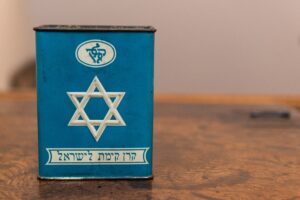
He prospered enough to give the business over to his son when he was in his fifties, and become a full-time workerJewish noit for Zionism. He used to go round the manufacturers, big and small, collecting money to support the cause. He was friendly with them all. He would knock on the door and say – suppose it was Montague Burton[ii] – “OK, Moshe, you gave me a thousand last year, we need more this time.” He was good-humouredly effective at extracting money. This was his main activity for more than twenty years, into his 70s at least. He was made honorary president of the Leeds Zionist organisation, and his wife, my grandmother, was honorary president of the Women’s organisation. There is a forest named after him somewhere in Israel – over the ruins of some Palestinian village, I’m sure. My mother clearly absorbed some of this Zionism. When she and my father moved to Liverpool she got involved in the Liverpool branch of WIZO, and became chair more than once, but it didn’t take over her life the way it had her father’s. We had a blue JNF box in our house, of course.
As soon as Israel was founded my grandfather wanted to visit. There was some mishap on his flight and it belly-flopped into the sea near a coast – it might have been Egypt? Everyone had to be ferried ashore. Because of his diabetes he was very rigorous about his diet, and he had set off equipped with all the food he needed and knowing what time he had to eat it. He was carried out over the water eating a sandwich!
On neither side was the family religious. My parents never went to synagogue, but they sent us children, because they wanted us to engage with and be socialised into the Jewish community, and I went to Cheder after school. I found it all so boring – despite all those nice Jewish girls up in the balcony! – that I rebelled about a year after my Bar Mitzvah. I was very shy, so I didn’t go to Habonim, though lots of the people I knew did.
My parents must have been extremely concerned, maybe excited, by what was going on in 1948, though I don’t remember them talking about it. But I did become very worried that the Jews might lose, and I remember being very pleased when we – “We”! – won. There were always glossy magazines around with photos of handsome young men bending over agricultural tools and so on. But I was cack-handed, like my father, who would have regarded changing a light-bulb as really rather demanding.
Teenage years
I didn’t go to a Jewish school. I got a scholarship – £12 a year – to one of the city’s main grammar schools, the one Paul McCartney went to. He was in the form that I had to look after as a prefect, lining them up to go in after break. He was always very charming and outgoing. My brother was at another grammar school, where John Lennon went. There were about 30 of us Jewish boys at my school. It was an unruly sort of group, and they weren’t role models.
I was not aware of discrimination or antisemitism at school – maybe it was there, but perhaps I failed to spot it. Certainly the kids in my class didn’t seem to make any distinction. Some years later someone who I had known at school startled me by shouting from across the road something about a Yid. I had no idea he cared! That’s the only overt incident of antisemitism I remember from school – and there were only another two or three incidents later in life. But my parents had let me know that it was likely to be around, and on occasion advised me to consider that maybe some setback I had experienced could be due to antisemitism.
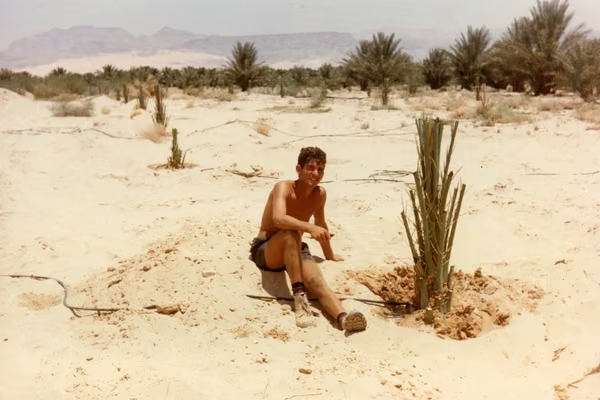
The first evidence that I was developing as a person in my own right was when my father’s mother died. She left me £100, and I decided to spend it on going to Israel. I was 17 or 18. I went for six weeks on the ‘Summer Institute’ run by the Jewish Agency, which obviously hoped that we would ‘make Aliyah’ to Israel. It was a very nice group of 20 or so people, mostly students a bit older than me. I visited some family members there, second cousins; and I worked on a kibbutz for a week – back-breaking! I wanted to go to the Dead Sea, and that’s the adventure I remember most. I was gaining confidence. I took a bus to Be’er-Sheva and then hitched a lift on a truck to the Dead Sea, where I was put up in a hostel for workers at the factory that processed chemicals from the Sea.
So my visit to Israel was a positive experience, and extremely helpful for me in one particular way. I had what we then called an inferiority complex, because I wore spectacles, wasn’t blond and blue-eyed like the illustrations in the books and comics I had read. And I was no good at sports. And being Jewish, so an outsider, didn’t help at all. But in Israel I met lots of people who weren’t short-sighted, physically inept, or underconfident. And they were Jewish! I realised Jews are just like other people, and my Jewish identity ceased to be the big problem it had been. I was conscious when I came back that I didn’t need Israel any more: ‘Oh well, Jewishness is one thing I don’t have to worry about any more.’
This was in 1956, just before the Suez crisis. Just after I left, my father went over to Haifa as a UN expert, I think with the Haifa Technion. He was there in October and was evacuated on an American destroyer and taken to an aircraft carrier. Later he was for few years a member of a board of experts that gave Haifa Technion a bit more respectability. My father still felt attached to Israel, but it was marginal to his life – which focussed on his work and his roles in Liverpool University. I myself still didn’t have any doubts about Israel, but since my visit its importance had shrunk.
Political activism
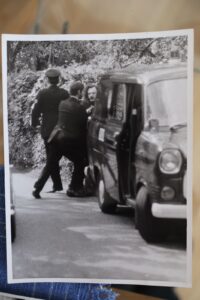
I went as a student to Cambridge, where I managed to be Treasurer of the Labour Club, despite my shyness. I was always political. Jumping ahead, I became a Labour Party parliamentary candidate in 1966[iii], and subsequently engaged in a series of political campaigns mostly focussed on bad things happening overseas. I was recruited into the Anti-Apartheid movement by its chair, Tom Kellock, my Liberal Party fellow-candidate in 1966, and for a year I was on AAM’s Executive Committee. So I was boycotting away, and later campaigning for Venezuela, and other things. I became chair of the British Society for Social Responsibility in Science[iv], which worked for science to be used in socially constructive ways rather than for warfare or capital. I got involved in the Irish question as a result of that, because one thread of the Society’s work was concern about the use of CS gas and rubber bullets in Northern Ireland.
I never engaged with any of these issues as a Jew. I had solved my own Jewish-identity problem in 1956, and I never thought of my Jewishness as having a political dimension. I certainly didn’t engage with any Zionist activity, though I was still rooting for Israel in 1967, and was really worried that it might get wiped out. Little did I know!
Starting to criticise Israel
The break point came quite soon after 1967, because within a year or so Israel started its violent and excessive retaliation against any Palestinians who showed any sign of resistance (though we were still thinking of them as ‘Arabs’). I thought, ‘Why are they doing that? They’ve got a viable space now.’ I had been convinced by the story that Israel needed more land because there was a narrow seven-mile neck between southern and northern Israel. But now they had more land, so why didn’t they just sort things out and come to an agreement? First it was puzzlement, and then gradually it became distress.
My mother and I would talk about it at this stage, but over time that stopped. She lived in an almost entirely Jewish social milieu where support for Israel was so assumed it didn’t have to be proclaimed. I can’t recall any word of criticism of Israel being spoken at the social gatherings of my parents and their friends. But I vividly recall her saying to me, much later, “You know, Jonathan, this isn’t the Israel I thought we were working for.”
I got together with my wife, who was not Jewish, in 1968, and she became quite critical, making comments about Israel that I bridled at. ‘Is she being antisemitic?’ I worried. Then I realised that quite a lot of my friends were saying the same things. They were nearly all politically active – people who supported liberation movements, cared deeply about Vietnam, grieved over repression in Chile. It took me a decade to catch up with them. Back in 1966 in my Labour party circles everyone had been in favour of Israel: if you weren’t an antisemite you were in favour of Israel. I was slow to absorb the change.
My discomfort grew, but it didn’t manifest itself in any action until 2002 – a long gestation, over thirty years. That was when Steven and Hilary Rose[v] launched a call for a moratorium on providing European research funding to Israeli universities. I signed up to that, as did thousands of other academics. For me, the decision to sign and go public wasn’t something I had to wrestle with. My views were clear, the call was a logical consequence of what I was feeling, and going public among a thousand people is neither here nor there. At some point it became more public, and my picture with others was on the front page of the Jewish Chronicle. As a result, various members of my family stopped speaking to me or responding to my emails. I even got a message from Selig Brodetsky’s daughter, saying “Your father must be turning in his grave”. I entered into a correspondence with her; but it was no use, she was not up for a discussion. I had arguments, she had gut feelings.
Steven and Hilary Rose had been founders of the British Society for Social Responsibility in Science. In 2004 they set up BRICUP, the British Committee for the Universities of Palestine, as a mechanism for supporting academic boycott of Israel, and I joined and became active. When they moved on, I became chair, a role I have had now for about 15 years. It was founded to support the academic boycott, but has since expanded into other related areas such as freedom of speech. When Artists for Palestine UK (APUK)[vi] was launched, several members of BRICUP went across to join that as well, but I stayed mostly with BRICUP to keep the shop open.
Mike Cushman[vii] was at LSE, like me, and the two of us took the boycott question to our union, then the Association of University Teachers[viii]. We were derided out of court at the time. There was a great majority of “How dare you? What rubbish! Nonsense!” Now of course the LSE branch of AUT’s successor union, the UCU, is entirely in favour of boycott, as is the whole union.
I don’t know that my career has suffered because of my views. Around 2002 I was asked to take the position of Vice Chairman of the Academic Board at LSE, which is the assembly of all teachers; if there had been concern that I was antisemitic or any political worry, that wouldn’t have happened. But other things didn’t happen: I have not been approached for the sort of committees that the Great and the Good get put on – but you never know why. It might be (this is my late parents whispering in my ear) because I am Jewish, or because I am antizionist, or because I am not sufficiently learned.
Becoming anti-Zionist
My own movement has been very gradual. When the question came up in BRICUP of one-state or two-state solutions, I regarded the people who were in favour of one state as extremists, unrealistic. It took me a few years to see the logic. I have never called myself an anti-zionist until recently. I don’t go around calling myself things anyway. There were other positions people took that were more ‘advanced’ than mine which I then thought adventurist but now see as being entirely reasonable. Settler-Colonialism as a description of Israel’s system, for instance.
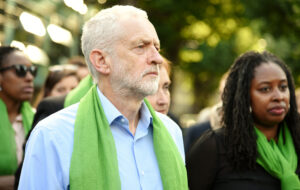
One crucial event that influenced my journey was Jeremy Corbyn being elected leader of the Labour Party in 2015. I had resigned from the Labour Party more than once – because of Harold Wilson’s reneging on various policies, and again after Tony Benn’s leadership challenge failed. I was out of the party for 28 years, but on the day that Corbyn was selected I rejoined. The next spring, the antisemitism stuff started, with the Oxford University Labour Club accused of being antisemitic[ix]. Soon after that a small gang of us got together, mostly Jews and a couple of non-Jews, and we formed Free Speech on Israel[x], which was in a way a forerunner of Jewish Voice for Labour. The discussion now was transformed: it was not just about Israel but at least as much about being Jewish. It was very educational for me, indeed I have learned a lot. I was quite unaware of the Bund, for example. I am much more Jewish now than I was before, much more aware culturally and historically.
Another early stage of the confected antisemitism crisis was Ken Livingstone’s suspension from the Labour Party[xi]. He was hauled up before a tribunal, and Michael Mansfield acted as his lawyer[xii]. Five Jewish people gave evidence that nothing he had said was antisemitic. I was one, along with Naomi Wimborne-Idrissi and Jenny Manson[xiii], and Walter Wolfgang[xiv], who had been thrown out of the Labour Party conference in 2005 for heckling Jack Straw. We all said that nothing Livingstone had said was antisemitic, and that was absolutely true. But that was when the fight began to get really dirty.
On the idea of one state rather than two states, I go in and out on it. A one-state solution is the ideal but I think utterly unrealistic, particularly since Oct 7th 2023. Israelis are clearly not ready to live peacefully with Palestinians, and what sensible Palestinian would want to be with the people who’ve done what they have? I think it is politically unrealistic for a generation or more – which is bad for everybody. It’s not something I would campaign for right now. I can’t see a medium-term workable solution that gives the Palestinians even a fraction of what they are entitled to. These wounds will take a long time to heal, on both sides, and there will be scar tissue.
Oct 7th sharpened everything. Now that Israel has revealed itself in so gory a fashion, I expect that men and women of good faith will be able to see the threads that connect back to Israel’s foundational ideology of Zionism. I’m one of those pushing for Jewish Voice for Labour to debate whether we should become explicitly antizionist. In my view, it’s important to say that the state of Israel is an illegitimate intruder into another people’s country and was practising apartheid and racial discrimination even before it outrageously embraced genocide. Ours is an uncomfortable inheritance.
[i] Selig Brodetsky, 1888-1954, mathematician, member of the World Zionist Organisation executive, President of the British Board of Deputies 1940-49, Professor at the University of Leeds 1924-48, President of the Hebrew University, Jerusalem 1949-52.
[ii] Montague Burton (1885-1952) arrived in UK from Lithuania in 1900, speaking very little English. He rose from being a peddlar to founding Burton’s Menswear, which claimed to clothe one fifth of the British population from Europe’s largest clothing factory, in Leeds. The firm made a quarter of British military uniforms in WW2.
[iii] In the UK’s 1966 General Election, Rosenhead stood as Labour candidate for Kensington South. The conservatives held the seat.
[iv] The British Society for Social Responsibility in Science was formed in 1968 to oppose university research into chemical and biological weapons. Its inauguration was supported by 64 Fellows of the Royal Society. The Society was very active through the 1970s, but folded in the early 1990s.
[v] Steven Rose, b 1938, award-winning English neuroscientist, Professor at Open University from 1969, humanist. Founder member of British Society for Social Responsibility in Science in the 1960s, initiator of open letter to the Guardian in 2002 calling for academic boycott of Israeli institutions, founder member of British Committee for the Universities of Palestine, 2004. Hilary Rose, b 1935, British feminist sociologist. Married to Steven Rose, and collaborated with him in many activities.
[vi] Artists for Palestine UK, launched in 2015, is a network of people in the arts working for freedom and justice for Palestinians.
[vii] See interview in this series
[viii] In 2006, the AUT merged with another union of teachers in higher education, NATFHE, to become UCU, the University and College Union.
[ix] In February 2016 the Oxford University Labour Club voted to endorse Israel Apartheid Week. The Club’s co-chair resigned in protest, accusing the Club of antisemitism. The Labour Party’s NEC appointed Baroness Royall to investigate. Her report in May 2016, which found no institutional antisemitism but occasional incidents, caused further controversy.
[x] Free Speech on Israel was active for four or five years but had become dormant by 2022.
[xi] Ken Livingstone, b 1945. Labour politician, leader of the Greater London Council 1981-86, MP 1987-2001, Mayor of London 2000-2008. Suspended from the Labour Party in 2016 accused of antisemitism. He had said that Hitler supported Zionism in the 1930s. He resigned from the party in 2018, after repeated suspensions and disciplinary investigations.
[xii] Michael Mansfield, b 1941, English barrister, socialist, known for his often very high-profile work in civil liberties and human rights cases.
[xiii] Media officer and co-chair of Jewish Voice for Labour
[xiv] Walter Wolfgang 1923-2019, socialist, Labour candidate, Vice-President of CND and supporter of Stop the War
Really interesting. Thank you
If ? We are to tackle the really big issues of the near future, concerning the whole of mankind, then logic dictates we must put aside the minor differences such as which of the various Gods on offer we should take. The “one-state” solution would be a huge step in bringing forward a logical conclusion to the immediate problem and show the way to a World unified system that can tackle the huge problem of Global Warming.
For unless that happens then there is a very grim future for the whole Planet and all the issues that separate us now will not matter a fig !
I found the article very interesting and showed the glow of Humanity.
You could make a book of these.
We hope to, can we get one from you for the collection?