
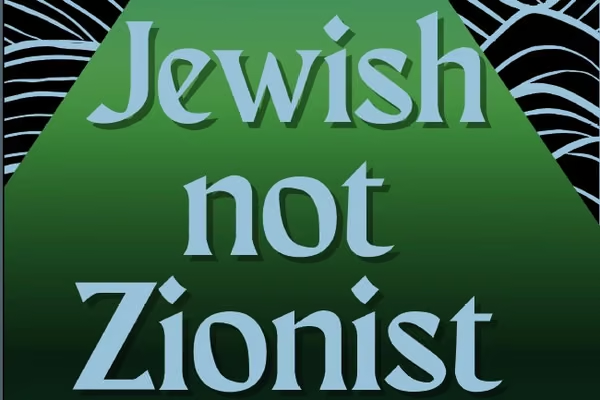
Jewish not Zionist: a review of a timely book
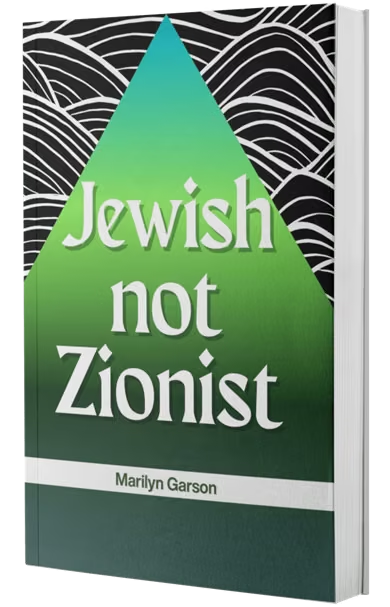
Marilyn Garson‘s important new book, Jewish not Zionist”,is reviewed here by JVL member Felicity Laurence. Marilyn is involved in JVL partner organisation Sh’ma Koleinu – Alternative Jewish Voices (NZ).
Felicity notes :”In JVL’s series, Jewish Journeys from Zionism, each story involves the re-evaluating of identity and each examines the question: “what does it mean to say you are Jewish, but not Zionist, at this time?” For our cohort of Israel-critical Jewish voices, Marilyn Garson’s exquisite articulation of this problem profoundly enriches our quest – looking as it does at the very crux of what it is not just to be Jewish, but to be human, and fellow-human, now.
LL
I begin with a simple statement: this book is luminous, essential, inspirational and it speaks with a desperate urgency to all of us in this JVL forum, and to all others who watch with us in despair as the extermination of the Palestinian people of Gaza continues not only unabated, but ever more frenzied. This narrative of one person’s experience in her far-off homeland throws a powerful light upon what all of us are witnessing and agonising over in these darkest of days. It takes us to the depths of suffering, and then up again to a call to action and to potent and novel ideas about what we can do in taking that action.
Centred in her homeland of Aotearoa New Zealand, Marilyn Garson’s account is informed by her lived experience across the world: including her Zionist upbringing in Canada, her training in philosophy and other disciplines, her journey from and back into Judaism, and her work over many years in the war grounds of Afghanistan, Cambodia and, for four years, Gaza.
This book has acute salience for us all, wherever we are living. It opens rich avenues of thought to explore and bring front and centre the role of our solidarity, as people of Jewish heritage, in the humanisation of the Palestinian people as people with exactly the same human rights as everyone else.
It is a story for our time right now.
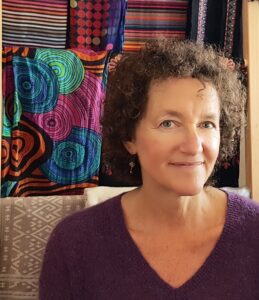
When Marilyn Garson returned to her home of Aotearoa New Zealand in late 2015 after living for four years in Gaza, she “brought a mission home from Gaza. I wanted to overturn the dehumanisation of Palestinians.” (JnZ, p24). She spoke about Gazan people, and wrote about her Gazan experience in her book Still Lives: A memoir of Gaza.
But instead of finding open minds, she found herself the recipient of sustained abuse from her own synagogue, and from further afield. Her attempts to argue the equal humanity of the Palestinian people with whom she had worked and then suffered under the devastating Israeli bombardment in 2014 met with accusations of treachery, and the blindness to the reality of Israeli aggression that we are seeing again now.
The opprobrium that poured upon her from her very own Jewish community was brutal and tenacious; and over time it destroyed her health and threatened to engulf her very spirit.
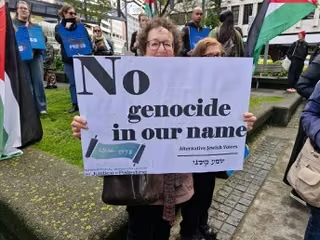
Jewish not Zionist is not only a chronicle of this traumatic experience. It is also an account of her survival of it, and the subsequent founding of the group, Alternative Jewish Voices (NZ). This has become, through its inspired strategy and activity, a powerful counter in New Zealand to the Israel-is-justified-whatever-they-do narrative that holds sway there, as so widely elsewhere. She takes us right into the present – the book was launched only a few weeks ago (October 22nd) and she confronts what we are seeing now, and what we need to do.
After a brief Introduction situating the story that follows in terms of her recent past, comes her explication of ‘Why I am an anti-Zionist’. This chapter will resonate profoundly with so many of us here. She is clear:
Zionism is a calamity for Palestinians and others. [It is] the project of violently Judaising square inches at any cost […] the reality of Zionism is racist, violent and unlawful. (p40)
And here is her concluding reflection:
Anti-Zionist Jews walk a paradoxical path of loss, exclusion and discovery as we outgrow everything we have been told. We situate our Jewish selves in the actual world before our eyes. The motif of passage is familiar to us. We are inveterate wanderers, explorers, guests on the threshold hoping to be welcome. (p41)
The ensuing Part One is Marilyn’s painful telling of the years from 2016 to 2024. It tracks her return to New Zealand from Gaza, the appalling ostracism from her synagogue, the repudiation of her voice from many other public spaces, the shocking level of physical and mental trauma that these attempts to obliterate her persona caused her over several years: and then her emergence from this, her co-founding of Alternative Jewish Voices in Aotearoa New Zealand in 2020, and its trajectory, and hers, as AJV developed reach and influence across political and societal domains of the country, and beyond.
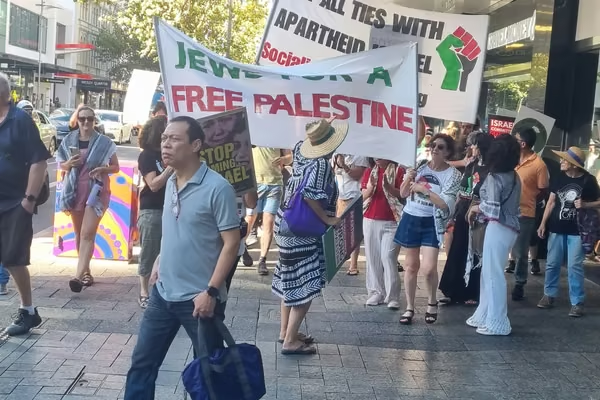
We had no roadmap. We deployed the wisdom of small communities to find our own way, and we have been part of a broader movement for justice. Anti-Zionist voices are now routinely heard in government offices, at public fora, at rallies and in the community. We are consulted by boards facing unfounded accusations of antisemitism. AJV is also a founding member of the largest sustained Jewish organisation for international political change, Global Jews for Palestine. (p23)
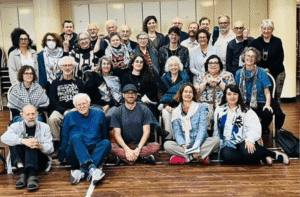
Marilyn’s work with AJV offers concrete and eminently doable suggestions for those of us in our own communities where similar groups are springing up, as in my hometown of Hastings. We may feel that our tiny groups are powerless; she shows us what can be possible to achieve despite the forces that try constantly to demolish our resistance to the prevailing narrative of Zionist supremacy, and its cruel and inhuman consequences.
Part Two starts with two major essays, respectively on human rights, and on the IHRAWDA (the International Holocaust Remembrance Alliance Working Definition of Antisemitism).
On the question of rights, here some brief excerpts from a detailed interrogation of an arena which now has some further ballast in light of recent international legal judgements against Israel’s occupation and its actions in Gaza.
She begins: I believe that human rights constitute a radical politics for Gaza. (p179)
She develops this thesis from that point, sketching realities on the ground, her own thought processes, and evoking Amartya Sen’s stipulation that ‘rights are also a demand addressed to anyone who can help.’ (p179)
Here again: Because they equate the value of all people, human rights constitutes a radical politics for dehumanised Gaza. If Gazans are fully human and the value of human life is indivisible, then the choking blockade must go. […] Human rights rejects the structural power of blockade, not by being anti-anyone but by restoring the full, equal value of each discounted life. […]Rights have not failed Gaza: we have. In the absence of a caring authority, the fact that endangered people have rights is not a fix. Their rights become, instead, our obligation. (p185-186)
Later: Don’t ask why rights haven’t been delivered. Ask instead why the agreed framework of rights, conventions and international law has not been tried. (p191)
And she goes on to recount the July 2024 ruling of the ICJ – that the occupation is unlawful and must cease, declaring that therefore:
There has never been a more auspicious moment to let rights guide policy [and] the ICJ instructs all states to do just that. (p191)
The following chapter, ‘The power of definition’, is a seminal analysis of the IHRA working definition of antisemitism (IHRAWDA). Marilyn makes clear that this ‘definition’ – which was never intended to be the final word and is long renounced by its author – underlies and makes possible both the ongoing onslaught by Israel and the attempted silencing of protest against it across so much of the Western world; as we see in the UK, the immediate accusation of ‘antisemitism’, often followed as quickly by threats of legal action, closes down again and again public debate, public spaces, protest, journalistic analyses, film showings, plays, poetry readings, art exhibitions.
Quite simply: The IHRAWDA is a definition, a project and a strategy of influence. […] It is the enforcement regime of the Zionist project of occupation and power. (pp196-197)
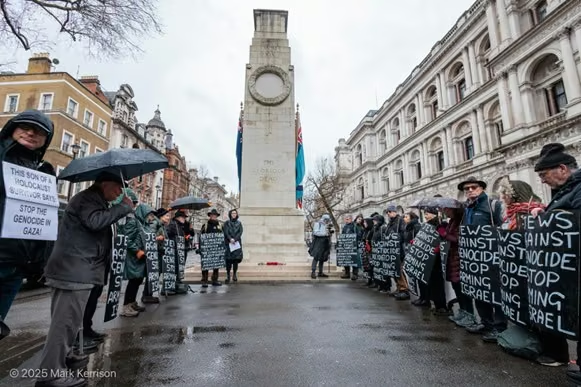
We know that the IHRA definition stifles speech, and that it is adopted whenever someone deems it appropriate to soothe ‘Jewish’ sensibilities; this is ongoing, it is insidious, and it is, in the end, underpinning genocide. As she puts it in her Mondoweiss article, June 11th, 2024 (reproduced in full in her Afterword, pp 246-248):
The IHRA definition is now the backdrop for the genocide which is being done in our names. Its power is pervasive. The IHRA definition has hemmed in the space of speech and protest, rendered statements of Palestinian identity and rights suspect, foreclosed on millennia of Jewish pluralism, and elevated political difference to the absolute wrong of racism. It diverts from urgent, lifesaving speech: permanent ceasefire now, sufficient humanitarian provision now, peace with justice forever. Every message must now be filtered (or rammed) through a language that places Zionist-Jewish discomfort before Palestinian survival.
Marilyn’s full analysis is supremely detailed and acute, and at this moment we need it at our fingertips.
There follow further discussions concerning being Jewish in Aotearoa New Zealand, and ‘Being anti-Zionist in a Jewish Voice’ – again, both with insights relevant to all of us engaged in this struggle, wherever we are geographically.
The book concludes with her ‘Afterword: the new Jewish International’, which articulates the burgeoning internationality of the ‘growing presence of Jewishness beyond Zionism’(p247).
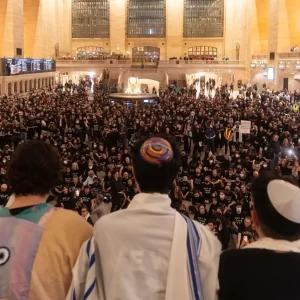
The thousands of Jews who march and protest in the sea of protestors are already proving to neighbors that Israel does not speak for us. We speak for justice.
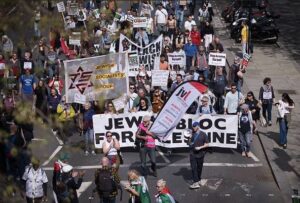
We are taking back the power of definition. We are breathing life into a 21st century Jewishness. (p248)
Included throughout this remarkable book are posts from press articles and the AJV blog, each one a short but sharply illuminating reflection on its particular topic.
The book has been on the bestseller list of Unity Wellington, at #1 for a week, and then #5, and continues to arouse significant interest and response among those both of Jewish heritage and those who are not but who want to understand what it really means being Jewish but not Zionist, and what really constitutes being antisemitic.
Jewish not Zionist was published by Left of the Equator on October 22, 2024.
It is available now here as an ebook from: Amazon, Apple, Kobo and other ebooks: $9.99 US / $16.50 NZD (ca£7.65 for Kindle)
Plans are afoot to make the print edition available directly within the UK: more information soon. If people register their interest in buying a paper book, it will help to guide the printed quantities. (You can register as a comment so your interest can be noted, although will not published)
Print edition; Order direct from the Contact page or through the channels listed here: https://www.marilyngarson.com/jewish-not-zionist/, or from the publisher Retail price: $30 NZD, plus postage.
Further information: Marilyn’s OpEd that this is a story about developing a liberatory Jewish identity. https://thespinoff.co.nz/books/21-10-2024/justice-as-our-common-cause-what-can-an-aotearoa-jewish-identity-look-like


Totally absorbing and moving story. Many would have given up but this wonderfully brave and determined lady kept going and eventually the tide, which she helped to create turned.
One day in the future, this story could be made into a film but only after Zionism suffocates itself and becomes a part of history, where, like Nazism it is hated by the majority of people around the World.