
The question that won’t stay buried
JVL Introduction
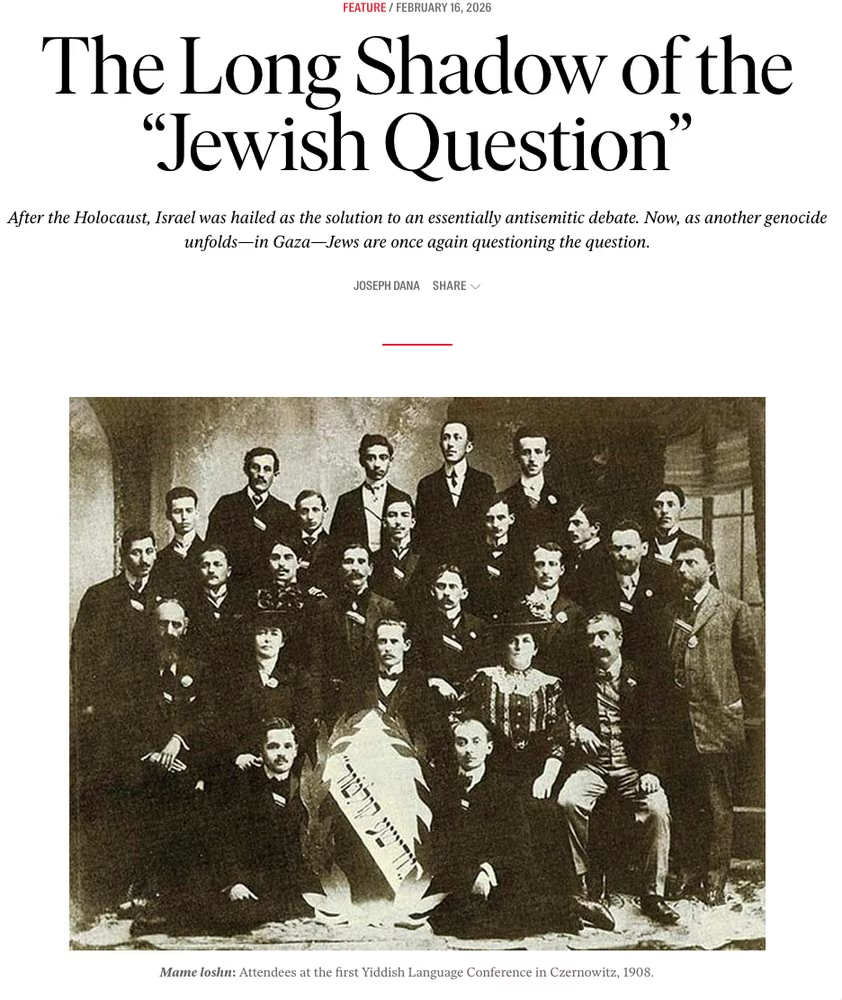
Joseph Dana has published a long and important article The Long Shadow of the “Jewish Question” in The Nation, 16th Feb 2026.
A short introduction to it appears on Tony Karon’s substack and is reposted below.
The “Jewish Question”, Dana reminds us, was a debate that originated after the French Revolution, asking whether the newly emancipated Jews could be loyal citizens while remaining a separate people.
Its assumption was Jewish exceptionalism and Zionism perpetuated that exceptionalism, claiming that Israel had settled the Jewish Question.
In reality such claims are hollow: it was never settled at all. Indeed, says Dana, it was the wrong question.
There was always an alternative, intellectual traditions that contested Zionism at its start, and many are returning to a search for alternatives.
This is evidenced in the reassertion that “Jewish existence never required territorial sovereignty because the tradition itself is portable, sustained by practice, text, and community rather than borders”.
Read the full article here.
RK
This article was originally published by Tony Karon's substack on Thu 19 Feb 2026. Read the original here.
The question that won't stay buried
Loading article text…



A really useful article. “ . . . Jews [are] a religious community and not a nation.” I would go further than this and say that, they/we are a cultural community, linked strongly with a religion, but not necessarily dependent on it – and certainly not a nation. Though my mother was Jewish, and I have therefore always described myself as Jew(-ish) as Jonathan Miller would have put it, I have always, and particularly since reading Shlomo Sand’s book, “The Invention of the Jewish People”, come to question what my Jewishness means to me. I think there is a parallel with being Catholic – more particularly with being a lapsed Catholic. I have noticed how, whilst no-one would begin to described Catholics as a race, there are ingrained traditions and ways of thinking that can take several generations to fade away. So too, whilst never having been a practising Jew – nor was my mother – I find myself identifying with Jewish ways of thinking and seeing the world, not least as expressed through the Old Testament.
I regards myself as a British Jew, and I say that rather than a Jewish Briton or a Jewish Englishman because for me being British or English is the more important part of me. I cannot remember my parents, family or friends ever talk about Israel except in one important conversation. My grandparents were the only members of my family that were religious and even they did not talk about Israel – they came from Russia at the turn of the 19th/20th century. Even in Sunday morning Hebrew classes nobody talked about Israel nor did anybody suggest that we would be better off there rather than London.
A Jewish teenage friend of mine in the 1950’s had a father who had been a British soldier in WW2 and he went as a British soldier to Mandate Palestine in 1945 with a friend who he had been with in the British Army in Italy. The friend got killed in the bombing of the King David Hotel. That may have coloured his views of Israelis, but he also said he did not like the way they treated Arabs. His phrase about Israelis was “They are not like us”.
I am not religious, and I can see that religious Jews may form a community, in the same way that religious Christians form communities. I am occasionally invited to Jewish events by Jewish friends and I am also invited to Christian events by Christian friends. Both groups of friends know I dispute the veracity of Bible stories, and have been known to make rational explanations for miracles, and explain current customs in terms of scientifically ignorant nomadic peoples of 2,500 uyears ago.