
The Ideals of the Jewish Labour Bund have outlived Nazi genocide

JVL Introduction
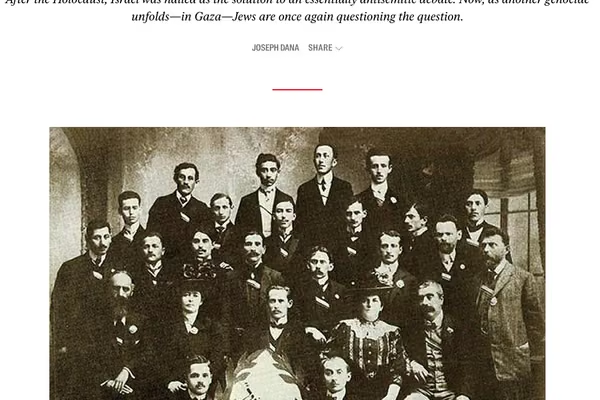
The Jewish Labour Bund played an important role in pre-revolutionary Russia and after, particularly in Poland in the nineteen-thirties, and offers important lessons for socialists today.
Here David Rosenberg reviews two recent publications on the Bund for Jacobin magazine.
They are Yiddish Revolutionaries in Migration: the Transnational History of the Jewish Labour Bund by Frank Wolff (Haymarket Books, 2021) and Socialism in Yiddish: the Jewish Labour Bund in Sweden by Håkan Blomqvist (Sodertorns Hogskola, 2022)
The new issue of Jacobin is out now. Subscribe today and get a year-long print and digital subscription.
This article was originally published by Jacobin on Wed 29 Jun 2022. Read the original here.
The Ideals of the Jewish Labor Bund Have Outlived Nazi Genocide
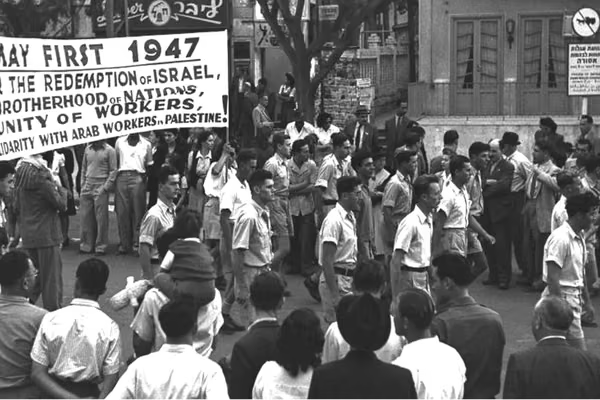
In tsarist Russia and interwar Poland, the Jewish Bund developed a socialist alternative to Zionism while fighting against antisemitic oppression. The neglected international history of their movement is a vital resource for our own time.
Loading article text…


Fascinating. Really interesting and thorough reviews.
Thanks Dave.
My father’s father was certainly active in the US Arbeter Ring and is buried in the Jewish Workmen’s Cemetery in Boston. (Workmen’s is how the Arbeter Ring is often described in the US.) He was a fulltime union organiser for the US Boot and Shoeworkers Union. As far as I can make out, he didn’t ever join the US Communist Party, so I think at the very least he must have been heavily influenced by Bundist ideas. I’ve found one of his speeches that he gave to the Boot and Shoeworkers Union and it was an impassioned plea for the release of Eugene Debs from prison for his antiwar activities during WW1. My father’s father was born in Poland and grew up there until about 1900.
My father’s mother (who split from my father’s father in 1922) came back to England and seems to have not had much to do with the Workers Circle but joined the Communist Party in Whitechapel. However, her father (born in Poland) seems to have been more interested in the Bund. He had been a member of the Socialist Democratic Federation and as far as I can work out, didn’t ever join the CP so he too seems to have been more Bundist than Communist! My father said that as a boy he used to help his Zeyde (grandfather) read the English newspapers, his first languages being Yiddish and Polish.
Meanwhile, on my mother’s side, her father was an active member of the Workers Circle. I can remember him meeting up with this Workers Circle ‘chaverim’ (friends) on Hackney Downs when we went to see him. They would speak to me in Yiddish and laugh (in a nice way) if I tried to understand them. My mother, a fairly staunch CP-er until 1956/7, once described her father as a ‘Trotskyist’ but I suspect that the CP put about a rather crude put-down for all leftists they disagreed with, calling them Trotskyists! To my mind , that rather confirms he was in or with the Bund.
One other person pointed out to me as being a Bundist, was my friend Chris’s Zeyde (grandfather). He spoke Yiddish to Chris’s father and carried bits of cloth around in a brown paper back, that (Chris reminds me) he called ‘remlets’.
Back in the US, my father’s uncle and aunt are also buried in the Jewish Workmen’s Cemetery and all three of them have the Arbeter Ring image of two embracing hands on their gravestones and the branch number too. I’ve been in touch with the Boston Workmens Circle, which seems to be flourishing.
Back with the article that Dave has written: perhaps Dave you could do a little postscript about Marek Edelman?
Btw, my long rambling comment was partly meant to be a suggestion that others delve into their family histories. People may well find Bundist forebears!