
The Bund – A graphic history of Jewish Labour Resistance
Richard Kuper writes:
The Bund: A Graphic History of Jewish Labour Resistance has recently been published by Between the Lines Press in Toronto.
It is, as the title and front cover suggest, a beautiful comic book history of one of the most powerful political movements to develop among modern Jewry.
Only the Zionist movement could rival it – and it took the Second World War and the Holocaust to enable the triumph of the latter.
The spirit of the Bund lives on in small but committed organisations of Jews in many countries in the diaspora today but, more importantly, wherever and whenever Jews identify with the struggle of the oppressed and organise in their support – in apartheid South Africa, in the US civil rights movement, in Argentina under the junta or, most significantly today, in support of Palestinian freedom.
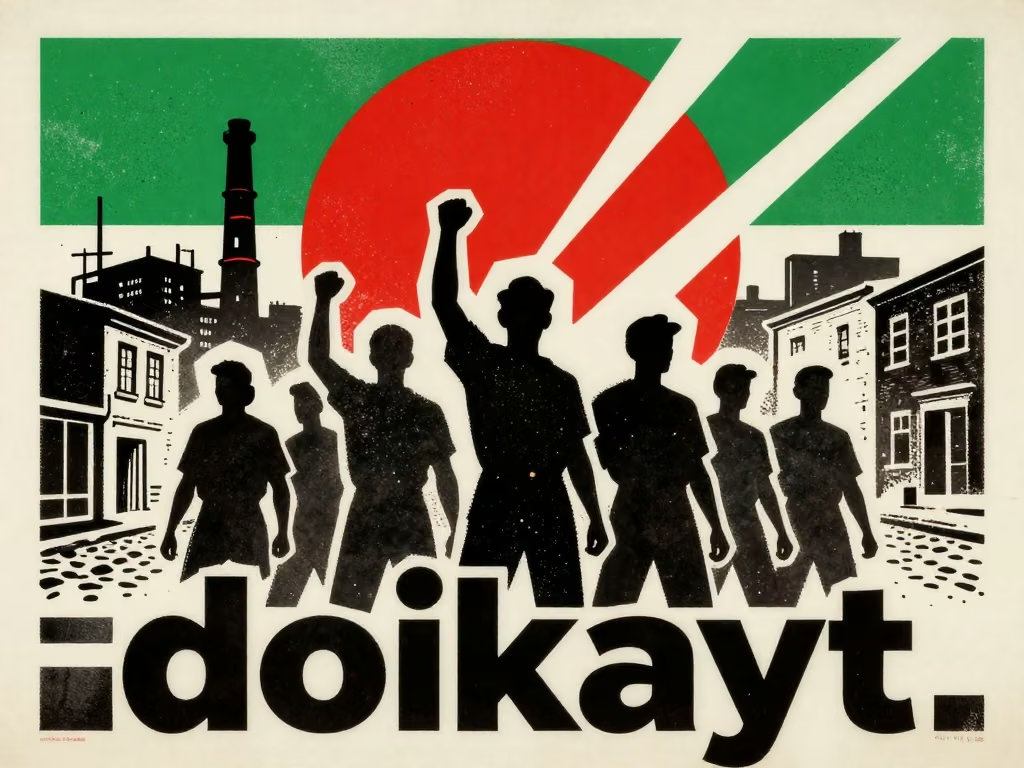
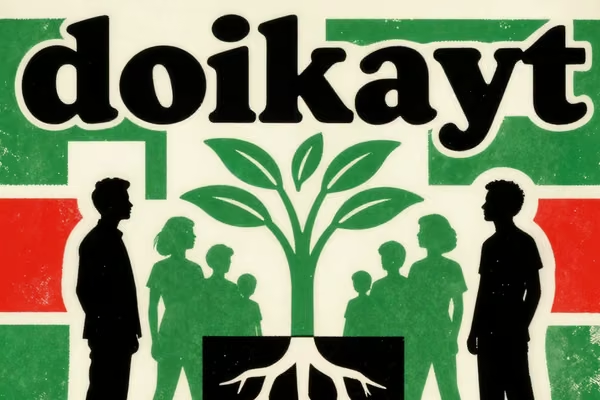
All express the Bundist idea of doikayt “hereness”, “where you live, that is your country”. Not just that, of course, as there were many other traditions – liberal, progressive, radical, socialist, communist and anarchist – which inspired those who took part in the struggles in the USA, South Africa and elsewhere.
Indeed, not so many of the Jew who participated in these struggles did so collectively as Jews, but rather out of an individual commitment – informed by their Jewishness, for sure, but also by their wider value systems.
The Bund tells the story of those how organised as Jews, collectively, in areas of the Russian empire and then the USSR from the 1890s until the early 1920s when Soviet pressure led to the Party disbanding. It introduces us to some of the leading women and men who were active in building the movement: Pati Kremer, Arkady Kremer, Iulii Martov, Isiah Izenshtat, Anna Heller, Maria Zhadlusky and others. And it shows that building the movement was a cultural as well as a political activity, with education and love of Yiddish important themes in the story.
There are a few pages towards the end on Bundist resistance to the Nazis, and also on the Bund in Poland in the interwar period. These couple of pages are, in my view, an opportunity lost, since that history in Poland in the twenties and thirties was one in which the Bund truly became a mass movement – of self-defence but also one that applied the socialist principles which it embodied in day-to-day organising in massive trade unions, as elected reps on local and regional councils, and in socialist self-help. The Polish story, including the resistance in the Warsaw ghetto in which Bundist leaders played a crucial role, deserves a future graphic novel in its own right!
The book tells its story well with a light-touch, short-dialogue approach and beautiful, sometimes haunting, cartoon illustrations. It has a brief introduction by David Rosenberg of the Bundist-influenced Jewish Socialists’ Group in Britain, and an afterword by its editor Paul Buhle, a veteran of the 1960s Students for a Democratic Society (SDS) and prolific chronicler of the left’s history, often in graphic form.
I wish The Bund were longer than its 120 pages but, alas, producing graphic novels isn’t cheap, and this volume is already relatively highly priced.
Make sure you get hold of a copy. It is available in the UK from Hive here and from other bookshops.
[corrected 1 Dec 23]
The Bund
A Graphic History of Jewish Labour Resistance
Publisher’s blurb
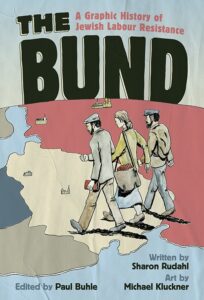 Told in an engaging graphic novel format, The Bund explains the oppressive origins of Jewish resistance in Ukraine, Poland, and the “Pale of Settlement” in Tsarist Russia. Jewish people adapted to industrialization and organized against exploitation. As they became more divided along the linguistic borders of Yiddish and Hebrew, Jewish people split between those who sought a distant ancestral homeland, others who emigrated and adapted to the “new world,” and many more who fought against murderous Soviet and Nazi regimes. Charismatic resistance figures including Pati Kremer and Bernard Goldstein kept secular and progressive ideas alive against impossible odds in this graphic account of a little-known story. The first of its kind, this graphic history of Jewish labour resistance lays bare evidence of a radical past that can have massive implications for leftist Jewish struggles today.
Advance praise
“What can you say about an organization that was a union, a social movement, a political party, a culture-producing machine and a loving, contentious community all at the same time? Perhaps only that it’s a model for the politics we need right now. It’s no surprise that interest in the Bund is surging in young leftist circles these days, and this excellent populist primer fills an urgent need. This book also embodies the Bund’s own deep commitment to inclusive, radical popular education: buy it, inhale it, pass it on!”
– Avi Lewis, filmmaker, teacher, activist, politician, 4th generation Bundist
“Deeply relevant to today’s political debates, The Bund reminds us that throughout history many groups of Jews were themselves anti-Zionist. The Bund thus challenges the false and dangerous narrative that anti-Zionism equates to anti-Semitism.”
– Zelda Abramson, professor emerita, Department of Sociology, Acadia University; co-author of The Montreal Shtetl: Making Home After the Holocaust
“This is a book that lefty Jews need right now. We need to remember how sophisticated, committed, caring, and effectively organized we have been. With its dramatic illustrations and compelling, clear storytelling, it’s an exciting, accessible tool for conjuring the beautiful, powerful spirit of the Yiddish Bund into our lives today.”
– Geoff Berner, musician and author of The Fiddler Is a Good Woman
“This book tells the often forgotten story of the incredible Jewish socialist movement’s struggle for a better world. The beautiful graphic illustrations convey the brave commitment of socialist Jews to universal values of equality and justice while fighting dictatorship and fascism. Through such an original way of telling a story, the Bund appears as a genuine alternative to the Zionist colonization of Palestine. This is a crucial and relevant contribution for anyone who wishes to contemplate what the role of the Left is today and as importantly why anti-Zionism is not anti-Semitism.”
– Ilan Pappe, author of The Ethnic Cleansing of Palestine
“While the Bund was once a forceful and popular movement, its history has largely been forgotten. This graphic history presents the Bund’s rich history in a new way, introducing learned and young readers alike to its cornerstones and decisive moments. With select words and powerful images, it tells the story of how the Bund emerged as the leading alternative in modern Jewish life. Particularly in our day and age, a rediscovery of the Bund can teach us that resistance and humanness is possible, however dark the present may seem.”
– Dr. Frank Wolff, Osnabrück University, Germany
“Don’t miss this memorable book with lovely graphics of an important Jewish socialist labour organization in Lithuania, Belarus, Poland, and Russia. Members—like my mother in Piotrkow, Poland—joined the Bund in promoting Yiddish/Jewish culture and traditions in the quest for a better world. I’m pleased that this book pays homage to lives lost by the Bund’s many heroes and martyrs in the resistance against the Nazis. Among them was my uncle Yacob Berliner, in Piotrkow!”
– Suzanne Berliner Weiss, Jewish Holocaust survivor, author of Holocaust to Resistance, My Journey
“The Bund provides an engaging and accessible introduction to the often overlooked but undoubtedly influential social democratic organization that unified Jews from across the diaspora in a struggle for equality, justice, and a classless society. It exposes the significant contributions made by Jewish socialists to politics, culture, and resistance movements, demonstrating that, despite the Bund’s practical erasure from the historical record, it had a significant and lasting legacy around the world. For those seeking alternatives to mainstream Zionist and conservative Judaism, for left-wing responses to anti-Semitism, economic inequality, and racial injustice, this graphic novel offers a perfect place to start.”
– Roberta Lexier, Departments of General Education and Humanities, Mount Royal University

Between the Lines is a social movement press founded in 1977.
We publish nonfiction books that expose and challenge oppression in our society. We aim to amplify the struggles of Black, Indigenous, and racialized communities; migrants; women; queer folks; and working-class people. BTL is proudly leftwing and the books we publish reflect our activist roots and our commitment to social justice struggles. BTL authors are academics, journalists, artists, and activists—all our authors hope their books will spark political and social change.
As a product of New Left radicalism, BTL embodies the cooperative and democratic ideals of its founders. BTL has no boss, no individual owner; we are run by a small staff and a dedicated volunteer editorial committee. Decisions on what we publish are made by consensus. We publish books not to seek profit, but to document and promote struggles for a better world, challenge the mainstream, and offer readers new perspectives on critical political issues.
Our press is situated in Tkaronto, traditional Wendat, Anishinaabe, and Haudenosaunee territory subject to the Dish with One Spoon treaty. This land was stewarded by the Mississauga of the Credit River and is home to many Indigenous peoples, including the Métis, and those displaced from their homelands by Canadian extractive and other industries. Together we share a responsibility to care for and nurture these lands and to struggle for a better future for the earth and all peoples.
Learn more about our story, or visit our 40th anniversary page.








Comments are now closed.