
Studying UK Jewish entanglements with Israel from below
JVL Introduction
WE link below to a webinar held in January 2026 called Jewish and Yiddish Reactions to the Destruction of Gaza.
Our focus here is the paper given by Joseph Finlay who asks why, despite its important role in history more generally in the last half century, oral history has played little part in the writing of British Jewish history.
One important exception he draws on is Jamie Hakim’s research into changes in communal attitudes in the late 1960s.
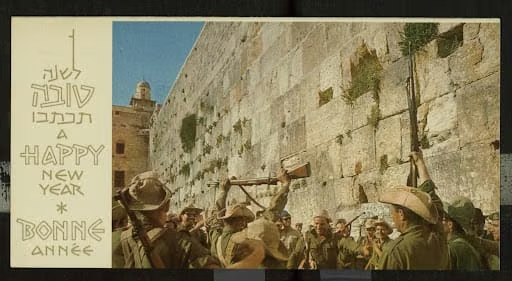
This shows how 1967 created “popular Zionism”’ amongst British Jews; a new form of identity expressed through social events, fundraising and tourism to Israel”. In other words, it showed the emergence of “something new rather than an inevitable part of Jewish identity, as Zionists had maintained”.
Finlay supplements this with survey data (and his own experience) to understand the changing nature of British Jewish engagement with Israel suggesting that the late sixties was an important moment of transition.
But uncritical, hegemonic, communal Zionism was short-lived. The massacre of Sabra and Shatila led to a wave of British Jewish protest and dissidence, most notably the establishment of a Peace Now group. And Oslo and the dissemination of the work of the new historians led to Palestinians being less feared and a wave of optimism among British Jews.
Attitudes hardened once again after 9/11 and the rise of Hamas but there was no return to the status quo ante.
As Finlay puts it, “popular Zionism had broken down, and younger generations, especially those who came of age after 2001 had not inherited the instinctive fears of annihilation and feelings of redemption that those who remembered the events of the late 1960s and 1970s had undergone”.
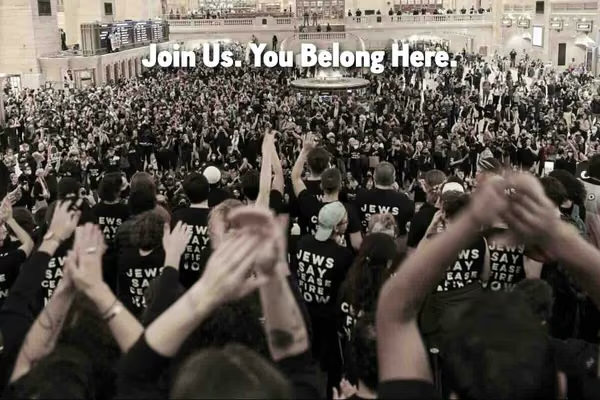
But again these voices don’t appear in oral history research. Looking at CST and JPR surveys, our major source of evidence as to British Jewish attitudes, it seems clear that British Jews are increasingly polarised between a non- or anti-Zionist left and a Kahanist right.
In such times Finlay finds it “unsurprising” that communal organisations aren’t seeking out evidence that contradicts their narrative of Zionism as an essential part of Jewish identity.
The essay ends with a call for a new Jewish history from below, one that would show “that Zionism and support for Israel does not emerge organically from Jewish identity but must be constantly produced and reproduced”, a history that would “interrogate the ways in which Zionism colonised the British Jewish community as well as colonising historic Palestine”.
RK
This article was originally published by Torat Albion on Thu 22 Jan 2026. Read the original here.
Studying UK Jewish entanglements with Israel from below
A greater focus on oral history would allow different narratives of British Jews’ relationships with Israel/Palestine to emerge
Loading article text…
Comments are now closed.