
Why British Jews are experiencing their biggest change in 60 years
JVL Introduction
It is interesting to see this BBC InDepth posting about conflicts within the Jewish community in Britain, recognising “shifts in discourse about Israel – including a generational divide that is starting to become apparent among British Jews”.
Don’t be put off by its focus on establishment Jews and attitudes at the start. Read on.
As Robert Cohen says on his Facebook page, it does “succeeds in capturing some of the diversity and nuance which exists across the Jewish community post 7 October and Gaza.” Though he regrets that “it doesn’t have much room to rehearse the actual debates among British Jews about the nature of all that’s happening in Gaza”.
It is good to see critical voices like Robert Cohen and Tash Hayman’s included, even if for Joseph Finlay it is “a bit basic – and I don’t buy the ‘biggest change’ framing – 1982, 1993, 2001 and 2014 were all significant changes too.”
For all its weaknesses, it is encouraging to see the reality clearly recognised: there is no monolithic “Jewish community” speaking with one voice on Israel and issues like “Jewish safety”, as the leading communal institutions still insist despite the overwhelming evidence to the contrary.
RK
This article was originally published by BBC InDepth on Sun 21 Dec 2025. Read the original here.
Why British Jews are experiencing their biggest change in 60 years
Loading article text…
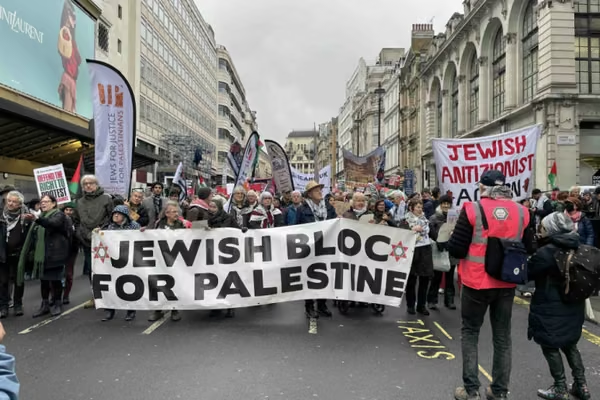

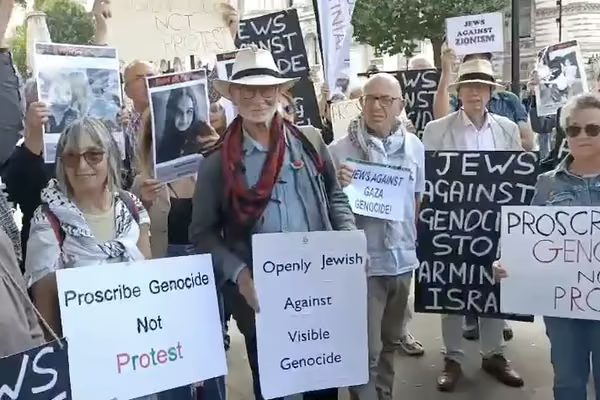
It’s often possible to find much better reporting on Israel/Palestine and related matters (like growing antisemitism – or not) on the BBC website than on radio or television. This is especially true when some of its reporters go into the West Bank and report the daily horrors there. However, in this case, though the authors did manage to talk to Robert Cohen – which was important – and one other clear critic of Israel, overall I was disappointed. It felt superficial, anecdotal, random, no recognition of new(ish) Jewish organisations, the Jewish bloc on demonstrations, the growing volume of Jewish commentary and writing in English (here, the US, Canada, Australia, the Israeli English language contribution to our understanding and thought (+972 Mag, Ha’aretz), the mix of political campaigning and reclaiming and reinterpretation of traditional religious tradition. And perhaps, most important, no addressing of the profound ideological divides amongst British Jews, and how the different ‘sides’ deal with them. Also, no mention of an international context – the vibrant Israel-critical Jewish movements around the world. I am not sure this article would mean very much to non-Jews – but hopefully it is the start of an implied acknowledgment as to how fanciful, actually misleading, is the BBC’s standard descriptor, ‘the Jewish community’.
I thought the BBC article ever so biased towards the establishments, of all sorts and in all ways. It is, consequently unbalanced; it is really misleading.
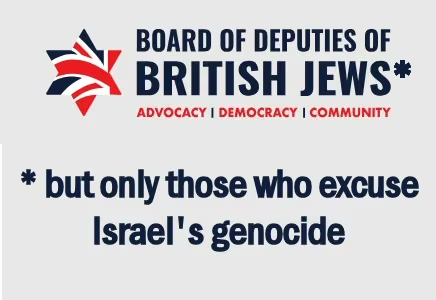
Never knowingly undersold Phil Rosenberg. “Master of the dark political arts “Lynton Crosby’s protégé Isaac Levido, Pope Francis. The connection? Levido founded Fleetwood Strategy, Rosenberg was Senior Director at Fleetwood Strategy. Birds of a feather. Pope Francis ‘openly urged for an investigation of genocide allegations over Israel’s actions in the Gaza Strip. (In September 2017), he said Israel’s attacks in Gaza and Lebanon have been “immoral” and disproportionate, and that its military has gone beyond the rules of war’ https://www.timesofisrael.com/pope-calls-for-probe-into-whether-israel-is-committing-genocide-in-gaza/ Rosenberg, PR man, bedecked his Linkedin page with a full colour photograph of himself and the Pope both beaming like the proverbial Cheshire Cat in an audience that Francis had with Mr Rosenberg. Of course out of a sense of common decency and ‘fair play’ I instantly flagged up to Rosenberg that his Linkedin page now had ‘bad optics’ as the PR peeps say. No acknowledgement. It took several weeks before I emailed The Board and the offending pic was taken down. No ‘Thank You’ from Rosenberg. I’m a Goy. It would be demeaning for him to acknowledge his debt to me. Which simply confirmed my opinion of him. As for the article on the Beeb web site, I have little or nothing to add to Naomi Wayne’s comprehensive Reply. I was surprised and underwhelmed to note that such an insignificant % of Jews (is it OK to use the word Jews? “Hail Mary, Mother of God…”) before and after 7 October/gen Z and wrinklies ticking the anti-Zionist box. This goes back to one of my bêtes noires… – Keir Starmer’s Holocaust Memorial speech pledging to ensure that ‘the Holocaust’ will be taught in every school in this Sceptic Isle. Fine and dandy. But only if accompanied by the teaching of how the Palestinians were shafted and robbed blind by the British
[cut to our limit of 300 words – admin]
I found reading the snippets of research interesting. The generational differences in opinions and attitude would seem to follow along with other generational differences among people of different backgrounds. “Others I spoke to, including Ben Dory, suggested that a generational split over views on Israel could be associated with young people having less of a direct connection with the Holocaust and a lack of awareness of its impact.” I would suggest that as younger people do not have a direct connection they do not have an emotional connection, but that does not mean they have less awareness. The Holocaust and the World War 11 history is taught in British Schools though I am unaware of the emphasis given and differences in how this is taught in Faith Schools. Family connection to an event must have an impact on how any person feels about that event. However the further away from an event a person is will lessen the impact, unless there is great focus, within their circle of influence, on the effects. Having seen, at a distance, several conflicts involving injuries and deaths over my lifetime it would seem that the so called “communities” on the edges divide and retreat into their individual “safe spaces” on fear of direct attack while some are brave enough to show their identity. Two fairly recent instances I can think of are a former neighbour I had known from her childhood who started to wear traditional Muslim attire after 9.11. and more recently a gentleman who after Oct.7. I saw several times at my local supermarket wearing a Kippa. I am unsure if these individuals were making a statement about their identity.” Look at me, I am****** you have known me before this happened.” or showing allegiance to some Ideal.
[cut to our limit of 300 words – admin]