
A not-so-unorthodox history of British Jews
JVL Introduction
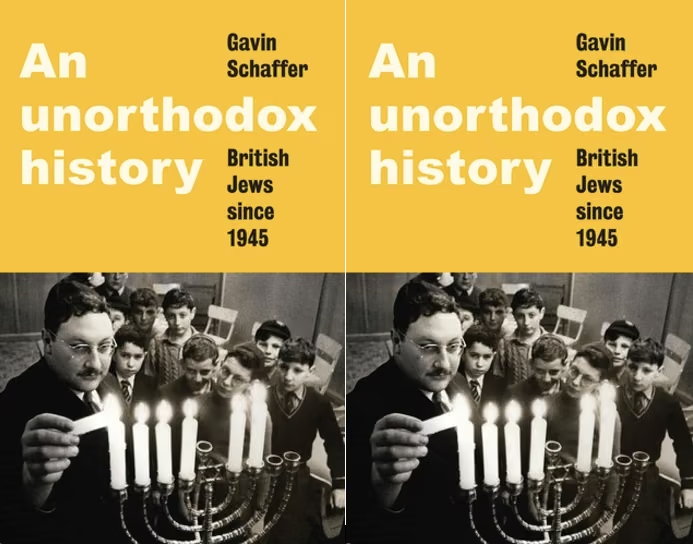
In his book An Unorthodox History, Gavin Schaffer argues against the common view that the British Jewish community is hidebound, conventional and decaying, focusing instead on diverse, heretical, “unorthodox” forms of being Jewish that have been developing since 1945 and have created a flourishing “fluid and vibrant community”.
At the same time he believes in the fundamental unity of the British Jewish community.
Deborah Maccoby, though she finds An Unorthodox History often engaging, is not convinced by this thesis.
Teasing apart his arguments which juggle with contradictory aspects, she queries how he deals with “Israel-critical Jews and the Zionist majority” and his conclusion that Zionism has largely “proved irresistible to British Jews”.
The large numbers who don’t identify as Zionist cannot be written off as marginal as Schaffer does.
Nor can a book published in 2025 virtually ignore October 7th and its aftermath, as this one manages to do.
A good alternative title to this book — as well as A Not-So-Unorthodox History – might be: Juggling While Gaza Burns.
RK
An Unorthodox History: British Jews Since 1945
Gavin Schaffer. Manchester University Press, 2025, pp. 196.
Reviewed by Deborah Maccoby
In his Introduction to this “unorthodox history”, Gavin Schaffer tells us “a story told to me by the historian Pam Fox, about criticism of her social history of Golders Green, condemned by one irritated reader for failing to mention her grandfather! (p.11) ” I would like to reassure Professor Schaffer that his book won’t get this reaction from me – because, though he doesn’t mention my grandfather, he does mention my great-grandfather! He was well-known in his day in the Jewish East End of London by the title of the Kamenitzer Maggid (after his birthplace in Kamenitz-Litovsk in White Russia, now Belarus), the first and only Maggid (preacher) of the Federation of Synagogues; his name was Chaim Zundel Maccoby. Citing Geoffrey Alderman’s history of the Federation, Schaffer writes:
Alderman has noted that the Orthodox luminary the Kamenitzer Maggid, who had come to Britain in 1890 and supported Jewish settlement in Palestine (but not the creation of a political state) regarded Theodor Herzl “as a false messiah and his movement as a threat to the preservation of Orthodox Jewish values”. (p.98)
Though I don’t share my great-grandfather’s Orthodoxy, it seems to me that subsequent events have proved him correct in describing Herzl “as a false messiah” (the Kamenitzer Maggid compared Herzl to Shabbatai Zvi, the false messiah of the 17th century).[1]
Schaffer’s central aim is to argue against the common view that the British Jewish community is hidebound, conventional and decaying. He barely mentions sclerotic communal organizations such as the Board of Deputies and the United Synagogue; instead, his book focuses, by means of stories about individuals, on diverse, heretical, “unorthodox” forms of being Jewish that have been developing since 1945 and have created at present a flourishing “fluid and vibrant community”. In his Introduction, he writes that “to me, British Jewry sprawls and thrives” (p.10); and in his Conclusion he writes of “the rude health of Jewish Britain” (p.194):
The dominant constructions of Jewish Britain as vulnerable, traditional and rigid need to be kept in their places…. When you bypass, at least to an extent, the communal centre, an unorthodox set of narratives come to the fore which capture a more fluid and vibrant community, changing in alignment with broader British values.
Yet at the same time, Schaffer insists in his Introduction on the fundamental unity of the British Jewish community:
this book argues that there remains value in seeing and understanding the Jewish community as a unitary whole, and that the different paths taken through post-war Britain do not diminish this case. (p.7)
Even while most chapters in this book are about “outsider experiences”, there are also chapters that emphasize this sense of a unified community – in particular Chapter 3, on political activism in relation to Israel during the first decades after the 1967 Six-Day War and in relation to the campaign to liberate Soviet Jewry. Even Chapter 2, which is about the battle between two outsider-but-growing religious Jewish communities, both separate from the mainstream United Synagogue – i.e. ultra-Orthodoxy and Progressive Judaism – ends by arguing that the Jewish community is not polarized between these different versions of Judaism; the community is fundamentally united:
beyond using each other as bogeymen and beyond very real divisions in thought and practice, this was, for the most part, a community that still recognized each other as family…. Indeed, one could argue that determined in-fighting itself pointed to the ultimate unity of the community. (p.70)
The book juggles contradictory elements – outsiders versus the unified community; a sense of a strong, secure community versus memories of the Holocaust and the perceived threat of antisemitism; looking inwards to the Jewish community versus looking outwards to wider British society and indeed “the international experience of living globally in the post-war world” (p.190). The penultimate chapter takes us outside Britain altogether, to examine the experiences of British Jews who – in Israel’s early years, when it was considered Socialist – in their youth abandoned bourgeois lives in the UK (often to the consternation of their parents) to join kibbutzim in Israel. Schaffer’s point here is that, even though these British Jews rejected Diaspora life in the UK by emigrating to Israel, they remained fundamentally British. In his first chapter, Schaffer argued that Jews are still embedded in Merthyr and are intrinsic to all parts of Britain; so, in his last chapter before the Conclusion, Schaffer is making the point that Britishness is intrinsic to British Jews, even when they leave Britain for Israel.
Schaffer’s juggling with contradictions works particularly well in Chapter 5, about gay and lesbian Jews and Chapter 6, about interfaith marriage and patrilineal Jews; in these chapters, Schaffer shows how the increasingly liberal and enlightened attitudes in wider British society have slowly influenced growing Jewish community acceptance of these outsider groups.
However, I find Schaffer’s approach more problematic when it comes to Chapter 7, about Jewish converts to Christianity who insist that they are still Jewish. Schaffer implicitly criticizes the “binary division” (p. 165) that many Jews make between Judaism and Christianity, and concludes this chapter:
In an increasingly secular society, where British Jews accept many kinds of diverse and divergent views, Messianic Judaism raises crucial questions. When does a Jew stop being a Jew? And who is in a position to judge? (p. 173)
One crucial question that Schaffer doesn’t raise in this chapter is: what is meant by “Messianic”? In Judaism, the Messiah is a human figure; in mainstream Christianity the Messiah is divine. Jews who believe that Jesus was the human Jewish Messiah are clearly still Jews; but, in my view, Jewish converts to Christianity who believe in the divinity of Jesus cannot be called Jews. The separation between human beings and God is essential to Judaism (as it is to Islam). Here it seems to me that Schaffer’s non-binary, non-judgmental juggling with contradictory concepts leads to confusion rather than to the creative tension and nuance that we find in other chapters of the book.
But Schaffer’s approach is most problematic in relation to Chapter 4, about “Israel-critical Jews and the Zionist majority”. By “Israel-critical” he means anti-Zionist and non-Zionist. But his historical account of the development of non-Zionist Jewish organisations does not go beyond the setting up of Jews for Justice for Palestinians in 2002 and of IJV in 2007.[2] Much of this brief chapter is devoted to tracing the origins of Jewish rejection of Zionism (this is the context in which he mentions my great-grandfather!) Schaffer does write vaguely: “For those Jews who take an Israel-critical stance, new communities and groups have offered space to thrive or at least to support each other”, but he does not go into detail; and his qualifying “or at least to support each other” seems to indicate a hidden disapproval of these “new communities and groups” (p.108). He concludes:
In the main, Zionism has proved irresistible to British Jews, notwithstanding any concerns they may have about Israeli policies or specific governments.(ibid.)
And he writes of the thinking of “Israel-critical” Jews that, while at one time, in the distant past, it was mainstream, “at present it is marginal” (ibid.). He puts forward no evidence to substantiate this claim of marginality – a claim that is contradicted by the evidence.
Schaffer never mentions an Institute of Jewish Policy and Research (JPR) survey report, dated February 2024, a year before the publication of his book in February 2025 and providing results for a survey taken in 2022 (thus, before October 7, 2023). To quote from this survey:
63% of respondents self-identified as Zionist. To contextualise this figure, the last time UK Jews were asked this question, in 2010, 72% self-described as Zionist. (p.88) [3]
A figure of 37 per cent of British Jews who rejected the label of Zionist in 2022 (these are divided into anti-Zionists, non-Zionists and those who are unsure whether they are Zionists or not because – understandably — they are not sure what the term means) cannot be called “marginal”. And a fall in the percentage of those identifying as Zionist from 72 to 63 belies the contention that “in the main, Zionism has proved irresistible to British Jews”.
JPR has published an even more recent report, dated November 2024, which provides results for a survey taken after October 7, 2023. This report would have been too late to be mentioned in Schaffer’s book, but is still highly relevant to it. The report sums up its findings on page 25. There is a slight rise in the percentage of British Jews identifying as Zionist: from 63 per cent to 65 per cent. Yet at the same time the percentage of Jews identifying as anti-Zionist and non-Zionist has also slightly increased (the percentage of anti-Zionists has grown from 8 per cent to 10 per cent, while that of non-Zionists has grown from 15 per cent to 18 per cent). But there is a significant drop – from 14 per cent to just 7 per cent — in those unsure whether they are Zionists or not. The conclusion reached by the report is:
The implication appears to be that views on this issue have crystallised somewhat in the year since the October 7 attacks; there is less uncertainty, and it is distinctly possible that those who were previously unsure are more likely to have moved in a non- or anti-Zionist direction than a Zionist one…. Based on this indicator, it may be that the October 7 attacks and war in Gaza have been something of a clarifying experience for British Jews, and we are seeing signs of greater polarisation among them as a result – movement both in a more Zionist and in a non- or anti-Zionist direction. (p.25) [4]
Even though the figure of 35 per cent of British Jews at present not identifying as Zionist is slightly lower than the 37 per cent of 2022, 35 per cent is still a substantial minority; it is not “marginal”.
But the most remarkable finding of the 2024 survey is a considerable drop in the number of young British Jews identifying as Zionist. In the 2022 survey, the percentage of those self-identifying as Zionists among 20-29-year-olds was 57 per cent (p. 91) – the lowest percentage of any other age group. But in the survey conducted after October 7 and its aftermath, the number of 16-29-year-old British Jews identifying as Zionist is only 49 per cent (p. 27) – meaning that an actual majority– 51 per cent — of British Jews in this age group now do not identify as Zionists.[5]
As stated above, the author of the second JPR report writes: “it may be that the October 7 attacks and war in Gaza have been something of a clarifying experience for British Jews”. This is not the case in relation to Schaffer. It is not merely that he fails to bring clarity to the issue; he almost completely leaves it out. His hidden sympathies on this topic appear to be with the organized Jewish community; but to discuss October 7 and the Gaza genocide would mean he would have to take some kind of definite stand, which would interfere with his non-binary, non-judgmental, boundary-blurring juggling act and also with his insistence on the fundamental unity of the Jewish community. His only reference to the catastrophe occurs in the Conclusion and is in parentheses where he writes):
At the Campaign Against Antisemitism’s London march in November 2023 (held in the context of the war in Israel and Palestine), the prominent attendance of a ‘huge number’ of non-Jews was widely noted. (p.195)
To Schaffer, this “tells a story about the intermingling of Jewish activism and British multiculturalism more broadly” (ibid.). He makes no mention of the huge London protest marches in solidarity with Gaza that have taken place since 2008-2009 and that have always featured a Jewish bloc, marching together with groups of British people of all faiths and none. Nowadays there are large pro-Gaza marches every week not only in London but all over the UK and always featuring a Jewish bloc. Instead, Schaffer mentions only a march organised in November 2023, after the beginning of Israel’s genocide in Gaza, by a far-right Zionist group that has since 2014 exploited the serious issue of antisemitism in order to deflect attention from Israel’s atrocities against the Palestinians. This is not to deny that there is a genuine rise in antisemitism whenever Israel attacks Gaza; but Schaffer seems unable to see that the rise in antisemitism is fuelled by Israeli atrocities. He also himself, on the next page, points out the “contradiction in British Jewry in contemporary Britain; a safe and successful community dogged by the persistent feeling that it is unsafe and at risk”.
It may be argued that the book is about British Jews, not about Israel; but three of the book’s eight chapters (i.e., almost half the book) are about Israel and Zionism. Also, it may be argued that the book is a history; but its main aim is to show that the present-day Jewish community is “fluid and vibrant”. The book often doesn’t seem quite sure whether it is a nostalgic history or a celebration of present-day “fluid and vibrant” Jewish life; the aim is clearly that it is both, tracing the history of current “unorthodox” aspects of British Jewish society; but the two elements often sit uneasily together.
To try to conclude; To an extent, the book succeeds in its main aim of portraying a flourishing “fluid and vibrant community”. And An Unorthodox History is often an engaging history, told by means of individual stories, in which many British Jews will find resonances with their own personal and family memories (even if they don’t find specific mentions of their grandfathers or great-grandfathers!) But Schaffer’s non-judgmental, non-binary, boundary-blurring approach can at times be very irritating, because of its lack of clarity. One thing that is clear, however, is that Schaffer’s history is not as “unorthodox” as he makes it out to be. There is an appallingly gaping hole at the centre of the book: a virtually unmentioned elephant in the room. It is breathtaking that a book published in 2025 on the subjects Schaffer is writing about makes virtually no mention of October 7 and its aftermath: the still ongoing genocide in Gaza.
Endnotes
[1] The first chapter of the book, entitled “The Last Jew of Merthyr” also resonated with me personally. Schaffer writes here of the South Wales town of Merthyr Tydfil, to which his own great-grandfather emigrated at the turn of the century, becoming a door-to-door salesman there. My mother’s grandfather, who was a Russian-Jewish immigrant, set up a rag and bone business in Swansea, in South Wales, and later a scrap metal business in nearby Llanelli (where I was born). Schaffer points out (p. 23) that the disbanding of these small communities is actually a sign of Jewish success – Jewish families have moved to the affluent centres of London or Manchester. And Schaffer tells a story (p. 24) of a brother and sister, children of a Welsch-Jewish father and a non-Jewish Welsh mother, who still live in Merthyr and regard themselves as Jewish; his point is that Jews are still embedded in Merthyr and all over the UK. Another of Schaffer’s stories that resonates with me concerns the Jewish community of Sunderland, where my father was born and grew up. He told me that his family, though long-established in Sunderland, always felt like outsiders in the Jewish community, because most of the families in that community had emigrated en masse from one town in Lithuania. Schaffer (p. 81) identifies this town as Kaunas and points out that the Sunderland Jewish community, during the campaign to liberate Soviet Jewry, adopted the refusenik Jews of Kaunas.
[2] Another problem I have with Schaffer’s analysis in this chapter is his claim that a main reason for the setting up of JfJfP and IJV was that, while “sometimes the evolution of Jewish identities within broader counter-cultural struggles against racism, capitalism and colonialism led to non- or anti- Zionist Jewish politics” (p. 99), Jews often felt threatened by antisemitism in the non-Jewish movements they had joined and so sought out a “safe space” where they could feel secure among other Jews: “post-war Israel-critical British Jews fought their case under a specifically Jewish banner because non-Jewish Israel-critical groups have not always felt like a comfortable space for Jewish people to be” (p. 104). Schaffer quotes from various Jewish activists who expressed concerns about the position taken by the feminist magazine Spare Rib in the 1980s; and he also cites the debate about Jim Allen’s play Perdition (pp. 104-106); but nowhere does he provide any evidence that the need to be in a “safe space” with other Jews was a reason for the setting up of JfJfP or IJV. He cites (p. 100) a letter from Irene Bruegel in the JC about the founding of JfJfP that makes no mention of this as a reason; she writes that the idea of JfJfP was conceived after a visit to the West Bank. (Personally, I have always found non-Jewish groups much more restful than Jewish groups, whose main cultural characteristic is constant argument!) In my recollection, a central reason for the setting up of these groups “under a specifically Jewish banner” was the need to counter the claim of the Board of Deputies and the Israeli Embassy that the whole Jewish community supported Israel’s policies, by giving a voice to Jews who opposed them (the same letters page that includes Irene Brueghel’s letter also includes letters about an imminent Israel Solidarity Rally, organised by the BoD and the Israeli Embassy, with the aim of giving the impression the whole Jewish community supported Ariel Sharon).
[3] David Graham and Jonathan Boyd, Jews in the UK today: Key findings from the JPR National Jewish Identity Survey, Institute for Jewish Policy Research (JPR), Feb 2024
[4] Jonathan Boyd, A year after October 7: British Jewish views on Israel, antisemitism and Jewish life, Institute for Jewish Policy Research (JPR), Oct 2024
[5] The author of the second report, Dr Jonathan Boyd, tries to downplay this finding by pointing to the number of Haredi (ultra-Orthodox) Jews in this age-group; he writes (p. 26) that Haredi young people reject Zionism “largely for theological reasons rather than political”. But even if we factor in the Haredi young people and the addition of the 16-20 age group, the large drop in such a short time in the percentage of those identifying as Zionist surely does indicate a link with the genocide in Gaza. Moreover, the phenomenon of Jewish young people turning away from Zionism is regarded by the organized Jewish community as so concerning that there are currently two articles on the subject on the JC’s website:
Karen Glaser, ‘I can’t discuss Israel with my anti-Zionist kids – it’s pointless.’, Jewish Chronicle, 9th Apr 2025
Who are the young Jews turning against Israel?, Jewish Chronicle, 10th Apr 2025
See also Robert Cohen, Jewish Journeys from Zionism on his PhD thesis on Gen Z

I am mystified why there is no reference to the 2015 Report ‘The Attitudes
of British Jews’ Towards Israel’ https://tinyurl.com/3zu3ebzf conducted by the Dept of Sociology at City University
It found that although 59% of British Jews identified as Zionists, 31% didn’t identify as Zionists and 10% who did not. This is in line with the above figures though this suggests if we add the 10% who didn’t know that the number not identifying with Zionism was nearly 4 in 10 British Jews.
What all of these figures mean is that the Board of Deputies, with its Zionism right or wrong policies, is far more overtly Zionist than the average Jew. The bourgeois leaders of British Jewry are far more Zionist than those they purport to represent.
This is not surprising since the Board represents synagogue going Jews not secular Jews.
The reason I didn’t mention the 2015 report (which wasn’t a JPR report; it was City University) was that it was ten years ago, whereas the two JPR reports are very recent. I thought it was best to stick to topical JPR reports.
To expand a bit on my reply to Tony: In footnote 22 on page 25 of the second JPR survey report, Boyd comments on the City University finding in 2015, in relation to the JPR finding of a higher number of Zionists in 2022, with the suggestion that levels “may be fluctuating over time” rather than going in the “direction of travel” of fewer British Jews identifying as Zionists. I felt that mention of the City report, as well as bringing in a report ten years old, would raise the complicated issue of why the number of Zionists has increased in the 2022 JPR report; and my discussion of the two JPR reports was already complicated enough. Note too that Boyd points out that “methodological differences between different studies make comparisons complex”.
It will be interesting to see the forthcoming JPR report mentioned in this footnote:
“In our recent study of British identity – the 2022 National Jewish Identity Survey – we noted that fewer British Jews (63%) identified in this way in 2022 than did so when we measured it a decade or so earlier (72%). Although very few comparable data points exist to assess this, it is reasonable to assume that this has been the direction of travel.22
Footnote 22: That said, a 2015 study found that 59% of British Jews self-identified as a Zionist at that time, so levels may be fluctuating over time. See: Miller, S., Harris, M. and Shindler, C. (2015). The attitudes of British Jews towards Israel. City University London. Note that methodological differences between different studies make comparisons complex, and a forthcoming JPR report on British Jewish attitudes to Israel will provide a more robust assessment of change over time. “