
Jewish Journeys from Zionism (18) Sarah Frankel
When I visited Perth on a family visit earlier this year I met an embattled but determined group of Australian Jewish pro-Palestinian rights activists. Among them was Sarah and she recounted the internal struggle she had experienced to shed her inherited support for Israel.
It is a pleasure to read an extended account of how she forced herself to learn that what she believed was wrong. Sarah describes with insight her progress: from unquestioned family support for Israel; to curiosity about the possibilities of alternative narratives; to increasingly critical support for Israel; to questioning the whole legitimacy of ethno-states; to reach identification as anti-Zionist
This honest account shows that all Jews can move from Zionism if they, like Sarah, are prepared to do the hard and painful work and open their minds to the possibility they have been wrong.
Thanks, as always to Kitty Warnock who has produced this account from a zoom conversation.
MC
Interviewed by Kitty Warnock via Zoom at home in Perth, Australia
My name is Sarah Frankel, and I’m 36.
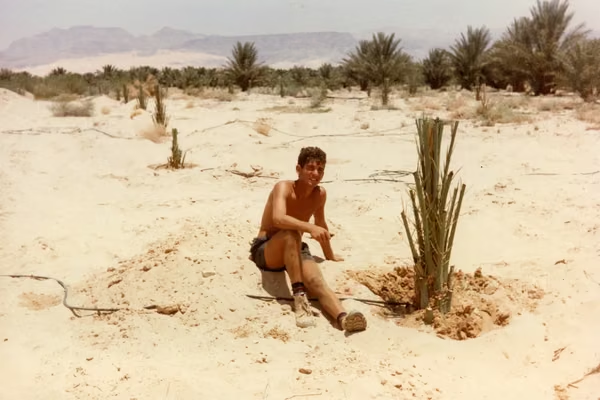
My family are Ashkenazi Jewish. They came from Eastern Europe, via South Africa and Zimbabwe to Australia, where I was born. My maternal grandfather published – just for the family – an autobiography, in 1988, the year I was born. He was born in Latvia and he was part of a Zionist group there from 1921. He moved with his family to South Africa, then when Israel was founded he went there, to join the army and help settle the land: he joined a Moshav. He eventually went back to South Africa, but soon moved to Zimbabwe because he didn’t want to live in an apartheid state!
Index of all the personal stories
Support for Israel was unquestioned in the family when I was growing up. The only person who could argue with my grandfather was my uncle, one of my mum’s older brothers, who had been born in Israel and served in the Israeli army. When they argued about Israel at the dinner table, I never paid much attention, never really understood. I guess I thought, ‘They’re the only two people qualified to have that discussion; they’ve both lived there and experienced it. If they want to have an opinion, then absolutely, they can have an opinion.’
I went to a Jewish primary school, which I see now was quite a conservative orthodox school. It raised me to love Israel and celebrate its Independence Day, and all of that. There was no reason to question any of it at all.
My father was quite religious, but he died when I was five. When I was a child we went to Shul, we had Bar and Bat Mitzvahs, we did Shabbat – not particularly strictly – and High Holy Days, but we were not Kosher. Judaism is an ethno-religion, and we’re probably more the ethno- part than the religious!
I didn’t go to the Jewish High School in Perth, so I was less surrounded by the automatic pro-Israel culture than before, but I still had a certain defensiveness – “You don’t really understand” – and I didn’t listen much to anything anyone else had to say. No one really said anything anyway.
I went to Habonim a couple of times and to one camp, when I was 11 or 12. My mum had been in it, and other members of the family. But I’m not a particularly social person, and I hated some of the activities they did – very messy, like throwing food at each other. I wasn’t into it. Not for ideological reasons, but it just wasn’t for me.
I’ve never been to Israel, and never particularly wanted to go. My mum had been, and she used to urge me to go – just to experience being in a place where Jews are the majority, because that’s such a strange experience, and valuable. But I never had any interest. But I did feel a sense of Israel being my country, of having an umbilical cord tying me to that land. ‘This is where my people are, this is Us in some sense.’ It’s only very recently that I’ve been able to talk about Israel without using the word “We”.
Informing myself
When I got to university I was aware of a few things, like people saying groups who were banning Israeli flags in their marches were being antisemitic. I didn’t really question that. But I wasn’t in any political groups where this was being discussed. My friends were generally very left-wing, and I’m queer so I’ve got lots of queer friends, but Israel-Palestine didn’t come up much. I never debated with anyone about it. My progress has been a very internal thing, until recently.
At some point, I became a little bit curious about what the other side was saying. I felt, ‘Somehow Hamas has won the PR war: everyone believes what they say. But is it true?’ I had been taught that Hamas (or whichever group it was at the time) had managed to convince the media and the internet to believe their lies about what was happening in Israel, so you couldn’t trust anything you heard about people being killed etc. Looking back, I don’t think anything was really being promoted in a particularly pro-Palestine way; I think this was just my over-reaction: ‘They said this many people died, but we don’t really know that.’
We have a TV current affairs programme called Q&A, which invites politicians and so on and people in the audience ask them questions. I remember seeing a pro-Palestinian journalist, and I started following her on Twitter, because I was curious. I wanted to understand the pro-Palestinians’ arguments so that I could argue with them – and understand my fellow human beings better, I guess. She posted about what Israel was doing to Palestinians – and I bristled at half of it! Eventually it reached a point where I thought, ‘Why don’t I get more information from a neutral source? A trustworthy neutral source.’ I trusted myself to be able to tell if what I was reading was reliable or if it seemed questionable, and with that in mind I went to the website of the Red Cross, and started looking at their reports about what had been happening. All the things said on this side, all the things said on that side, I wanted to look at them properly and do a critical evaluation.
That was a very difficult few weeks for me! Really difficult. These things I was reading validated what people were saying, and I realised: ‘OK, maybe Israel isn’t the good guy, maybe…… bad things are happening to Palestinians, they’re not being treated well.’ There were reports about uprisings and protests, and excessive force being used to quell them – that’s my main memory. And I thought, ‘That’s not right, that’s not a good thing to be doing.’ So it was a few weeks of adjusting my world-view. I talked to my mother about it as well. It was very difficult. It is very hard to overturn the way you’ve been thinking about things, and realise that what you’ve been told is not accurate. It was a very hard period of time until I of adjusted to that way of thinking.
A long half-way stage
Then for many years, until the recent events, my world-view was pretty stable. It was, ‘OK, the Israeli government is doing bad things (I had learned about Jewish people from the Middle East being involuntarily sterilised and stuff like that), it is an imperfect country, it is a racist country, it is doing things it shouldn’t be , but … but the situation is still more complicated than people are making it out to be.’ I didn’t really get into arguments – for a lawyer, I’m kind of conflict-averse! If I did, I would just have argued “It’s too complicated, you don’t understand.”
I would still bristle at calling it colonialism, for example. I would say, “It’s not really! Israel has more right to exist as a country than Australia does, or the USA. Those are proper colonialism – white people going out and conquering native people just for the sake of expansion.” Israel felt more complicated because the Jewish people are native to Israel as well, so it’s more like a tribal conflict. The two tribes have always been against each other, but both have equal claim to the area. One side is much more powerful, so it’s winning and doing bad things it shouldn’t be doing to the other side; that’s very unfortunate. I really didn’t like the word Zionism being used as a pejorative.
Another idea I held was, ‘Jews didn’t ask to be put there. After the Holocaust no one wanted us, and so the UK decided that we should go there. It’s not our fault, it’s just how history happened.’ I guess I was thinking, ‘It’s good for the Jews to have a homeland, but it doesn’t necessarily have to be in Palestine. Don’t treat it as a colonialist ideology, because it doesn’t have to be there, it doesn’t have to involve displacing people, it could just be having a homeland somewhere where everything’s fine.’ I remember explaining this to some friends: “Israel doesn’t have to exist where it is, but obviously Jews should have some safe place to go.”
I didn’t understand what it was like to live in the West Bank or Gaza, the status of the people living there. I thought it was almost like two countries: I didn’t understand why people were so worried about recognising the place where Palestinians were living as a Palestinian country, because to me it seemed like what was already happening.
A clearer picture
I got to a point in my head where I was prepared to accept statements from pro-Palestinian groups without having to interrogate them much. I don’t read a lot of books: the problem with me and books is that if I start reading I don’t stop and I don’t do anything else, so I have to ration them. But when I see essays on line I try to read them. There’s a blogger I follow, Raphael Mimoun[i], a French-American Jewish guy. He is good at persuading people about what’s going on, because he’s Jewish, he has lived in Israel, he has seen things at first hand.
In particular, I remember reading some tweets of his about the colonialist language being used during the founding of Israel. What happened was very very intentional, not, as I’d previously thought, just going along with what the UK decided. He showed with excerpts from writing by those directly involved in the founding of Israel, that without any doubt whatsoever it was intentional lobbying on the part of the Zionists to have this happen and to position it as colonialism, which was acceptable back then …. That was news to me.
Another article that made a huge crack in my armour, if we can call it that, was about how even if you do have two native groups in an area, it’s still a form of colonialism if one of them is collaborating with the white colonisers and is being put in a position of power. It used Nigeria and Sri Lanka as examples of places where there is ethnic conflict between people in the same country and one of the groups is put above the other by an outside power. That was so close to how I was seeing things that it made me rethink how to think about this.
I don’t know exactly what it was that made me see it, but I kind of had a revelation: ‘Wait a second, nationalism is bad, ethno-states are bad!’ The concept of a state which gives more rights to people of a certain ethnicity over other people who are citizens there – in any other context that goes against everything that I believe in, my own moral code. I realised: even though bad things have happened to Jews in the past, and yes, it’s very comforting to have a safety net, it’s a lovely dream to have a place you could go if you need to – but we don’t get to have it just because it’s nice. It isn’t a good thing, maybe we can’t have it. I’m getting emotional thinking about it now, it’s such a painful thing to say: this wonderful dream that I’ve been sold my whole life, actually no, nobody deserves that, nobody deserves to take away someone else’s place to make their own place and raise themselves above other kinds of people living there.
Until then, part of my thinking had been, ‘Well, it’s happened, it’s the same as Australia.’ I am talking to you from stolen land, the land of the Whadjuk people of the Noongar Nation. It is their land, which has never been ceded. If you live on stolen land you say, ‘Oh well, it’s already done.’ On a practical level, the colonialist nation of Australia is not going to dismantle itself to give the land back. But what I hadn’t appreciated at all is the way in which Israel is worse than Australia. Yes, indigenous people in Australia have a lot of problems, we don’t treat them very well, they have massive incarceration rates, lots of social problems due to their history of trauma and lack of investment by successive governments in supporting them, but at the very least they are full citizens. At least in theory they have the same rights as I do. The law says you can’t discriminate, the same law applies to everybody. I hadn’t realised that Palestinian people in the West Bank don’t have the same rights as an Israeli citizen also living in the West Bank. That’s a very big difference; that’s the reason they call Israel an apartheid state.
This has been a very painful process, tearing at the umbilical cord, like extracting my own sense of identity out of Israel, despite my never having even been there. It’s obviously an ongoing process but I have got to the point now that I’m comfortable saying and hearing, “This is old-school colonialism dressed up.” I don’t react, “No, that can’t possibly be right, it must be something else.”
I don’t think I could be in a relationship with someone who didn’t share my view. My partner shares my views, which helps. I am finding it increasingly stressful to deal at all with the people in my life who are pro-Israel, because there are gaping differences in the way we see the world.
Since October 7th 2023 – seeking dialogue
Since October 7th has been a very emotionally difficult time. I’ve been reading more, understanding more, and once again changing my whole view. But I’m more about doing something rather than reading. One of my colleagues is a strong socialist, very involved in socialist activism, and he’s been involved in the pro-Palestine movement, so I was aware from him that if I wanted to be more involved, that was there.
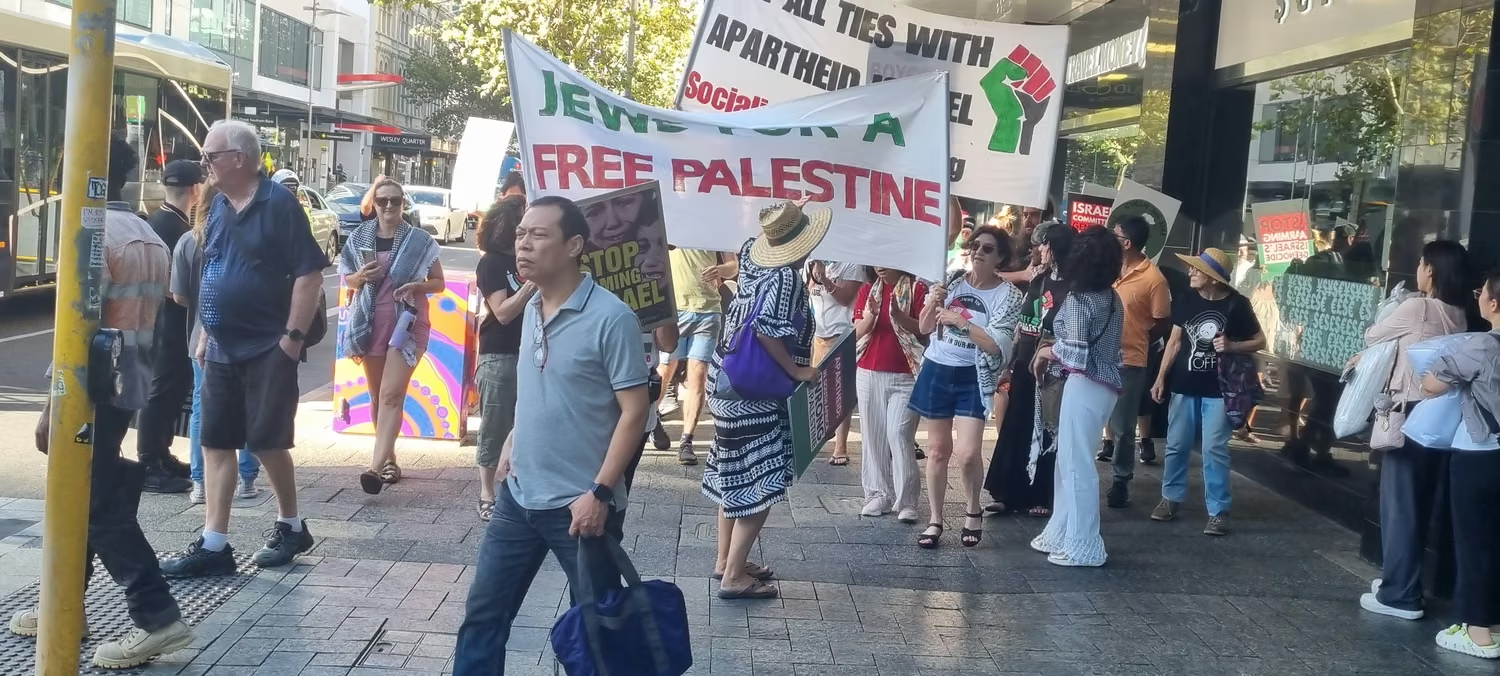
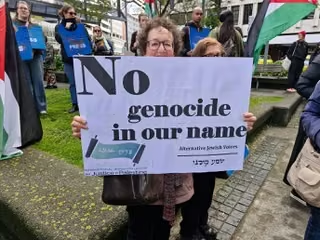
I went to a couple of protests on my own. It’s striking that I still felt uncomfortable, even though intellectually I knew, “No one here is antisemitic, everyone here is just trying to do good for other people and I am welcome here, and it is just fine.” But I still had a sense of discomfort. Then I got in touch with a “Jews for Palestine” group which has been set up in Perth, and joining the protests now, in a loudly-identifying group of Jews for Palestine, is easier. But even now, the old programming is so strong, I still get twinges.
The Jews for Palestine group is still small. The Jewish population in Australia is very conservative. I don’t think we have the tradition that exists in America and I think also in the UK, of leftist, socialist Jews – certainly not here in the west, in Perth. It’s a very orthodox community here, with a lot of people who came from South Africa. But I’m interested in trying to reach out, to talk to people. In Jews for Palestine, we’re trying to put together some sort of online meeting for members of the Jewish community in Australia who are curious. To most jews in Australia it’s a contradiction, an oxymoron, to be a pro-Palestinian Jew. How can this exist? It can’t happen. So we are framing it as, “Hey, we are this thing which you think is impossible. Come and hear us explain ourselves.”
I just want to open some sort of dialogue. I think there is a lot of room for it. What surprises me still is the concept people have that you can’t criticise Israel, even if you are just thinking on the level of ‘Is what the government is doing good or not?’ You can’t even criticise what a very right-wing, extremist government is doing – that’s weird! In any other country, people understand that criticising what their government is doing is not criticising the whole country or the people in it; when you criticise what Russia is doing in Ukraine people understand you’re not talking badly about the average person in the street in Russia, they know you are talking about Putin. But for the Jewish community in Australia that’s not the case with Israel. I don’t think it’s that they are scared, I think it just doesn’t occur to them. Jewish people wouldn’t do anything terrible because they’re Jewish and we’re good people, so obviously a Jewish government can’t be doing something terrible. The feeling is, ‘There must be a justification for it.’ Or what’s happening is not as bad as people say, or “We’re very sorry people are dying, but we need our safe place.” I used to think like that myself: I didn’t pay attention to which government was in power, which party, it was all just Israel.
I’ve always had a very strong sense of identity as a Jewish person, and maybe even more so, more loudly, at this point. I’ve never been religious, not since I was old enough to question the concept of God, but I don’t think that’s important to being Jewish. The difficult bit has been unpicking my Jewish identity from Israel. I suppose I’d call myself an antizionist, but I don’t think there are enough of us here to infight about the exact terminology. That would be a good problem to have. I’m not that fussed about labels. I don’t think the current state of Israel in its current form which privileges Jews (i.e. the right of return) should exist, and I hope that there can be a country where everyone manages to live in harmony, where everyone is treated equally.
However: I have met many white South Africans who are genuinely terrified of black South Africans and living in the same country as them. It’s been decades since the end of apartheid and they still feel that, and when I look at Jewish Israelis I see a far more extreme version. I worry a lot about what it would look like to try and dismantle the colonialism of the current Israeli state. I can’t see how it can happen, I can’t see Israeli Jews tolerating it. It is the only moral thing to do, but it is going to be ugly.
[1] Raphael Mimoun is a French-American Jewish blogger and human rights activist (www.onesmalldetail.blog)
The original Mandate for Palestine encompassed what is today Israel, the disputed West Bank territories, and a substantial part of Jordan. Most of that territory had already been given to Jordan. Secondly, the permission for Jewish settlement in the British Mandate was directly contingent on not undermining the rights of the non-Jewish populations there. But the British Empire actually undermined Jewish rights of settlement during the 30’s and 40’s– something that David Ben Gurion furiously opposed. Thirdly, the Arabs intended on having a state with a capital in Damascus, stretching throughout the Levant and down to Arabia. The concept of a national identity in Palestine was non-existent in Ben Gurion’s time and only began solidifying in the 60’s. Arabs then were part of Syria, and part of the Arab Revolt during World War One was to establish that people following the collapse of the Ottoman Turk Empire.
Very interesting story. Thanks
Re Debs’s comment on the British Empire’s support for Jewish settlement in Palestine in the 1930s, it was more nuanced – on and off if you will – than that. But what was decisive was the British defeat, with Zionist support, of the Palestinian revolt, 1936-39.
Palestinian national consciousness developed in the1920s and opposed Palestinian organizations Zionist settlements. Her use of the label ‘Arabs’ is unfortunate.
Please elaborate Paul Smith.
I don’t know where to start except to argue that Maxime Rodinson’s book, Israel: A Colonial Settler State’ is the book to which I return time and again.
His optimistic afterword was undermined by Israeli Labour governments in the aftermath of the 1967 war.