
Jewish Journeys from Zionism (14) – Felicity Laurence
JVL Introduction
This is the 14th in the Jewish Journeys from Zionism series and, like the others, makes for fascinating reading. Felicity was born in New Zealand and spent time living in Germany and elsewhere. Her work as a musician and her work with children’s choirs has taken her into Israel and the West Bank and she has published, for example of involving music and empathy and music and solidarity.
Once again our huge thanks to Kitty Warnock who took on this task as a volunteer at the beginning of the year.
Index of all the personal stories
LL
___________________________________
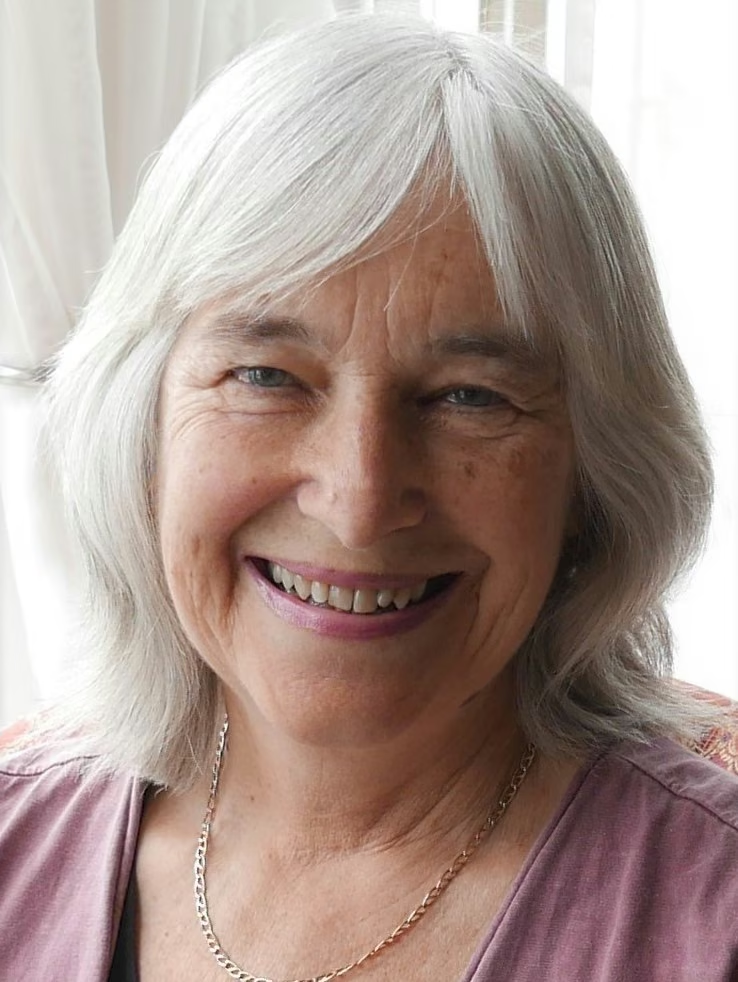
My name is Felicity Laurence, and I’m 77.
My father was from an Orthodox Jewish family. His father was born in the Old City of Jerusalem, but he went to New Zealand as a young man to become rabbi for the small Jewish community in Auckland. His mother had come from Lithuania to Newcastle as a baby in the 1890s, and went to New Zealand to marry my grandfather. It was expected that my father would become a rabbi as well, but I think he was already slipping away from Judaism in the 1930s, and after three years in the war and then being invalided out, he had lost what interest might have remained. He rejected the faith and to some extent his family too. He married out, which caused consternation for both sets of parents: they were reconciled to the marriage when I arrived soon after the war, the first of six children. My mother was from a strongly protestant family; we were brought up bit Christian but agnostic, really.
My father still felt very Jewish, and he suffered a lot from antisemitism, which was woven through the fabric of society in New Zealand in the 1930s and 40s, as it was in the UK. He was a medic, and he felt he didn’t get the promotions he should have, because of antisemitism. He still had deep links with his family, though he was estranged from them: when his brother died decades later he went and said Kaddish. I think he felt quite conflicted.
My mother learned about the Holocaust immediately after the war, and though she wasn’t Jewish she became more anti-German than my father. They hung out with Jewish emigres who had gone over to New Zealand after the Holocaust, and my mother belonged to Friends of Israel groups and so on. The house was very pro-Israel, and there was never any discussion of what had actually happened to create the state.
I was very aware of having a Jewish identity. I knew about the Holocaust from a young age: that children just a wee bit older than me had perished only a few years before I was born. I read the first book in English on the Holocaust, The Scourge of the Swastika[i], soon after it came out – it included eyewitness accounts – and I absorbed Anne Frank’s diary, as many children did. I very much identified with her. I certainly bought into the idea that the Jewish people needed somewhere safe to be. And I still feel that, that’s not really in dispute: what’s in dispute is how that was managed, what went on around it, that I now know so much more about.
The first jolts to my thinking
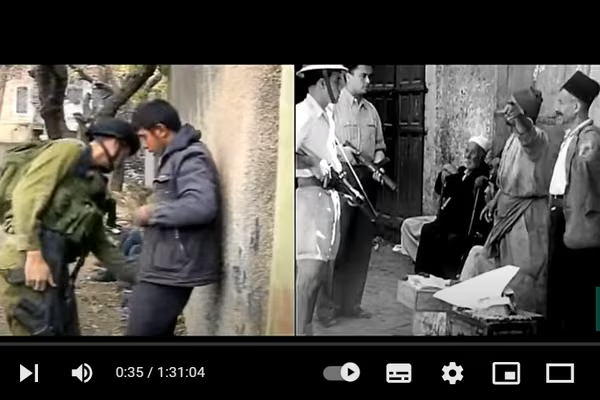
In the 1967 war, I just felt, ‘Thank goodness the Israelis prevailed.’ I didn’t have any awareness of what was really going on. I think the first inkling I had that Israel wasn’t what it said on the tin was in 1988 during the first intifada, when I saw a film on television of Israeli soldiers deliberately breaking the fingers of young Palestinian men, while somebody filmed it. I couldn’t believe it, it was so dissonant with what I thought I knew. In all the publicity about that bit of film, I saw a man saying in an interview, “I would rather be hated in Israel than murdered in Auschwitz”. That really stayed with me. It was a jolt to my consciousness – but I didn’t make it my business then to find out more. I didn’t understand why this was happening, I just knew that something was out of kilter and horrendous. I coped by thinking it was an aberration, one bad egg. I only found out last year that breaking bones of young Palestinian protesters was an express order from Yitzak Rabin in that first intifada.
My next step towards awareness came in Israel, around 1991. I’m a music educator, composer and specialist in children’s choirs, and I was invited to Israel to teach children and their teachers at the Jerusalem Music Centre[ii]. I’d been there several days before I realised there were no Palestinian children. I asked my students – sweet ten-year-olds – “Why are there no Palestinian children here?” and they looked at me as if I was bonkers. “That’s impossible! Of course not!” That was my introduction to apartheid, though I didn’t see it that way at the time.
I was already a peace activist; I had done lots of peace-oriented work in South Africa and other places, and a lot of my songs were what I call “ethical propaganda”, about peace. I would often set children’s texts – and children of about ten always talk about wanting peace. (Whether that is still the case in Israel, I would hesitate to guess.) One lovely girl wrote a poem about wanting peace, and asked me to set it to music, which I did. But what she said to me was, “We want peace, but the other side don’t.”
I went to Israel several times, and soon decided that I wouldn’t continue unless I could teach Palestinian children as well as Jewish. I made it my business to find out about Palestinian choirs, of which there were a few in the Old City. I have the idea of “levels of knowing; I was going up a little in knowing, step by step.
Germany facing up to the Holocaust
At this time, in the 1990s, my husband and I and our two young daughters were living in Germany; he and I were working in a music conservatory. It was soon after the fall of the Berlin Wall, and the German people were learning anew – some for the first time, and in any case, much more – about what had happened during the war. So many people my age had little real idea of what had happened, or the enormity of it. Everything came bubbling up in the eight years we were there, stories coming up the whole time about what had happened to Jewish people, and others. I couldn’t pick up a newspaper – whether local or national – in that entire time, without seeing some allusion to the Holocaust. We discovered that there had been a small concentration camp just down the road from where we lived, where Jews and others were held before being deported to the death camps. I was very caught up in all that, and it made me very aware of my Jewish identity – because I knew what my fate would have been, and my children’s, and my husband’s, as he is also half Jewish.
The first Holocaust Memorial Day was announced in Germany in1996, and every institution was supposed to mark the day, in our case with a concert. The German staff found it very difficult thinking about how to memorialise the Holocaust with music, and when nothing seemed to be happening to set up any kind of event, I and my husband and an American colleague took it on. I had to think about how to involve the German children in my choir in such a way that they would become aware of the history but wouldn’t feel guilt. I took poems from I never saw another butterfly, a book of poems and art by children in Theresienstadt concentration camp[iii]; I asked the children in my choir – those around 12 and over – if they might write their own responses to those children of fifty years ago, and I set it all to music. It was amazing. The children responded with such gentleness and empathy – we reached across time. A lady who would have been alive during the war said to me after one concert, “This needs to be heard by everybody; it gives us space to reflect on what happened without pulling the burden down on today’s innocent German children.”
I was so caught up in all that, I wasn’t thinking about Israel. I still didn’t know very much. If there was any critical discussion of Israel in Germany at that time, it didn’t reach us in our rural conservatory. I realise now that it would have been difficult to say anything against Israel. To this day, the German attitude towards Israel is deeply problematic; now it’s insane, like Israel. Later, in the early 2000s, when Israel was starting to throw its weight around much more, I remember a German friend asking me, “What do you feel about Israel’s actions in Palestine?” By then, I knew much more and I told her where I stood. She said, “We Germans can’t say that, that Israel is acting in any kind of bad way.” Let alone recalling Nazi behaviour. It seems as if they have this guilt, and they need Israel to exist, to atone for what they did – although I know there are other interpretations being argued.
I could write a book about how German people in that period of the 1990s tried to cope with the Holocaust. Where we lived there were three different ability levels of secondary school. At the grammar school level, children learned something of the Holocaust, though it was incredibly badly taught, in my view. The next level down got a little bit of history, but the third level – children who were going to be plumbers and so on – got even less. They got a good education, but little history. So there’s a whole population coming out of the schools with very little understanding.
Three lessons from a Peace Festival
Through the 1990s I was visiting Israel regularly but still not really seeing the violence, because I was working in “Israel proper”. I thought I was doing OK by making it my business to work with some Israeli Palestinian children, but it was still impossible for me to work with Jewish and Palestinian children together.
My next big leap was in 1997. I was involved in setting up a Peace Festival in Stockholm, to which 400 children in choirs from areas of conflict all over the world were invited: a black and a white choir from South Africa, a Russian choir and a Lithuanian one, Irish protestant and Irish Catholic choirs, a choir of refugee children in Sweden and one of native Swedes. And of course an Israeli choir and a Palestinian choir, both consisting of teenage girls. The Palestinian girls were from Bethlehem. The Israeli choir leader, a prominent figure in Israeli music, had taught the Palestinian choir leader, and helped her choir into existence, and she had made an effort for the girls to get to know one another before the festival. She felt she was on a peace mission, and she wanted it to look like that, so she got the girls to hold hands while they were performing their peace songs. That made me quite uncomfortable: I knew enough by then to know that the girls were being brought up separately, that Palestinian girls didn’t have freedom of movement, that there were intermittent attacks. I knew that asking for peace is irrelevant unless you have justice as well. The girls agreed to hold hands but I felt that neither group was comfortable doing it. It was showing a reality that wasn’t real.
But there was a much bigger moment for me: a well-known Swedish composer had been commissioned to write some songs for this event based on poems that children from all these choirs sent in. He picked a number of poems and set them to music, and then all the children learned those songs, as well as their choirs’ own. One of the Palestinian girls asked me, “I sent in a poem, but it hasn’t been set. Do you know what happened?” I went to ask the Israeli choir leader, and she said, “Yes, I saw her poem, but it was too political, so I didn’t submit it.” For me, that was huge! I couldn’t believe that she had taken it upon herself to censor that poem. It taught me so much about the power of the oppressor. She had no right to do it, but she had the power – and she felt entitled to do it, to stop the girl’s voice. We were in a peace festival! As if anything from that country could not be political! It was a revelation. It’s sometimes the apparently little things like that that open up the whole picture.
In the book I wrote about the festival later, I included the poem[iv].
I was in charge of the children’s workshop programme during the festival week. The Israeli and Palestinian girls were not having anything to do with each other, even though they had met before they came. The Irish kids, who were only ten or so, were also completely stand-offish, and I was thinking, ‘Gosh, what am I going to do here?’ And then I had the idea of asking the Israeli and Palestinian girls, “I’ve got a bit of a problem here. The Irish kids are suspicious of one another. Can you help me?” That integrated them: for that week they were able to see one another as older girls looking after younger children. The Irish kids talked a lot about that: “For this week we can just be normal. They’re alright, those other kids.” But at the end of the week one of the Israeli girls said to me, “This has been great. I can see how peace would look – but I’m still going into the army.” The reality was still that Israeli children are inculcated with the need to fear Palestinians.
Israelis’ cognitive dissonance
Increasingly when I went to Israel I felt that I was walking round inside a psychosis. There was such a cognitive dissonance – for instance, in all those young people who had been or were going into the army. They lived as if they were carefree westerners, but they weren’t – some of them were going to go and kill people, and routinely humiliate Palestinians at checkpoints. Checkpoints which I could just glide through as an international. It seemed to be getting more and more frenetic, fed by the propaganda about the Holocaust: Israelis drove like mad people, cutting each other off, very aggressive, and I was hearing about domestic violence by people returning to their families from the army. And there was building everywhere. Everything was frenetic, psychotic; there wasn’t a real grasp of reality.
I was picking up more and more little signs all the time, in my own field of music education, of Israelis’ sense that Palestinian people were not quite human. As well as working with Palestinian kids in Jaffa and the Old City, I also visited music conservatories in Bethlehem and Ramallah (my privilege as an international; it would have been very difficult for an Israeli teacher to do that). Back in Israel, perhaps teaching a song to Israeli student teachers, I might mention, “Yesterday I was in the West Bank and the kids were singing this so beautifully”, and there would be this reaction – a sort of shift in the air… as if to say: “What? They can sing? This music?” I’ll never forget sitting in a café with a senior music educator telling me about an orchestral project she was doing with Palestinian kids (in Jaffa, I think). “The Israeli players go and show them their instruments, and prepare them for the concert.” So far so wonderful, they’ll know the music by the time they hear it. Then she said, “Of course with Arabic music you don’t need to do anything like this because it’s not complicated like Western music.” I had to stop my mouth from dropping open – did I just hear that? I didn’t tackle her, I didn’t know where to start: “Have you heard of quarter tones?” I wasn’t working with Arabic music then, though I love it and know that it’s incredibly complex.
In 2009 I met two members of The Villages Group[v], one Israeli and one Palestinian, who were visiting the UK to talk about their work supporting Palestinians in the West Bank against settlers. I was invited to work with them in music education, and that’s when I got to other parts of the West Bank. They had a project outside Nablus, and one in the hills near Hebron, the Masafer Yatta area – the place portrayed in the film No Other Land[vi] – where the Israelis have been trying for years to push people off their land. The first time they took me to a village in Masafer Yatta, Israeli soldiers had just grabbed a couple of kids, a girl of 12 and a boy of 15, roped them up, and thrown them into a car, because they’d gone over into a forbidden zone to retrieve some goats. By the time I got there the children had been returned: the village spokesman had gone to get them out, and he was beaten up. When I saw the bruises on his face I was shocked, but he said, “You should see my midriff” – but he didn’t show me. The little girl had no English and I had no Arabic, but she held up her wrists, and I saw the rope marks. That was my introduction to what the occupation really looks like, when you get away from quote unquote “civilisation”. That was another awakening for me. Horrendous.
I kept going there, and worked with children, just sitting on a floor in a tent, singing….. One of the villages, Umm al-Kheir, was right hard up against a settlement, and it has been in the news recently as it has been completely demolished. The children I worked with were already deeply traumatised, ten years ago. I sing with them and give them a time of joy if I can. What more can I do?
So that’s my journey to understanding what’s going on, augmented by a great deal of reading, especially in the last year. There’s so much more coming out.
The lynchpin of the Villages Group, Erella, who is a good friend of mine, visited the UK in 2023. We told them what had been going on here – the vilification of Labour people as antisemitic, the weaponisation of antisemitism. They were horrified to learn about the IHRA definition. One of the tenets of the IHRA definition is that it is antisemitic to compare the actions of Israelis to those of Nazis (though how they can hold onto that now I have no idea). In fact Erella had already written a news story in which she tells how a young Israeli soldier excuses an attack on a group of villagers by saying to her, “It’s not my decision. I am only following orders”. For Erella, this recalls the Nazis. “When I hear these words,” she writes, “so familiar, the blood freezes in my veins. There are certain things that Jews are not allowed to utter.”[vii]
Zionism or anti-Zionism?
I still find it hard to say I’m an anti-Zionist. I don’t see the world quite that way. I haven’t got words for how I feel about what Zionism has wrought, so it’s more than being anti it, I am utterly appalled at what has been done in its name. But “Anti-Zionist” for me carries of a bit of a meaning of, “I am against everybody in Israel”, and I’m not. I profoundly disagree with anybody who wants to wage this war, which I know is the majority of the Israeli people, but I’m not against my friends or the peace camp. I certainly reject the colonialism and apartheid which I know was baked into Zionism. Still on a journey, I think.
I come from a background which was Zionist in the sense that it felt that Jewish people had a right to be in Israel. I do feel that people who were born there have a right to be there, like everybody else, because one, two generations on, you can’t say they don’t. It’s like my own country, post-colonial New Zealand: it doesn’t make sense for me to be thrown out, but it does make sense for me to query the basis on which New Zealand was established, and to atone, as I can, for the sins of my forefathers. That’s where I stand.
Zionism is a wide concept. My father told me that my grandfather was completely against it; he would have seen it as blasphemy. He grew up in Jerusalem living alongside Palestinian people, no problem. The concert director for the Edward Said National Conservatory of Music[viii], who I speak with often, told me recently something he’d heard from his grandmother who lived in Silwan, in East Jerusalem. Around the turn of the last century a lot of Yemeni Jews, who were suffering in Yemen, came to live there; the Palestinians took these Jewish people into their community, and they were so closely bound, that if a woman couldn’t produce enough milk for her baby, a woman from the other community would feed it. And then the Zionists came along and removed those Jewish people to another part of Israel.
John Lynes[ix] is interesting because he was alive during the establishment of Israel, and can remember it all. He has a very different experience of what it was to be Zionist. I think that people who came from an intellectual socialist background thought that they could come and live at peace with the people who were already there, but they were a minority. The other day I was reading the testimony of a woman from Transylvania who survived a concentration camp and the most appalling things; she ended up in Palestine, and the next moment she’s in the Palmach, holding a gun. She was just a girl who didn’t really know anything, she wasn’t from an intellectual or left-wing background, she’d lived a sheltered life, she didn’t even know there was a war on until it came to her front door, and then she suddenly found herself in a concentration camp. When she got out to Palestine, she obviously bought wholesale, “They’re out to get us”. Which of course some of them were, and with reason.
The future, and what we can do
I can tell you one nice story, in all this horrible darkness. One day I was meeting the head of the main performance school in Tel Aviv, in his office. He was on the hard right, had been high up in the army. We were talking about the work I was doing in a very conservative village outside Nablus. He said, “I must play you something,” and he played me a video of a girl from this village singing. I don’t know how he had come across her. “Isn’t she amazing, just wonderful. And she sounds like my culture!” That wasn’t surprising to me, he was an Arab Jew from Iraq, but for him it was an epiphany. “She’s somebody like me.” It had cut through the “Oh well they’re not like us…..” barrier. He wanted to bring the Palestinian children over to Tel Aviv, but of course that was impossible. If they had come they would have been seen as collaborators. We did take three Israeli boys in to the West Bank with their instruments, to improvise with the Palestinian kids outside Nablus. Those boys came back and said, “We’re not going into the army.” One said, “I never realised that they don’t have water all the time. We see pictures of how they live but we’re never told.” But they must have been from left-wing families, or their parents wouldn’t have let them go.
Epiphanies like this – seeing the light, in a moment – are increasingly unlikely to happen. The state does everything it can to stop them, especially now.
I know that hundreds of thousands of people have left Israel. A friend there told me a couple of weeks ago that it’s hard to get a doctor’s appointment because the doctors are leaving, the academics are leaving, anyone who can get a passport. Anyone who is even a little bit left-wing. So the shape of Israel to come looks like Smotrich and his lot, people on the far right. The two populations, Jewish and Palestinian, will be about the same size, and I can’t see a good end to this. I can’t see two states. I could only ever see one state, but that one state would have to give up being a Jewish state, which is impossible for those people who are left there. So I despair. I’m struggling because I feel a sort of involvement, from my own life and historically. I’ve felt much more Jewish over the past year. I feel that those of us from a Jewish background who do not condone what Israel is doing, have a real duty, an imperative ….
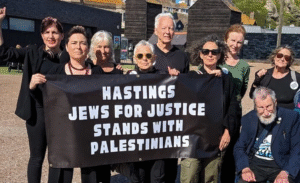
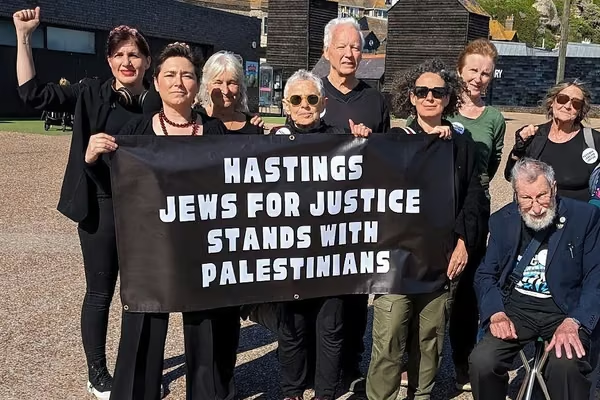
In Hastings, where I live, we formed a “Hastings Jews for Justice” group before the general election. We were jumping around quite visibly, and punching well above our weight. Over 30 people signed up to it, which must be most of the Jewish-background people in Hastings. We got in touch with all the candidates. Few got back to us, but one LibDem one met us and posted a comment: “This group is full of people of such integrity,” something like that. He really responded to us. Of course he was thinking, “Hamas are terrorists”, but he was open to nuance. Most people don’t know very much, and they are misinformed by the mainstream media so horribly. On marches, I make a point of going up to clearly Muslim families and saying, “My grandfather was a rabbi, but I stand with you,” and always, always, they say, “That’s so important to hear.”
The main thing that needs to happen is a big shift among young people in America, enough to shift policy, and we can support that by what we’re doing. My friends in the Israel peace camp say, “We need all the help we can get, because we can’t do it ourselves.” And Palestinian friends say the same, “Just keep doing what you’re doing.” I’m somebody who can’t not feel hope.
Different voices are so important – to say, “It’s not antisemitic to criticise a fascist government” – but in the arts world where I am, so many doors are being closed, so much is being shut down. We have to keep protesting and explaining why.
Index of all the personal stories
_________________________________
[i] The Scourge of the Swastika: A short history of Nazi war crimes, 1954, by Edward Russell, Baron Russell of Liverpool, who was one of the prosecutors in the Nazi war crimes trials. The book was very controversial – the British government tried to stop its publication – but it quickly became an international bestseller.
[ii] The Jerusalem Music Centre was founded in 1973 by violinist Isaac Stern and then mayor of Jerusalem Teddy Kollek, to support young Israeli musicians and music teaching. It also hosts a recording studio and holds international concerts.
[iii] I Never Saw Another Butterfly: Children’s Drawings and Poems from Terezin Concentration Camp, 1942–1944 is a collection of works of art and poetry by Jewish children who lived in the concentration camp at Theresienstadt. English edition, McGraw-Hill, 1964
[iv] Extract from Rasha’s poem (1998):
I want peace that makes me feel as a valuable child…
that makes me feel safe and not disappear in time.
I want to feel the sun rising and setting every day.
I want to see it smiling brightly on me and see it happy…
Not shedding a tear that it tries to hide from me
So as not to remind me of the suffering of my beloved people.
I want peace, and love and a future…
I want a home, a country and somebody to hold me.
I want a confession of my existence and a respect for my wishes and my childhood.
I have a homeless childhood…
and my freedom
my lost freedom…
I see, but conception is forbidden;
I hear but my words are not heard.
…The world is there and it has forgotten the children…
[v] The Villages Group is a small group of Israeli anti-occupation activists who have worked since 2002 to support West Bank village people against encroachments and attacks by settlers, at first around Nablus and currently in the Masafer Yatta area in the south of the West Bank.
[vi] No Other Land, 2024 documentary film by a group of two Palestinian and two Israeli activists, documenting Palestinian villagers’ resistance to twenty years of efforts by Israeli soldiers and settlers to evict them from their homes in the Masafer Yatta area near Hebron in the West Bank. The film focuses on the repeated demolitions of homes and village amenities such as schools, wells and mosques. It won two awards on its premiere at the Berlin International Film Festival in Feb 2024, and many other awards subsequently at international film festivals.
[vii] The story can be found on the website of ICAHD-UK, (The Israeli Committee against House Demolitions), Dec 2 2020.
[viii] Edward Said National Conservatory of Music, founded in Ramallah in 1993, to teach Arabic and Western music to young Palestinians. By 2023 it had over 1,000 students, with branches in Jerusalem, Bethlehem, Nablus and Gaza.
[ix] See his forthcoming interview in this series
A really touching piece that strengthens me. I appreciate the efforts you have taken to keep reaching out across otherwise closed boundaries.
Thank you Felicity – I hadn’t realised that you had done so much work in Palestine. The Edward Said Conservatory has done such wonderful work too, and the joy it, and you brought show the major importance of the arts, but at the moment, there’s so much darkness…
What Felicity says about hundreds of thousands of people leaving Israel recently (especially doctors, academics and the centre-left) echoes what I read in a Chris Hedges report (and greatly doubted when I read it).
The Hedges report was an interview with a now retired US senior officer (a Lieutenant-General?) who’d worked on liaison between the USA and Israel. Hedges thought 500,000 Israelis had left. The retired officer thought as many as a million Israelis had left. Both figures flabbergasted me because there were only about 7 million Jewish Israelis living in Israel just before 7.10.23.
Losing a million Jewish Israelis in 13 months (a seventh of the population) is enough of a demographic change to destabilise Israeli society, politics and political groupings. It could well increase Israeli paranoia about the sustainability of their state and culture. Even if only 500,000 Jewish citizens left in that time the social shock of losing a fourteenth of that population would be extreme.
The massive number of Jewish Israelis emigrating won’t be offset by the arrival (into a warzone with an army of conscripts and a stuttering economy) of Jewish immigrants who are similar in education and earning capacity to those leaving. There will be some rise in the percentage of Jewish Israelis who are from ultra Orthodox families.
Truly inspirational interview with a wonderful woman. Thanks to Kitty for bringing another fascinating life experience to our attention.
This was a great interview, thank you Felicitly for all work you have done to help achieve peace.
A journey indeed with no end in sight, that you are still on Felicity and I am in awe of your ability to bring people together through music and everything else you do and have done – and you do have hope and a glimmer – and you go to up to the Palestinian here and there when you are on a march and you tell them who you are and what you feel, and it gives them hope to go on. It helps me who has no cultural or social connection to also hope; to see what the dialectic result of that might be in my imagination, one Israeli at a time – the potential -like the ‘epiphany’ of the Israeli guy listening to the Palestinian girl’s voice in song. But heh. Maybe that is fantasy. Your energy, compassion and depth of understanding helps those non Jews like me see layers and layers within the entrenched savage histories of two peoples -one whose voices are not heard -not really, whose suffering is blacked out on media by these ace propagandists, and the other, the political voice of dominant oppressive Zion that won’t even let the Israeli Jews who can think, think. No wonder abrogation and exile is the route out for the professional class and the intellectuals. Perhaps a 20th century country born out of cruelty and violence can never know anything else. I was asking a non Jewish friend which charity she would like me to donate to for her Christmas present and she said oh – one for Gaza but maybe that is pointless, so maybe one for a British families who don’t have beds to sleep in. Pointless! (I donated to medical charity MAP for her). That abject word is life erasing. Giving up must never be allowed to take hold. Rather the imperative is to keep talking about it. Keep telling the truth. Keep shining a light and never, ever stop.
A woman speaking about overcoming prejudice on the radio gave an example of a racist who learned to appreciate black people when he couldn’t play basketball in prison without them. Then a kindly Jew helped his rehabilitation by employing him despite the Nazi tattoos. Time and again you’ve fostered the transition from enemies to friends using the unifying and uplifting qualities of music.