
Reflections from Occupied Palestine
JVL member Felicity Laurence talks to Mohammad Maragha about music and children, resilience, and holding onto humanity against all odds.
Introduction
In the ever more coruscating accounts of Israel’s increasingly blatant killing spree in Gaza, openly displayed and boasted about on Tik Tok in real time, the latest evidence of its descent into depravity is their especially constructed viewing platform on the Gazan border. This edifice, complete with binoculars which you put coins in to use, was witnessed in person on November 19th by an appalled Matthew Hoh (Eisenhower Media Network). His description in the interview recorded here is mind boggling, and burningly urgent (see also JVL’s account). Here, ‘ordinary’ Israeli citizens, and parties of school children – for whom this obscene spectacle is evidently now part of their curriculum – can visit to watch and cheer on the genocide. Enjoy the show.
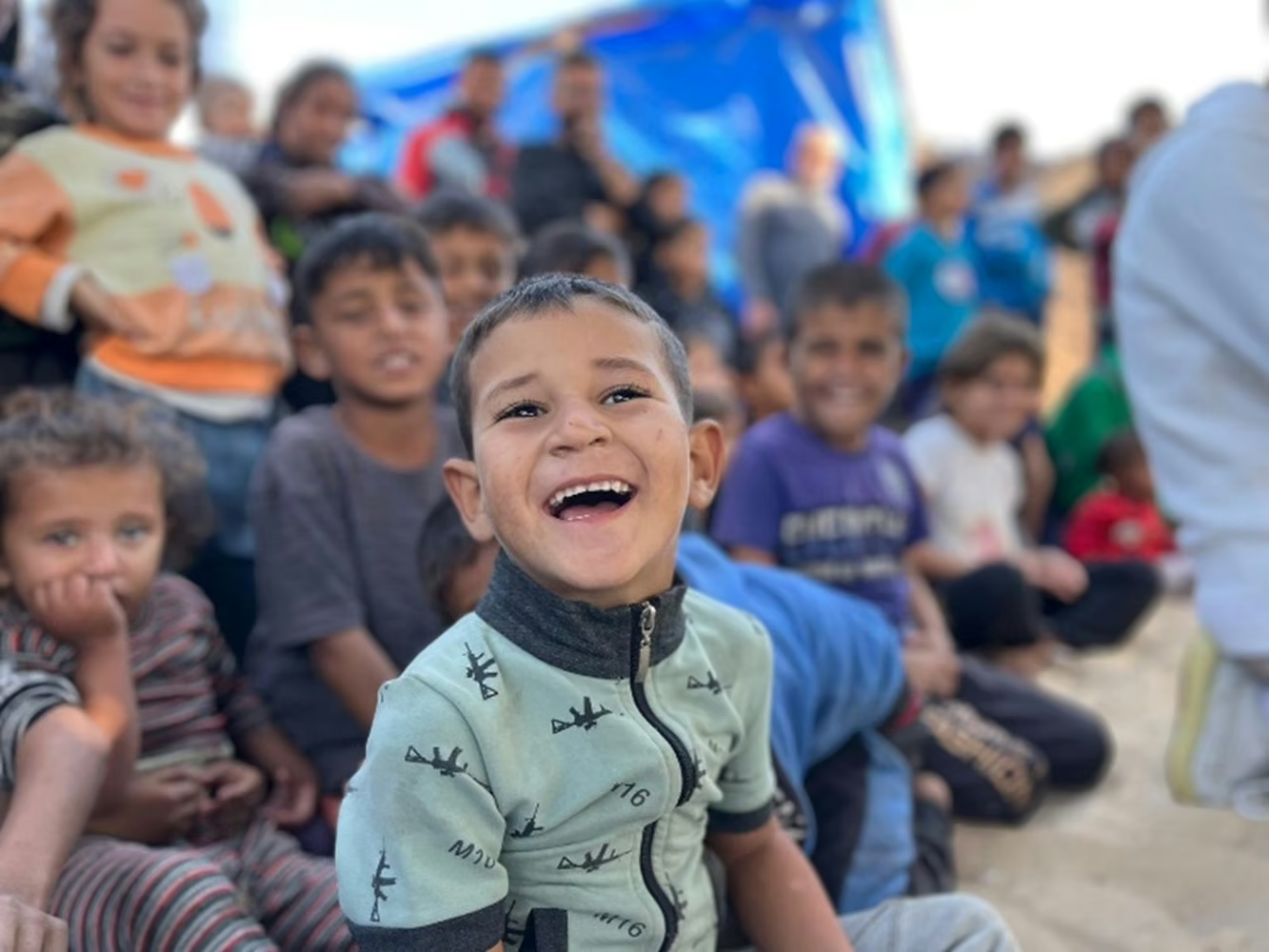
But among the people of Gaza, still there is incredible resilience and courage, kindness and mutual support. This takes many forms, among them the efforts to look after the children and bring them respite and even moments of joy in whatever ways might be possible.
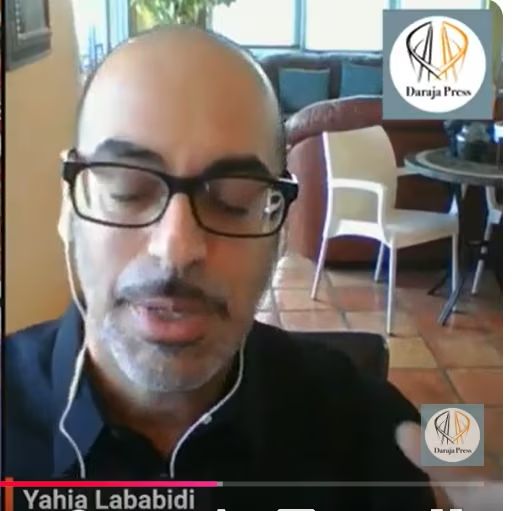
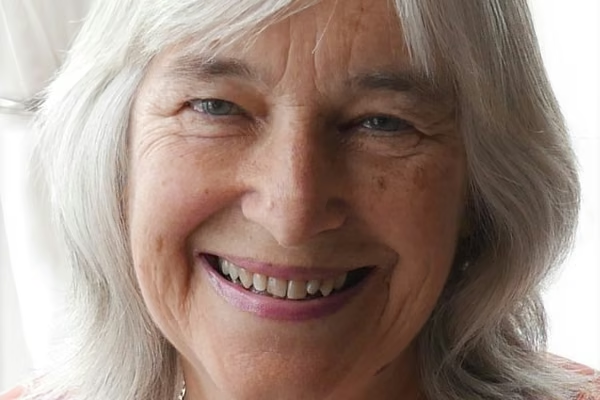
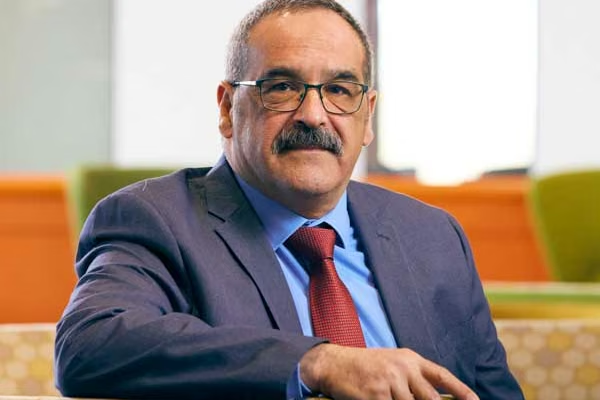
One source of such work is the Edward Said National Conservatory of Music (ESNCM) , which has six branches across occupied Palestine, including Gaza. The students are taught both Western classical music and also the equally beautiful, equally mysteriously complex Arabic music. Mohammad Maragha is the programme and concert director of the ESNCM, and, as fellow professionals in music education, we are maintaining a conversation. We talk about children, music, humanity … and he tells me about what he and his colleagues are doing there to keep life worth living, if only for the next day or the day after that. Especially in Gaza, and especially for the children.
Since October 7th 2023, the conservatory’s website has kept ‘diaries of music under genocide’, which document the activities the ESNCM strives to continue under bombardment. A glimpse of these can also be gained in this BBC report from March this year (listen from 16.30 minutes in).
Last summer, ESNCM organised concerts in Amman for students from Palestine and the diaspora. Mohammad described this visit to Jordan “as part of our flagship project with the Palestine Youth Orchestra, titled: Gaza, Sacrifice and Heroism; all revenues that we received from the two concerts in Amman go to rebuild the music education in Palestine and specifically in Gaza.”
For now, those young people are able to cling on to their dreams, and to keep some semblance of normality as they continue with their musical learning.
In Gaza, it is a different story. Here the children live from one day to the next, and every day more of them are killed – shot in the head by a sniper whose soul must forever remain the darkest place of horror: picked off after a bombardment by drone attacks: left to suffocate under rubble; or burned alive in a hospital bed…
As I began drafting this article, Mohammad sent me news of the death of a young member of his team in Gaza. Amani Al-Omari was killed on 18th October by Israel in their onslaught on Jabalia, as described in ESNCM’s announcement, “in a massacre that reaped the souls of more than 30 people. The massacre in Tall Al Zaatar area in Jabalia was waged against the inhabitants and displaced leaving more than 70 injured. This massacre is part of a strategic and deliberate plan to ethnically cleanse the North of Gaza during a horrific ongoing Genocide against the Palestinian people.” Amani was twenty four years old.
Here is Amani, in summer this year, during Eid. She cherished the children there, and sang with them in the midst of terror and destruction. Now she lies under the rubble.
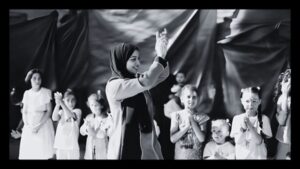
See the children, faces decorated for the Eid celebration, happy, and Amani, radiant, conducting them, holding them, loving them. And you can catch a glimpse of her here: the young leader in a pink coat, who claps with the children at 13 seconds in.
Farewell, beloved Amani.
On music, children, humanity and the future: putting smiles on the children’s faces
I asked Mohammad if he might share with us some thoughts, from his perspective as a culture-bearer and therefore destined to be a target in Israel’s unremitting attempts to obliterate the poets and the writers, the artists and the academic leaders in every field of study, as we are witnessing time and again in Gaza. We spoke informally, and he described for me how it is for him living in occupied Palestine these days.
“I wake up every morning, listen to the news. It can make you very depressed. As a middle class person – should I leave? I have a boy – 3 years old: for him, my family – they don’t want to hear the negative voice. So I remain positive – but without any illusions.
We live minute by minute now. Planes have been flying over our heads across occupied Palestine night and day to Lebanon. After the second intifada, there were checkpoints between Palestinian cities. Now, checkpoints separate villages and towns. There is a higher level of apartheid. The wall tightly controlled movement during 2001-2006/7. But the Israeli economy needed cheap labour, and there had been a little more freedom of movement since 2006. There is none at all now. We are returning to the 2006 era, and worse.
The situation on West Bank roads is chaotic; everyone uses phones to work out how to get around. I wake at 4-5am, and check the traffic and the checkpoints to see a possible route to work. When the IDF enters, there is havoc.
‘Area A’ was under partial Palestinian Authority control, and Palestinians had felt a little safer there. After Oct 7th, Israel has been attacking full scale there – for example in Jenin, Nablus.
And yet… the cafés are open, and in a way, many of the 3 million people who live in the West Bank go about their lives as if life is normal. But we know this is not normal. And we have to keep going.
Overall, the situation in the West Bank is accelerating, the majority of people in West Bank think that it’s their time for genocide; they think that since the Israeli occupation with the support of USA, UK, Germany and France (and many other countries) did this unprecedented genocide in Gaza, why not repeat it in the West Bank, of course not necessarily in one day, but in the coming four years, city after city and village after village…
But from the other side, Palestinian people do not have any other choice, they have to resist and stay on their land and in their homes. We will never surrender.”
We spoke about the attacks on the entire cultural infrastructure in Gaza, which seem to be the logical endpoint of the long term Israeli project of eradication of the culture of Palestinian people. It extends indeed to our own country here – where there are continuing and relentless attempts to silence Palestinian cultural expression. Mohammad described this process as it has been played out over the past decades.
“There have always been political obstacles. Occupied East Jerusalem was the cultural hub in the 1970s and 80s – the unnamed capital of culture for Palestinians. The main hospitals were there, and the theatres, the musicians. But Sharon wanted to ‘clean’ East Jerusalem, and separate it from close occupied Palestinian cities . If there were any links between an institution – hospitals, universities – and the P.A. or any Palestinian political party, Israel could deem you as a foreign or alien institution, and then shut you down. Sharon shut down one of the Palestinian institutions in East Jerusalem supporting education and health in 2001. Then, many more places of learning – in engineering, law, and more – were also shut down.
Since then, these institutions operate separately within the West Bank, with no support from or affiliation to Israeli institutions.
From 2001, Israeli policy has been to separate and dominate occupied Palestinians from the West Bank – pushing people out of East Jerusalem.
Jerusalem is the most important project for the Israelis (not Haifa –for example). In the last four years, these policies have been accelerating – under Netanyahu, Smotrich, and Ben Gvir.”
“The ultimate project is to weaken the Palestinians, as in 2000-2006. Smotrich’s plan is quite simple; there are three options for Palestinians: 1. Live as second class citizens, or slaves. 2. Be killed. 3. Leave.”
On Gaza
Two million people in Gaza are facing extermination. Many in the north of Gaza, where this annihilation is well underway, are now exhausted far beyond their limits of endurance. Mohammad put it like this:
“ I hope this genocidal war will stop soon. They are very tired by the daily killing and displacement … but they do not have any other option than surviving and steadfastness.”
The ESNCM buildings in Gaza are in smithereens now, but the ESNCM team there is doing whatever is possible, and in all this devastation, and with the slenderest resources imaginable, they continue to make oases of happiness and respite from the horrors of the children’s dwindling lives. Mohammad explained more about these activities:
“We have been active in the south, centre and north Gaza, with about 300-400 children. But our activities in Jabalia were stopped now for many weeks, because the Israeli army is doing their hobby on daily basis, killing hundreds of people and destroying the whole north of Gaza area.
Where we can still work, our team makes music with the children, and also dancing, drawing, sewing activities. We are not idealists – music cannot change the political situation, but music and the other activities can strengthen steadfastness, release the emotions. Music won’t compensate for everything of course: it can just create a space for a little relief. It puts smiles on the children’s faces.
“We are catching the human values – otherwise, we will just be monsters. This is what we are doing.”
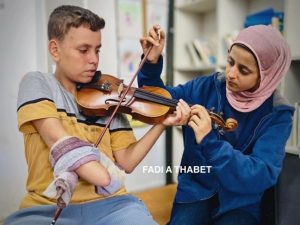
Mohammad’s description to me of the children’s determination to resume their music lessons wherever remotely possible is incredibly moving. He told me about two young boys who have lost limbs in Israeli bombardments. One fourteen year old boy who was learning the oud, and passionately committed to this instrument, lost part of his right arm, from the elbow. One of ECNMC’s young teachers had the idea of attaching a bow to the remaining part of his arm, and trying him on the violin instead. Another boy, ten years old, lost his foot in another Israeli massacre; he can still play his beloved oud, but he longs for his foot back. Mohammad has told me that the chances of getting prosthetic limbs for these children are non-existent while the savagery rages on in Gaza. Maybe in a future when the bombs have stopped. But meantime, he is happy that the boys can still be helped to play and make music: “For me, even just those two children… even just a single person – if we can reach them, music with them, help them – it’s enough.”
“The people of Gaza are crafting every day a new hope for themselves so they do not die. Brave, our people in Gaza, they are teaching us the core meaning of humanity, sacrifice and resilience every day. They teach us how you can lose everything, but still you maintain your humanity.”
We speak sometimes of how the future looks, in all this darkness when our Governments in the global north seem so reluctant to condemn what Israel is doing, not only standing by, but actively supplying the weapons and other help that Israel needs; what can a future look like? Ilan Pappé speaks these days of the inevitability – however long this may take – of the decolonisation and liberation of the Palestinian people. Mohammad’s recollection of his own family’s harmonious co-existence long ago with Jewish people reminded me of the same impression I had of the world of my own grandfather, a rabbi who was born and brought up in the Old City of Jerusalem. There is precedent for co-existence – but are things too bitter and broken now to invoke that precedent once more? The extent of the interweaving of the two cultures as described by Mohammad is hard to imagine now:
“I was told by my old mothers and fathers that Jewish people who had been brought from Yemen at the second half of the 19th century to Jerusalem lived peacefully with us and they were welcomed . She told me that if a mother couldn’t feed her baby, another from the other community would give it her milk. This changed between 1917 to 1936. But the roots of living together are there. We can live together with the power of justice. For me what justice means is the right of return and self-determination for the people of Palestine, within a social democratic state.”
We both see the reality as it is now, of course; and we both dream – I of an international brigade – what if 10,000 of us, unarmed, sailed off to Gaza and began rebuilding in the face of the IDF? – among us, the architects already poised to start: and the doctors, artists, educators whom Mohammad in his own dream also envisages.
“Of course Israel is winning now – tactically. They have been since I was born; this is not new. But they are destroying the Jewish people. Who knows where things will be in 100 years? In the long term, they are losing. We are all one. If we don’t see that vision, we will all die. We have our Sumud – resilience, self-belief – it’s better in Arabic! I think an international protection force for Palestinian people in occupied Palestine could be a tactical solution at this point: and maybe we could ask for the entrance of a delegation of doctors, artists, engineers, lawyers, musicians … to go to Gaza – and your Governments to push Israel to accept their entrance. You can do more and so can we.
“We need a human coalition against colonialism, fascism, discrimination and climate pollution. I think writers, thinkers and artists can build this. You know how much our fight is not just in the 365 square km of Gaza, our fight is for our values and existence as human beings. With your support and struggle (the word in Arabic is much better!) I think we will reach the end of this situation, and this will happen when Palestinians get their rights of return and self -determination.”
I have mentioned to friends Mohammad’s idea of a delegation; each one said they would be there in a heartbeat.
Mohammad has told me that there are already many people trying to support the work they do in the ESNCM. They have links with similar institutions in different countries, for example in Aarhus and Geneva; discussions are ongoing with El Sistema in Venezuela, and recently a new memorandum of understanding (MoU) was signed with the Colombian university Universidad Distrital Francisco José de Caldas. Mohammad’s explanation of this agreement points to a long term view that assumes Palestinian ability to travel, and to exchange knowledge:
“The MoU was signed recently and it’s mainly trying to build up a long term relationship focusing on joint production and some kind of exchange programs (online classes from both sides, exchanging experiences, knowledge and skill on different levers) but of course we understand the challenges that we both face to make it more structured and solid.”
Meanwhile, individual music educators, including several in the UK, give online training in such fields as early years music education, community music education, and in working with disabled children – much in the way of the virtual medical school described here.
I commented the other day to Mohammad that it is the people of Israel who are throwing away their humanity, while the people of Palestine are showing the world how to hold on to theirs.
Mohammad sends this message to all of us who stand in solidarity; he is right when he speaks of the future being for all of us – in and beyond Palestine.
“Really we appreciate what you are all doing, this is not easy and needed in depth. I know it will not stop the genocide directly but it will make so much difference for us and for our future .. all of us.”
You can see much more about ESNCM’s work with the children in Gaza in this Newsletter October 2024 and on their Facebook page .
If you would like to contribute directly to the work with the children in Gaza, you can donate here: Donate to Palmusic UK – Palmusic and send a private email to Mohammad at [email protected] to let him know that you would like your donation to go to support ESNCM’s activities in Gaza.
And here is a wonderfully exuberant, uplifting snippet of film from ESNCM Gaza made just a few days ago as I write:
https://www.facebook.com/gazaesncm/videos/621350053763591
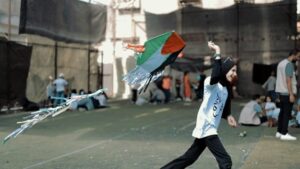
Perhaps it gives a glimpse of the future that Ilan Pappé sees – perhaps far, far distant, but inevitable, when Palestinian children can be this happy, this free, this joyous in a country where at last they are recognised as fully human, with full human rights.
I am humbled by the positive messages in this interview and needed them. The hope shown by those who are directly suffering shook me out of my stupor. Here I am, safe, protected from trauma, watching from afar the horrific genocide , remembering that this is what man has done to man and complaining bitterly about the destruction, the leaders we have chosen, this dystopian world where thousands of children are victims and the perpetrators don’t care. I care. I care about you and am re-energised by the hope and bravery shown here and the message about music and how beauty can still be heard among the falling masonry.
As a music teacher who has worked with many groups of children over the years in Aotearoa New Zealand, I found this testimony extremely poignant and I’m overwhelmed by the optimism and amazing generosity of spirit Mohammed expresses. Like that of Māori who embrace Kotahitanga despite the assault of colonialism. The photo of the boy learning the violin having lost his arm particularly moved me. The indomitable human spirit in the face of such awfulness.
This is an amazing article. I am continuously floored by the resilience of the Palestinians, the ability to still look to a brighter future, consideration of once again living in peace with Israeli neighbours and even alluding to forgiveness of the terrible crimes committed against them. The importance of any therapeutic and fun activity with children at the moment cannot be overstated and Mohammad and his team are doing quite incredible work. The future psychological trauma of children, and adults, who will have lived through this Nakba, is unimaginable. Please know Mohammad how many supporters you have in my home town of Hastings, UK and around the world, ordinary people who stand with you and hope every day for peace and your freedom. Sincere condolences for the loss of Amani, in her short life she evidently brought much joy to the children she worked with.
Thank you Mohammed and all your colleagues for the incredible work you do to maintain creative life against almost impossible odds. Reading these accounts of the work of artists and teachers is both inspirational and heartbreaking. They model the ideals to which all musicians ought to aspire but they also pay the most terrible price for providing moments of joy and pleasure in the lives of such beautiful children.
I can’t help thinking that if Amani Al-Omari had been a British, German, American or indeed, Israeli music education expert who had been killed her story would have been widely and reported and shocked musicians everywhere to protest and rage.
Her brilliance (in all senses of that word) will nevertheless always shine bright for those who – thanks to reports such as these – do know about her great life.