
A poetic love letter to Gaza: a belief in hope
JVL Introduction
For John
I believe a leaf of grass is no less than the journey-work of the stars – Walt Whitman
Hope
Hope’s not quite as it seems,
it’s slimmer than you’d think
and less steady on its feet.
Sometimes. it’s out of breath
can hardly see ahead
and cries itself to sleep.
It may not tell you all this
or the times it cheated death
but, if you knew it, you’d know
how hope can keep a secret.
And now the interview:
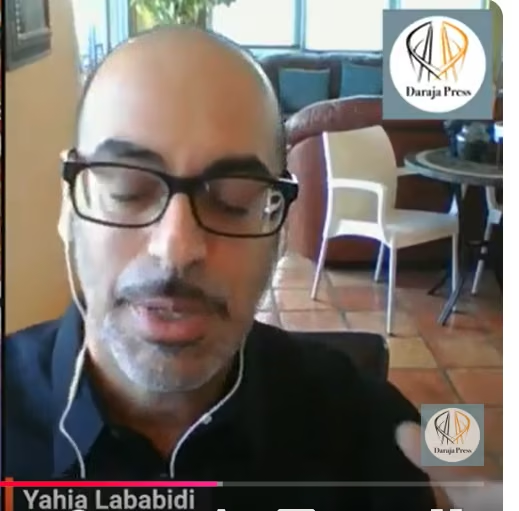
The video’s introduction includes: “Palestine is personal for writer, Yahia Lababidi. His Palestinian grandmother, Rabiha Dajani — educator, activist and social worker — was forced to flee her ancestral home in Jerusalem at gunpoint some eighty years ago. (you can read his Letter to My Departed Palestinian Grandmother. Ed) … Lababidi feels deeply betrayed by the USA’s blind support of Israel’s genocide of Palestinians. In Palestine Wail, he reminds us that religion is not politics, Judaism is not Zionism, and to criticize the immoral, illegal actions of Israel is not antisemitism… Using both poetry and prose, Lababidi reflects on how we are neither our corrupt governments nor our compromised media. Rather, we are partners in humanity, members of one human family… We are made aware of the basic human truths that no lasting peace can be founded upon profound injustice and that the jailor is never Free”
Readers may also be interested in this interview with PEN America from which we publish this extract:
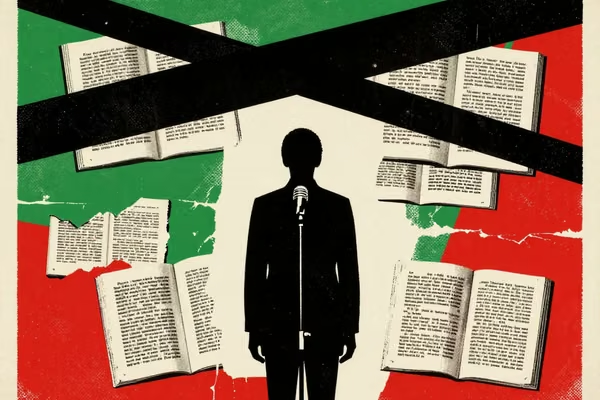
10. I wanted to allow some space to talk about the publication process for this collection. A lot of these poems are critical of governments. Did you face any pushback or censorship while getting this published? How conscious were you of the possibility of pushback while you were writing these poems?
“I am really grateful for this space to speak about pushback and censorship. As an Egyptian and American I am a kind of involuntary activist and, frankly, critical of both my governments’ positions regarding Palestine. As a global citizen, I consider it my duty to take corrupt governments and compromised media to task by reminding them of their Ideals. Being Arab, naturally, I wish for greater solidarity with Palestinians and want us to do more to protect our brothers and sisters and stand up for them. As an American, of course, I feel painfully betrayed and alienated by the US government’s blind support of Israel and their ongoing military support of the genocide of Palestinians and their ethnic cleansing.
I regret to say that this bias, towards Zionism and Jewish suffering, extends to the publishing process where I experienced, directly, how they are part of larger machinery of violence. After 6 months of working closely with an editor I deeply admire (respected scholar and poet) my once enthusiastic US publisher lost their nerve and dropped my Palestine book for fear of offending.
In a two hour Zoom meeting, the publisher let me know that they were uneasy with my use of words like Genocide, even murder — as they felt that it was “prejudging a legal matter” — and they went so far as to suggest that if they were to publish my book, it would result in scandal for them and some of their authors would walk out.
Crestfallen, I had to move on… Mercifully, before too long and with the passionate assistance of many principled friends from around the world, I was able to find a less alarmist, more courageous publisher — lifelong Kenyan activist, Firoze Manji, whose Daraja Press is based in Canada — to carry Palestine Wail forth.”
If you are keen to delve further, here is another excellent interview with Yahia Lababidi on this book and the Poetry of Free Expression – DAWN
Yahia Lababidi, Arab-American of Palestinian background, is the author of 11 critically-acclaimed books of aphorisms, essays, poetry and conversations. Lababidi’s latest is Palestine Wail (2024) a love letter to Gaza, composed during the Genocide as well as Quarantine Notes (Fomite Press, 2023) short meditations reflecting on our global pandemic. Previous publications include: Desert Songs (Rowayat, 2022) a bilingual, photographic account of his desert retreats in Egypt; Learning to Pray (Kelsay Books, 2021) a collection of spiritual aphorisms and poems; as well as Revolutions of the Heart (Wipf & Stock, 2020) a mixed-genre compendium of his essays and conversations on crises and transformation.
Comments are now closed.