
If I Must Die
JVL Introduction
Deborah Maccoby reviews Refaat Alareer’s posthumously published collection of poetry and prose.
Through his writings Alareer tells the story of Gaza over recent decades, a story succinctly and moving reconstructed by Maccoby.
Starting with a powerful analysis of Alareer’s iconic poem of the genocide in Gaza which gives the book its title, Maccoby reveals many depths and resonances that those who have heard the poem on demonstrations may not have suspected (this reader hadn’t).
Not uncritical of Alareer’s work – she thinks he is simply wrong in what he writes about Fagin and Shylock – she nonetheless finds him a brilliant poet and storyteller, able to transform trauma, death and despair, into words and into poetry, occasionally rising to true greatness.
RK
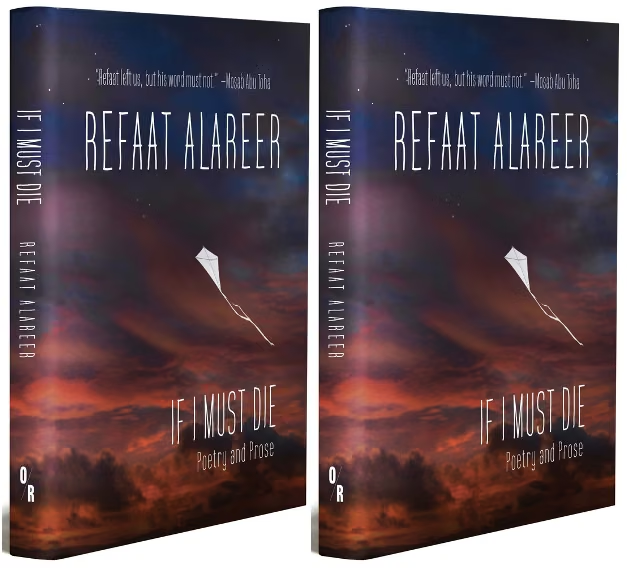
Refaat Alareer, If I Must Die: Poetry and Prose
edited by Yousef M. Aljamal, Foreword by Susan Abulhawa (Or Books 2024), pp. 252.
reviewed by Deborah Maccoby
If I must die,
you must live
to tell my story
to sell my things
to buy a piece of cloth
and some strings,
(make it white with a long tail)
so that a child, somewhere in Gaza
while looking heaven in the eye
awaiting his dad, who left in a blaze —
and bid no-one farewell
not even to his flesh,
not even to himself –
sees the kite, my kite you made, flying up above
and thinks for a moment an angel is there
bringing back love
If I must die
let it bring hope
let it be a tale
Refaat Alareer’s poem “If I must Die” has become the iconic poem of the genocide in Gaza. My response on first reading it was to cry; and I have heard it recited at demonstrations by speakers who also ended up in tears, as did most of the crowd. Yet it is difficult to analyse why it has this immediate and powerful emotional impact. In her Foreword to the book, the Palestinian novelist Susan Abulhawa provides a clue by reporting Alareer’s explanation to her of why he chose to write in English rather than in “poetically charged Arabic”:
he believed English to be more practical and pliable. More importantly, he wanted to master the language of the empire that oppressed him. Always thinking of Palestinian liberation, Refaat believed there was great value in speaking and writing to the people of empire to lay bare our humanity before them (p. xiv).
Alareer’s English poetic style is at first glance very simple and unadorned. “If I Must Die” is written mostly in words of one syllable. It is about a child’s toy; and we learn from the book that the “you” of the poem is a child, Alareer’s daughter Shymaa, who was a little girl when the poem was written in 2011, in the wake of Operation Cast Lead in 2008-9. Yet each reader feels that the “you” is addressed to them – that the poem is a direct appeal from a human being to another human being. The poem, it seems to me, is bare and essential in style because the poet wants to “lay bare” the essence of what it is to be human. Animals find meaning and purpose in the realm of instinct, which tells them exactly what to do. Having left the realm of instinct, we humans need stories to make sense of our lives. The poem is about human meaning, human freedom (symbolized by the kite flying free), human autonomy (symbolized by the strings used to control the kite), human individuality, human creativity, human dignity, human love, all set against the utterly meaningless, inhuman background of high-tech missiles smashing into densely populated residential buildings and destroying human lives in an instant. The tail of the kite is a symbol of pride, dignity and beauty – like the tail of a comet or of a peacock — and at the end, in a pun, the tail becomes a “tale”, a story that, against this background of meaningless mass slaughter, is full of individuality and meaning. The style of the poem – free verse and yet highly controlled, economical and masterly (with interspersed end and internal rhymes) – reflects the kite itself, which is both free and controlled.[1]
We learn from If I Must Die: Poetry and Prose — a selection of Alareer’s poems, stories, essays and interviews — that he was killed on December 6, 2023, along with his brother, sister and three nephews and nieces, having been, it is thought, deliberately targeted by an Israeli missile because of his defiant non-violent cultural resistance, conducted mainly on social media. Shymaa, who, as a little girl in 2011, had been adjured by her father to “live/to tell my story”, was herself, we learn from the book, killed by an Israeli missile in April 2024, together with her husband and baby (p. xx). In the face of this horror, we, the readers of the poem “If I Must Die”, feel doubly obligated to live to tell the story of Refaat Alareer; a story that – even though in some respects he is atypical — is also the story of Gaza.
He was born in 1979, in Shujaiya in Gaza; in his childhood, he threw stones at Israeli soldiers and made and flew many kites. Unlike 70 per cent of the Gazan population, he did not come from a refugee family; but his family lost lands that they owned beyond the border created by Israel: he writes (p. 97), bringing out the tiny size of the prison where he was born and grew up: “this is only part of Gaza. There’s something called Greater Gaza”. Again unlike the majority of Gazans, he came from a well-off family and was able to study abroad, gaining an M.A. in Britain (University College, London) and a Ph.D in Malaysia (Universiti Putra), both in English literature. As Yousef M. Aljamal, the book’s editor, writes in his introduction (p. xix), Alareer “could have taught anywhere but chose to return to Gaza where he taught literature and creative writing as a professor at the Islamic University of Gaza (now destroyed by Israel).
In a 2014 essay, Alareer writes that, after Operation Cast Lead, while he was re-reading Daniel Defoe’s Robinson Crusoe, he felt the need to tell the story of Crusoe’s black servant Man Friday:
I thought there could have been a different story that Friday could have told, had he not been silenced (p. 35).
Alareer points out that Zionism began in poetry and literature:
Even the colonisation of Palestine came in the form of a poem and a story long before it became a reality. Hence, let a free Palestine materialize first in the form of a story or a poem (p. 42).
He encouraged his students to write down their stories, which he edited and published in Gaza Writes Back: Short Stories from Young Writers in Gaza, Palestine (2014).
Yet despite his passionate promotion of non-violent cultural resistance, Alareer never condemns the militarism of Hamas. In an essay on the non-violent 2018 “March of Return”, he writes:
The armed Palestinian resistance is legitimate, it’s moral, it’s something that Palestinians have to do sometimes to defend their very existence (p. 101).
However, he writes in the same article:
something is changing in the Palestinian community…. those people who are well-trained, militarily speaking… They’re trying to see what other scenarios, what other means of resistance they can be involved in (ibid.).
But the mainly non-violent resistance of 2018 was met with a brutal massacre of civilians – including medics and disabled people – by the Israeli army. This failure, and the earlier failure of diplomatic signals that Hamas was prepared to accept a two-state solution[2] if Israel withdrew to the pre-1967 borders, led to the explosion of October 7, 2023. Anyone who is unable to understand why October 7 happened needs to read this book (in fact, everyone needs to read it). Apologists for Israel often make the point that, in losing 1,200 people on October 7, Israel, with a population of about 10 million, lost a percentage of its population equivalent to tens of thousands of the populations of much larger states.[3] Of course, October 7 was deeply traumatic for Israel; but those who make this point about its population percentage never add that, for decades before the catastrophe of October 2023, Gaza, with a population of only two and a half million, had been subjected, every few years, to the equivalent or worse than October 7. In one of his last essays, dated October 19, 2023, Alareer lists (p. 204) with typical black humour – evidently a coping device amid the trauma — only the onslaughts since 2008, omitting the many previous Israeli attacks on Gaza:
A Palestinian in Gaza born in 2008 has witnessed seven wars: 2008-9, 2012, 2014, 2021, 2022, 2023A and 2023B. And as the habit goes in Gaza, people can be seven wars old, or four wars old. My little Amal, born in 2016, is now a B.A. in wars, having lived through four destructive campaigns. In Gaza, we often speak about wars in terms of academic degrees: a B.A. in wars, an M.A. in wars, and some might humorously refer to themselves as Ph.D. candidates in wars.
In an essay dated May 13, 2021, Alareer writes of himself and his wife:
Nuseyba and I are a perfectly average Palestinian couple: Between us, we have lost more than thirty relatives (p. 115).
One of his essays – “The Story of my Brother, Martyr Mohammed Alareer” (pp. 47-51) – tells us about the life of his brother, who was killed during Operation Protective Edge in 2014, at the age of 31.
In an interview conducted on October 26, 2023 for the Electronic Intifada podcast, Alareer says of Israel’s genocidal onslaught: ;
This is an extermination. Israel long ago created the concentration camp. But this is now an extermination camp (p. 225).
In an interview conducted on October 13, 2023 for the Electronic Intifada podcast, Alareer was asked about the media blackout of the genocide and bias towards Israel. He replied:
The other night I was with Chris Cuomo [of CNN]…. I was expected to speak for about twenty or twenty-five minutes about Israelis, poor Israelis…. at the end of the interview I told him: Chris, your framing is riddled with inaccuracies, with fake news. Because if you think this is what’s going on, if you start the story from B, you blame the Warsaw Ghetto rebels, you blame the Native Americans, you blame the slaves that rebelled against the slave-owners,[4] and you blame the Palestinians (p. 197; square brackets in original).
Alareer’s essays are full of prophetic warnings of the catastrophe; for instance, in an essay dated December 14, 2011, he writes:
Israel seems to be pushing the Palestinians yet again towards a corner whose options are very limited and whose consequences might be devastatingly harmful for both sides (p. 23).
My only reservation with the book concerns Alareer’s interpretations of Fagin and Shylock. Alareer writes that, for many of his students, Fagin was “the source of evil, the embodiment of the devil (p. 130)”.
He taught them, he writes, that “Fagin was a mere product of a society that hates those who are different, those with a darker skin or a different race or having different stories.”
Similarly, Alareer writes that he taught his students, who were at first inclined to see Shylock as a devil-figure, that Shylock “had to endure many religious and spiritual walls erected by an apartheid-like society”.
It seems to me, however, that, in terms of Shakespeare’s and Dickens’s intentions and the actual impact of the characters, the students were correct in their assessment of Shylock and Fagin. In my view, Alareer’s anti-racism and anti-colonialism – admirable though they are in themselves and though at their highest level they produced his great poem “If I Must Die” – blind him to the real imaginative impact of these characters.[5] Alareer seems insufficiently aware of the Christian story or myth that cast the Jews in the role of God-killers and therefore of the Devil. This story is very relevant to the Palestinian story, because the Christian myth led to centuries of persecution of Jews in Christian Europe and laid the ground for the Holocaust; and the centuries-long persecution of the Jews perhaps helps to some extent to explain – though certainly not to excuse – the callous dehumanisation of the Palestinians shown by many Israeli Jews (and their ever-dwindling ranks of Jewish apologists outside Israel).
But this is only a quibble. Alareer is primarily a poet and storyteller. Many of the poems are articulations of the constant presence of death and despair. Helpless though the poet feels, in a way he masters the trauma by turning it into poetry. For instance, in “O Earth (Land Day Poem)”, the poet addresses his native soil”
Hug me
And hold me tight
Or devour me
To suffer no more.
There is understandably a nationalistic tone to some of the poems. They are all fine poems; but Alareer rises to greatness, in my opinion, in his universalist, humanistic poetry, the flower of which is “If Must Die”. Running it a close second is a 2012 poem directly addressed to the Israeli soldier who seeks to kill him: “I am You”, which tells the soldier that he has turned into a Nazi, while the Palestinian has become a Jew, the Israeli Jew’s past self. In killing the Palestinian, the Israeli Jew kills his past self and his own humanity. The poem ends:
I am you.
I am your past.
and killing me,
you kill you.
For anyone wanting a first-hand, personal account of the last decades in Gaza and the genocide that began in 2023, this is the book to read. It is heartbreaking, but at the same time it represents a triumph of the human spirit over meaningless destruction and genocide. The editor of If I Must Die: Poetry and Prose has put together a kite that brings hope and is a tale.
Notes
[1] Indeed, the look of the poem on the page bears some resemblance to the shape of a kite. The poem is a perfect union of form and content. Like many of Alareer’s poems, it contains an echo of English literature — in this case of part of Hamlet’s last words to Horatio: “And in this harsh world draw thy breath in pain/To tell my story”.
[2] See Norman Finkelstein, Gaza: An Inquest into its Martyrdom (University of California Press, 2018), p. 31: “A 2009 study by a US government agency concluded that Hamas had ‘been carefully and consciously adjusting its political program for years’ and had ‘sent repeated signals that it was ready to begin a process of co-existing with Israel’.”
[3] See, for instance, this paper from the Washington Institute: “The attacks by Hamas … killed more than 1,300 Israelis in a country whose population is less than 10 million. In America, that would be equivalent to killing nearly 40,000 – 15 times more than the number of Al Qaeda victims on 9/11.
[4] See Norman Finkelstein on the 1831 slave revolt led by Nat Turner and its relevance to October 7.
See also Hans Kohn on the 1929 Hebron massacre: “We pretend to be innocent victims. Of course, the Arabs attacked us in August [1929]. Since they have no armies, they could not obey the rules of war. They perpetuated all the barbaric acts that are characteristic of a colonial revolt. But we are obliged to look into the deeper cause of this revolt. We have been in Palestine … without having even once made a serious attempt at seeking through negotiations the consent of the indigenous people. We have been relying exclusively on Great Britain’s military might. We have set ourselves goals which by their very nature had to lead to conflict.” Quoted in Shlomo Sand ,Israel-Palestine: Federation or Apartheid? (Polity Press, 2024), p. 56 (Sands’s square brackets).
[5] The very first time that we meet Fagin, Dickens writes: “In a frying-pan, which was on the fire … some sausages were cooking; and standing over them, with a toasting-fork in his hand, was a very old shrivelled Jew, whose villainous-looking and repulsive face was obscured by a quantity of matted red hair.” The fire and the toasting-fork — accessories with which Fagin often appears in the book — immediately evoke the Devil’s fire and pitchfork; and the Devil is traditionally pictured with red hair (as was Judas in medieval Passion Plays). Fagin plays a thoroughly villainous part in the plot, trying (for the sake of financial reward) to corrupt Oliver so that he will lose his inheritance; and – in the full knowledge that this will lead Bill Sikes to murder Nancy — Fagin reveals to him that Nancy has been telling Oliver’s friends what she knows of the conspiracy.
As for Shylock, there is no reason to suppose that Shakespeare rose above the prejudices of his age. Antonio is a Christ-figure ready to die to pay the debt of sinful mankind, represented by his friend Bassanio, and Shylock plays the role of the would-be executioner. He is modelled on the Pharisees of the Old Testament (and on the Puritans of Shakespeare’s own day, whom he hated). It is true that most of the Christians are a worthless lot; but Shakespeare is making a theological point about Original Sin; the Christians throw themselves on the mercy of God, whereas Shylock insists on justice, grossly distorted by Shakespeare into cruel legalism (the pound of flesh). I am indebted for this interpretation to my father, Hyam Maccoby: see his chapter on “Shakespeare and Shylock” in his posthumously published book of essays Antisemitism and Modernity: Innovation and Continuity (Routledge, 2006).
Many will disagree with this interpretation of The Merchant of Venice; but it seems to me to be true to the impact of the play and even to bring out its greatness, as a great dramatic representation of the conflict between the Old Testament and the New, between Justice and Mercy, Judaism and Christianity (as perceived by Shakespeare). Dickens, it is true, was, unlike Shakespeare, a 19th century liberal and humanitarian; but Fagin is the product of Dickens’s Romantic imagination, which drew on the archetypes of European folklore. Dickens tried to make amends for Fagin by creating a sympathetic Jew, Mr Riah, in Our Mutual Friend, but Mr Riah is a totally unmemorable character.
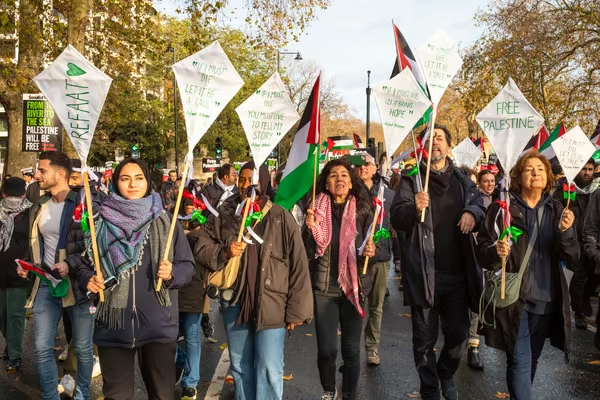
“I am you.
I am your past.
And killing me,
you kill you.”
So few words, say so much.
I have tried to order this book for my mother. Being unwilling to shop with Amazon, I tried Waterstones, W H Smith and Hive, all of whom say the book is sold out. Good in one way but sad in another. Does anyone know how I can order the book in the UK without using Amazon? Thank you.
Ieuan
Ebay have it
You can order from the publisher, OR_Books:
https://orbooks.com/catalog/if-i-must-die/
Good to hear that the book has sold out in all the bookshops!
As Debbie says, her comments about Shylock and Fagin are only a quibble in an otherwise admirable essay. However I disagree with her nonetheless. Firstly Shylock and Fagin are two very different characters at different times.
Shylock represented the Jewish money lender who was a very real figure in the Europe of the time. Actually Shakespeare also makes him a very human character. Fagin too was not the devil but part of the social fabric of Dickensian London. But it is true that Jews and money were interchangeable at that time. That is how Jews were seen. There was a verb ‘to Jew’.
The students were looking back from the present to a different period entirely and that is why their opinions are both subjective and besides the point.
Where Debbie goes wrong is in her assertion that
‘the Christian myth led to centuries of persecution of Jews in Christian Europe and laid the ground for the Holocaust; and the centuries-long persecution of the Jews perhaps helps to some extent to explain… the callous dehumanisation of the Palestinians shown by many Israeli Jews’
Where does one start? This is the Zionist myth of eternal anti-semitism. It is ahistorical. What Salo Baron called the ‘lachrymose history’ of Jews. Jews were oppressed and oppressors. Their fortunes changed as society changed but whatever use was made of the Christ-killer myth there was a very sharp break between feudal Christian antisemitism and the racial antisemitism that led to the holocaust.
For Martin Luther, a convinced antisemite, once a Jew was converted that was it. For the Nazis conversion was immaterial because Jews were raciallly not religiously Jewish, hence the phenomenon of Christian Jews.
Christian anti-semitism had little or nothing to do with the Holocaust just as the Holocaust has little or nothing to do with the genocide in Gaza
[cut to our limit of 300 words – admin]
Tony writes: “Shylock represented the Jewish money lender who was a very real figure in the Europe of the time. Actually Shakespeare also makes him a very human character.” The Jewish money-lender was indeed a very real figure in the Europe of the time. But why were the Jews forced into money-lending (which was more or less the only profession they could take up, since they were denied entry to the guilds)? Because usury was forbidden to Christians; and Jews were seen as an accursed people who could appropriately take up this accursed activity. So we see here how religion was the driving force behind the economic situation.
Alareer actually makes quite a lot of the famous “Hath not a Jew eyes?” speech. But this merely says that Shylock is a human being in the most minimal sense. It is mostly about physical characteristics. Shakespeare is at pains to make all his villains — Richard III, Edmund in King Lear, even Iago — into believable human beings and gives them speeches expressing things from their point of view and even at times creating some sympathy for them; but they are still villains.
I don’t know – we may have some idea about Dickens’s ‘intentions’, but we don’t have the slightest idea what Shakespeare’s were. All we have is the text, which is there to be interpreted. This can be done in different ways. We can try for example to say that it is an inherently antisemitic play. The Nazis – and many others – have done so. What I know (having played Shylock on stage) is that both the play and the part lend themselves very well to a humane, sympathetic portrayal of Shylock, and lots of actors have responded to this. Kean (who was the first to do so) and Irving were two 19th century examples. Jewish actors too have seen his tragic dignity, including Jacob Adler, in his heroic Yiddish performance and, in modern times, David Suchet and Henry Goodman.
While it is possible to romanticise the ‘Christian’ characters – Antonio the Christ-like victim, Portia the champion of mercy – there is plenty in the play to show their hypocrisy and the way, over time, that they engineer Shylock’s downfall.
In the end, the play in my view is as much about class, and the historic struggle between different forms of capitalism, in which racial discrimination plays a key role. Shylock draws our attention in a meta-theatrical way – Shakespeare wrote such a vivid part for him. Like Falstaff and Richard III he dominates our perceptions of the play, even though he has only a small part and appears in only five scenes out of twenty.
Briefly to address two more of Tony’s many points: Of course there is a major difference between the religious antisemitism that reached its height in the Middle Ages and the racial antisemitism that began in the 19th century. But while noting the difference, we should also note the continuity. I think it is absurd to talk about a “clean break” as though modern antisemitism has nothing to do with the legacy of religious antisemitism. Tony mentions Martin Luther, whom Hitler regarded with great admiration.
Second: re Fagin. Dickens tried to explain him away by telling a correspondent that at that time receivers of stolen goods were almost invariably Jews. This could well be true; but Fagin is not a realistic portrayal of a receiver of stolen goods. He is drawn with imaginative power as an archetype. I don’t think Dickens was consciously an antisemite; but his imagination drew upon a tradition that went back to the Middle Ages.
People are often reluctant to acknowledge how bleak Shakespeare’s vision of human nature was. What the Christians say about Shylock is true, and what he says about them is also true. Looking for a hero in The Merchant of Venice is a futile enterprise. It is probably fair to say that the play presents a contrast between a moral order based on justice and one based on mercy but if so Shakespeare is deeply cynical about both. As he represents things all the moral principles by which people purport to live are adapted in practice to their own ends.
Fagin presents different issues. Clearly he is not intended to be a ‘typical Jew’. Dickens is at pains to emphasise his alienation from the mainstream Jewish community. Equally however he is seen to be villainous in a specifically Jewish way, just as Sikes, for example, is villainous in a specifically Goyish way, if I may use the expression. Undoubtedly there is some racial stereotyping here but it is more subtle and interesting than the simple attribution of all good qualities to one group and all bad ones to another.