
We Are Not Numbers – London exhibition 3rd – 11th May 2024
JVL Introduction
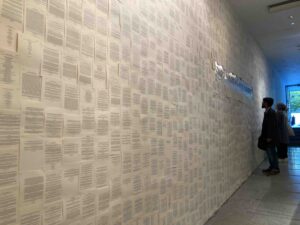
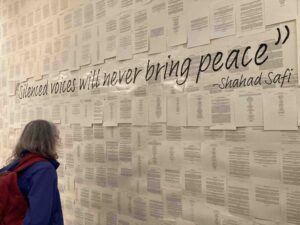
An exhibition of Palestinian art and storytelling from Gaza had its launch last night in London at the P21 Gallery, 21-27 Chalton Street, London NW1 1JD (between Euston and Kings Cross stations).
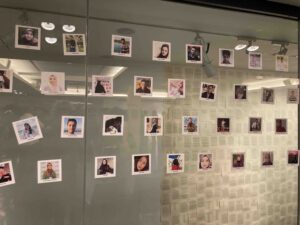
It put together a collection of the work of Are Not Numbers (WAAN), a youth-led Palestinian project in the Gaza Strip now in its tenth year, giving voice and presence to “the real life stories behind the media statistics”.
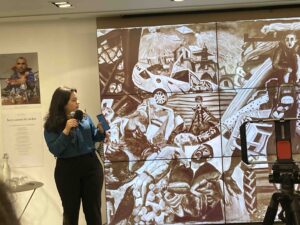
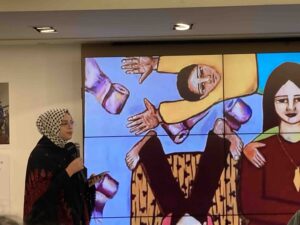
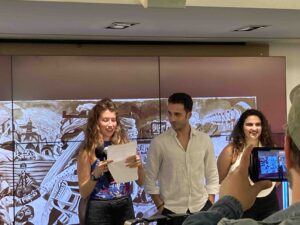
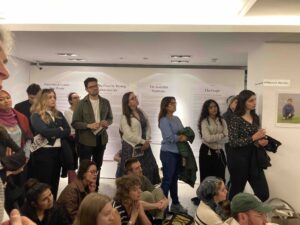
A packed and enthusiastic audience heard short contributions from some of the artists, mentors and curators of this fabulous exhibition, as well as supporters such as Andrew Feinstein, Jeremy Corbyn and Matt Kennard.
“At the heart of the exhibition is the recognition that every Palestinian has a story to tell, a voice to be heard, and the right to justice. By providing a platform for these narratives, the We Are Not Numbers presentation challenges stereotypes, breaks down barriers, and fosters understanding and solidarity.”
We urge all who can get there to go along before the exhibition closes at the end of next week.
You can find WAAN here on the web and instagram
RK
Bringing Voices of Palestine to London
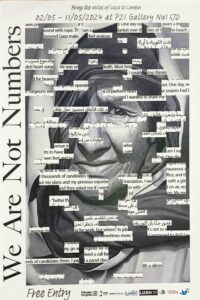
P21 Gallery is pleased to present We Are Not Numbers, an exhibition featuring works from talented Palestinian artists and storytellers, offering visitors a glimpse into the rich culture, heritage, and struggles of Palestinians’ stories – the real life stories behind the media statistics. In addition to the visual displays, there will be panel discussions, film screenings, and interactive workshops exploring various aspects of Palestinian life, history, and activism.
We Are Not Numbers (WANN) is a youth-led Palestinian nonprofit project in the Gaza Strip. It tells the human stories about Palestinians in the news and advocates for their human rights. Through this platform, we share and celebrate Palestinians’ lives whose authors have been mentored by experienced writers from all over the globe. The mission of WANN is to create a new generation of Palestinian writers and thinkers who can bring together a profound change to the Palestinian cause to get their voices heard, without foreign intermediaries speaking on behalf of the Palestinians.
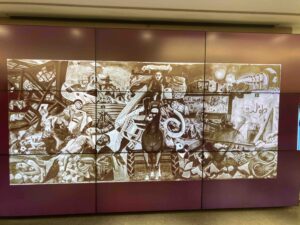
The platform celebrates a diverse range of Palestinians’ life stories, whose authors have developed their stories with the help of experienced media professionals. Through various forms of artistic expression, including photography, paintings, and multimedia installations, the We Are Not Numbers exhibition showcases the resilience, creativity, and humanity of Palestinians living under occupation and in refugee camps.
At the heart of the exhibition is the recognition that every Palestinian has a story to tell, a voice to be heard, and the right to justice. By providing a platform for these narratives, the We Are Not Numbers presentation challenges stereotypes, breaks down barriers, and fosters understanding and solidarity.
“We believe in the power of storytelling to create empathy, build bridges, and inspire change,” Ahmed Alnaouq, WANN Co-Founder, told the curators of the We Are Not Numbers exhibition. “Through this exhibition, we hope to shed light on the realities faced by Palestinians and to advocate for their fundamental rights to freedom, justice, and equality.”
Join us by standing in solidarity with the Palestinian people and in amplifying their voices for justice and peace.
The exhibition is in partnership with WANN and organized by a volunteering team: Almuhannad Allahham and Taya Amit “Curators”, Karen King “Advisor”, and Soraya Fahmy “Graphic Designer”.
Added 9th May:
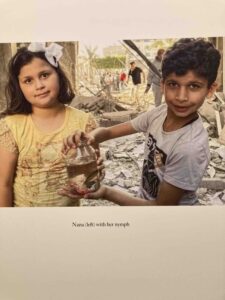
The story has come to be known as
“Nana and the nymph.” She the little girl couldn’t be more delighted.”
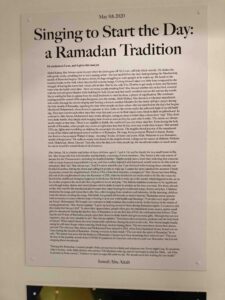
Reimagining Passover – Majed Absulama
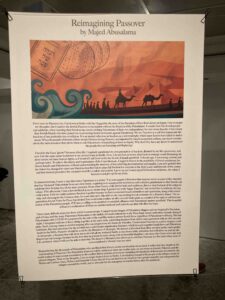
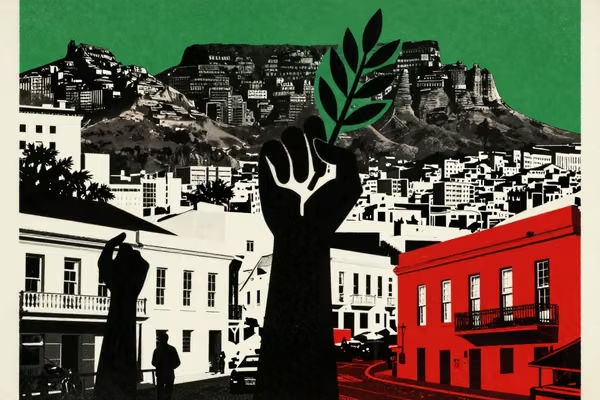
Every year on Passover eve, I sit down at Seder with the Haggadah, the story of the liberation of Jews from slavery in Egypt. I try to escape my thoughts, but I cannot: the Jewish Passover is incomplete without the freedom of the Palestinians. I wonder how the Jewish people can celebrate, when securing their freedom has meant robbing Palestinians of their own independence for over seven decades. I have many dear Jewish friends who have joined me in protesting Israei criminality against Palestinians. We see Passover as a call that transcends the freedom of one particular race or religion. It is an annual reflection on freedom as a universal right, which many Israelis have failed to understand. When thousands of Jewish settlers invade Hebron during Passover, accompanied by Isracli occupation soldiers, one has to wonder about the indoctrination that allows them to rob Palestinians of something as basic as dignity. Why don’t they have any desire to understand the people they are harassing and displacing?
I lived in the Gaza “ghetto” for most of my life. I regularly questioned my own perception of freedom, dictated by my life experiences, and now I do the same under lockdown in my current home in Berlin. Here, I do not have to worry about how to manage social distancing. let alone secure my basic human rights, as I would if I still lived under the thumb of Israeli apartheid. A decade ago, I was young, curious and perhaps naive. To relieve the misery and hopelessness of the Gaza blockade. I began to believe in the possibility of liberal coexistence between Israelis and Palestinians, without understanding the necessity of first achieving decolonization and equality. I am now grateful that my vision has changed to reject any liberal notion that fails to place full freedom for everyone in the Holy Land (and beyond) at the centre, and that instead prioritizes the occupiers’ need for comfort and security. I grew up and rooted myself in freedom and justice, the values I leamed to not give up for any price.
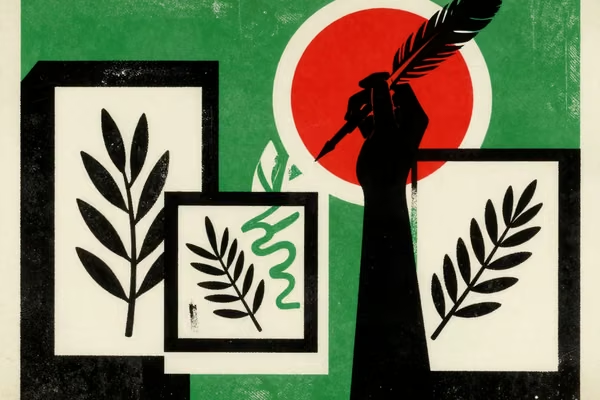
In demonstrations, I carry a sign that states *Ignorance is a choice*. I do not support a liberation that requires me to co-exist with a brutality that has “cleansed” Palestinians from our own streets, requiring us to accept severe restrictions and collective punishment so that Israclis can celebrate their holiday free of our mere presence. From what I know of the Jewish faith and traditions, this is a clear betrayal of the religion’s valucs. This aftemoon. I met a Jewish friend at an ice cream shop. I greeted her with “happy Passover,” and invited her to celebrate the day with a treat. I felt we could celebrate freedom together because we have co-resisted Israeli colonialism and oppression, along with censorship and silencing by the German state, for some time now. She told me she was meeting Jewish comrades for a Passover dinner. The organization Jewish Voice for Peace has invited Jews worldwide to place an olive on each Seder plate as a symbol of the right to self-determination of the Palestinian pcople. JVP also is calling on its members to establish alliances with Palestinians against apartheid. This beautiful tribute is a reclamation of Passover, an intersectional and symbolic act that will offers me hope.
I have many difficult memories from which I cannot escape. I cannot escape images of Palestinian refugees and our longing for liberation. and of Gaza and the many Palestinian Bantustans in the middle of Israchi settlements in the West Bank. Israeli authorities recently dumped Palestinians with COVID-19 symptoms by the side of the road like trash to protect Isracli Jews, regardless of Palestinian wellbeing. But last night, I imagined millions of Jews sitting together at the same table, celcbrating freedom from slavery and oppression with an olive on each plate. Such a strong vision is vital for keeping alive our imagination of a future for Palestine. I understand Passover as a call to imagine a radical future, like that articulated by the revolutionary antizionist organization Matzpen, which brought together Isracli Jevs and Palestinian Arabs in the 1960s, Passover should be a call for the liberation of all people. We deserve a liberation that offers absolute justice and equality to my people, a freedom that will allow me to sit with all my scattered family at one dinner table, a freedom that will allow me and my siblings to see our younger brother for the first time in at least six years, along with his beautiful daughter – my neice who I have never met and I do not know when I will ever be able to meet her. We deserve a liberation that allows us to celebrate Passover in a free land where none of us is considered a “chosen” over any other.
Remembering the thousands of Palestinians who sacrificed their lives to secure our freedom on our land, I realize that they taught us the real meaning of Passover. Our Palestinian Passover will be celebrated when our exodus ends, we can retum to historic Palestine and the world realizes it must accept a resolution to the conflict that is inclusive of everyone – including the hundreds of thousands of scattered, displaced refugocs. Now, in my thoughts, I am no longer locked down in Berlin. I am thinking instead of the people in the refugee camps of Moria and Lesbos, Gaza, Hebron and Kashmir. I hope that all of us can find it in our hearts to have greater empathy and compassion for refugees around the world, and to advocate for the emergence of a better future after this pandemic.
I just wish everyone would give up on religion, and the world will be a safer place, because there really are no such entities as gods. But hey believe what you want.
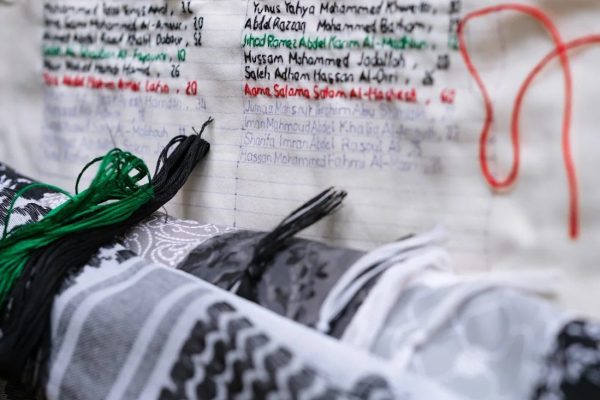
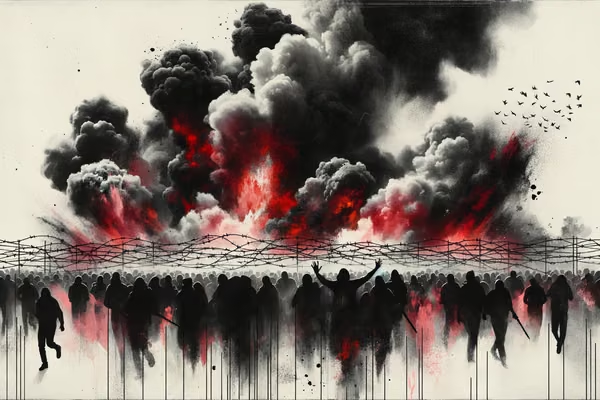
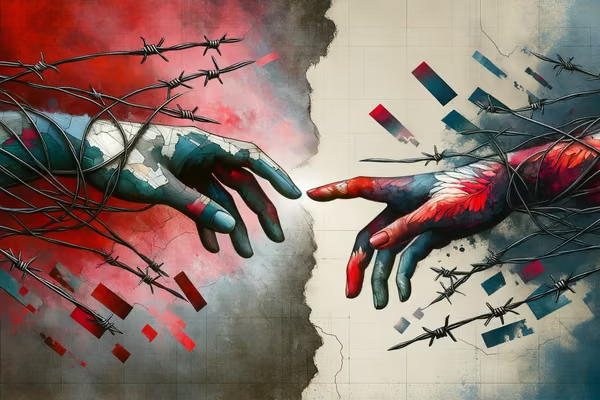
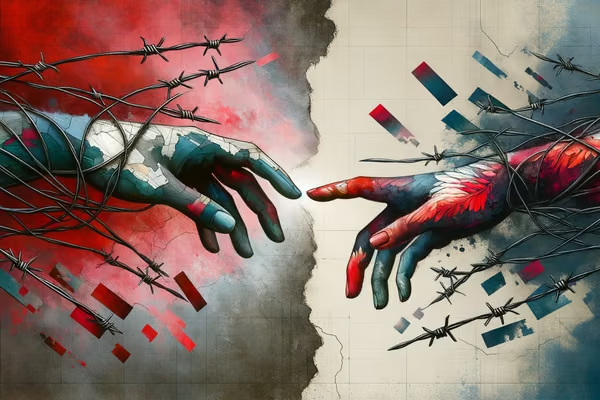
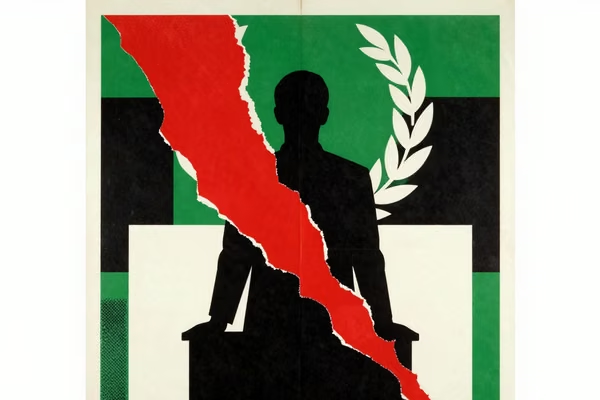
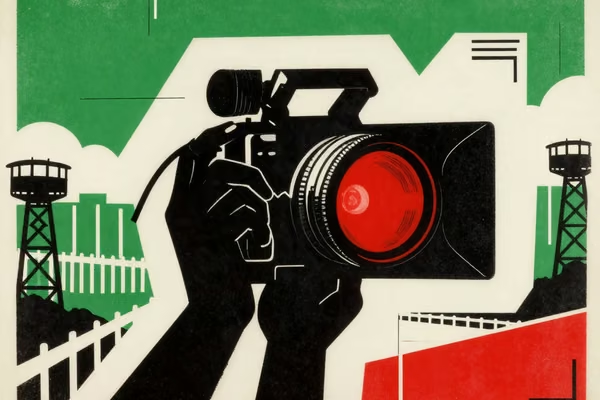
Very moving stuff! No interventions from the CAA yet? One particularly Guernicaesque image here. Perhaps history will record the work as even more momentous?
I have met Ahmed, and this is a wonderful project; despite terrible loss of his family in Gaza he continues to show such dedication and creativity. The exhibition looks wonderful and a celebration of culture and resistance. I struggle to see the relevance of John McLaughlin’s comment. It feels disrespectful to me. Let’s recognise resilience when we see it in action
Taking up John McLaughlin’s comment, above, I share his view on what the polymathic geriatrician/philosopher Raymond Tallis (in ‘Aping Mankind’) called ‘the most profound, and possibly the most terrible, idea mankind has ever entertained’. I’m just not sure that (1) everyone *can* ‘give up on religion’ or (2) that the world would ‘be a safer place’, as John hopes.
For one thing humanity would fill the god-shaped vaccuum with some other ideology and quite soon there’d be splits and quarrels and fights over that too.
For example, especially relating to our concerns here at JVL, I’m not the only one who thinks that, so to speak, after Hitler killed the Jewish God, Zionists rescuscitated Him (and it is a ‘He’) in what the ultra-orthodox call a blasphemous idolatry.
We humans need meaning almost as much as we need food and drink, which is what culture, in its widest possible sense, gives us. We may reject supernatural accounts of the world, but for many people there’s a deep feeling that if the visible, audible tactile world is all there is, then life is empty, jejune.
Not all my fellow-atheists share my view that we lost something very precious when we lost our gods. The philosopher Colin McGinn has argued that we humans have no direct contact with one another’s minds, we must rely indirectly on what they tell us, their body language and automatic reactions. Which also means that no other human being, no matter how intimately they engage with us, knows us in the way we know ourselves.
McGinn thinks that as a result we experience a kind of ultimate loneliness in the world, which believers fill with the invention of ‘God’ or gods. Only they, in their fictional reality, can really know and understand our deepest fears and hopes and longings.
Agreed, John, and without gods there was no god on hand to ‘give’ Israel to the Jewish people. A lot follows from acceptance of that fact (in my opinion).