
Global Anti-Apartheid Conference on Palestine – a report and two speeches
JVL Introduction
The Global Anti-Apartheid Conference on Palestine took place in Johannesburg from 10th-12th May with activists from more than 20 countries in attendance to launch what is hoped will be a new global anti-apartheid movement for Palestine.
We post below:
- a short report on the conference from Glyn Secker, who was there;
- the Conference Declaration;
- the opeing address by Naledi Pandor, South Africa’s Minister of International Relations on the indivisible bond of solidarity between South Africa and the Palestinian people, “forged by the crucible of the two nations’ respective liberation struggles”;and
- the speech delivered by Sinn Féin’s National Chairperson Declan Kearney, on the paradigm shift required within the Palestinian struggle to win.
RK
Glyn Secker reports from the Conference
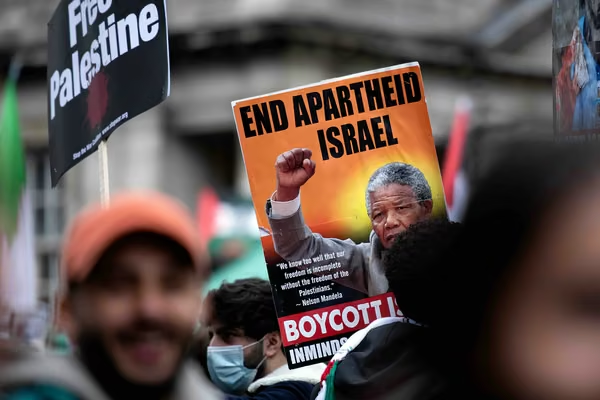
“We know too well that our freedom is incomplete without the freedom of the Palestinians”
Nelson Mandela’s famous pronouncement ran like a skein through this landmark South African conference.
It was humbling to be invited by Ronnie Kasrils, the leading Jewish ANC MK activist and Director of Intelligence in the liberation movement which brought down South African apartheid. The MK was the paramilitary wing of the ANC set up by Mandela after the Sharpeville massacre.
It was apposite that leading ANC figures had come together to bring their knowledge and experience to the fight at this time, with the sense that this genocide in Gaza could be Israel’s Sharpeville. Planned months in advance, and led by senior figures in the government, the organisers nevertheless had to overcome considerable resistance by the powerful South African Israel lobby, which has roots stretching back to the military and material support furnished by Israel to the white South African regime.
The conference was chaired by Rev. Frank Chikane, previously General Secretary of the South African Council of Churches, Director-General in the Presidency of the Government of South Africa, and currently a Moderator of the Churches Commission on International Affairs (CCIA) of the World Council of Churches (WCC);
The conference was opened by the towering figure of Dr. Naledi Pamdor, the South African Minister of International Relations, previously on the world stage of the International Court of Justice leading the South African case of genocide against Israel.
Many Palestinian organisations were present, led by their member of the Palestinian Legislative Council and General Secretary of the Palestinian National Initiative, Mustapha Barghouti.
With contributions across the spectrum, from political activists to leading figures of faith communities and civil society, there was an acknowledgement of the crime against humanity committed by Hamas on October 7th. But, without exception, it was placed within the context of colonial repression, and when from the floor I asked who in the world today would dare to describe the Kenyan Mau Mau rebellion against the British, or the slave rebellions as acts of terrorists, there was loud applause.
It is those who speak from an experience of oppression who cut through the obfuscation surrounding the Palestinian struggle, who name its obvious place in the history of liberation struggles. Such was the power of the Sinn Fein National Chairman, Declan Kearney, who voiced the common cause against the role of the British in both Palestinian and Irish history. As was the clarity of a Sinn Fein speaker on the stage of one of the massive London marches earlier, when stating simply “we know about the weaponisation of famine” joined their deep memory of British oppression with Israel’s starvation of Gaza.
Kearney encapsulated the purpose and ambition of the conference when he declaimed that
“a paradigm shift is required within the Palestinian struggle. An integrated political strategy with properly defined objectives should be agreed, and both generate and direct political momentum within Palestine itself and internationally.”
There were regional workshops to lay the ground for coordinated campaigns covering Africa, Asia-Pacific, the Arab world, Latin America, North America and Europe. And there were workshops covering BDS, interfaith activities, legal spheres, supporting Palestinian prisoners and the Palestinian popular struggle.
South African Jews for Free Palestine played an active role in the organisation of the conference, there was a representative from Jewish Voice for Peace in the USA. My presence, articulating the views of groups of the UK Jewish bloc, was much appreciated. And speakers praised our collective presence.
The collective Declaration of the conference can be seen below.
GS
Johannesburg Declaration on Israel’s Settler-Colonialism, Apartheid and Genocide:
Towards a Global Anti-Apartheid Movement for Palestine 12 May 2024
We, delegates from more than two dozen countries around the world, expressing the views of millions of people from all walks of life, of all faith and non-faith persuasions, of diverse political and ideological views, meeting in Johannesburg, South Africa, from 10 to 12 May 2024, are outraged by a century of colonialism; 75 years of ongoing Nakba; 75 years of Israeli genocide, colonialism, and apartheid; more than 75 years of land theft; 75 years of repression and denial of basic rights and freedoms. Palestinians in the West Bank (including Jerusalem), Gaza, the ‘48 areas, the refugee camps, and in the diaspora have suffered for decades under the Zionist military machinery.
We have witnessed seven months of ongoing genocide. The world has watched Israel brutally bombard Gaza from land, sea and air, turning it into an extermination camp. Israel has destroyed the conditions for life of Gaza’s people, including medical care, nutrition, education, infrastructure. Israel uses sexual violence, starvation, the deprivation of water, medicines and medical assistance as weapons of war against 2,3 million civilians in Gaza – in violation of international law and any sense of ethics and morality. The extent of the Gaza carnage is still being revealed as mass graves are discovered. Israel is deliberately murdering children and women; women who create, sustain and defend life. We oppose Israel’s reproductive genocide. Israel is destroying Gaza’s environment and infrastructure to make it uninhabitable.
Israel’s powerful western allies, primarily the United States of America and some European states, continue to enable this genocide against the Palestinian people with their supply of the most sophisticated weaponry. They also protect Israel diplomatically and politically, including the use of the UN Security Council veto, and the refusal to sanction the apartheid state despite its egregious violations of international law. Western political and economic elites profit off the blood and lives of Palestinians in a form of indefensible war capitalism. The war prosecuted for decades by Israel and its genocidal enablers is not only against the Palestinian people, it is against humanity as a whole.
But the Palestinians and the people of the world have not been silent.
Palestinians have been heard across the world, from beneath the rubble, from within the refugee tents in Gaza, echoed through the resistance all over occupied Palestine. Their pain has become the pain of us all; their anger, our anger; their steadfastness, our steadfastness; their struggle, our struggle.
The voices of justice-loving people across the world have been heard in our streets, in the media, on social media, in our student encampments, places of worship, courts, workplaces and schools.
These voices have been amplified in multilateral institutions, in international courts, by those of our political leaders and governments with conscience. The relentless efforts of the Government of South Africa at the International Court of Justice stand out in this regard. These efforts must include the prosecution of all Israeli war criminals. We will be unrelenting in our mobilisation to pressure governments to sanction Israel.
All these voices inside Palestine and outside, stand firmly against the Zionist settler-colonial, racist, apartheid and genocidal project. We are inspired by the African Charter on Human and People’s Rights which ‘undertak[es] to eliminate colonialism, neo-colonialism, apartheid, zionism and to dismantle… all forms of discrimination’. Zionism is racism!
We further amplify those voices of anger against and resistance to Israel’s violence and injustice, and against imperialist machinations on the Palestinian and other people around the world.
We, inspired by, and many of us having been part of, the global Anti-Apartheid Movement that helped end apartheid in South Africa and Namibia, now rise, as the continuation of that movement, to confront the settler-colonialism and apartheid of Israel and its backers, to ensure Israel and those complicit in its genocide are held accountable, to support the struggle for the liberation of the Palestinian people, for the restoration of their rights to freedom, dignity, self- determination, return, resistance, as guaranteed by international law.
We rise now as part of a Global Anti-Apartheid Movement for Palestine, in solidarity with the Palestinians of all faiths, backgrounds and ideologies, who struggle against occupation, colonialism, apartheid and genocide in Palestine and globally. Their heroism, strength and sumud (steadfastness) inspires us to greater heights and to urgent action. We rise with a determination for an immediate, unconditional and permanent ceasefire to end Israel’s genocide, the withdrawal of Israeli forces, ending settler and military terrorism in the West Bank and lifting the siege on Gaza. Palestinians are entitled to reconstruction of all that Israel has destroyed, compensation and reparations. We will not rest until the end of the ongoing Nakba and until Palestine is liberated. We will use all strategies and tactics to work towards our goal, including working for the total isolation of the Israeli apartheid state – as was done by the Anti-Apartheid Movement against the South African apartheid state – using boycotts, divestment and sanctions campaigns, and other strategies in our Plan of Action.
We call for the immediate release of all Palestinian political prisoners, detainees and hostages, and demand an end to arbitrary arrest, administrative detention, abductions, and torture of prisoners.
We salute governments that have shown their commitment to confront Israeli injustices and oppose colonialism and apartheid and act in line with their moral and legal obligations as members of the international community. We condemn governments that have enabled or been complicit with the Zionist project, which – from Balfour to Biden – remain complicit even as Israel perpetrates a genocide, and violates international law with impunity. Israel’s assault is on human values of truth, rights, justice, equality, and fairness; it entrenches racism and violent repression, and threatens humanity with nuclear devastation.
Standing with the Palestinian people means standing with humanity, justice and equality; it means standing against all forms of racism: anti-Palestinian racism, anti-Black racism, anti- Semitism, Islamophobia. Our Plan of Action lays out the unfolding and growth of a Global Anti- Apartheid Movement. We are determined to urgently work until the complete liberation of the Palestinian people.
In this first Global Anti-Apartheid Conference for Palestine, we have initiated a process to build on widespread mobilisation across the world over decades, to escalate Palestinian solidarity and build the Anti-Apartheid Movement, including that at the World Conference Against Racism in Durban in 2001, and the 2005 Palestinian civil society call for boycotts, divestment and sanctions against Israel. We call on all solidarity movements across the globe to join this effort of building a Global Anti-Apartheid movement, which will stand with all oppressed and exploited people.
We are committed to isolate apartheid Israel by intensifying consumer, academic, sports, arts, and cultural boycotts and escalating the campaign for economic and financial sanctions. We will prioritise blocking its shipping routes, campaigning for an arms’ embargo against Israel, targeting those supporting, funding, supplying weapons to and joining the Israeli Occupation Forces, and expelling Israel from international sporting, cultural and academic bodies.
Just as the Global Anti-Apartheid movement did not make concessions to the apartheid South African state until the complete dismantling of the apartheid system, we too refuse to concede until the total dismantling of Israel’s settler-colonial project. To that we are committed and we shall not stop until our purpose is fulfilled.
Palestine will be free, from the River to the Sea!
Amandla!
Awethu!
South Africa FM: ‘We will not rest until Palestine’s freedom is realized.’
Foreign Minister Dr. Naledi Pandor on the indivisible bond of solidarity between South Africa and the Palestinian people, “forged by the crucible of the two nations’ respective liberation struggles.”
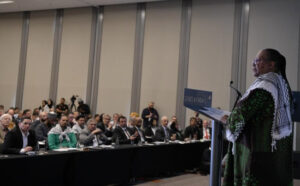
Editor’s Note: The following speech was delivered on May 10, 2024 by the South Africa Minister of International Relations Dr. Naledi Pandor to the Global Anti-Apartheid Conference on Palestine held in Johannesburg, South Africa.
Programme Director, Distinguished Guests, Ladies and Gentlemen
It is an honour to address you here today at the inaugural Global Anti-Apartheid Conference on Palestine. This is a watershed moment as it is the start of the global anti-apartheid movements on Palestine from around the globe coming together and joining forces in the struggle for justice for the Palestinian people. We would like to express our deep appreciation to Reverend Frank Chikane for spearheading the efforts to make this conference a reality at a pivotal moment for Palestinians who are fighting for their survival amidst mass starvation, military onslaught, and unspeakable war crimes and atrocities.
It has never been so urgent for the progressive forces around the globe to come together in a collective effort to exert maximum pressure to end the genocidal campaign underway in Gaza, and to end the apartheid system in Israel and the Occupied Territories which is worse than what we experienced in our own country. The ongoing genocidal atrocities being committed by Israel in the Occupied Territories has put renewed focus on the urgent need for the wider international community to demand decolonisation and an end to Israel’s settler colonialism. Progressive forces need to push for the fulfilment of the inalienable right of the Palestinian people to self-determination, which has been systematically denied since the British mandate, as well as the right of refugees in the diaspora to return.
South Africa is of the view that the international community has an obligation to find a comprehensive and just resolution to the Palestinian issue. So far, the traditional approach to conflict resolution has failed to achieve peace in the Israel–Palestine conflict. It is possible that a different approach, one that uses a human rights perspective on conflict resolution, could produce what the old approach could not.
A human rights approach asserts that the principles and practices enshrined in the Universal Declaration of Human Rights, including equality and non-discrimination, participation, inclusion, and accountability, and the importance of the rule of law should guide all the stages of the peace process.
South Africa calls for international solidarity and increased pressure to support the just cause of the Palestinian people to achieve their legitimate demand for a viable independent state alongside the state of Israel. South Africa stands ready to work more closely with Palestine and believes that the only way to bring about a lasting peace in the Middle East is to have a comprehensive and negotiated settlement, without preconditions, to end the Israeli occupation of the Palestinian territories and Israel’s continued blockade and siege of Gaza.
South Africa recognises the connection between the Palestinian struggle for self-determination and the wider global movement for liberation from both colonialism and other associated forms of structural and institutionalised racism. South Africa has consistently shown its commitment to the Palestinian cause over the past 30 years of democracy, and we are also intent on supporting efforts to bring the Palestinian factions closer together so that they speak with one voice and have a common vision on the way forward.
The people of South Africa and Palestine share an indivisible bond of solidarity, forged by the crucible of the two nations’ respective liberation struggles. South Africa has, since the dawn of democracy in 1994, always been an ally of Palestine and has constantly highlighted the struggles of the Palestinian people, supported them in international bodies, and offered material assistance within its means.
The Palestinian experience evokes memories of South Africa’s own history of racial segregation and oppression. As oppressed South Africans, we experienced first-hand the effects of racial inequality and discrimination, and we identify fully with the struggle for freedom and self-determination in Palestine.
For many decades, South Africa’s struggle for freedom benefited greatly from international solidarity. The steps to our own freedom during the liberation struggle in the period between 1960-1994, was premised on four pillars that marked an important watershed in the struggle against apartheid namely: mass mobilization; armed operations; underground organization; international solidarity work. These pillars amplified the plight of oppressed South Africans worldwide, thereby putting a spotlight on the then government, and widening the clarion call for action in various multilateral bodies. These actions put pressure on the government to hold talks, which ensued.
Thus, we believe the inaugural meeting of the Global Anti-Apartheid Movement on Palestine is rightly hosted in South Africa as a launch pad to consolidate international efforts to bring down “Apartheid” Israel. At a governmental and political level, we suggest that the conference as a collective should, as a matter of priority, consider a role for “front line states” as the liberation movements in South Africa had done in our struggle for freedom and democracy.
The pivotal role played by the United Nations and civil society in supporting our respective liberation struggles and the impact this had in us achieving our self-determination must encourage the UN and its Member States, the international community and civil society to strengthen international action and coordination to uphold international norms and standards in seeking justice for the Palestinians.
The UN General Assembly and the UN Security Council are obliged to heed the compelling evidence presented by Amnesty International, other human rights organizations, as well as the evidence presented in our case at the ICJ and hold Israel accountable for its crimes against the Palestinian people. The reports shine a spotlight on Israeli laws and practices that warrant scrutiny and appropriate action. The national law promulgated by the Israeli Government is evidence that the government is set on maintaining Israel as an apartheid state.
Since 1948, Palestinians have endured ethnic cleansing, the Nakba (catastrophe) of forced displacement and exile; the denial of their right to return to Palestine; and an ongoing process of domination, foreign occupation, annexation, population transfer, and settler colonialism.
We gather here today just prior to May 15th, the date when we commemorate Nakba Day, which in history marked the beginning of the never-ending struggle for independence for the Palestinian people and the denial of their inalienable rights as laid down by international covenants like the Universal Declaration of Human Rights and the International Covenant on Civil and Political Rights.
The Nakba involved a combination of mass murder, and the forced displacement of hundreds of thousands of native Palestinians by Zionist militias, to replace them with Jewish immigrants and create what is known today as “The State of Israel.” Now we are witnessing “Nakba Two” in Gaza.
This conference provides us with an opportunity to demonstrate solidarity with the people of Palestine and to collectively acknowledge the fact that Palestinians are still deprived of many inalienable rights including the right to self-determination as well as the right to independence.
Since Israel was established in 1948, its policies and legislation have been shaped by an overarching objective: to maintain a Jewish demographic majority and maximise Jewish Israeli control over the land to the detriment of Palestinians. In order to achieve this, successive Israeli governments have deliberately imposed a system of oppression and domination over Palestinians. The key components of this system are territorial fragmentation; segregation and control; dispossession of land and property; and denial of economic and social rights.
The guiding principles of the current Israeli government, formed in December 2022, explicitly declare that “the Jewish people have an exclusive and unquestionable right to all areas of the Land of Israel’ and pledges to “promote and develop settlements in all parts of the Land of Israel – in the Galilee, the Negev, the Golan Heights, Judea and Samaria (occupied West Bank); and the transfer of the administrative powers of the occupation to the Israeli government and the extension of direct civil legal authority over the settlements, which amounts to de jure annexation. By doing so, Israel institutes its annexation of the OPT. In recent months, Israeli officials and settler movements have been calling for resettling northern Gaza and places that the Israeli army destroyed during its ongoing genocide in the Gaza Strip.
We need to stress that there can be no solution to the situation for as long as the international community continues to ignore Israel’s systematic human rights transgressions and settler colonial apartheid project and through it, sustain the illegal Israeli colonial settler project at the cost of Palestinian liberation.
On 21 August 2022 South Africa and Palestine launched a Strategic Dialogue with the intention of mobilizing African countries to support Palestine and to enhance bilateral relations with Palestine on the continent. The other objective was to exchange views based on the South African experience that will assist to end Israeli domination in Palestinian territories, and raise international awareness on the plight of Palestinians, especially the expansion of illegal settlements by Israel.
South Africa has actively lobbied for the withdrawal of Israel as an observer member of the African Union and will continue efforts towards support for the two-state solution and the right to self-determination. We will continue to support Palestinian efforts for membership of the United Nations and the creation of positive, credible, and lasting international mechanisms to address the Palestinian cause based on international law. We would like to see the formulation of practical strategies regarding taking up the Palestinian cause at the ICC and ICJ to declare Israel as an apartheid state, and to mobilize civil society both in Palestine and internationally to support the Palestinian cause.
South Africa supports calls for the international community, the United Nations, and civil society to act against Israel’s settler colonial apartheid regime through a series of recommendations, including for Third States to take steps towards completely decolonising Palestine. This must involve the dismantlement of all structures of domination, exploitation, and oppression, and the realisation of the Palestinian people’s inalienable rights, including to self-determination and to return to their homes, lands, and properties.
Third States need to recognize and condemn, including through regional and international organizations, Israel’s discriminatory laws, policies, and practices which have cumulatively established, and continue to maintain, an apartheid regime of systemic racial oppression and domination, over the Palestinian people. Member States of the UN General Assembly should adopt a resolution to reconstitute the UN Special Committee against Apartheid and the UN Centre against Apartheid to address Israeli authorities’ commission of the crime against humanity of apartheid against the Palestinian people and empower these bodies to proactively pursue the dismantlement of Israel’s settler colonial apartheid regime.
We would like to see the Office of the Prosecutor of the International Criminal Court expedite the current investigation into the Situation in Palestine without undue delay, including into war crimes and crimes against humanity, comprising, inter alia, the crimes of apartheid, population transfer, appropriation and destruction of property, pillage, persecution, wilful killing, murder, and torture carried out on the Palestinian territory.
South Africa remains committed to ending impunity for war crimes, crimes against humanity and genocide, and it is hoped that the situation in Palestine will be prioritised by the ICC in order to deliver justice to the victims of these grave crimes.
South Africa is amongst the countries that made presentations from 19 to 26 February this year at the International Court of Justice (ICJ) public hearings, having requested an advisory opinion in respect of the Legal Consequences arising from the Policies and Practices of Israel in the Occupied Palestinian Territory, including East Jerusalem. The hearings were held against the backdrop of the deadly military onslaught on Gaza which has seen the killing of over 33,000 Palestinians since October 7th.
South Africa made a presentation to the ICJ on 20 February this year, and told the Court that Israel is responsible for apartheid against the Palestinians, and its occupation is inherently and fundamentally illegal, and by implication in violation of the Palestinian people’s right to self-determination.
It is encouraging to note that the majority of countries that are supporting the Palestinian cause hold a position that by transferring parts of its civilian population into the Occupied Palestinian Territories, Israel violated Article 49(6) of the Fourth Geneva Convention, which prohibits occupying powers from deporting or transferring parts of their civilian population into the territory they occupy. It also prohibits the ‘individual or mass forcible transfers, as well as deportations of protected persons from occupied territory.’ This reaffirms the ICJ’s advisory opinion on the West Bank wall.
Now that the hearings have concluded, the Judges will undergo a process of reviewing all the arguments, including 57 written submissions, and provide an advisory opinion. The judges are expected to take about six months to deliver an opinion in the case.
South Africa calls on civil society and governments around the world to recognise and condemn the ongoing discrimination, dispossession of land, repression of non-violent resistance, suppression of civil society organizations and indiscriminate killings, and pressure the State of Israel to end its occupation and apartheid system.
There must be concerted international efforts to bring about a just solution to the question of Palestine. This will not only provide the Palestinian people their inalienable right to self-determination and independent statehood but will also ultimately contribute to the establishment of peace in the region.
In this regard, it is imperative to revitalize international action and seek avenues for justice. We must intensify the call for international action with the UN playing a leading role to find a solution which is premised on a just settlement with just laws that are rights-based. We must, as the international community, seek a solution which facilitates equality and equity for all who have the right to live in the territories of Israel and Palestine. In the absence of these, security, dignity, and prosperity will not be achieved.
Lastly, the South African Government will continue to act within the institutions of global governance to protect the rights, including the fundamental right to life, of Palestinians in Gaza, which continue to remain at urgent risk including from Israeli military assault, starvation, and disease, and to obtain the fair and equal application of international law to all, in the interest of our collective humanity.
We will continue to do everything within our power to preserve the existence of the Palestinian people as a group, to end all acts of apartheid and genocide against the Palestinian people, and to walk with them towards the realization of their collective right to self-determination. We continue to do so following in the footsteps of Nelson Mandela and will not rest until the freedom of the peoples of Palestine is realized.
I thank you.
Dr. Naledi Pandor
Dr. Grace Naledi Mandisa Pandor is a South African politician, educator, and academic who has served as the Minister of International Relations and Cooperation since 2019. She has also served as a Member of Parliament for the African National Congress (ANC) since 1994.
South Africa, Ireland, Palestine, and political strategy
Sinn Féin National Chairman Declan Kearney on the paradigm shift required within the Palestinian struggle to win.
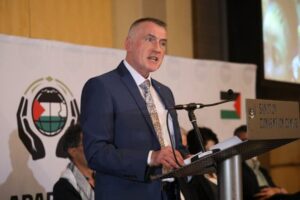
I am honoured to have been invited to address this conference in Johannesburg on the development of a Global Anti-Apartheid Campaign on Palestine and the support of Palestinian national and democratic rights.
I have never visited South Africa before, but the historical significance of Johannesburg resonates strongly with me
Where Nelson Mandela and Oliver Tambo established their joint law firm.
The resting place of Joe Slovo and Chris Hani; revolutionary leaders of the armed struggle.
The birthplace of Joe Modise who not only commanded MK forces, but managed their integration with SANDF.
And, it is also the home of my friend and comrade, Ronnie Kasrils, who remains as committed to political struggle today as when he first joined the national liberation, and became part of its collective leadership.
I also think of Soweto, which was so central to achieving the freedom of South Africa.
The connections between South Africa’s liberation struggle and Ireland are historic, and endure to this day.
MK and the IRA maintained close links and provided mutual support to each other.
That political and military relationship was directly overseen by Joe Slovo and Joe Modise.
Sinn Féin, and Irish Republicans generally, were deeply committed to the campaign to end apartheid here.
When democracy was finally achieved, the new Republic of South Africa and the ANC became important partners, as well as touchstones for Sinn Féin, in the development of the Irish peace process, and shaping the path to self-determination and national reunification in Ireland.
The political and fraternal links between Irish Republicans and the Palestinian national liberation cause have also existed for many decades.
Palestinian and Irish freedom fighters shared a special bond of solidarity.
Sinn Féin’s commitment to our Palestinian sisters and brothers is absolute and unbreakable.
Just as we stood by those who struggled against apartheid in South Africa, we remain in active support with the Palestinian people who struggle against the apartheid and illegal Zionist occupation imposed upon all of Palestine.
Ours is an internationalist commitment to all those who have and are struggling against repression, exploitation, and for freedom in pursuit of a better, equal, and democratic world.
Whether that has been the townships of South Africa; the refugee camps of Palestine; the mountains of the Basque Country; and the Sierras of Cuba; or, the barrios of Latin America.
History did not commence on the 7 October, but that date has now become a watershed, not only for Palestine itself, but for the entire international community.
It has raised existential issues for the most powerful states which dominate, and for global multilateral institutions, about how international law is implemented, and the dynamics of our multipolar world are democratically managed.
Israel’s genocidal war against Gaza, its aggression in the West Bank, and the collective punishment and ethnic cleansing against the Palestinian people, has posed explicit questions specifically for that cartel of Western governments which control the global north about:
Their actual commitment to international law and primacy of the UN charter;
Their attitude to geopolitical relations with the global south;
And particularly, their moral compass towards international relations, and the actual value they confer on Palestinian humanity, and the national rights of Palestinian people.
The war in Gaza and continued oppression of the Palestinians has laid bare the moral hypocrisy of the big Western powers.
Their imperialist and colonialist histories casts a very long, dark, contemporary shadow over their decisions and actions.
Their stances on Palestine are absolutely untenable, from opposition and equivocation to the calling for a ceasefire, to continuing to fund and arm the Israeli murder machine, and refusing to enforce sanctions.
These positions are incompatible with universal democratic principles, multilateralism, and peaceful coexistence.
Israel’s genocide, ethnic cleansing, collective punishment, and settler colonialism may yet become a seminal point for global diplomacy and how it is conducted.
As an Irish Republican party, Sinn Féin is dedicated to the sovereignty of all people.
That is, democracy in its fullest sense.
Our Republicanism is an expression of our progressive internationalism.
Our Republican ideology is internationalist by definition. Its genesis rest in the ideals of the American and French revolutions of the 18th century.
We are committed to the universality of peace, equality, social justice, national self-determination and democracy for all peoples.
Our approach to international relations is governed by adherence to international law, the UN Charter, military neutrality and nonalignment, diplomacy, multilateralism and peaceful coexistence; and also an opposition to imperialism in all its forms.
We bring a struggle perspective to how we engage the world.
We stand for the independence of all nations and peoples, including our own.
Progressive nationalism, not narrow chauvinism.
I believe that national self-determination is the essential, international struggle of our time.
The world we live in is dominated by this issue; the national democratic struggle; the aspiration and right of peoples to determine their own destinies and relations with other nations.
The UN Charter expressly establishes the right to self-determination in Article 1, Paragraph 2.
The denial of that right goes to the heart of Israel’s apartheid of, and occupation in, Palestine.
The struggle for national self-determination in Ireland is centuries old.
Its roots lie in English colonialism eight centuries ago.
Just over 100 years ago British imperialism imposed the partition of Ireland; creating a one party, apartheid state with an inbuilt unionist majority.
Four years previously, the Balfour Declaration established doctrine of a Zionist state, later to emerge as the state of Israel.
Since then, the rights of Palestinians have been repeatedly subjugated by Western imperial interests, in collusion with Zionist colonialism.
When World War II ended in 1945, there were some 45 states in the world.
Today there are nearly 200 as the old colonial empires broke up and new nation states emerged.
Consider the straight lines on maps which marked the boundaries of most African and Asian states.
These were drawn by the rulers of European empires and 19th and 20th century colonial powers – the products of imperialism and colonialism.
Churchill drew the boundaries of Iraq – locking the Kurds into a political prison.
Bismarck cantonized Africa.
Lloyd George oversaw Ireland’s partition.
And Balfour foreshadowed the breakup of Palestine.
Throughout the 20th century, the Palestinians have been dispossessed, displaced and exiled.
Israel state strategy systematically hollowed out the Oslo Accords.
It has sought to put the prospect of Palestine in national sovereignty beyond reach.
All of this has been done with the active complicity and acquiescence of Western powers.
Yet, modern history has also been progressively shaped by anti-imperialist and national liberation struggles.
Only two weeks ago, South Africa celebrated Freedom Day.
Thirty years ago the national democratic revolution came into existence.
Four years later, in April 1998, Ireland’s peace settlement, the Good Friday Agreement, was signed.
The Irish peace process was formalized and a line was drawn under political conflict.
A framework was negotiated to oversee the democratic reform of the northern state.
And critically the right to self-determination was built into the provisions of the Good Friday Agreement.
Change has been slow and protracted.
Challenges remain, but today Ireland and especially the north, once a militarized war zone, has been transformed.
The permanent unionist majority has disintegrated and Sinn Féin is the largest party in Ireland.
We now lead the power sharing coalition in the north, and real potential exists to lead government in the southern state.
Constitutional change is on the political horizon.
While nothing is ever inevitable, today we are closer than ever to Irish unity.
The historic changes achieved in South Africa and Ireland emerged from the changed context created by revolutionary armed struggle, which then gave way to negotiations, and ultimately negotiated settlements.
The ‘Four Pillars of Struggle’ in South Africa provided strategic direction and cohesion to the people’s war and mass struggle to end apartheid.
The implementation of our ‘National Strategic Objectives’ by the Sinn Féin leadership guided the Republican struggle from the phase of armed struggle; into multi party talks; the achievement of the Good Friday Agreement; and, it must be said, successive phases of negotiations since then.
Negotiations is a permanent site of struggle.
The ANC and Sinn Féin leadership learned from, and supported each other, throughout these dramatic periods.
Together, we prioritized the primacy of political strategy and leadership, and the centrality of unity and cohesion among the forces of struggle.
These objectives were essential to building political strength.
We did so by taking strategic initiatives, making strategic compromises, and at all times asserting the primacy of politics.
However, neither national democracy in South Africa, or peace in Ireland, would have been achieved without the development of international strategies.
Both the ANC and Sinn Féin successfully internationalized our respective struggles for national democracy and self-determination.
The global anti-apartheid campaign against the Afrikaner regime realigned world opinion and shifted the position of key Western powers, including the USA.
It was a cumulative process of international pressure built up over many years until its momentum was unstoppable.
In Ireland, young striking workers in the mid-1980s changed the policy of the Irish government towards trade with the apartheid government.
Sinn Féin’s peace strategy identified the strategic importance of the Irish diaspora in North America.
We successfully ‘greened’ the U.S. White House in the early 1990s.
The Good Friday Agreement itself was the result of positive international engagement by the U.S., EU, Canada, South Africa, and other international stakeholders.
World government and popular opinion embraced the objectives of ending apartheid in South Africa, and the ending of the war in Ireland, through a peace settlement and a negotiated process of democratic change.
The war in Gaza has become a lightning rod for mobilizing popular global opinion against Israel’s apartheid occupation in Palestine.
The solidarity of ordinary people for Palestine across the global north is unprecedented.
The actions of students, particularly in the U.S., but also in Ireland, Britain, and Europe are reminiscent of the student movement against the Vietnam War.
Students in the U.S. have ensured Israel’s war is now at the center of the Presidential election contest.
The inherent contradictions within Israeli society have never been more sharply exposed.
A pro-peace movement is growing and the state administration of Israel is divided.
The ground-breaking legal action at the ICJ in The Hague by South Africa is not only courageous; it has directly impacted upon the policies of other international governments.
Even though key Western powers have taken outrageous positions in backing Israel, because it serves as a proxy to secure their security and economic interests in the Middle East, the fact is that the West and Europe are not monolithic.
Consider the advanced positions taken by Spain, Portugal, Malta, Belgium, and Ireland. They have all stepped away from the prevailing consensus in the EU.
In addition, clear divergences on policy in Palestine exist within the White House, U.S. State Department and National Security Council.
All of these factors are relevant to the development of the global anti-apartheid campaign which is now essential to securing Palestinian national self-determination, sovereignty and statehood.
Of course there are lessons to be applied for the international interventions which were so important in South Africa and Ireland.
However, the focus of this initiative must be clearly aimed at the complete political, diplomatic and economic isolation of Israel until a complete ceasefire is achieved, and the apartheid occupation is finally ended.
That will mean influencing the balance of power relations and forcing in policy positions of all Western and regional powers towards Israel and the Middle East more generally.
The aim must be delivery on the national and democratic rights of Palestinians, as indemnified in international law.
I believe the global landscape is changing.
A properly calibrated global anti-apartheid strategy can affect and maximize opportunities within that evolving context.
There is now a moment.
A strategic and political opportunity is emergent.
That should not be lost on the Palestinian leaderships.
The South African anti-apartheid campaign provides an historic point of reference with regard to economic divestment and sanctions, diplomatic and multilateral pressure, and political objectives.
However, this cannot be addressed in isolation from the imperative of establishing Palestinian national unity and political cohesion between all national movements and parties, and with civic society.
For the success of a global campaign to be fully maximized, there must be a resolution of divisions within the Palestinian national struggle.
Make no mistake; there is no alternative to an agreed national liberation strategy.
The resistance and reluctance to develop a strategic consensus, embrace political unity, and provide united leadership, is both a strategic failure and weakness.
A united Palestinian leadership which commands overall popular support will give positive impetus to a global anti-apartheid campaign.
A paradigm shift is required within the Palestinian struggle.
An integrated political strategy with properly defined objectives should be agreed, and both generate and direct political momentum within Palestine itself and internationally.
Israel will never defeat the Palestinian spirit of resistance.
There is no military victory for any side.
But the Palestinian struggle needs to equip itself with the cohesion, capacity, and strategies to win.
More of the same is no longer an option. Passing the torch of struggle to future generations is not tenable.
This moment must be seized.
A new phase of struggle is needed.
Progressive and democratic international pressure must be geared to introduce positive initiatives and interventions to deliver a full ceasefire; inclusive talks; followed by fully representative negotiations; an irreversible peace settlement; and achievement of Palestinian national determination and full sovereignty.
The South Africa Freedom Charter, the Harare Declaration, and the principles and provisions of the Good Friday Agreement are political resources which can assist with that paradigm shift.
This war will eventually end.
A new phase will open.
The Palestinian struggle and its component leaderships need to prepare now for the negotiations table when that time finally arrives.
The domestic and international experience of Ireland and the Sinn Féin leadership is available to that end.
We are committed to supporting the development of a Global Anti-Apartheid Campaign for Palestine, while at the same time helping to achieve national unity and development of an agreed political strategy for national democracy and sovereignty.
Declan Kearney
Declan Kearney is the current National Chairman of Sinn Féin. Kearney has been active in republican politics in Northern Ireland since 1980 and has been a key member of Sinn Féin’s national leadership since 2003.
A moment of tremendous hope, so proud Glyn was able to be there to represent us. Many clear new strategies put forward by the SA minister. Centring human rights , is there a tension there with the nation-state perspective as put forward by the Irish speaker? She mentions the two-state solution as already agreed in international law; he looks forward to a united Palestine-Israel and a united Ireland. Maybe the first can be a step to the latter.