
Too good to be true
JVL Introduction
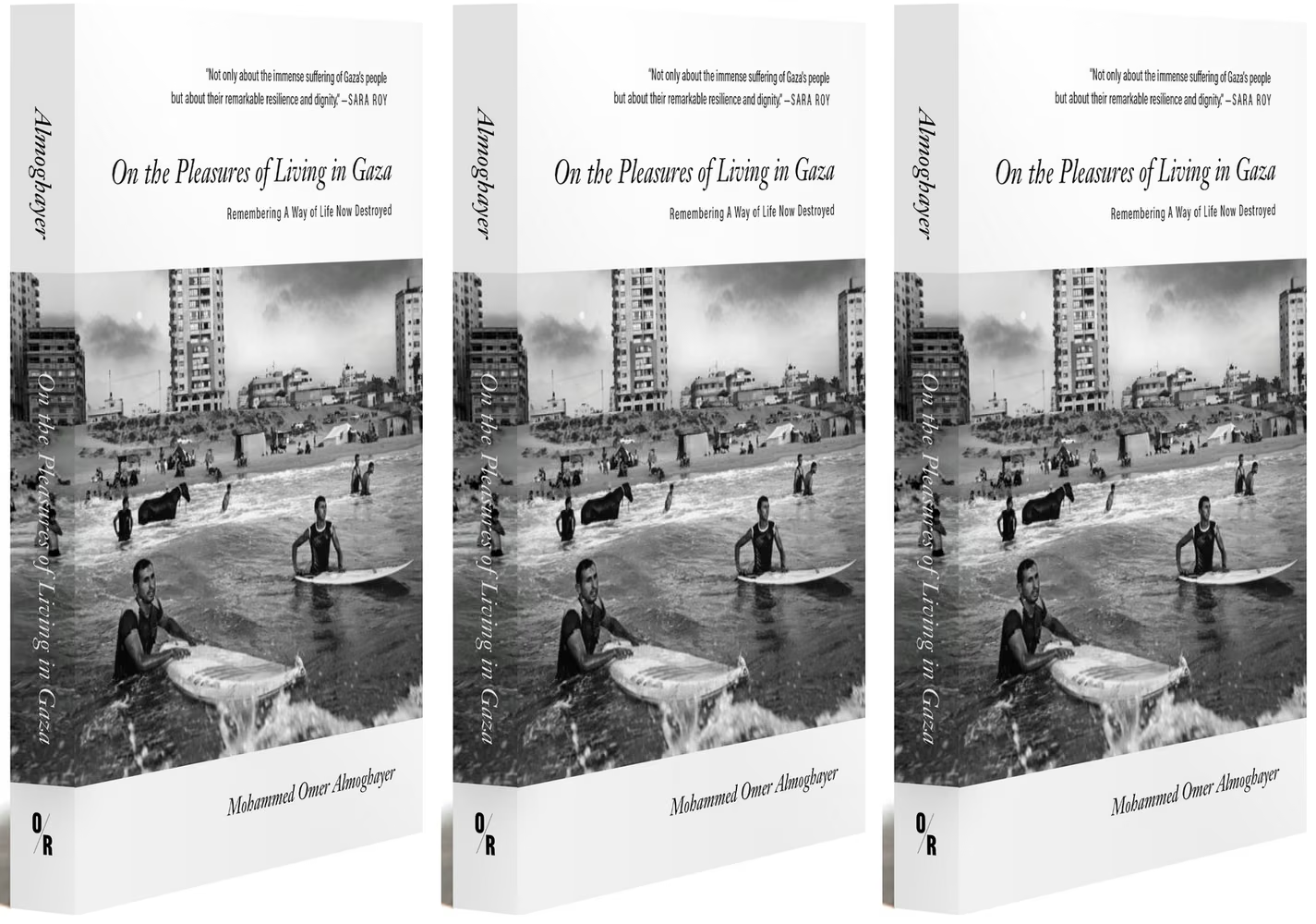
OR Books has just published Mohammed Omer Almoghayer’s book On the Pleasures of Living in Gaza.
This aims to get away from “the way folks fixate on the sad side of the story” – and Gazans as victims – by reconstructing for readers the real Gaza as it was before the ongoing genocide.
Deborah Maccoby is not convinced.
While the author does to some extent capture “pleasures clutched from adversity’s depths”, Maccoby finds that “the Gazans of his book are not real human beings; despite all their diverse passions and pleasures, they are one-dimensional, identical … The stories are heartwarming; but they are too heartwarming, inspirational and feel-good”.
It reminds us of the sterling work of WANN (We Are Not Numbers), now over 10 years old, continuing to work out of Gaza to this day, to give voice to “the daily personal struggles and triumphs, the tears and the laughter, and the dreams and aspirations that are universally experienced but often not recognized for Palestinians, who instead have been dehumanized”.
WANN seems to be better at it than Omer Almoghayer, speaking more nuancedly and with a much wider range of voices as a visit to its website shows.
On the Pleasures of Living in Gaza can be ordered from OR Books here.
RK
On the Pleasures of Living in Gaza: Remembering a Way of Life Now Destroyed, by Mohammed Omer Almoghayer, Or Books, 2025, pp. 258.
Reviewed by Deborah Maccoby
In a press conference held on February 4, 2025, President Trump, unveiling his plan to empty Gaza of its people and turn it into a “Riviera” for the international super-rich, described Gaza as
a symbol of death and destruction for so many decades and so bad for the people anywhere near it, and especially those who live there and frankly who’s been really very unlucky…. It’s been an unlucky place for a long time.[1]
Mohammed Omer Almoghayer’s aim is to reconstruct for his readers the real Gaza as it was before the ongoing genocide. He objects to “the way folks fixate on the sad side of the story” (p. 1), in a “one-dimensional portrayal of little more than ‘victims and terrorists’” (p. 180). Even Gaza’s supporters usually view its inhabitants only as victims. Instead, his book seeks to fulfil Gazan aspirations “to be recognized not solely as a besieged and war-ravaged enclave but as a place inhabited by over two million real human beings” (ibid.).
Omer Almoghayer explains in his Introduction: “I write mostly in the present tense to make Gaza feel alive once more – an illusion, a resurrection, a magic spell” (p. 5). He waves his magic wand, and we are now, he tells us, in Gaza as it was before the genocide. Each chapter provides one, two or three examples (loosely linked together by theme when there are more than one) of simple pleasures in pre-genocide Gazan society, as told through stories about individuals.
To take Chapter 2, which is called “At the Shoreline: Quail, Surfing and Pizza”, as an example: we learn here about: Maher Shamalakh, a 19-year-old quail hunter who enjoys the “simple pleasures of catching quail at dawn and sharing them with his loved ones”, in spite of Israel’s restrictions on fishing in Gaza’s waters[2]; two young Gazan surfers, Ahmed and Mohammed, who share one old second-hand surfing board, and an 86-year-old Jewish-American doctor and surfer, Dorian “Doc” Paskowitz, who persuades four Israeli surfing board equipment companies to donate to Gaza fourteen brand-new surfing boards, which, to the joy of Ahmed and Mohammed, who are each given one, he manages to bring to Gaza in person; and the pleasure Gazans take in a pizza festival at the port, held by a delegation of Italian chefs, who have come on an exchange visit funded by the Italian government. Gazan chefs learn to cook pizza and in return teach the Italian chefs to cook traditional Palestinian cuisine.
There are also the “silver lining” (p. 106) joys that are found within destruction itself. A typical example of this is the sport of parkour – jumping and climbing over obstacles — which turns out to be particularly suited to the ruins of the buildings destroyed in Israel’s periodic missile attacks against Gaza: “Gaza’s rubble and debris provide unique environments for exploration and discovery” (Chapter 7, p. 105). Omer Almoghayer tells us about Amira, an “unstoppable” young woman finding temporary freedom in parkour both from the prison that is Gaza and from restrictive cultural expectations about the role of women (pp. 105-106). Again, two young men who have each lost a leg in Israeli missile attacks – one his right leg, the other his left leg – become inseparable friends and share the cost of buying one fashionable pair of new shoes; one has the left shoe, the other the right one (Chapter 5, pp. 85-88).
The chapters are linked by a “connecting thread” as the author puts it (p. 2) of the tale of a farmer called Naji, a newspaper photo of whom — showing him bound and blindfolded and “inexplicably buried up to his navel in a sandy ditch”, surrounded by Israeli soldiers, at a time “in the middle of the second intifada”[3] (pp. 12-13) — was seen by an American couple, who charged Omer Almoghayer with the task of finding Naji so that they could help him. Each chapter includes an Interlude with a new episode of the story of the author’s journey from his hometown, Rafah, in the south of Gaza, to northern Gaza in search of Naji. Eventually, Naji is found, living in misery with his wife and children in a broken-down house in a dangerous buffer zone (pp. 32-33); but his life and those of his family are transformed when the American couple donate thousands of dollars to them (p. 60).
In contrast to the “connecting thread” of the story of Naji, there is a sudden break in the book in the last two chapters before the conclusion (Chapters 13 and 14). These describe the author’s kidnapping in February 2015 by a mysterious IS-linked Islamist group, who torture and threaten to kill him unless he pledges allegiance to their leader, the self-described Emir of Gaza. In stark contrast to the hospitality, kindness and love shown by everyone we have met so far, these people are full of hate and violence. Omer Almoghayer concludes these two chapters by writing that his ordeal was one of the reasons that he decided to write this book:
They envisioned Gaza as isolated, hopeless and devoid of pleasures and joyous moments. So, I decided to write this book to prove to him [the self-described Emir] and his associates that they are wrong (p. 224).
According to the book’s blurb, Omer Almoghayer tells the story of the ability of the people of Gaza “to rise above their hardship and enjoy the simple pleasures of life” while “in no way diminishing the horrors hurled on the Strip in the recent past, or the prior suffering of those forced to live in what was effectively an open prison”.
It is true that throughout the book Omer Almoghayer reminds us that these are “pleasures clutched from adversity’s depths” (p. 228). This gives the simple pleasures that he describes an intensity and poignancy unknown to those of us who do not live in a prison subjected to blockade and periodic massacres. These qualities of intensity and poignancy do come over in the book. But at the same time, as I read it, I felt a growing sense of unease. At the back of my mind, I kept hearing the word “Pollyanna”, the eponymous heroine of the 1913 novel[4], who always manages to find the silver linings to dark clouds; the darker the cloud, the more she rises to the challenge. “Pollyannish” means, of course, a kind of fake, unrealistic optimism.
When I came to Chapter 12, which includes a description of a TEDx conference held in a hotel in Gaza, I realized that I had become aware at the back of my mind of another quality in the book that can best be described in terms of a TEDx motivational speaker. Almost everyone we meet in the book is “amazing”, “incredible”, “inspiring”, “wonderful”, “an unstoppable force”. Omer Almoghayer’s aim is to counter the “one-dimensional” portrayal of Gazans as either “terrorists or victims” and to depict “real human beings”. But the Gazans of his book are not real human beings; despite all their diverse passions and pleasures, they are one-dimensional, identical and straight out of a TEDx talk.[5] Everyone (apart from the IS kidnappers and torturers) is calm, compassionate and understanding. One longs at times for someone to throw a temper tantrum. The stories are heartwarming; but they are too heartwarming, inspirational and feel-good. At the end of the story of Naji, one can’t help thinking about all the other Najis who don’t have rich American benefactors. And the emphasis on American benefactors merely reinforces the sense of Gazans as victims needing charity.
My uneasiness came to a head when I came to the last paragraphs of the last chapter (before the Epilogue). After praising the “incredible” people of Gaza, who, “faced with insurmountable odds, find pleasures, show strength and keep a sense of humour even in the most trying of circumstances”, the author tells us:
And now, dear reader, I must leave you, as tomorrow I leave Gaza for an exciting opportunity as a research scholar at Harvard University (p. 234).
I couldn’t help feeling at this point that it is easy and satisfying to be Pollyannish and motivational on behalf of other people, while Omer Almoghayer himself is able to escape “the most trying of circumstances”. Only a few dates are provided in the book. The time-range (which often has to be worked out from internal evidence) is from the 1990s to 2015; but the use of the present tense almost throughout the book creates an impression of an eternal present, in which the fact that Omer Almoghayer has not lived in Gaza since he left for Harvard in 2015 (a date that is not provided) is not mentioned and escapes attention.[6]
This critique is not to deny the hospitality, community spirit and resilience of the people of Gaza. To an extent, these qualities do come over in the book. But in the end, it seems to me that it is written by an Americanized Palestinian who has moved away from Gaza and looks at it from the outside. He skims the surface, like a surfer riding a wave. Omer Almoghayer’s “magic spell” is superficially very readable, charming and persuasive (two of his favourite words are “captivating” and “enchanting”). But it seems to me that ultimately it takes us not into the authentic pre-genocide Gaza, but into a dream-Gaza conjured up by Pollyanna and a motivational TEDx speaker.
Endnotes
[1] Full text of Trump and Netanyahu’s explosive news conference, MiddleEasst Eye, 05 Feb 2025
[2] Quail are small birds, not fish, but, in a very interesting explanation, Omer Almoghayer tells us that they are caught in shore nets. “’It is all a matter of luck,’ says Maher. ‘Sometimes they land on my shore nets. Other times they fly over and head towards high buildings or land further down the shore in my friend’s nets'” (p. 40). The quail only arrive once a year and just for a few weeks (the time of this varies from year to year); but at that time Maher’s family have a feast of them. The rest of the year the family relies on vegetables and fruit from their garden (p. 41).
[3] This would have been about 2003.
[4] By the American author Eleanor H. Porter.
[5] I also found myself wondering at times whether the book has been “enhanced” by AI. The word “delve” (p. 22 and p. 141) is used twice and “tapestry” (pp. 24, 162 and 234) three times (these are two of AI’s favourite words). The style is very readable and comes over at first as poetic, but it is rather too smooth, corporate and formulaic.
[6] In addition to these reasons for my sense of uneasiness, there are a couple of small points that I find very puzzling. In Chapter 13, about his kidnapping and torture, Omer Almoghayer writes: “I had hoped my linguistic skills would enable me to decipher the identity of my captors, drawing on my university classes with Noam Chomsky and his behaviorist view of language acquisition” (p. 195). Chomsky is famous for his devastating attack on the behaviourist theories of B. F. Skinner. Is “behaviorist” a misprint for “anti-behaviorist”? In the context, it doesn’t appear to be. The natural interpretation of “my university classes with Noam Chomsky” is that Omer Almoghayer was taught by Chomsky; but it seems — from a reference to the author’s need in one of the Interludes, in “the middle of the second intifada” (which must be about 2003) to “get home and study for my linguistics exam” (p. 95) — that he means simply that he encountered Chomsky’s books in his undergraduate university classes at the Islamic University of Gaza (he graduated from there in 2006 with BAs in English and in literature). It remains baffling that he refers to Chomsky’s “behaviorist view of language acquisition” Again, on page 13 the author tells us: “I was with Rachel Corrie, a young American woman, a few weeks before she was run over and fatally crushed by an Israeli bulldozer as it destroyed an innocent family’s home. I later guided her parents around the neighborhoods – some of them destroyed – where she spent her last weeks in Rafah.” Yet on page 253, in the Epilogue on the genocide, he comments: “With each fresh Israeli atrocity, I am tempted to think … this is the one that will finally end the massacres. But I have been saying this since I carried Rachel Corrie with the ambulance driver Abu Alaa to the same morgue and through the same metal doors over two decades ago.” If the dramatic story that he carried Rachel Corrie’s body to the morgue is true, why didn’t he mention this on page 13? In addition, terrifying though his kidnap and torture by IS must have been, it is hard not to suspect an element of embroidery in his account of his unflinching courage in defying his tormentors. He claims he said to them: “’I would rather face death than collaborate with creatures of the night. I am a servant of the sun, destined to toil under its warm rays’” (p. 200). Would someone being tortured and threatened with death really come up on the spot with such flowery language?

Deborah — you have made me think this is a rather good book, thank you for drawing our attention to it! Clearly the writer’s motivational puff-language is irritating ( I remember the same from one speaker from the Arab Spring who came over and then probably moved on to the USA leaving many of the real movement activists behind).
But the varied experiences of Gazans speak to me. Remembering time in another occupied part of ‘Greater Israel’ (the Sinai, now technically back under Egyptian control) when I saw many such moments. More, remembering that wonderful immersive play ‘Go to Gaza, Drink the Sea’ which showed so many strands of experience…It was of course fiercely attacked for ‘antisemitism and appropriating the Holocaust’ even though one of the main characters was a Jewish antizionist woman in the solidarity movement. Many of the attackers, I recall, went on to found Spiked and Unherd and all their myriad horrible alt-right front organisations.