
A template for Solidarity With Gaza
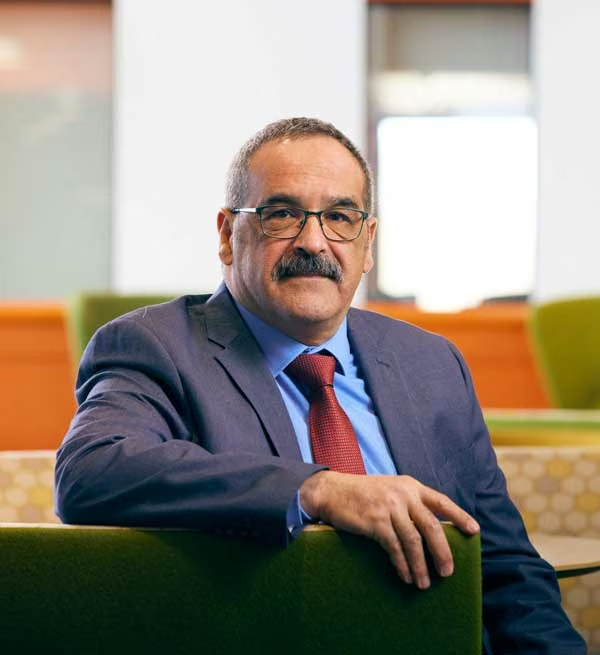
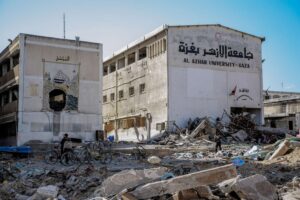
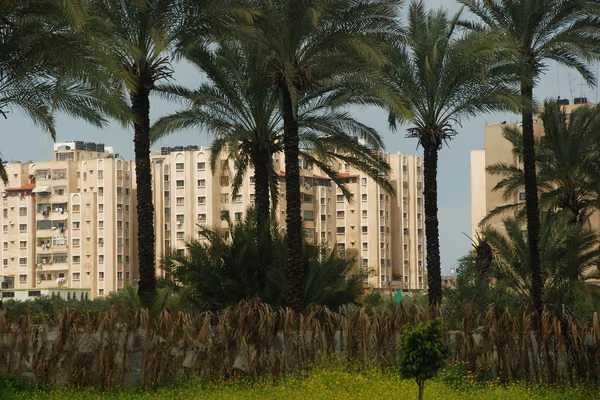
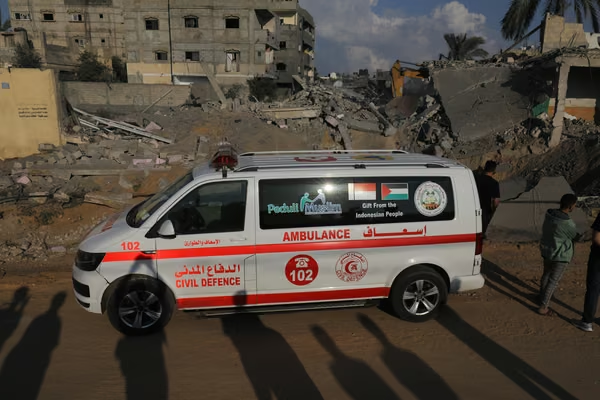
JVL member Felicity Laurence interviews Professor Mahmoud Loubani where she learns more about the horrors being endured and the terrible impact on Gaza’s medics and the health services more generally. The two medical schools in Gaza (pictured here) have been destroyed, at least five hundred healthcare professionals have been killed, 1500 injured, and 300 are detained. Medical care in Gaza is therefore decimated. But there is also hope borne out of an astonishing degree of international solidarity, astonishing because of the scale and the complexity of organising; as Felicity Laurence writes:
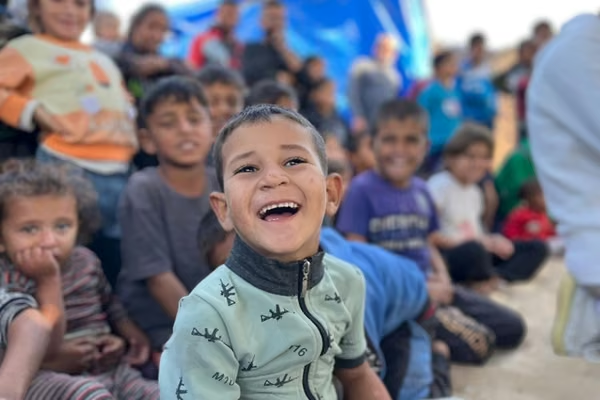
In all the horror of the ongoing genocide in Gaza, you can find – in the rubble and the devastation and the cruelty – tiny points of light; they pulse for moments here and there, now you see them, now you don’t (our media erasing yet again the truth and suffering revealed therein). But what they illuminate for those moments are the astounding resilience of the people there, and their relentless insistence on their very humanity. We see fleeting films of children singing, or watching someone being a clown to enchant them away from the nightmare for a little while: teachers setting up small learning centres, and the doctors and nurses who never rest and try to mend with anguished hands and hearts.
And in those moments of light we might also glimpse the embrace of those far beyond the inferno who do not just sit and watch, whether with sorrow or apathy, but who are acting directly to make things change, however incrementally, with a depth of solidarity that helps keep hope alive.
Gaza Educate Medics; Interview with Prof Mahmoud Loubani
The Gaza Educate Medics (GEM) project
In January this year, Prof Mahmoud Loubani met with colleagues from the PalMed Academy to discuss the idea of providing online training for the 2500 medical students in Gaza whose education has been disrupted by the obliteration of their places of learning, and by the slaughter of so many of their teachers and fellow students. The aim was to explore the possibility to work together with those surviving faculty from the two medical schools in Gaza in restoring medical education to these young students, enabling them to return to their studies and finish them to become the doctors which Gaza will so desperately need in the years ahead for its survival in the aftermath of these catastrophic events.
As I write, a voice on the news announces that Dr. Hassan Hamdan, head of the burns and plastic surgery department at Nasser Hospital was killed this afternoon along with eight members of his family when their house was bombed. Another heartbreaking annihilation of a family, and one less doctor to tend to the children whose images sear the soul. How can this be happening…
I interviewed Prof Loubani yesterday to find out about this project in which hundreds of staff from across the world will be joining the medical education teams in Gaza to make it possible for them to fulfil the curriculum they once were able to offer their students in standing buildings, and properly functioning hospitals: and with colleagues who were alive and committed to their medical vocation and serving their communities.
Prof Mahmoud Loubani is a consultant cardiothoracic surgeon, Honorary Professor of Cardiothoracic Surgery at the University of Hull, and the Chair of the PalMed Academy which is part of PALMED Europe. The meeting on January 24th, just over five months ago, resulted in the setting up of Gaza Educate Medics (GEM) virtual medical school, of which he is Chief Executive Officer. On March 1st, the call was sent around the world for volunteers to contribute their expertise to GEM. By the end of that month, 350 medics from across the planet – from the United States, the UK, from Russia, from all over the Middle East, from everywhere – came on board to support the local faculty in Gaza, while just over two thousand students registered for the project (in fact, 2003 students), of whom 80% remain in Gaza, 16% are in Egypt where they were able to seek safety, and the remaining 4% are now in various places across the world.
The two medical schools in Gaza have been bombed to smithereens, totally destroyed, with many dead and injured among both students and faculty. Five hundred healthcare professionals have been killed (as of this afternoon, 501), 1500 injured, and another 300 are detained. Medical care in Gaza is therefore decimated. But the Deans of each institution survive and are now working directly with the GEM initiative to restore their curricular programmes.
The first three years of the medical training is in the basic sciences, which are possible to teach in this virtual manner: however, the subsequent three years’ training requires clinical experience in the hospitals and this will prove more problematic given that the hospitals have been so severely damaged. There are layer upon layer of difficulties, but Prof Loubani was clear that the only way through these is to take one step at a time. There are few laptop computers that remain intact, but enough to gather around for the time being; NGOs entering Gaza are asking how they can help the project. Small steps forward.
Prof Loubani explained that the degree programme is very well structured and properly accredited by the two Gazan medical schools, with an extant assessment protocol that can be put back in action as soon as required. The intention of GEM is to enable students to continue their studies in Gaza, rather than be forced to leave in order to qualify elsewhere: as they begin to graduate, they will be able to provide the medical care their ravaged communities will need, and thus play their part, alongside those providing education for the children and students of Gaza, at the nub of the rebuilding of their lives and places.
GEM is envisaged as a 3-5 year project, after which the international group will hand over to the two medical schools in Gaza for the future. At this point, there would have developed an intricate and extensive global network of cooperation, knowledge transfer, and educational exchange, all of which would sustain subsequent communication and ongoing support for the doctors of Gaza. Once the medical programme is up and running, there are plans to apply the same template to the education of nurses.
While the project relies completely upon voluntary participation, there are of course ways to contribute financially. Laptops are needed for all of the students, and GEM is currently approaching IT companies that might be able to donate these. Each student needs $150 (approximately £120) monthly to survive and be able to study; as Prof Loubani pointed out to me, if just 2003 people took on the support of one student each, that would be transformative for the project and for the young students involved.
A South African company has donated a bespoke platform for the teaching material that will be used, some of which has been recovered in Gaza and some added from medical programmes in Ireland, the Netherlands, and elsewhere. On June 1st the GEM scheme was formally launched, and the online platform goes live next week, so from that point, hundreds of young Gazan medical students will be able, albeit cautiously, to return to their studies and their future.
It is very hard to feel anything other than helpless in the face of the continuing savagery, and Prof Loubani concurred that in the beginning this helplessness is what he and his colleagues experienced. But the GEM project is such a direct, concrete way of offering not only solidarity but tangible help -not only to these students and their teachers, but to the entire Gazan population who will benefit so greatly from the skills and knowledge of these students as they emerge as doctors from their programme of study.
As Prof Loubani put it, this is ‘a massive, massive project’ and he invites anyone with medical training to join and help, for example in offering lectures, teaching and also, where this could be possible, materials from their own medical programmes. People who might be able to offer other needed skills – organisational and administrative for example, are also invited to join.
As I spoke with Prof Loubani, going through numbers and the kinds of details that anyone must consider when setting up a complex educational programme, the scale of what has already been achieved was hard to grasp. After a few short months, 2003 young people in the middle of the cruellest of wars are coming into contact with people from across the international domain who are with them for one reason – to do what is possible from outside the maelstrom to preserve and bolster the precious lives within it – those of the students, those of the people they will treat and save, within a society that will rise again.
More information can be found, Prof Loubani contacted, and donations made, here.




Shiver went down my back reading this brilliant peace about the profoundly humane Prof Loubani. One must not underestimate the fear people have even taking one step at a time to do good and keep an eye on the medical future – this is about rebuilding and the rebuild starts now. BUT we must all be aware of the fact that any and all efforts to care/feed, provide medical assistance. train and rebuild for the future is watched carefully by those zealots who would eradicate anything and everyone doing good for Gaza. We must protect the Professor and all who support this amazing project. Well done and incredibly moving and hopeful.
After so much gloom & doom in our media, and minimal coverage of the carnage in Gaza, it is uplifting to learn of GEM which brings hope to the people of Gaza. GEM is a superb example of SUMUD.