
Jewish Journeys from Zionism – Diana Neslen (2)
JVL Introduction
JVL is collecting stories of people’s journeys away from Zionism and have just completed the pilot phase, resulting in four moving and thought provoking pieces following interviews with JVL member, Kitty Warnock. Further interviews are planned. For all those interviewed, the events on and following October 7th have been pivotal. We will publish the first four over the next few days and others as they become ready.
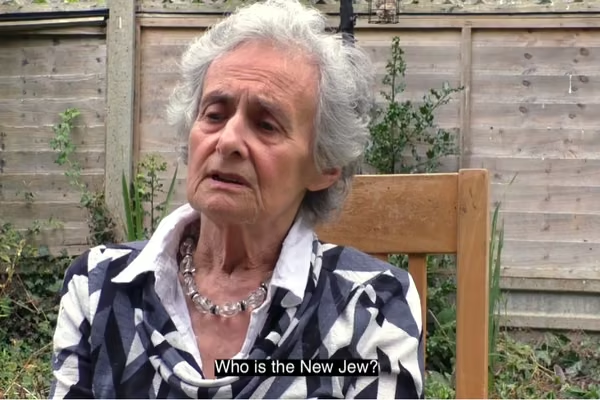
This is the background and journey of Diana Neslen, a member of JVL among other progressive Jewish and secular movements for social justice and political change.
Just a bit more background: one of our Executive members spoke in her hometown with three other locally based Jewish people about how we came to be active supporters of Palestinians. The meeting was planned for – and took place on – October 7th. Despite it being the date forever etched on our collective memories, the room was packed and there was deep interest; two Jewish people in the audience felt empowered to speak for the first time and the idea for this series of interviews was born and we were delighted and fortunate that brought her enthusiasm as well as her professional skills to this task, which is ongoing.
Kitty Warnock has been a secondary school teacher, worked in development in the Middle East and Africa, and taught for four years at Birzeit University in Ramallah. From her interviews with many Palestinian women about their experiences of social change and occupation through the twentieth century came her book “Land Before Honour” (Macmillan; Women In Society series)
Family background
My name is Diana Neslen.
I was born in South Africa, in 1939. Both my parents were South-African born, which is unusual. My mother’s mother had come from east Prussia, her father, who I never knew, from Lithuania. On my father’s side it’s an interesting story. His father came from a wealthy assimilated English Jewish family who lived in Russell Square in London. My grandmother, his wife, was an orphan. She was brought up in the Jewish orphanage in West Norwood[i], and sent as a maid to my grandfather’s house. When he fell in love with her, his family were horrified so they sent him off to south Africa. She followed him, and they got married – but her mother-in-law did not accept her. My grandfather died when my father the eldest child was 13. So my grandmother had to hope that her husband’s family would support her. The support she received was through the private education of the three youngest children, but not my father.
Index of all the personal stories
My parents married in the 30s and I was the youngest child. They were an unusual couple, my mother who was very religious on one side, and my father’s English assimilated family on the other. When they married, my father didn’t exactly become religious, but he did become what’s called a Macher, an important person. He became the president of the synagogue and he was very much associated with the main Cape Town orthodox synagogue, the Gardens Synagogue.
Zionism in the family and social environment
Zionism was not a big thing in my family. In their charitable work neither of my parents supported Zionist charities. My mother was involved in the Jewish Board of Guardians, who provided relief to poorer members of the community, and also the Jewish Orphanage, and we used to collect for the Guardians, but there was no blue box in the house [to collect money for the Jewish National Fund]. But they used to get the local newspaper, the Zionist Record[ii], as well as the Jewish Chronicle. I can’t say they were great Zionists but they were very delighted at the establishment of the state of Israel.
My mother had visited Palestine in 1933. Her first husband had died and I think she was very distressed and so she went on a trip – she may have had friends there, and she must have felt attached to Palestine because of her religion. She was wealthy, and prior to the Holocaust she was able to bring her cousins out of Germany – all of them, I think. Some went to Palestine, some to Zimbabwe and one to Canada as well as one branch to Cape Town.
Zionism was not a big part of their lives, but South Africa was a very Zionist country, certainly after the war. It was very much part of the Jewish milieu even if not many people left for Israel. The hall where weddings and events were held was the Zionist Hall. A cousin who had settled in Palestine, as it then was, from Germany came with her husband to visit us, and there was a lot of toing and froing. I learned Hebrew with an Israeli teacher. That was the way it was. Zionism was something you grew up with, part of the social structure around you, you imbibed it. You felt there was an umbilical cord attaching you to the Jewish state.
Disillusionment
I joined the Zionist youth movement, Habonim. Its whole thrust in the 50s was to get young people to emigrate to Israel, and the whole group was planning and preparing to move to Israel, to live on a kibbutz; we were part of that colonial sort of system. Although I didn’t go to a Jewish school, my friends were all Jewish, I was completely settled in a Jewish environment, we were young, we wanted to join a youth club, and this was the local youth club, the Jewish option. I was intensely involved with them, and went with them on a trip to Israel while I was studying at university. I went to Israel hoping – I was really keen to settle in Israel, I felt this was the future. Living in South Africa we were very clear what apartheid was and I felt very strongly against it. The holocaust actually influenced me in a sense – I recognised what had happened to Jewish people and I lived now in a society where black people were demonised the way Jewish people had been.
But I found that Israel was pretty much like South Africa. It was a militarised society. For instance, I remember talking with a cousin who had been a soldier in 1956[iii]. He talked about taking prisoners, and when I said, “What did you do?” he said, “We shot them.” I had been brought up knowing about the Geneva Conventions, and had read a lot about what’s right and wrong in war. You don’t shoot prisoners. Another thing I saw was in a kibbutz: someone wanted to join but wasn’t allowed to, because he was a Mizrahi, from one of the Middle Eastern countries, and they felt superior to the Mizrahi citizens. I was very shocked and I felt betrayed. So I didn’t settle there. But I didn’t give up my Zionism then.
After that trip to Israel I went back to South Africa and I started reading about what had really happened, the history you are never told. This is so important. I remember Erskine Childers who wrote in the Spectator, and there was Bernard somebody, a Jewish journalist (was it Bernard Levin?) , people on the right of the Labour Party. There were also people known as “Arabists”, mostly upper class English people who felt strongly about what happened in the Nakba and wrote about the refugees. One was Michael Adams, who wrote for the Guardian. I remember saying to my mother, “Why don’t they let the Palestinians come back to their country?” “Oh, they’d be a fifth column,” she said. I was willing to accept superficial replies at that stage. I visited Israel again with my mother in 1963 or 64, and the huge military parade we saw on Israeli Independence Day turned my stomach. I had visited France when It was still in the midst of the Algerian war[iv] and there were soldiers everywhere, and I remember thinking Israel was rather similar. Which indeed is the whole colonial thing.
I came here [to England], I did a social work course, I met my husband and got married, and there was the ‘67 war. For many people that was a watershed time. The ‘67 war and the hubris afterwards created a sense of such pride in Jewish people, pride in what they had achieved, what they had created. An aunt of mine changed her will and gave all her money to the Israeli army – can you imagine that? I remember writing to my mother when everybody was so excited and so overjoyed and triumphal in ‘67: it had the opposite effect on me. I saw the lines of refugees, the destruction of homes in front of the Western Wall, people being expelled, and I realised, ‘This is not what I want. This country is going in a direction I want nothing to do with.’
Life as a non-Zionist
My husband Chaim was completely anti-Zionist. He came from a Bundist background, in Canada. We never really worked against Zionism, we just had nothing to do with it and challenged it. I belonged to a synagogue, because that was part of my background and I felt comfortable there, but I didn’t join in the social stuff, I wasn’t engaged. If you’re not Zionist, it’s very hard to be engaged with the Jewish community, because the Jewish community, as somebody has said, seem to be idolatrous, their religion is Zionism, unfortunately. It’s very painful to come out of Zionism: you leave behind a lot. Some people stay friends, others no longer want to have anything to do with you, it’s a difficult thing. As I say, it took me ten years to leave, and it was very lonely, because everyone was a Zionist.
Jewish cultures
My children were brought up not to be Zionists, but my husband Chaim gave them a strong sense of Jewish culture. He was secular but he had a deeply-rooted sense of what Jewish culture was, and he did a lot for it.[v] He was a Yiddishist, and a Bundist. Many young people – those who leave the warm embrace of Zionism, such a warm embrace – start searching for alternative ways of being Jewish. The alternative way is to be part of the Jewish culture that is so vibrant and vital and has gone on for centuries, and grew out of the places we lived. It’s tragic that to a large extent it is being destroyed, because Israel has imposed its own militarist culture. I remember an exhibition in a museum in New York about the culture of Moroccan Jews: it was so interesting and so vital, and it’s all dissipated, there’s been no effort to nurture it. Their first language was Arabic, which is no longer accepted. And Yiddish – Israel did everything it could to destroy Yiddish culture. For instance, they put a tax on newsprint when people were trying to develop Yiddish newspapers. The Israeli government looked down on Yiddish and the people who spoke it. The awful part is that people who experienced that still feel subordinated. Israel got a lot of money in reparations from Germany but the holocaust survivors were very badly treated, they didn’t get much and many lived in poverty. After the holocaust, the Zionist leaders said that Jews had gone like sheep to the slaughter. They came up with the idea of the “new Jew” – a blond, blue-eyed, gun-carrying man – and a sense of shame about Jewish people from Europe. A friend told me that Holocaust survivors in Israel then were called “soap”. He’s an antizionist, but it’s the antizionists who know the real stories, the others know the myths.
People say Israel is an insurance policy for the Jewish people, a bolt hole in case there is a future outbreak of antisemitism. It’s not an insurance policy, you’re far more likely to be killed in Israel than you are elsewhere. Even during the Holocaust (in which I didn’t lose close family, but my husband did) – if you really study it, you find that while it was happening, the Zionist leaders prioritised establishing a state, not saving Jewish people. Israel still protects the state at the expense of the people: Look at what it is doing now about the hostages. They have saved one captive, and killed, actually killed, six. The only way they got any out was through negotiating: but I heard recently in a podcast that the Hamas person who was killed in Beirut [Saleh al-Arouri], was actually negotiating for the hostages. If you really want the hostages out you don’t kill the negotiator. But the Israel-supporters who congregated with their flags to Trafalgar Square want a) no ceasefire, and b) the hostages out. Clearly they haven’t thought through what they are asking for.
A lot of the people who died on October 7th were killed by Israeli fire. I think half the reason they are attacking Gaza is because they had all this arrogance about their army, and the army and the rest of them were found wanting on October 7th.
Zionist myths
We told our children the truth, which most children are not told. The film “Israelism” shows how young people [in the US] are inculcated from day one with militarism, like in Israel. I think it’s even worse here in the UK, because in the US they don’t have Jewish schools, but here there are Jewish schools, where everything is built around the myths. Everything is a myth, everything you learn about.
Zionists are slaves to the myths they are taught, as was I. Your whole identity is bound up with the fervour for a state where you are no longer a minority but a majority to dictate terms. Jews had long felt insecure about their status and Israel gave so many a sense of pride in achievement. When Jews challenged this, the Zionists’ response was to silence the interlocutor. It has become a practised defence for Zionists ever since.
There’s the myth that the Arabs invaded Palestine [in 1947] and the Arab [leaders] told the Palestinian people, “Leave the country and you’ll come back as part of our victorious army.” This is a lie, it never happened, there’s no evidence. In fact it was the Zionists who had been pushing the Palestinians out, starting long before the Arab armies came in. The armies only came in after a large proportion of the Palestinians had already been expelled from the country.
I think Israel realised early on that the holocaust could be a very useful leverage: “Look what happened to us poor Jews.” Of course the holocaust was utterly terrible, and there’s no way we can absorb it, but – it wasn’t the only one, and we weren’t the only people killed. I’ve spoken to holocaust survivors who were unwilling to accept that other people suffered. More importantly, if you want to get over a trauma, you’ve got to heal it. What Israel has done is scratch the scab, and not heal the trauma. Look at the difference from South Africa, where the trauma of apartheid is very deep and very long-standing, and yet they have tried to move on from it. Israel has its version of history: Jews had a country, we were a people (which we weren’t, not what we call a people, we were just tribes) and then we suffered for 2000 years and now the phoenix from the ashes is Israel. Israel is the reward for suffering, our redemption. That is what people feel, and what has been imposed.
Israel is so used to telling lies and getting away with it. Those of us who’ve studied what’s going on have always been shocked that anyone could believe the lies, this wonderful country etc. etc. It’s not just the Jewish communities but the whole of UK society that upholds these myths. Look at our education system. I understand that history in English schools teaches certain periods like the Tudors and the holocaust. If people learn about the Holocaust they are bound to feel horrified and identify with Jewish suffering. Then they are less likely to reflect on the present day status of most Jews, who are well integrated into the dominant white society. The people who are being demonised are Muslims and black Africans.
The myths became set in stone, and you didn’t challenge them. I would find that you can’t argue with them. Even people on the so-called left, there is a point beyond which they can’t go, and you get hysteria whenever you challenge something. Israel could continue to tell lies, and was always being propped up by European and the US governments. Zionism has captured too much of the Jewish community and it’s a tragedy, a tragedy. Even young people in Israel are extremely right-wing, and it’s not helping them that the Western world is always propping them up. I saw pictures recently of children attacking a teacher who wanted to explore the situation in Gaza, to talk about peace. It’s horrible. We have these awful politicians in charge, and the stuff you get from the mainstream media is dreadful. There are a lot of Zionists in positions of importance in the media, and they probably go to dinner parties and tell the myths and stories and everybody goes on believing it.
But I think it’s going to become much harder. Now Israel is finding that noone is believing them, except the people who have been indoctrinated. You get the sense that they’re losing it now, this is the way people lose it. All they can do is try to repress and silence debate. You don’t want to hear the truth so you repress it, and those who tell you the truth are excluded from polite society. Our government is really pushing propaganda organisations to go and speak to schools, so that they can shut down the ideas. In this part of London there are a lot of Muslims, and the teachers and children are very worried because they are denied the right to talk about what’s happening, and they feel very intensely about it. You’re also seeing the iron fist in the velvet glove with the attacks on students in universities.
My own view is that what has happened (especially since October 7th) has radicalised a generation, in America and here. I think young children growing up, seeing what’s happening, seeing their experience is not recognised, that they’re being silenced – many of them are not willing to accept it. Not young Jews so much, in this country, because their identity is so much created through their schools and synagogues and also visiting Israel and so on.
The Zionists are starting to use antisemitism to attack everybody. When people talk about peace they will call it antisemitism, a march is a hate march. Every time Israel is under any sort of investigation, it’s all antisemitism. Using antisemitism is the last refuge they have. But it’s lost all purchase, because many of the supporters of Israel, particularly in America, are often quite antisemitic themselves. The congress that has said that antiZionism is antisemitism are the same people who believe in the Great Replacement, and it’s very antisemitic. A large proportion of the extreme right in this country are people who don’t like Jews but love Israel. Who are these people to tell me what is antisemitism? Who is the Labour Party to tell me? The people who accepted the antisemitism charge were the people who believed what the Zionists were telling them. But there are a lot of people now whose eyes have been opened.
The future of Israel
I don’t know, I really don’t know. It’s got worse and worse inside Israel. In the Lebanon war there were a huge number of people who refused to fight. They had Yesh Gvul[vi], and there were lots of people protesting. This time there is only one young person who has refused to fight, and the only people protesting are the families of the captives.
As far as I can see Israel has lost all credibility on the street. The global south, and young people in many countries, have seen Israel for what it is. I hope there is a generation growing up that will come to their senses about this country, and see the light. But what has been such an eye-opener since October 7th is how much our countries – the US, Britain, the EU – have become Israel’s cheer-leaders. We have to recognise that Israel has a status in the imperialist world; Israel is so interwoven into the American and European imperial system, for our own economic interests. The imperial system needs Israel desperately and has set itself up to protect Israel and defend it. Things can change – look at South Africa. But the difference is that the imperial rulers could jettison South Africa. They’re not going to jettison Israel. In the US they’ve got Genocide Joe and Trump, we’ve got Starmer and Sunak, and they will not say a word against Israel, not a word. But this is betraying a generation. The young generation will say, “You talk about democracy, but democracy is a sham.”
[i] The Norwood Home for Jewish Children, founded in 1863 and closed in 1961
[ii] Zionist Record, monthly, established 1908, the official organ of the Zionist movement in South Africa
[iii] Suez War, (or Sinai War) 29 Oct – 6 Nov 1956, when Israel invaded Egypt and the Gaza Strip, in alliance with the UK and France, seeking to regain control of passage through the Suez Canal.
[iv] 1954-62
[v] Chaim Neslen, d 2018, leading UK-based Yiddish writer, teacher and musician
[vi] Yesh Gvul (which can be translated as “Enough is enough”) is an Iraeli movement founded in 1982 at the outbreak of the Lebanon war by combat verterans who refused to serve in Lebanon.
so good to read this! thank you
This is very very interesting and enlightening. We all need to do our utmost to understand more and to be open-minded and ready to change our minds if necessary. Thank you.
I wish the main stream media would publish this.
Thankyou Diana, very much.
Very interesting and very moving too, thank you. Early indoctrination can be so difficult to shake off, largely of course because it’s learned in such a highly emotional way and becomes part of one’s identity.
I think it took me even longer than 10 years to be rid of it really properly. In the process I realised with some shame and guilt that there were times even long after I’d taken part in two study tours (ICAHD) of the oPt and joined some antizionist groups, when the old habits of thought and feeling were threatened by some justified but extremely vehemently expressed anti-Israel sentiment and I’d find myself trying to sabotage the discussion.
For example it was a long time before I could accept the word ‘apartheid’ and before I did, I coined ‘neo-apartheid’ as a less unacceptable compromise. But of course it was apartheid, two legal systems, separate roads and the rest of it.
But it became increasingly impossible to deny the sheer criminality, the cruelty of the oppression, the racist supremacism. But cognitive dissonance is a real thing and one has to be willing — and able — to be honest and prepared to abandon some deeply cherished attitudes. Which is why even now I try, sometimes unsuccessfully, to understand Zionists, especially those who still believe, against reality, in the ‘Israel as a bolthole’ argument.
The other difficulty for many people is how the universal human need for meaning finds expression for them. For some, it seems, the Israelocentric form of Judaism is what gives their lives meaning. For others, that’s sheer idolatry, and although Zionism is not yet another god that failed, evidence is mounting that it is failing and the false god will fail.
But how do people find a new sustaining, central meaning when the old one has shattered?
Diana Neslen’s wonderfully written article and Brian Robinson’s excellent comment should be saved as references to how Zionism has corrupted Judaism.
These stories are fascinating. Thank you.
I wonder if Justin Welby, the Archbishop of Canterbury, would be willing to add his family history, to your chronicle.
These contributions are very useful and courageous because they show how people struggle through propaganda and myth but achieve clarity. The last paragraph is important: it is about imperialism and the economic and military dominance of ‘the west’ and the way it abuses the so-called ‘values’ it has and the so-called ‘rules based order’. The propaganda flows directly from this. Western imperialism is being challenged with the rise of the BRICS. The hard right understand this and see support for Palestine as a threat because Israel is their outpost in the Middle East. So allegations of genocide are countered by accusing all Palestinians and those who support them of being ‘terrorists’. This is the pro-Israel narrative. It is incredibly crude and appallingly wrong BUT many right wing people will embrace it because the alternative is defeat. We are at an inflection point in the world. The hysterical propaganda in the ‘legacy’ media shows just how panicked the ruling class is. This is why they object to the genocide in Gaza being reported and why they increasingly want to police the internet. .
Fascinating, Insightful & humanitarian experience. Our access to information & personal stories like these, help to better educate the world around antisemitism, zionism & Jewishness. To counter BDS, as it gained support in Europe & US, Netanyahu on his world leaders campaign tour, inadvertently increased my understanding of antisemitism. I wanted to be clear what constituted it, his visits to facists like Viktor Orban made no sense to me. It’s important to me that I’m not being antisemitic & not discriminating against anyone anywhere & I can distinguish in order to effectively criticise behaviours. Such knowledge gives me confidence to challenge inhumanity when I encounter it. Thank you for sharing these life stories, I enjoyed reading.
Thank you for this.
“Zionists are slaves to the myths they are taught, as was I.”
These myths are also taught to non-Jews as well. That is certainly my experience from my school days. We were certainly not taught about the Bund. I do not know what the position is today.
Thank you for this enlightening recount of your personal and family journey. The more I learn about the real history of Israel, the more shocking it sounds. After all, we discuss colonizing land and pushing out the local population like they were inanimate objects. And this unlawful, unjust action was and continues to be done in the name of Zionism (a nationalist ideology), with the support of the whole self-declared “democratic” West. Here in my country, Romania we didn’t know much about what stood behind the founding of Israel and people were sympathetic to the sufferance of Jewish people during the Holocaust. At the same time, people were also supporting the fight for justice and a country of their own for the Palestinians. In my family, in which my Mom escaped deportation because of the selflessness and courage of good people, while my maternal Grandfather died in a Nazi death camp, along with his other 3 siblings, we always stood with the Palestinians and I remember that Yasser Arafat was much respected. So here I stay, appalled, horrified by the criminal support of the genocide in Gaza and ethnic cleansing of the West Bank by the Israeli Government via IDF. I am appalled and ashamed by the EU leaders, the US leaders and the whole mainstream media whitewashing the murderous military campaign of the IDF, the demonization of the Palestinians and the constant efforts to silence anyone criticizing Zionism, Zionists, and Israeli politics. My grandfather and his family were open-minded people who were at home in this land and never sought to move to Palestine. They were mildly religious and not Zionists. In their memory and their name, I say: Never Again for Everyone! Justice for the Palestinian people!
There was no “Oct 7” when the IHRA was formulated, as I recall it was part of the plot to bring down Corbyn (though finally what finished him off in the 2019 election was Farage and Brexit).
I was brought up as a Zionist/Israeli child in 1948-53. We had come from UK to live in Jerusalem (not as settlers but because my father had got a job at Hebrew University) so had not escaped the holocaust but it was so recent it was totally infused into my consciousness. Palestine became Israel when the Zionists won the 1948 war, but in my experience the Palestinians didn’t just roll over or give up their country, they fought to stop the Nakba (our house in the Jerusalem suburb of Beit Hakerem was shelled) but they lost that war, and now every excuse is used by Israel to brand them as terrorists and take over more and more of their country. I am now a proud co-founder of JVL and horrified to see the tragic history of my people used to justify Israel’s genocidal takeover of Gaza and ethnic bullying of the West Bank Palestinians.
It’s a wonderful thing to be able to change your mind. The reasons a person did so and the learning experience this offers others are invaluable to share.
In my view accounts of how Jews have turned against Zionism, through seeing the truth of Israel’s founding and its continual trajectory towards militarism and fascism, are one of the most powerful forms of testimony in the current situation.
These accounts give the lie to the myth that Jews need Israel to feel safe. As Diana says, there’s nowhere less safe to be a Jew. Israel’s actions and propaganda also exacerbate anti-semitism across the world, and it’s increasingly apparent that Zionism and anti-semitism are terrible twins.
I loved the way Diana ended the piece by exposing the complicity of the West, after talking about changing geopolitics and the views of young people. Shows you how a politically engaged mind can question oneself, learn from experience, and remain forever young.
I have read this article all the way through and I look forward to subsequent articles. It was such an informative and enlightening read.
A wonderfully written, thought provoking, and moving article .
Thank you .
When I was twelve my religious teacher at a grammar school (now a comprehensive) – near Bournemouth – taught us, evangelised, about this wonderful project. Half way through the lesson, I put up my hand and asked the question “What about the people who already lived there?”
The lesson immediately stopped. She left the class and returned with a senior staff member. They stood at the door pointing me out and I was discussing at some length whilst the class chattered without any of the usual discipline.
Thank you all so much for these extremely clarifying accounts. The increasingly reviled mindset of Zionists is what is propping up anti-Semitism these days. It is not only useful to show the world that there are and always have been so many Jews not thinking this way, it’s very useful for people to see and understand how people, Jewish and otherwise, have got drawn into this. From the perspective of so many, particularly in the Muslim world and the so called global south, the end result can appear to be nothing more than a mentality of sheer racist malevolence. Jewish people from Europe had infinitely more reason to want a refuge than others who all left hoping for a better life. However when the reality sinks in that the indigenous dont just obligingly dance off into the forest or the desert, then the self justifying nonsense starts to spread. Heard it all at my Presbyterian grandparents dinner table. These days Zionists are doing a pretty good job of giving the impression that they have a monopoly on this sort of thing. Everyone else in Europe has been at it one way or another. This context is so so useful please more of this!