
Shireen Abu Akleh: in memoriam
JVL Introduction
Oren Ziv’s report of Shireen Abu Akleh’s funeral originally appeared in “The Landline,” +972’s weekly newsletter. You can subscribe to the newsletter here.
Rodayna Raydan collects together media workers’ tributes to Shireen Abu Akleh, “the brave voice of Palestine”, in an article in the New Arab
Ronnie Kasrils’ poem in tribute, below, first appeared in the Palestine Chronicle.
A funeral brutalized
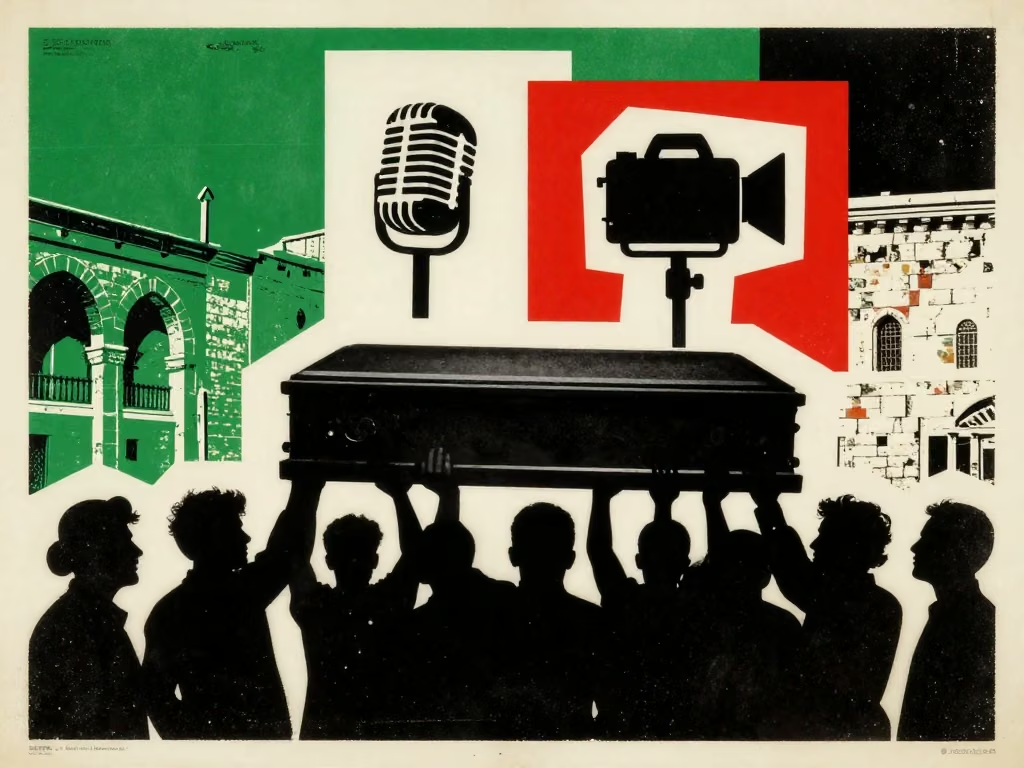
I’ve documented my fair share of political funerals, but never have I witnessed what occurred as Shireen Abu Akleh’s body was laid to rest on Friday in Jerusalem. Despite the visible grief of Abu Akleh’s colleagues, who worked with her in the occupied West Bank and Jerusalem, and the other Palestinians in attendance who had regularly tuned in to her reporting over the years, the Israeli police’s behavior during the funeral procession was brutal, even by their very low standards.
Despite the documentation, which clearly shows the police attacking the pallbearers and mourners, the Israeli media, as well as a number of prominent international media outlets, continue to refer to what took place as “clashes.” Perhaps, then, it would be useful to set the record straight.
On Friday morning, hundreds of people — Abu Akleh’s family members, friends, journalists, and others — gathered in the courtyard of St. Joseph’s Hospital in the Jerusalem neighborhood of Sheikh Jarrah. The police immediately put up barriers around the perimeter of the neighborhood, preventing many from entering.
At noon, mourners held an Islamic prayer followed by a Christian one. After the prayers, dozens of people waved Palestinian flags and chanted as Abu Akleh’s body was brought out for the funeral procession, an act the police deemed “incitement.” The officers warned that should the chants continue, they would disperse the crowd.

At around 1 p.m., when a hearse arrived to take Abu Akleh’s body to its burial place, some of the Palestinians in the procession announced that they wanted to carry her on foot — as is customary during Palestinian political funerals — to the Old City, and from there to be buried in Mount Zion Cemetery. Police tried to force the family to arrange for the body to be transported in advance, but from the public’s point of view, the funeral should have taken place according to the family’s desires, not those of the police.
By now, the images of what happened next have spread far and wide, shocking the world. As the coffin was removed from the morgue, hundreds began marching toward the exit gate of the hospital, where dozens of riot police officers armed with batons were waiting for them. The police began brutally beating the mourners as they carried the coffin, almost causing it to fall. Contrary to police claims, no stones had been thrown. Only after the officers tried to disperse the crowd with batons and stun grenades were several objects, mostly bottles, thrown at them.
The attacks continued. Soldiers fired sponge-tipped bullets and threw stun grenades until, 15 minutes later, the body was whisked away in a vehicle. Even after that, the police did not allow Abu Akleh’s colleagues — who were not only there to report, but also to mourn — to leave the hospital yard, beating them once again with batons. As the vehicle made its way from the hospital yard, a police officer was seen removing the Palestinian flags that were draped on it. Only an hour later was everyone allowed to leave.
The conduct of the police was not surprising; it was merely a blatant demonstration of the racism, brutality, and humiliation that Palestinians routinely face in East Jerusalem and beyond.
At an event of this magnitude, though, one could have expected Public Security Minister Omer Bar-Lev or Prime Minister Naftali Bennett to ensure that the procession be allowed to take place undisturbed. Yet it seems that both the police and, likely, the political echelon decided to clamp down on the funeral and its unabashed expressions of Palestinian identity in a city where even waving a Palestinian flag is beyond the pale.
In an attempt to justify the police’s conduct, Police Spokesman Eli Levi released a partial video, taken from the police drone camera, showing the events in the hospital yard. Levi claimed that objects were thrown before the dispersal began. Yet the video begins only after the police force had already stormed into the hospital compound and started attacking people.
Unsurprisingly, the parts where the police storm with batons were entirely cut out. Synchronizing the drone footage with video footage from the ground shows, for example, that one of the people alleged to have thrown stones was in fact waving a Palestinian flag.
The disgraceful conduct of the police continued even after the initial aggression at the hospital. In Sheikh Jarrah, police prevented mourners from marching, and many “flying checkpoints״ were set up around the Old City in order to prevent people from attending the final part of the funeral procession.
Later, Palestinian residents were asked by police whether they were Christian or Muslim in order to decide whether to let them enter the cemetery for the burial; Palestinian flags and Arabic signs were confiscated; officers tried to force a young woman to remove her hijab because police said it had the colors of the Palestinian flag; and when several young people climbed the walls of the Old City to observe the funeral, undercover police detained them in order “to look for flags in their pockets.”
The attempt to brutalize Palestinians into silence is doomed to fail. This was also the case with the placement of metal detectors at the entrance to Al-Aqsa Compound in 2017, and again last year with the police barricades at Damascus Gate. This year, some were hopeful that the police had changed its attitude under the orders of the so-called “government of change,” but the violence at Al-Aqsa last month has already proven otherwise. The brutality that took place during Abu Akleh’s funeral was merely an extension of that.
Shireen Abu Akleh documented and broadcasted the occupation to millions. Her killing in Jenin Refugee Camp was symbolic of the Palestinian story as a whole, which she insisted on telling the world for the past 25 years. The conduct of the police at her funeral reveals that even in moments of mourning, and even when Israel itself admits the possibility that Abu Akleh was killed by Israeli soldiers, it has no intention of allowing the Palestinians to say their goodbyes with dignity.
 Oren Ziv is a photojournalist and a founding member of the Activestills photography collective.
‘She was the reason why I wanted to be a journalist’: Media workers pay tribute to Shireen Abu Akleh, the brave voice of Palestine
Rodayna Raydan, The New Arab, 13th May 2022
For many, Shireen Abu Akleh wasn’t only the voice of Palestine but one who empowered and encouraged many aspiring journalists. As the world mourns her death, we speak to people about the impact the veteran journalist’s life and work had on them.
Israel’s war on Palestinians continues to take lives away with a lack of accountability and global community inaction. This time it was Shireen Abu Akleh, a well-known and respected Palestinian Al Jazeera journalist who spent her life on the grounds of Palestine covering the attacks, violations, and crimes committed by Israeli forces before being deliberately targeted and shot dead by them.
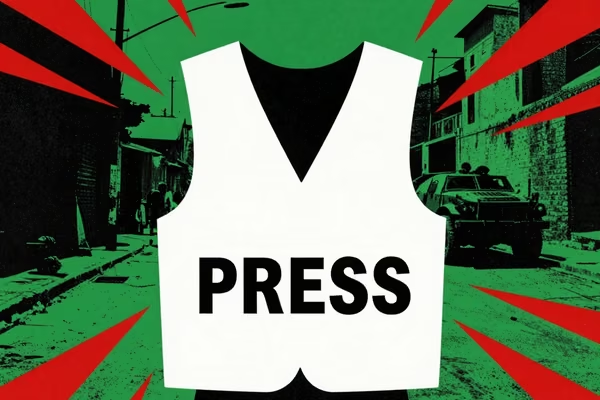
“She was shot despite wearing her press vest and helmet, meaning she was identifiable as a journalist”
She was shot despite wearing her press vest and helmet, meaning she was identifiable as a journalist, hence proving that there is an intention to try and silence credible voices that reach a global audience whilst seeking to intimidate and silence the Palestinian voices.
People across the Middle East region and beyond are triggered by her death and there is a growing voice calling for justice, but one has to be naively optimistic to expect Shireen Abu Akleh’s tragic death as an effective wake-up call, given Israel’s history of blaming the victim for their own death, in manipulating the truth and whitewash their crimes.
“She was the reason why I wanted to be a journalist and the reason why I have continued to be a journalist even during the hardest times. She was someone I looked up to and was inspired by”
Al Jazeera, the network for which Shireen Abu Akleh worked, along with activists, journalists, and Palestinian rights organisations are calling for a transparent international investigation, but they all seem to have something in common, “a little faith in Israel’s justice system”.
“She was the reason why I wanted to be a journalist and the reason why I have continued to be a journalist even during the hardest times. She was someone I looked up to and was inspired by,” Palestinian journalist Haya Abushkaidem told The New Arab.
Shireen has been a notable journalist reporting the Israeli war crimes against Palestinians for over two decades. She had become a household name to all those who watch Al Jazeera and thousands of Palestinians are mourning her loss.
“Since I recognised Shireen’s name on the breaking news banner saying she was killed, I have been in awe and at a huge loss of words, reading further Shireen was hit by a live bullet in the face on duty, covering Israeli raids in Jenin, was the pain climax,” said in agony, Mohammed Rafik, a Palestinian journalist based in Gaza, to The New Arab.
“Shireen has been a notable journalist reporting the Israeli war crimes against Palestinians for over two decades”
At least 55 journalists have been killed by Israeli forces since 2000, according to the Palestinian Ministry of Information. Press freedom activists say it’s an attempt to silence Palestinian journalists and a free society means a free press, but Israeli forces continue to violate this notion.
“Shireen has had a role not only informing my awareness of the Palestinian cause but also in what I, a woman, am capable of providing this cause”
For the many, Shireen Abu Akleh wasn’t only the voice of Palestine but she empowered and encouraged other women as she was brave, independent, and keen to deliver the truth.
Amena Ashkar, a young Palestinian journalist told The New Arab how Shireen inspired her as a female journalist. “Shireen has had a role not only informing my awareness of the Palestinian cause but also in what I, a woman, am capable of providing this cause.”
“She is a role model,” Ashkar added.
For Palestinian commentators, the lack of accountability on Israel is a driving factor to continue holding crimes and violations against Palestinians, as just a year ago, on May 15, Israel took down Al Jazeera offices but justice remains unserved.
As Israel continues to act without impunity, activists fear that Shireen Abu Akleh’s death will go unnoticed and uninvestigated as they quote international law when it suits their own narratives.
“For the many, Shireen Abu Akleh wasn’t only the voice of Palestine but she empowered and encouraged other women as she was brave, independent, and keen to deliver the truth”
Yousef Alhelou, a Palestinian political analyst and journalist told The New Arab: “We are not expecting anything good coming out of the Israeli government, on the same day she was killed, Israeli occupation forces stormed her house and wanted to prevent Palestinians to mourn her death.”
For Yousef, the world and particularly the West are distancing themselves from Palestine and little has been done to pressure Israel.
Al Jazeera had called Shireen Abu Akleh’s death “a blatant murder and a violation of international humanitarian law.”
She told stories of ordinary people living unordinary lives and on the day she was killed by Israeli forces, Shireen was reporting yet another military raid on Jenin in continuous and escalated violence.
“For Israel, it’s just another body,” said Mohammed Rafik.
Journalists, media analysts, and commentators are criticising major media outlets like CNN, NYT, BBC News, Forbes, and most notably AP – who had their offices bombed and completely destroyed by Israel just a year ago in Gaza – for their biased coverage of Shireen’s death and the terms used to announce and describe her death.
“There is something particularly spinless about news outlets who watch their fellow journalists get targeted and killed by a known entity and then seek to muddy the cause of death by referring to ‘clashes’ or failing to assign responsibility for the actor that did the killing,” Mai El Sadany, a human rights lawyer expressed her concern on the coverage of Shireen Abu Akleh’s death.
When it comes to Palestinian lives, Western media agencies seem to use too much passive voice and for analysts, this isn’t a stylistic choice and a neutral grammatical, it’s complicity in whitewashing Israeli crimes.
“There is something particularly spinless about news outlets who watch their fellow journalists get targeted and killed by a known entity and then seek to muddy the cause of death by referring to ‘clashes’ or failing to assign responsibility for the actor that did the killing”
Palestinians believe that international media outlets never respected their grief, instead, they want them to battle their selective, passive, and dishonest reporting on Shireen Abu Akleh’s death by failing to mention the murderer.
For example, NYT said, “Al Jazeera said one of its journalists was killed in the West Bank city of Jenin during clashes between Israeli forces and Palestinians gunmen.”
After a backlash on their Twitter account, NYT said in a tweet: “Correction: An earlier tweet misstated Al Jazeera’s comments about the death of Shireen Abu Akleh. The network said she was killed by Israeli forces in the West Bank city of Jenin.”
Any joint investigations with the Israeli committees were refused as Israeli authorities are to be fully blamed for Shireen’s death and for Palestinians, “murderers cannot investigate their own crimes”.
The Israeli government is circulating an out-of-context video of a Palestinian gunman as “evidence” that Shireen Abu Akleh was shot by Palestinians.
For experts, in circulating such visual content, they are inducing doubts into people’s minds and for those who are more likely to be sympathetic to Israel, it gives them a narrative that allows them to exsolve themselves of guilt when thinking about occupation, helping Israel keep the public opinion on their side.
The Israeli Defence Force has denied responsibility, saying in a tweet they were carrying out a raid at the Jenin refugee camp, and are investigating the “possibility that journalists were hit by the Palestinian gunmen.”
“She was covering the news but now she became the news”
Many Palestinians are in a state of despair having grown up listening to and watching her documenting their struggles.
Palestinians regard Shireen Abu Akleh as a passionate and remarkable journalist to the extent that she was keen and willing to travel miles to document the events that almost all western news media have normalised and ignored.
For instance, on the day of her murder, Shireen Abu Akleh sent Al Jazeera an email at 6:13 am: “Occupation forces storm Jenin and besiege a house in the Jabriyat neighbourhood. On the way there, I will bring you news as soon as the picture becomes clear.”
She was covering the news but now she became the news.
“Now that you are gone, Shireen, we mourn you and clutch your powerful legacy to serve you justice in free Palestine soon. Even if the fear we could be next is floating, we will keep on persisting and telling the truth that Israel killed you to hide, and you sacrificed your life to tell,” said Mohammed Rafik, giving his farewell message to the martyr, Shireen Abu Akleh.
Rodayna Raydan is a Lebanese British journalism graduate from Kingston University in London covering Lebanon.
Shireen Jenin Sumud – A Poem
Ronnie Kasrils, Palestine Chronicle, 18th May 2022
Shireen!
Shireen!
Struck down on Street Jenin
Bloodhounds
Snarl and bite
Her home they storm
Her corpse still warm
They salivate
Gobs of hate
Dogs of war
Raid hospital ward
Bereft respect
Dispensing pain
Like acid rain
Rioting police
Obstruct procession
Berserk with hate
Horse hooves drumming
In-human boots
Truncheons flaying
Erupt disrupt
Funeral march
Beating mourners
Breaking bones
Battering hearse
Bash the casket…
Freezing time
In the maelstrom
Coffin slanting
Crazily
Hold on
Steadfast
Sumud
Inhale exhale
Under blows
Of frenzied foes
One more heave
Onto shoulders
Never give up
Sumud
Homage
Serenity
The church
The cemetery
Where faithful tread
The Hallowed Way
Laid to rest
In tender peace
Tears shed
Solidarity spread
Shireen
People’s voice
People’s eye
Twenty-five years
Witness for the nation
Mentor to each generation
And loved as such
Along and beyond freedom road
Narrating
Recording
Repression
Resistance
Texture of trail
Homes bulldozed
Groves destroyed
Plundered land
Apartheid walls
Water theft
Lives wrecked
Widows bereft
Dispossessed
Heads erect
The youth on fire
Intifada
Sumud
Around her head
Phosphorous bombs
Piercing lead
Innocence dead
People risen
Midst settler mobs
Fearless calm
Truth spread
Intifada
Sumud
Shireen in death
Infusing light
Undying presence
Uplifting night
Birthing life
Onto victory
Legacy bright
Intifada
Sumud
Children laugh
Swim and play
Refugees home
Prisoners free
From River to Sea
Sabra Shatila
Gaza Galilee
Insha’Allah
Sumud
Olive trees
Distilling breeze
Shireen
Adored
A priceless queen
Shireen Jenin Sumud


Comments are now closed.