
The BBC recognises the Nakba – better but not good enough
JVL Introduction
Like Jonathan Cook, I watched both episodes of The Holy Land and Us – Our Untold Stories and found it both moving and frustrating. The documentary starts with the Balfour declaration thus highlighting the role of the British in the region. In his review Jonathan makes the important point, not addressed in either episode, when he calls the western governments that refused shelter to the Jews of Europe the real villains of the piece.
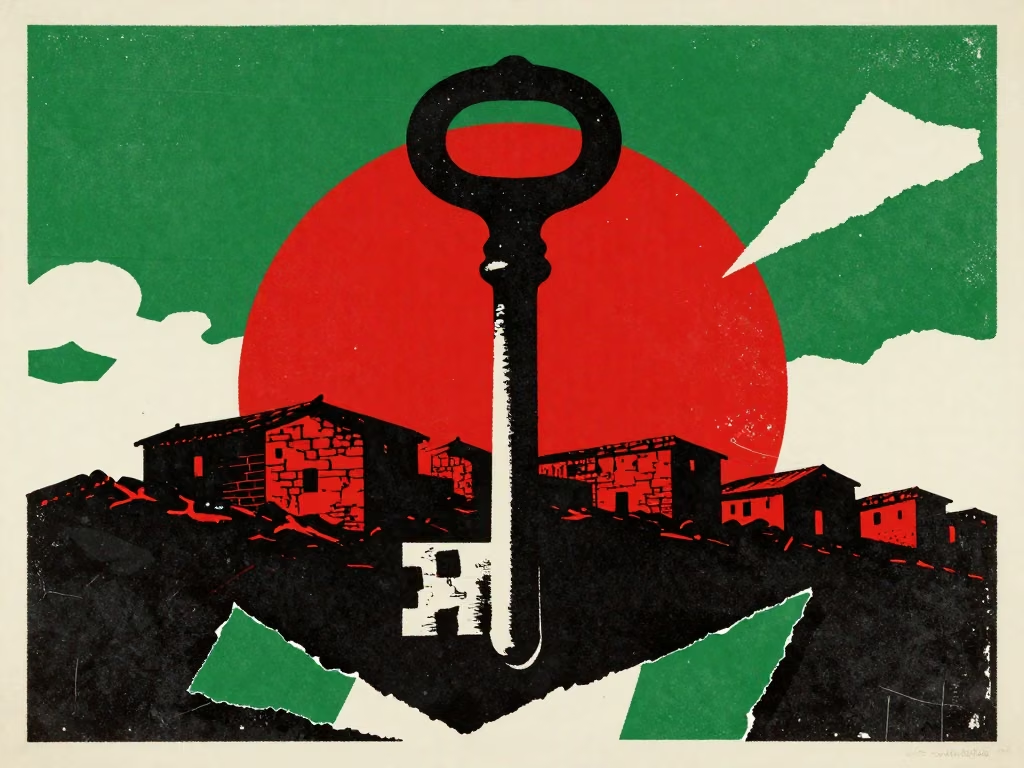
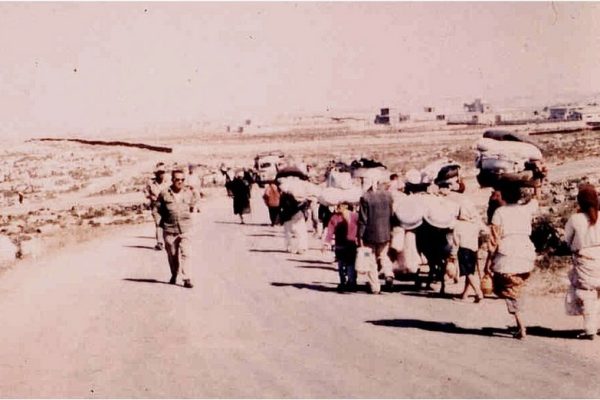
Whether or not we agree that the zionist’s stories are untold, the Palestinian stories of that time are, especially in the mainstream media; that showing some aspects of the impact of the Nakhba is considered brave shows how rare this is. It is also right that the reality of the Holocaust, its impact and further displacement for Jewish people are also shown. But, of course, there is an imbalance between the two sides that is ignored with the all too familiar “both sides” narrative. The reality is that the Nakba has not ended while, thankfully, the Nazi Holocaust has.
The Jewish Chronicle found this “a stressful watch” and is concerned that ” with wounds reopened rather than healed, positions seem more intractable than ever.” But the wounds have never closed up for the Palestinians and perhaps the stress for the Chronicle was in having to take the Palestinian experience seriously. At the end, Rob Rinder, tracing his Jewish relative’s role, expressed hope but this felt unrealistic or even desperate, particularly given the even more extreme government now in power there.
LL
This article was originally published by Middle East Eye on Wed 22 Mar 2023. Read the original here.
BBC broke the Nakba taboo – but still cheated Palestinians
The Holy Land and Us hides the real villains: Western governments that left Jews with only one credible escape from European antisemitism, by dispossessing Palestinians
Loading article text…
There was a previous series of programs – also broadcast by the BBC, of antisemitism in the 1930s existing in both Europe and the US.
Maybe someone has a link to them?
The US did NOT accept all European Jewish people escaping the Holocaust and there were quotas in place. There were heart-breaking accounts of US citizens desperately trying to get their relatives to America only to be defeated by this restriction where their relatives were later murdered. I think I have mentioned these programs previously on this site and others have too?
PS As I recall – the “Holy Land” programs commences with the “Balfour Declaration” but the Introduction is very brief. On the one hand the Zionists were promised land which was already occupied by Palestinians and on the other Palestinians were promised Independence if they fought against the Ottoman Empire. Indeed Balfour includes a promise to the Palestinians living there that they would not be disturbed! At the beginning of April 2021 The Times re-published a speech made in April 1921 of Winston Churchill to the Palestinians re-assuring them of this. So far as I remember the “Holy Land” program did not go into the promises made to the Palestinians in the Balfour Declaration and by politicians like Churchill.
I watched the first episode live, and haven’t yet seen the second. I had an immediate reaction – to wonder if people who were not ‘invested’ in the establishment of the state of Israel, but simply watched because they thought the programme looked interesting, would have shared the Jewish participants’ enthusiasm for the Jewish victory and the ways in which it was achieved.
I felt distaste, not only for the triumphalism of the telling of the Gantz story, and the Jewish victory at Jimzu, but also for the way various key issues were left hanging – issues which evoked no curiosity from today’s Gantz-related family. The reason Jimzu mattered was because of its strategic importance in enabling the Jewish military forces to hold onto Lydda and Ramle (which the UN had actually allocated to a future Palestinian state) and to prevent the Jordanian army from seizing back these overwhelmingly Palestinian populated towns. With the Jewish forces’ victory, nearly all Lydda and Ramle Palestinians, were driven out. Gantz’ relatives were told this, but neither asked what happened to the people of the two towns, nor was any information offered. It was their overwhelming lack of concern which got to me – didn’t they want to know how many Palestinian citizens (nearly all ‘civilians’) were kicked out, nor the circumstances of their expulsion (particularly brutal), nor what happened to them after that (also brutal)? Nor why the new state of Israel should have been permitted to hold onto territory which had been explicitly allocated to the Palestinians.
I know that casual viewers wouldn’t have known the details of the partition of Palestine, but they would have heard the outline of Lydda’s and Ramle’s destiny. Would they have been so uninterested in the morality of this victory, and of Gantz’ role in this? I just don’t know and am too close to judge. I just wouldnt assume that the programme necessarily achieved its aims.
I was very pleased to read this article, because I was shocked by the way the programme whitewashed the mass human rights violations against Palestinian Arabs, all to keep on the right side of today’s Israel.
Quite an honest and fair review in the JC.
I felt these were 2 programmes (and it is important to watch both) which I could recommend to very pro-Israel Jewish friends and relatives, Palestinian sympathisers and ‘absolute beginners’. And I have done so.
What each person takes from them will depend on their starting point: their existing knowledge, sympathies and moral framework.
There were small points I could quibble with, or things I wished had been mentioned, but within the time constraints, overall they were strong and careful productions which would be great for starting in-person discussions which could go further.
The detailed sections on the Naqba, a story rarely covered at all on main stream media in the UK compared to the very well-covered Holocaust, is certainly to be welcomed, and the timing of the broadcasts is fortuitously at a time when many in the Jewish community are more open to discussion than for many years.
I admired Sarah Agha for astutely challenging the Palestinian historian on the translated document he showed her, which purportedly documented the reason why her ancestors left their village. As Sarah said, this was a Haganah Intelligence Service (sh’ai) document, known as the ‘Migration Report’, and perhaps unreliable. I don’t know that I can include a link here, so do search for ‘The Erasure Of the Nakba in Israel’s archives’ by Seth Anziska in the Journal of Palestine Studies, Autumn 2019. It’s an interesting read.
You can also search for “Migration of Eretz Yisrael Arabs between December 1, 1947 and June1, 1948” to find and read the full report including annexes.
To those whose main focus is on the programmes’ failings, I would ask whether it is better to score those points or to see it as an opportunity to raise the subject with the wider public and within the Jewish community.
This is a great piece by Jonathan Cook.
What Gantz’s relatives failed to grasp when they were hugging each other was that Gantz was not some sort of hero or freedom fighter, he was a terrorist who had quite possibly murdered innocent people. This was not even alluded to by the programme makers.
I genuinely expected all participants to meet, discuss, share their experiences.
Alas. No third programme. How like life! No common ground because there really is no common ground. And Rob Rinder’s call for hope ….. Hope for what exactly? Of course Gaza wasn’t even on the map!
This is the first of the programs mentioned in my
post of 27th March at 17.33:
https://www.bbc.co.uk/iplayer/episode/p0dm3cwv/the-us-and-the-holocaust-series-1-1-the-golden-door-beginnings1938
There are 3 programs altogether.