
Between the Holocaust and the Nakba
JVL Introduction
For a long time, as David B. Green points out, it was impossible to use the words Holocaust and Nakba in the same sentence in polite society.
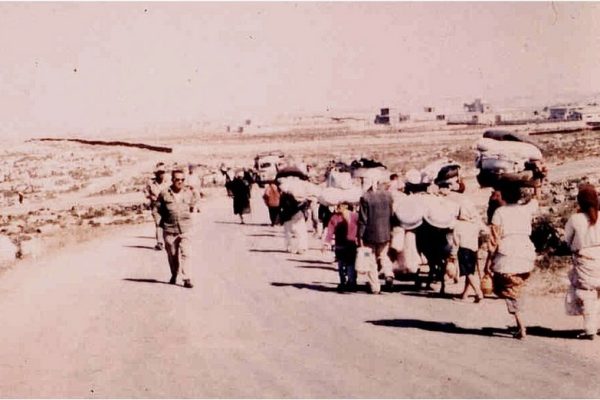
But while the events are not comparable in their nature, their objectives and their scale, continues Green, “it is delusional to deny that the two events are connected – objectively and also subjectively – in the two peoples’ respective collective memories”.
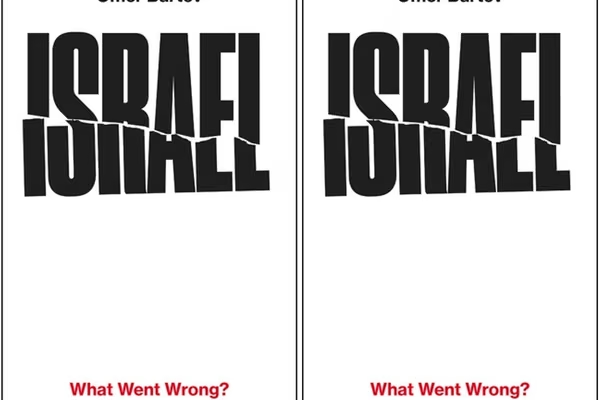
In a recent book Bashir Bashir and Amos Goldberg, two Israeli academics, bring together some recent reflections on the nature of these connections.
In this review published in Haaretz David B. Green puts the discussion in context.
This article was originally published by Haaretz on Fri 18 Jun 2021. Read the original here.
Between the Holocaust and the Nakba, Two Histories – and Maybe a Shared Future
“There are two different nations here in this land, each of which is deserving of self-determination and of a homeland. And their stories are interwoven with each other.” (Amos Goldberg, in an interview)
Loading article text…








This is an intriguing account of views and information that reflects the discordant nature of life and thinking in Israel/Palestine. It is encouraging that in Israel there is a very slow but increasing acceptance that both the Shoah and Nakba need to be related to jointly. Just how slow and the opposition that exists is revealed in the comments to the original piece in Haaretz.
Even though the original Hebrew version of the book was published in 2015, and the revised English version in 2019, we must applaud Haaretz for this piece at this time of continuing persecution. We should also also recognise the personal integrity of both Bashir Bashir and Amos Goldberg in wanting to find a way to bring a resolution to the conflict.
Of course Zionists do not want attention drawn to the Nakba. In the Pearson revised history textbook scandal https://www.campain.org/post/pearson-caught-in-middle-east-history-textbook-scandal far right Zionists together with a failure in editorial responsibility produced revisions that severely played down the nakba producing nothing but Israeli hasbara.
A very long article, too long in many ways. What is interesting are the reactions of people like Shlomo Avineiri who makes the same comparison as say Jon Lansman between the Germans who were expelled from European countries to the Palestinians.
Except that there was a major difference Whatever one things of what happened to the German colonists they did act as a 5th column, most notably in Sudetenland. In Hungary the Swabians formed the bulk of the gendamerie that implemented the deportations and ghettoisation.
The Palestinians were victims from the beginning.
Adam Raz is more disappointing. Of course the Nakba and the Holocaust are comparable because both spring from the desire to make the land either Judenrein or Arabrein. The Nazis also chose expulsion at first and only later turned to extermination. The treatment of Jews prior to 1939, such as forbidding Jews to live in most areas of the country is obviously similar to Israel.
The problem with Goldberg and Bashir is that their project is based on what they call ‘egalitarian binationalism’. It assumes that there is essentially a national or ethnic conflict as opposed to a settler colonial model of oppressor and oppressed
Lea David’s comments at the end remind me of a long-running difficulty I had over a number of years with a fellow member of a self-help group. Periodically we would get together to try and resolve our differences in the sensible, adult fashion that our shared philosophy suggested should be the right one. And every time we met I would walk away, more irritated and murderously inclined than before.
Then one day something struck me. I rang up my adversary. “I’ve just realised,” I said, “what the problem is; I just don’t like you.”
There was a moment’s silence from the other end, then a peal of laughter, followed by: “I don’t like you either.”
From that day on we were fine together.
How does My Lai fit into the analogy?
The war cry of ethno-nationalists everywhere boils down to blood (race) and soil (land.) This is not to assert an equivalence between Zionists and Nazis, but merely to point out that all humans share an atavistic set of instincts about their tribal identity and the land they occupy. No doubt at an earlier stage of history such instincts provided a useful motivating force for both conquerers and those who resisted them. But a people who like to believe they have arrived at a more advanced phase of social development should be ready to focus on kinder motivations: the celebration of a shared humanity, for example — the spirit, if you like, of the parable of the good Samaritan.
It should not need saying that the Holocaust and the Nakba are part of the same continuum in world history. The only reason for denying it would be to conceal the extent to which the Zionists who created modern Israel were acting, perhaps unconsciously, to avenge their persecution by replicating it, with themselves in the role of the oppressor. It is notable that during the recent outbreak of violence, when gangs of young Zionists ran through the streets of Lydd smashing Palestinian shop windows in a troubling echo of Kristallnacht, one user in a Telegram group of extremists wrote: “We are no longer Jews today, Today we are Nazis.”
For a people that has suffered centuries of victimhood suddenly to find itself in the dominant role can’t be an entirely comfortable experience. The peculiar level of cruelty and humiliation visited on the Palestinians – the use, for example, of Skunkwater — suggests nothing so much as the operations of trauma: a condition that is both painful and psychologically disfiguring. As so often before, I call to mind the message of Auden’s sadly prescient ‘September 1, 1939’:
Those to whom evil is done
Do evil in return.