
BBC Gaza coverage – “A question of complicity”
JVL introduction
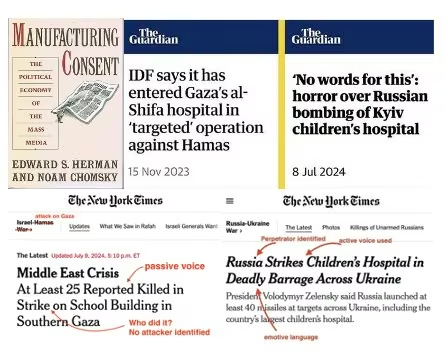
We recently published a piece by Jonathan Cook in which he explained why we can never expect mainstream media to diverge in any meaningful way from dominant news narratives. Media organisations function – in Noam Chomsky’s telling phrase – to “manufacture consent”. Not to inform the populace, but to reinforce conformity in the interests of those who rule.
Nowhere is this more evident than in news coverage of Israel’s war on Gaza, starkly illustrated in an analysis by a member of the British Broadcasting Corporation staff, published by Jadaliyya, an independent ezine produced by the Arab Studies Institute (www.ArabStudiesInstitute.org.
In November the journal published an email sent on October 24 to BBC Director General Tim Davie by Beirut-based correspondent Rami Ruhayem. It warned that the BBC appeared to be “reinforcing Israeli propaganda meant to dehumanize the Palestinians…This is not about mistakes here and there, or even about systemic bias in favor of Israel. The question now is a question of complicity.”
Jadaliyya has now published more material from Ruhayem, presenting his bosses with mounting evidence for his thesis – evidence to which they have offered no satisfactory response.
We reproduce below sections of Jadaliyya’s latest instalments, including two documents with extensive references. These deal with:
- BBC content relating to the events of October 7, examining ‘whether – and to what extent – the BBC applied, misapplied or simply cast aside journalistic standards in treating various claims about what happened on that day.’
- interviews with Israeli guests on the BBC News Channel between 10 and 25 October 2023, analysing them in light of what Ruhayem calls ‘Israel’s war on context’.
Ruhayem concluded: ‘I’ve found a sustained collapse in some of the most basic standards and values, one which seems to complement Israel’s propaganda purposes and strategy.’
Read Jadaliyya’s original publications from July 16 here and from July 18 here.
NWI
The BBC and Israel’s War on Context
By Jadaliyya Media Page Editors
Jadaliyya has obtained access to leaked internal emails from the BBC, the British Broadcasting Corporation, revealing the depth of staff grievances at its coverage of the genocide in Palestine, and accusing the BBC of complicity.
In an email dated 1 May 2024, Beirut-based BBC correspondent Rami Ruhayem wrote to the Director General of the BBC, Tim Davie, as well as several departments of BBC News staff, detailing the BBC’s editorial failings, which he considered ‘evidence of a collapse in the application of basic standards and norms of journalism that seems aligned with Israel’s propaganda strategy.’
Ruhayem indicated that BBC management had failed to respond to ‘a mass of evidence-based critique of coverage’ from members of staff. In conclusion, he wrote, ‘instead of putting together mechanisms for a thorough examination of output, and for inclusive, respectful, and professional discussions guided by [BBC] standards and values, it appears management has opted to oversee a continuation of the editorial direction the BBC has taken since October.’
The … email was leaked to the right-wing UK press, appearing quoted one day later, on 2 May, in the broadsheets The Times (‘BBC correspondent questions ‘facts’ of October 7 attacks on Israel’) and The Telegraph (‘BBC may be ‘complicit in Israeli war propaganda’ claims Beirut correspondent’), as well as tabloid The Daily Mail (‘BBC correspondent says the broadcaster has a pro-Israel bias and should be questioning the ‘facts’ of October 7 – sparking fury among Jewish colleagues’).
Email from Rami Ruhayem dated 1 May 2024 – ‘Follow-up on Gaza Coverage’ [JVL heading]
Sent to Director General of the BBC, Tim Davie and forwarded to BBC News staff
Dear Tim,
I’m writing to follow up on the message I sent to you in October in which I outlined what I believed were editorial failings of the kind that could raise the question of BBC complicity in Israeli war propaganda. During the time that has passed, I’ve managed to examine more thoroughly the extent of these failings, and whether management is serious about addressing them.
On the first point, I’ve seen evidence of bias in favour of Israel as well as evidence of a collapse in the application of basic standards and norms of journalism that seems aligned with Israel’s propaganda strategy. Such evidence has been pouring in for months at a dizzying pace. I’ve examined some of it, including in the two papers attached, which I sent to management’s feedback email in February. Other colleagues have documented other problems and presented them in different formats. We can only begin to determine the extent of the editorial failings when a well-resourced and transparent effort is undertaken to study BBC content during the past few months, and to understand the various mechanisms and levels of decision-making that have led to this.
This brings me to the second point. Management has recognized that many of us have deep misgivings about coverage, and that these should be heard. That seems to be the implicit logic behind the “Listening Sessions” and the feedback emails. But irrespective of what the intention(s) behind this process may have been, it has amounted to little more than a short-lived venting exercise. I have participated keenly in every avenue proposed by management that I managed to involve myself in, and more. Silence has been a common response to a mass of evidence-based critique of coverage. Nothing I sent to ‘feedback emails’ has received a response, except once to say that maybe someone will respond, maybe not. Others have had similar experiences.
The exceptions to such silence have usually been worse. In one email chain, a senior figure did not answer a simple question: do BBC presenters not have a duty to interject when serious, unverified claims are made on air? Another, when asked about the reasoning behind editorial decisions, saw fit to inform a group of staff that ‘editors edit’, seemingly in the belief that this should be enough to brush off everything we’d said. Remarkably, senior managers would occasionally offer a link or two as counterexamples to content that is editorially flawed, without addressing the latter. The implicit logic would appear to be that a collapse in standards is ok if there are exceptions. Faced with specific examples, senior managers might say it’s inappropriate to comment on individual stories. Faced with analysis that goes back in time to examine content, they might ask for ‘specific’ examples. One of them once referred a group of us back to the unresponsive ‘News board’ feedback email. Another told me they wouldn’t address issues that had already been raised to the News board.
In one reply by a senior manager to a group of staff, there was a strong suggestion that all the examples provided – including those outlined in the two papers attached – are the result of ‘decisions taken by editors.’ If that is indeed the case – would the editors be able to confirm that they gave instructions to drop requirements for applying scrutiny regarding the most serious, unverified claims that were being repeated by propagandists for Israel? Would they be able to explain why, and offer a defence of such decisions based on BBC values and standards? If that is not the case, would the editors be able to explain why – upon observing these standards being repeatedly cast aside – they did not intervene? In any case, would upper management clarify what it thinks its own duties are in such a situation?
The latest trend is to ask for ‘recent’ examples. This is usually in response to questions about the first weeks/months of coverage, during which Israeli claims about the events of October 7 were given an open, uncritical platform by the BBC. This ignores the fact that – in many cases – examples of this kind of thing were flagged as they were happening but not addressed at the time, or at any time. It also ignores the lasting harm such content is likely to have contributed to causing. In any case, many of us have offered – and continue to offer – feedback that covers all these categories; individual examples, systemic issues, recent examples, not-so-recent examples, without receiving a meaningful response in any instance, at any time, whatever the channel we use, and usually without receiving any response at all. In conclusion, instead of putting together mechanisms for a thorough examination of output, and for inclusive, respectful, and professional discussions guided by our standards and values, it appears management has opted to oversee a continuation of the editorial direction the BBC has taken since October.
The problems are evident, unmistakable, and ongoing. Acknowledging them would be a first step to fixing them and ensuring they never happen again. Alternatively, if you choose to endorse the coverage, would you kindly defend it by responding – thoroughly and directly – to the feedback that’s been sitting in management’s own feedback inboxes for months – or tell us who in the organisation can do that?
Respectfully awaiting your response,
Rami
SECTION 1 – Analysis of interviews with Israeli guests on BBC News Channel October 10-25, 2023
[JVL heading]
Follow-up on Listening Session, 8 February 2024
There is a growing body of evidence indicating that the BBC may have been withholding vital information from the public, contributing to incitement against Palestinians, and spreading and reinforcing Israeli war propaganda. Many of us have spoken out about this, urging immediate and meaningful change in line with the BBC’s editorial standards and values.
Management has responded with mixed signals. On one hand, we’ve been thanked for voicing our concerns, urged to keep doing so, and assured they’d be taken seriously. This suggests a recognition of the obvious – that it is our most pressing duty to address the problem in the public interest. But management has also behaved in ways that are not consistent with this recognition, including by ignoring a lot of detailed, specific criticism. Four months on, there still appears to be little meaningful effort to examine our coverage with urgency and transparency in pursuit of evidence-based conclusions.
I’ve taken a look at some of our output during what I believe is a foundational period of coverage, one that is certain to have had a potent and enduring impact on peoples’ attitudes and beliefs. Specifically, I’ve looked into interviews with Israeli guests – mostly officials and propagandists – on the BBC News Channel, between the 10th and 25th of October 2023.
I believe what I’ve seen indicates a collapse in editorial standards and values in that crucial period – one which complements, reinforces, and otherwise serves Israel’s messaging. BBC output appears to have aided two pillars of Israeli propaganda: the obliteration of vital context, and incitement against Palestinians. These are tightly intertwined, but it is useful to look at each in some detail. Here, I examine context.
I will begin with a few words about Israel’s war on context, before identifying some of the relevant context that should have been taken into account and used to challenge Israeli officials. I will then detail some of my observations of BBC interviews, present my conclusions, and end with a few disclaimers.
Israel’s War on Context
For about four months now, people all over the world have been exposed – mostly via social media – to a ceaseless flow of news and images of unspeakable horror coming out of the Gaza Strip. Israel seeks to influence how that information is processed by hundreds of millions of minds around the world. A key aim is to prevent it from triggering effective action in opposition to its attack on Gaza, especially in Western countries whose support is vital for Israel.
A pillar of Israel’s propaganda strategy has been to pin the world’s focus exclusively to the October 7 attacks; nothing that Israel did before has any relevance, and everything that has happened since – and continues to happen – is to be understood and interpreted through the lens of these events. It was therefore in Israel’s interest to excise from public debate and awareness the reality of what it was doing prior to the attacks.
To that end, Israel effectively declared a war on context. This was made dramatically explicit in the Israeli reaction to a statement by UN Secretary General Antonio Guterres, who said on the 24 October that the Hamas attack ‘did not happen in a vacuum’. Israel swiftly retaliated by calling for his resignation and denying a visa to the UN Undersecretary General for Humanitarian Affairs. ‘It’s time to teach them a lesson’, said Israel’s UN Ambassador.
Providing context is a crucial part of journalism, more so amid an attempt by a party to a conflict – and some of its allies – to impose a global silence regarding its actions and policies. That said, we must still identify the relevant context. Below is some of the broad background of the story, as well as the narrower context with immediate relevance to the issue at hand – conducting interviews with propagandists for Israel post-October 7.
The Context – Broad and Narrow
From the Jordan river to the Mediterranean Sea, Israel subjects Palestinians to different forms of oppression and discrimination. These should be explored in news and features and explainers, along with first-hand accounts of daily reality for Palestinians living under Israeli rule, explorations of various ways they resist – and all the ensuing dynamics.
Settlement expansion in the West Bank,[1] army,[2] and state-backed settler violence,[3] and the continuous displacement [4] of Palestinians are all central to the story, in addition to Israel’s plans to annex [5] more occupied Palestinian land. These things were escalating to in the run-up to October 7. Of particular relevance to this round of fighting is the Israeli prison system – a cruel and prominent tool of oppression of Palestinians.[6] The cumulative impact of wars and siege on Gaza over the years is also central.
These are some of the topics which should already be adequately reflected on our website, ready to be flagged up and linked to as background to the major unfolding story. The extent to which this is (or is not) the case is beyond the scope of this paper. Such context should also be at the forefront of presenters’ minds, and some of it can and often should be brought up during interviews, depending on various factors, including what Israeli guests happen to say.
Closely linked to the above is the ideology of the current Israeli government, which has often been portrayed as the most extreme in Israeli history. It is headed by Benjamin Netanyahu,[7] an opponent of Palestinian self-determination, who’d surrounded himself with people who held even more extreme views and pushed for more extreme violence against Palestinians.[8] Israel was becoming louder and clearer about its intentions, with many expert observers saying the rise of the far-right was leading to a growing push to somehow translate Israel’s ‘territorial victory’ into a ‘demographic victory,'[9] and ‘ethnically cleanse all territories under Israeli rule’ of Palestinians.[10]
Another crucial piece of context for our purpose is the so-called Dahiya Doctrine,[11] an Israeli military doctrine that was articulated in the wake of the 2006 war between Israel and Hezbollah, and put into practice later in Gaza. In the words of Gadi Eisenkot, at the time head of the Israeli Northern Command and currently a member of the war cabinet:
“What happened in the Dahiya quarter of Beirut in 2006 will happen in every village from which Israel is fired on. . . . We will apply disproportionate force on it and cause great damage and destruction there. From our standpoint, these are not civilian villages, they are military bases. . . . This is not a recommendation. This is a plan. And it has been approved.”
Finally, after the attack by Hamas on October 7, Israeli leaders and officials made statements relating to how Israel intends to conduct its war. The defence minister Yoav Gallant said, on October 9: ‘we are fighting human animals and we act accordingly’,[12] and on the tenth, that he’d ‘removed every restriction’ on the army.[13] An army spokesman said on the same day that the ‘emphasis is on damage and not on accuracy’.[14] There are many more such statements but I will only mention these, as they were made on or before the tenth of October, the starting point for the period under observation, and they have direct relevance to the question of Israel’s conduct of the war.
The above information could shed light on the aims and motivations of the Israeli government after October 7, and is therefore of vital importance for the purposes of interviewing anyone defending its conduct, and claiming it is acting in line with international humanitarian law. Key here is to take all of it together as a body of context, evidence, and expert opinion, suggesting:
- that Israel appears to place little to no restraint on its army when it comes to Palestinian civilians, and perhaps actively seeks to harm them.
- that Israel’s aims and policies after October 7 are in many ways simply a continuation– albeit dramatically escalated – of its aims and policies before October 7, and that the current Israeli government may well be seeking to achieve a permanent and decisive destruction of any chance of Palestinian self-determination.
Enter Israel’s West-facing propagandists, whose task is to convince audiences that Israel is acting within the constraints of international humanitarian law, waging war only against armed Palestinian factions, and aiming – to the extent it can – to prevent harm to civilians. It should not be controversial to state that the above should be used to pose a challenge to Israeli guests that is both rigorous and fair. While it can’t all be put forth in every interview, at least some of it should be, and all of it – and more – should be reflected across a range of interviews over a period of time.
Observations
I’ve looked into 22 interviews with Israeli guests – mostly current officials, a few former officials, army officers, politicians, and a ‘human rights activist’. All of them were conducted between October 10 and October 25 – on the News Channel. They don’t necessarily cover every interview with Israeli guests on the Channel during that period.
The main findings – for the purposes of this paper – are these:
- There was no challenge about different manifestations of what appears to be the Israeli government’s drive to destroy any chance of Palestinian self-determination, about Israeli officials in positions of power who had incited extreme violence against Palestinians prior to October 7, or what all of that might suggest about the motivations driving Israel’s conduct of the war.
- I found one single reference by a BBC presenter to one of the statements I mentioned above. It was the only such mention in 22 interviews that took place over a period of 15 days. In that exception to the rule, the issue was framed in terms of the potential legal and reputational harm to Israel. In other interviews, Israeli guests repeated claims that are at odds with such statements from top Israeli leaders, without the statements being mentioned by presenters.
- The Dahiya Doctrine is not mentioned in any of these interviews.
Had such omission occurred in one or two interviews, it might plausibly be explained in terms of the pressures of on-air coverage, or a unique set of circumstances surrounding particular interviews. But consistent omission of such crucial context raises some pressing questions: can it possibly be accidental, or is it the result of editorial choices and direction? If the latter, by whom, and why? In any case, the sole exception serves to highlight the rule; it would appear that the intent of the Israeli government is beyond question on the BBC, no matter the evidence, and that there is a ceiling on the kind of scrutiny allowed of the Israeli government, to the exclusion of any possibility of deliberate harm to civilians.
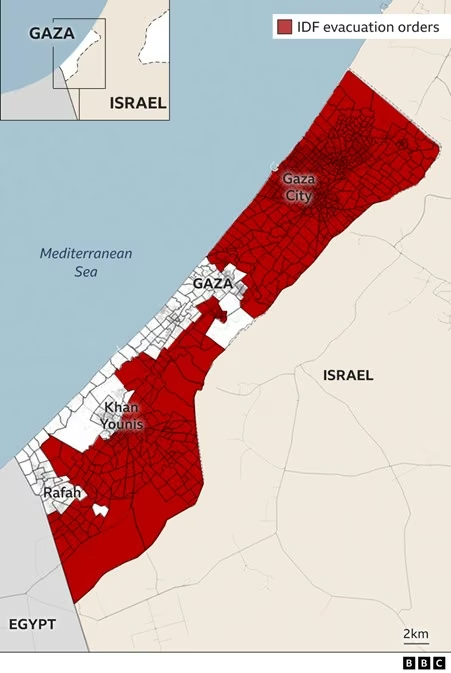
Within these limitations, Israeli officials are questioned on the BBC about Israel’s conduct, at times with rigour. There are some references to the siege of Gaza, one or two to the occupation, one or two mentions of charges of forcible transfer in relation to Israel’s evacuation orders, and an instance in which the words ‘ethnic cleansing’ and ‘genocide’ were mentioned, with attribution to a Palestinian guest. I also saw one or two interviews in which the subject of incitement against Palestinians – generally – was touched upon, as well as the lack of political progress –in general terms – before the attacks. These are mostly exceptions to general lines of questioning. Much more frequent are challenges about the number of civilian casualties, about whether there are safe zones within the Gaza Strip, about Israel cutting off fuel, water and electricity and other such issues relating to the humanitarian situation in Gaza.
It is important to note that the fact that such challenges are posed in no way diminishes the significance of the systematic omission described above. Such omission sets the terms of acceptable debate in line with the framework of Israel’s west-facing propaganda, and thus cements that framework and adopts its underlying assumptions. The main assumption is that Israel is trying to avoid harming Palestinian civilians as it conducts a war of self-defence. Thus, discussions between BBC presenters and Israeli propagandists are centred on the question of whether Israel is trying hard enough, or acting intelligently enough, to achieve its goal of ‘crushing’ and ‘dismantling’ Hamas without harming civilians – or its reputation. This framework is cemented because evidence to the contrary is erased.
Conclusions
There appears to be a ceiling on questioning Israeli officials and propagandists, expressed in the consistent failure of presenters to use crucial evidence to challenge Israel’s west-facing propaganda. Lines of challenge which are obvious to pursue and which would cast doubt on Israel’s west-facing messaging are conspicuously and consistently not pursued by BBC presenters. Important topics for future exploration include interviews with Palestinians, as well as explainers, packages, live correspondent reports, features, and other content – especially (but not exclusively) on BBC News online.
But even on its own, an examination of interviews is revealing. Interviews are about questions, a first and basic step in any search for truth. Fairly and rigorously conducted, they allow us to test claims against evidence; to the extent that guests are truthful, their positions would withstand scrutiny; to the extent they’re not, the proper challenge would unmask inconsistencies, inaccuracies, and other forms of disinformation. If, however, the relevant questions are not asked, entire lines of thought and inquiry are extinguished, and a central part of reality – the very heart of the story – is placed out of view. Unfettered by proper challenge, propagandists for Israel can then paint a picture of a peaceful state that has the misfortune of existing alongside pure evil, and present it as the backdrop to the unfolding horror in Gaza.
[SECTION 2 – The events of October 7 – appears below the footnotes and disclaimers for Section 1]
FOOTNOTES FOR SECTION 1
[1] On February 22-23, an Israeli government panel advanced plans to construct over seven thousand new housing units in various settlements, the largest such decision ever issued at a single planning meeting. The panel also scheduled a March meeting to discuss objections to the highly contentious E-1 project east of municipal Jerusalem, which would block north-south Palestinian contiguity in the West Bank. Israel has previously pulled back from building E-1 amid U.S. pressure, but the rise of far-right parties in Prime Minister Binyamin Netanyahu’s government makes it unclear whether this pattern will continue.
27 SEPTEMBER 2023: Tor Wennesland, United Nations Special Coordinator for the Middle East Peace Process, speaking via videoconference, reported ongoing settlement activity by Israeli authorities who advanced plans for 6,300 housing units in Area C, and approximately 3,580 housing units in East Jerusalem, pointing to the Israeli Government’s administrative actions that likely expedited settlement expansion. “In a continuing trend, many Palestinians, including children, left from their communities citing violence by settlers and shrinking grazing land,” he said.
https://press.un.org/en/2023/sc15424.doc.htm
[2] Measured as a monthly average, 2022 is the deadliest year for Palestinians in the West Bank since the United Nations started systematically counting fatalities in 2005, with 127 Palestinians killed so far this year.
04 April, 2023
The number of Palestinians killed by Israeli forces in the occupied West Bank since the beginning of 2023 has reached 95, including 17 minors and two elderly, after the killing of 21-year-old Mohamad Hallaq and 43-year-old Mohammad Al-Juneidi Abu Bakr, during a military raid on Nablus on Monday.
https://www.newarab.com/news/95-palestinians-killed-israel-first-quarter-2023
[3] 21 Sep 2023
Settler violence has been increasing across the West Bank over the past years. Three settler related incidents per day occurred on average in the first eight months of 2023 compared to an average of two per day in 2022 and one per day the year before. This is the highest daily average of settler-related incidents affecting Palestinians since the UN started recording this data in 2006
[4] 10 Aug 2023
Israeli settler violence and illegal takeover of Palestinian lands have forcibly transferred nearly 500 Palestinians from seven communities, over the past 20 months…
“There are entire Palestinian communities being wiped off the map, a shameful legacy of unrelenting violence, intimidation and harassment perpetuated by Israeli settlers and, in some cases, encouraged by Israeli authorities,” said Ana Povrzenic, NRC’s country director for Palestine.
“The rapid establishment of settlement outposts and takeover of Palestinian land is choking Palestinian communities, destroying their livelihoods, and putting Palestinian lives at risk. Palestinians have no choice but to flee, leaving behind their homes, schools, and jobs.”
[5] 26 July 2023
“Israel’s continuous annexation of portions of the occupied Palestinian territory, now focusing on large swathes of the West Bank after unlawfully annexing east Jerusalem, suggests that a concrete effort may be under way to annex the entire occupied Palestinian territory in violation of international law,” the experts said.
[6] ADMINISTRATIVE DETENTION AS A TOOL OF OPPRESSION AND DOMINATION
https://www.addameer.org/media/4898
THE IMPACT OF ISRAEL’S NEW ULTRANATIONALIST GOVERNMENT ON THE PALESTINIAN PRISONERS’ MOVEMENT
https://www.addameer.org/media/4978
TORTURE AND ILL-TREATMENT BEYOND INTERROGATION: VIOLENT RAIDS AGAINST PALESTINIAN PRISONERS IN ISRAELI OCCUPATION PRISONS
https://www.addameer.org/media/4429
IMPRISONMENT OF CHILDREN
https://www.addameer.org/the_prisoners/children
[7] 22 September 2023
Netanyahu brandishes map of Israel that includes West Bank and Gaza at UN speech
[8] https://www.youtube.com/watch?v=_dZUT1wPVPw
In February 2023 Israel’s governing coalition transferred most of the governing powers over the West Bank to the additional minister of defence, effectively designating Bezalel Smotrich, a civilian official, as the de facto governor of the occupied West Bank. The experts noted that the move solidified Israel’s annexation of occupied territory.
Palestine’s Huwara should be wiped out: Top Israeli minister (1 Mar 2023), https://www.aljazeera.com/news/2023/3/1/israel-arrests-settlers-after-anti-palestinian-pogrom
[9] https://www.youtube.com/watch?v=_dZUT1wPVPw
[10] ‘Indeed, the ultimate purpose of the judicial overhaul is to tighten restrictions on Gaza, deprive Palestinians of equal rights both beyond the Green Line and within it, annex more land, and ethnically cleanse all territories under Israeli rule of their Palestinian population.’
https://sites.google.com/view/israel-elephant-in-the-room/aug-23-elephant-in-the-room-petition
Over 1,000 academics, public figures say Israel judicial overhaul about ethnically cleansing Palestinians (11 August, 2023) https://www.newarab.com/news/ethnic-cleansing-aim-israel-judicial-reform-scholars-say
[11] The Dahiya Doctrine, Proportionality, and War Crimes
… a sinister strategy implemented by the Israeli military at least since the 2006 assault on Lebanon, which goes by the name “Dahiya doctrine.” The doctrine was revealed publicly by Maj. Gen. Gadi Eizenkot, who was head of the Northern Command in 2006, and who has been deputy chief of staff of the so-called Israel Defense Forces (IDF), the Israeli army, since 2013. After an entire southern suburb of Beirut, known as the Dahiya, had been devastated from the air by troops under his command using two-thousand-pound bombs and other similar ordnance, Eizenkot explicitly laid out what this doctrine entailed in 2008. He stated: “What happened in the Dahiya quarter of Beirut in 2006 will happen in every village from which Israel is fired on. . . . We will apply disproportionate force on it and cause great damage and destruction there. From our standpoint, these are not civilian villages, they are military bases. . . . This is not a recommendation. This is a plan. And it has been approved.”
… it is the very same that has now been deployed against Gaza for the third time in the past six years. Israeli military correspondents and security analysts repeatedly reported that the Dahiya doctrine was Israel’s strategy throughout the war in Gaza this past summer. [7]
https://www.palestine-studies.org/en/node/186668
UN presses for prosecutions in damning report of Hamas and Israel conduct (Tue 15 Sep 2009)
…Their key findings are:
Israel’s incursion was “a deliberately disproportionate attack designed to punish, humiliate and terrorise a civilian population, radically diminish its local economic capacity both to work and to provide for itself and to force upon it an ever-increasing sense of dependency and vulnerability”.
Israeli forces committed “grave breaches of the fourth Geneva convention” which gave rise to “individual criminal responsibility”, meaning soldiers could face prosecution.
Israeli troops used Palestinian civilians as human shields, a war crime.
Israel’s economic blockade of Gaza in the years before the war amounted to “collective punishment intentionally inflicted by the government of Israel on the people of the Gaza Strip”.
Israeli actions depriving Gazans of means of subsistence, employment, housing and water, and denying their freedom of movement, “could lead a competent court to find that the crime of persecution, a crime against humanity, had been committed”.
Palestinian rocket attacks did not distinguish between civilian and military targets, caused terror among Israeli civilians and “would constitute war crimes and may amount to crimes against humanity”.
Gaza’s security forces, controlled by Hamas, carried out extrajudicial executions and the arbitrary arrest, detention and ill-treatment of people, especially political opponents.
Gilad Shalit, an Israeli soldier held captive in Gaza for more than three years, is a prisoner of war and should be released on humanitarian grounds.
https://www.theguardian.com/world/2009/sep/15/israel-blamed-for-gaza-war-crimes
[12] Israeli Defense Minister Yoav Gallant declared on 9 October that “we are fighting human animals and we act accordingly”.
https://opiniojuris.org/2023/10/18/public-statement-scholars-warn-of-potential-genocide-in-gaza/
[13] “We will not allow a reality in which Israeli children are murdered,” Gallant said in a meeting with Israeli soldiers near the southern border on Tuesday, according to the AP. “I have removed every restriction — we will eliminate anyone who fights us, and use every measure at our disposal.”
“Israel war: Israeli defense minister tells troops all ‘restraints’ lifted in Gaza offensive” By Brady Knox
https://www.washingtonexaminer.com/?p=2455607
[14] Israeli army: ‘Emphasis is on damage and not on accuracy’ (10 October 2023 12:45 BST) https://www.middleeasteye.net/live-update/israeli-army-emphasis-damage-and-not-accuracy
Disclaimers:
- The above is by no means a comprehensive account of all the things that went unchallenged, or insufficiently challenged, in the interviews in question.
- None of the above is meant to suggest anything about the intentions of individuals in the BBC, whether presenters, producers, editors, or anyone involved directly or indirectly in the programs in which these interviews were aired.
- Further details about the interviews are available upon the request of management.
- The volume of BBC output is too large for a single paper to offer a comprehensive assessment. More light can (and should) be shed by further studies.
SECTION 2 – The events of October 7 – Feedback to the BBC from Rami Ruhayem, 25 February 2024 [JVL heading]
In the previous piece (sent on the 8th of February), I examined how a body of relevant context that would’ve cast doubt on Israeli messaging – especially what Israel’s west-facing propagandists claim are Israel’s war aims – was consistently ignored in BBC coverage. In this piece I look into some of the content relating to the events of October 7. This paper is not about what happened on that day and the days that followed; rather, it is an inquiry into whether – and to what extent – the BBC applied, misapplied or simply cast aside journalistic standards in treating various claims about what happened on that day.
I’ve found a sustained collapse in some of the most basic standards[1] and values, one which seems to complement Israel’s propaganda purposes and strategy.
Early Signs
From the start, it was evident that unverified claims of the most atrocious acts by Hamas fighters against Israelis were being circulated and repeated at the highest levels.[2] Even though it was not possible to rule them out, especially at an early stage, a set of basic measures should’ve been initiated; one of them would’ve been to make sure presenters inquire about evidence when such claims are made on air and clarify that the BBC had not verified them. Another would’ve been to direct the relevant teams to investigate and constantly update audiences –and everyone working on the story within the BBC – as to what it is we know took place, what it is we know did not, and what we remain uncertain about.
There were also reasons for extra caution. Among these were early signs of what appeared to be an attack by Israel on basic journalistic norms. Responding to questions from The Intercept about the claim that Hamas had beheaded babies, an Israeli spokesperson said ‘we cannot confirm it officially, but you can assume it happened and believe the report.’ In other words, Israel expected journalists to believe all the worst claims about Hamas, regardless of whether they’re backed by evidence.[3]
The Pregnant Woman and the Foetus
Among the most bloodcurdling accusations to have been made against Palestinian attackers on October 7 is one about a pregnant woman and her foetus. I have heard versions of it repeated at least four times on the BBC.
… just yesterday I heard one of the women that was pregnant there, this terrorist put his hand in, took out her foetus killed it while the umbilical cord was still attached to her…
The presenter let the claim pass without making any inquiries. Days later:
‘…they pulled a baby out of a pregnant mom and then beheaded the baby, beheaded the mom.
This, too, passed without any inquiry by the presenter. Days later:
The Guest:… we now know that there was a pregnant woman who had her belly cut open, the baby was removed from her stomach and beheaded in front of her. There’s videos of this.
BBC Presenter: Which is unverified, we haven’t seen these videos.
The Guest: You haven’t seen it. I know many people who have seen it. these videos are in existence, there’s countless others…
In relative terms, this much-needed interjection is a credit to the individual presenter. But it is also a de facto confession – on the part of the BBC – that the BBC had allowed this claim to be made – at least twice up until that point – without question, although it had not verified it. It would have been reasonable for audiences exposed to the previous two interviews – especially those who trust the BBC – to assume the BBC believes this event to have taken place.
Why – one might ask – were defenders of Israel going for such claims instead of all the documented instances of brutality against Israelis on October 7 by Hamas and other Palestinian armed groups and individuals? Why not simply talk about horrific things they know are true and verified, instead of claims that could – in theory and in the absence of evidence – expose them to charges of fabrication?
To anyone in doubt, an answer might be found in the next rendition of the story. The subject under discussion was the humanitarian situation in Gaza. More specifically, premature Palestinian babies were on the verge of dying:
BBC Presenter: let the fuel through, is that so hard?
Israeli guest: It’s very hard because we’re dealing with murderers and liars, and people who’ve done the most outrageous atrocities we’ve seen since the Holocaust. We’re talking here about babies who could not maybe survive in the incubators. Israeli babies didn’t even make it to incubators because those animals cut the mother’s stomach, took the baby out, killed it and then killed the mother. So when you’re dealing with these people it’s very difficult to send in fuel which you know at the end of the day will actually make Hamas use it for rockets ….
The claim once again passed without challenge or inquiry. The purpose of the repetition was made clearer; it was to drill in the idea that any action Israel sees fit to take is justified. By seeking to place Hamas on the most extreme end of the spectrum of evil, propagandists for Israel seemed to believe they’d be able to defend whatever Israel chose to do – and set the stage for more. The seeming suspension of basic standards of scrutiny on the BBC most likely encouraged that strategy.
Other claims
In almost every interview, Israeli officials, politicians, and other guests were making and repeating claims of the most horrific nature, often stringed together in a series:
…I’m talking about Hamas terrorists going street by street … Shooting down babies. Raping girls. Burning people alive. Beheading people…it’s important we don’t start the story from the middle…we’ve seen pictures of babies being shot from point blank…
…last week, young girls were raped repeatedly and brutally until their body parts were torn apart. Babies were set on fire. Babies were shot in the head.
…Who does that? I’ll tell you who does that. People who have no problem butchering babies in their bedroom.
A few basic questions could’ve shed some light on these claims, and helped other teams put together a comprehensive picture of verified atrocities to inform audiences. But in all of the examples above and more, no such questions were asked, and the allegations passed with no comment, clarification, or interjection of any sort.
Once again, the BBC was implying to its audiences that it had verified all these claims, although in these cases, it wasn’t clear what – exactly – it had supposedly verified. Was it that children, including babies, had been killed? Or that they’d been killed by Hamas? Was it that Hamas fighters had walked into a bedroom, and ‘butchered’ a baby? Or ‘babies’? Or set them on fire? Had the BBC seen the pictures one of the guests mentioned – of ‘babies shot from point blank’? If not, why not ask to see them and verify them? If such things had been verified by the BBC, why weren’t they in a BBC piece online?
It is left to audiences to imagine the worst, and to believe that the worst had been verified by the BBC. The effect over time, is the merging of what propagandists for Israel say and what the BBC says about the events of October 7, as one Israeli spokesperson appears to have understood:
…bloodthirsty terrorists who rape and burn people alive, it’s been reported on the BBC, I don’t need to restate all the things that Hamas did on that terrible Saturday morning.
The Screening
Israel has held several screenings for journalists to show evidence of some of the actions of Hamas fighters. BBC Verify [4] carried a piece about one of them, with description of some of the violence inflicted on Israelis on October 7. But the piece neither confirms nor denies – nor mentions in any way – the stream of allegations which were allowed to be hammered into the heads of BBC viewers without challenge. Does the video shown include evidence in support of these allegations? Have the Israeli officials present at the screening spoken about these allegations? No questions, no answers, no verification.
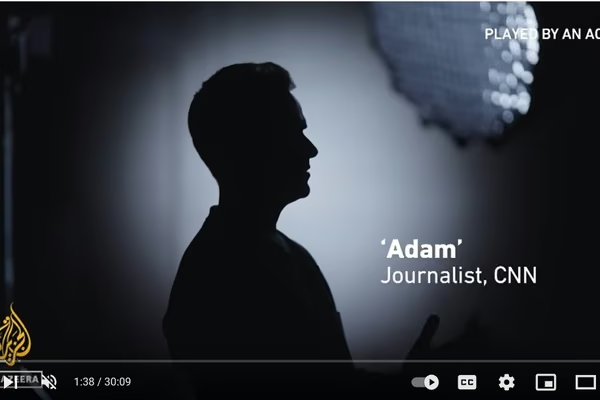
The BBC also interviewed a journalist who attended one of the screenings. He too had almost nothing to say about these claims, and the BBC presenter did not ask about them. Instead, the presenter chose to ask about ‘the deniers’ out there:
BBC Presenter: …perhaps we can talk about the reasons for that briefing yesterday … it’s also very much to address the deniers that are out there, you go on to social media and you can see it just tweet after tweet.
Journalist: Yeah … the scope and reach of disinformation, misinformation, straight out lying, is huge and they were forced to do this because the level of denial was so great, and you know there was a lot particularly, a lot of denial around the issue of the murdered babies. Now I’m not going to go into details, but we were shown an image of one of them and it was horrific… there’s still lots of people saying it’s all lies…
Does the image he saw ‘around the issue of the murdered babies’ substantiate, in part or in full, the claims made above? Were the journalists told what the Israeli authorities know about how the baby was killed? Were any details/photos provided about all the other babies Israel says were killed, given that the claims made and repeated on the BBC were all in the plural? At least some of these questions can be answered without going into the terrible details around that image, and they’re questions that would help any BBC team working on building an accurate, comprehensive and evidence-based picture of the events of October 7.
They’re also questions that were not asked. Once again, the audience is led to believe all the claims and to imagine worse. In addition, we now have what amounts to a collective smear against people who doubt the Israeli version; all of it, any of it. Who are these ‘deniers’ –lumped together by the presenter and the guest? Doubtless, social media is flooded with people who do not believe many of the claims. There are many articles [5] – based on testimony [6] and evidence – that reinforce their doubts [7] about several key aspects of the official Israeli narrative of what happened. [8] These are not blanket cries that ‘it’s all lies’. These are journalists, on different sides of the divide, who’ve presented evidence to back up their doubts.
Maybe they all got it wrong? Maybe they misinterpreted the evidence? The BBC has an impressive array of resources that can be marshalled to investigate, lay out the available evidence, and critically examine various interpretations of it.[9] But more than four months on, there appears to be no trace of such things on BBC News Online, including something as simple as a call for an investigation by families of Israelis killed during the attacks.[10]
Conclusions
There has been a sustained collapse in the application of some of the most basic editorial standards on BBC outlets when it comes covering the events of October 7, one that appears aligned with Israel’s propaganda strategy.
Claims and testimony that encourage the most extreme portrayals of Israel’s enemies are allowed to be repeated without challenge – regardless of whether or not they’re backed by evidence. Claims and testimony that raise the possibility of Israeli disinformation around the events of October 7 are ignored – despite the evidence.
Such coverage is likely to have aided Israel’s efforts to ensure political support in the West for its actions, and to intimidate those opposed to them and portray them as supporters of the most hideous atrocities.
An important subject for future examination is the extent to which incitement and hate speech against Palestinians have been permitted on BBC outlets. Another is the subject of consistency in how much attention – and what kind of attention – is given to the victims of atrocities,[xi] before and after October 7.
But for the purposes of this paper, the most pressing question is this: why does the BBC seem to have steered away from the growing body of evidence that casts doubt on the official Israeli version of the events of October 7?
FOOTNOTES FOR SECTION 2
[1] … the BBC editorial guidelines underpin everything we do.
These guidelines are the blueprint for our journalism – ensuring we forensically check and verify facts, double and triple source information, and track down first-hand eyewitnesses.
And that as we pursue the truth, we do so with impartiality and with accuracy. This is our promise.
https://www.bbc.co.uk/mediacentre/articles/2022/deborah-turness-bbc-news-trust-is-earned/
[2] CNN (Updated 3:25 PM EDT, Thu October 12, 2023), President Joe Biden’s graphic description of horrors in Israel was intended to “underscore the utter depravity” of the Hamas attack on civilians, the White House says, even if he hadn’t personally viewed or confirmed the imagery he described.
https://edition.cnn.com/2023/10/12/politics/joe-biden-photos-children-hamas-israel/index.html
[3] October 11 2023, THE ISRAEL DEFENSE FORCES could not confirm a horrific claim that Hamas beheaded babies during a weekend assault, a spokesperson for the military told The Intercept on Tuesday. The claim went viral, becoming a headline-grabbing aspect of a massacre that left more than 1,000 Israelis dead.
“Women, children, toddlers, and elderly were brutally butchered in an ISIS way of action and we are we are [sic] aware of the heinous acts Hamas is capable of,” the spokesperson wrote in response to questions from The Intercept about the viral reports. “We cannot confirm it officially, but you can assume it happened and believe the report,” she reiterated in a follow-up phone call.
https://theintercept.com/2023/10/11/israel-hamas-disinformation/
[4] https://www.bbc.com/news/world-middle-east-67198270
[5] https://mondoweiss.net/2023/10/a-growing-number-of-reports-indicate-israeli-forces-responsible-for-israeli-civilian-and-military-deaths-following-october-7-attack/
https://www.middleeasteye.net/opinion/israel-palestine-war-media-ignoring-evidence-actions-7-october
Aryeh Golan: When they tried to eliminate the abductors, Hamas?
Yasmin Porat: They eliminated everyone, including the hostages. Because there was very, very heavy crossfire. I was freed at approximately 5:30. The fighting apparently ended at 8:30. After insane crossfire, two tank shells were shot into the house. It’s a small kibbutz house, nothing big. You saw it on the news.
Aryeh Golan: Yes
Yasmin Porat: Not a large place. And at that moment everyone was killed. There was quiet, except for one survivor that came out of the garden, Hadas.
Aryeh Golan: How were they all killed?
Yasmin Porat: From the crossfire.
Aryeh Golan: Crossfire, so it could also be from our forces?
Yasmin Porat: Undoubtedly.
Aryeh Golan: Really?
Yasmin Porat: That’s what I believe.
https://www.newarab.com/news/israeli-helicopter-fired-nova-festival-goers-oct-7
[9] https://theintercept.com/2024/02/07/gaza-israel-netanyahu-propaganda-lies-palestinians/
[10] The families of 13 Israeli civilians killed amid an intense firefight between Hamas and Israeli troops in Kibbutz Be’eri on October 7 are seeking a military investigation of the soldiers’ actions that day, due to the likelihood that at least some of the civilians were killed by army fire, including tank fire, at the house where they were being held hostage by terrorists.
[11] https://www.middleeasteye.net/news/too-dangerous-play-west-bank-children-shot-dead-israeli-soldiers
https://www.ncbi.nlm.nih.gov/pmc/articles/PMC1226264/
Disclaimers:
- None of the above is meant to suggest anything about the intentions of individuals in the BBC, whether presenters, producers, editors, or anyone involved directly or indirectly in the programs in which these interviews were aired, or in the pieces written, or not written, on BBC News Online.
- Further details about the interviews are available upon the request of management.
- The volume of BBC output is too large for a single paper to offer a comprehensive assessment. More light can (and should) be shed by further studies.

the BBC would rather reflect the views of stinking Israelis than adhere to facts
What brave, sustained work from this correspondent and what a familiar series of bureaucratic evasion from ‘desk murderers’ in the Corporation. Can anyone tell us what the managers did to Jeremy Bowen too? He, the BBC’s veteran and chief middle east reporter was rapidly removed from our screens at the time when his knowledge and accuracy would have made a difference, and then sent to Ukraine. One wonders what kind of fight took place behind the scenes. If any. Unexpectedly the BBC News 24 channel did interview the son of Lord Levey, evidently expecting a pro-israel response and not realizing that as co-founder of J Street he was moving to a totally different view. He demolished the ‘self defence’ excuse and called for immediate negotiations and Ceasefire. This was early in October! The interviewer was clearly flummoxed and as far as I know Levey wasn’t ever asked on again. There has clearly been tremendous government pressure and managers caved because said government is their employer and there had been repeated threats to the license. An expense of spirit in a waste of shame.
PS I’ve just noticed the previous Comment and would like to ask the moderators of this blog to be more careful. Imo the language of that comment is unacceptable. Perhaps the writer didn’t know that for centuries Jews were called ‘stinking’? What is more worrying is that the post has already got five Thumbs Up and no Thumbs Down (although I’m going to add mine). Maybe JVL’s hard pressed Education section could also give some sessions to our supporters. Hopefully whoever wrote and commended that Comment, they are not actual JVL members.
Thank you for this, JVL. My own observation of BBC coverage is that many relevant facts and current news items are omitted or are swamped by an overwhelming pro Israel bias which is inclusive of repetition of stock whoppers.
I sent off the following comment nearly 2 months ago to the BBC – ‘At least twice in the past few months I have heard discussions on Woman’s Hour treating as if fact the allegations that rapes were committed on Israeli women by Hamas fighters on Oct.7 2023. In light of articles such as those below debunking these allegations, isn’t it time that Women’s Hour revisited this topic, including apologizing for misleading listeners, and indeed getting the story so badly wrong. “For seven months Israel has engaged in a no-holds-barred propaganda campaign to push its 7 October rape claims… but all of its atrocity claims about sexual violence on that day have collapsed under scrutiny… Meanwhile, [ICC Chief Prosecutor] Khan has so far completely ignored the mounting evidence of systematic sexual violence against Palestinians by Israel, including first-hand victim accounts.”
https://skwawkbox.org/…/times-becomes-first-msm-to…/
https://electronicintifada.net/…/debunking-screams…
https://electronicintifada.net/…/watch-ny-times…
https://electronicintifada.net/…/ny-times-found-no-7… ‘
The BBC is now Officially the Propaganda Office for the US, UK and Israeli Governments and it never tries to hide the fact. Its language when it’s about Gaza has been a total disgrace.
An excellent, scrupulously researched article showing how the BBC ignores its own staff as well as audience in its loyalty to Israel.
Important as these kinds of investigations are (and especially if they are as thorough as this is), we are always reminded how difficult it is to catch the hare once it has started to run and what damage can be caused by first impressions.
I have never understood how the BBC is so frequently quoted as trusted around the world. Perhaps I am watching/listening to too much BBC broadcasting!
There is no simple remedy, of course. We might have hoped that media education in schools would at least lead to a kind of healthy skepticism and an understanding that the means of communication are under the control of those who wish to preserve a world that supports their power, but the nature of much social media content does not suggest that this is happening.
In the end, it’s a failure of politics. The hope aroused by the, essentially accidental, emergence of Corbyn was always going to mean that, if it ended in defeat, the fall would be serious. People would be left believing nothing – or anything!
The fact that fewer than one fifth of the population supported Labour ought to give them and us cause for thought, no matter how much the Parliamentary majority is spun.
Only the Palestine Solidarity movement is providing energy and encouragement; we must build on it. There’s not much else. Palestine is the issue. The painstaking evidence-presenting exemplified here is an essential element in the fight.