
Bowen shows understanding the BBC rarely displays
“The Hamas offensive came out of well over a century of unresolved conflict.”
We might quibble over use of the word “conflict” to describe decades of violent state repression of a dispossessed people, but from the first sentence of his review for BBC News, the British Broadcasting Corporation’s International Editor Jeremy Bowen demonstrates a great deal more understanding of the context to the last 12 horrific months than the myriad pundits given free rein to spout Israeli propaganda elsewhere on BBC platforms. This is also evident from his contribution to The Today Debate aired on Radio 4 on October 8, One year on: Is there a path to peace in the Middle East?
We know that the nation’s public broadcaster is under attack, not least from within the Labour Government which is reviewing its funding structure in ways that do not bode well for those concerned to preserve space for dissenting voices in UK politics. We also know that it bears considerable responsibility for popularising the conflation of antisemitism with criticism of Israel that helped undermine the movement around former Labour Party leader Jeremy Corbyn and now underpins much of the mainstream coverage of opposition to Israel’s war on Palestinians.
Bowen himself has long been the object of attacks and complaints from Zionists enraged by his (for them) infuriating impulse to consider the Palestinian perspective. His assessment of the situation now in the Middle East below is well worth reading. See the original report to view all the images it included.
NWI
The Hamas offensive came out of well over a century of unresolved conflict. After Hamas burst through the thinly defended border, it inflicted the worst day the Israelis had suffered.
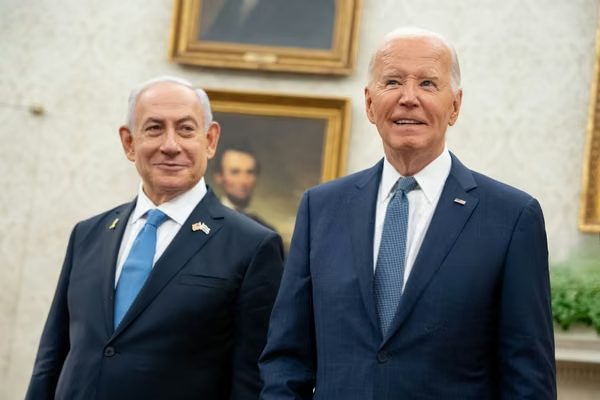
Around 1,200 people, mostly Israeli civilians, were killed. Israel’s prime minister, Benjamin Netanyahu, phoned President Joe Biden and told him that “We’ve never seen such savagery in the history of the state”; not “since the Holocaust.” Israel saw the attacks by Hamas as a threat to its existence.
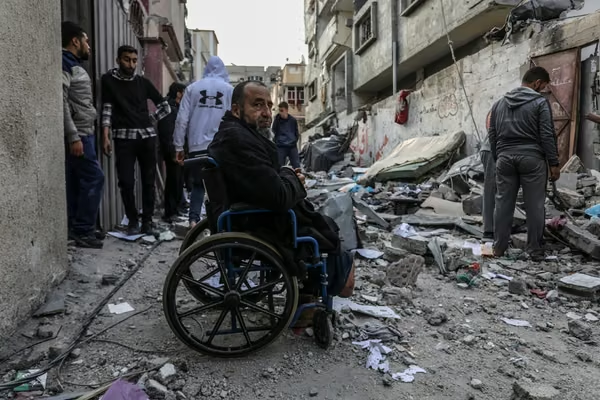
Since then, Israel has inflicted many terrible days on the Palestinians in Gaza. Nearly 42,000 people, mostly civilians have been killed, according to the Hamas-run health ministry. Much of Gaza is in ruins. Palestinians accuse Israel of genocide.
The war has spread. Twelve months after Hamas went on the offensive the Middle East is on the edge of an even worse war; wider, deeper, even more destructive.
The death of illusions
A year of killing has stripped away layers of assumptions and illusions. One is Benjamin Netanyahu’s belief that he could manage the Palestinian issue without making concessions to their demands for self-determination.
With that went the wishful thinking that had comforted Israel’s worried Western allies. Leaders in the US and UK, and others, had convinced themselves that Netanyahu, despite opposing a Palestinian state alongside Israel all his political life, could somehow be persuaded to accept one to end the war.
Netanyahu’s refusal reflected almost universal distrust of Palestinians inside Israel as well as his own ideology. It also torpedoed an ambitious American peace plan.
President Biden’s “grand bargain” proposed that Israel would receive full diplomatic recognition by Saudi Arabia, the most influential Islamic country, in return for allowing Palestinian independence. The Saudis would be rewarded with a security pact with the US.
The Biden plan fell at the first hurdle. Netanyahu said in February that statehood would be “huge reward” for Hamas. Bezalel Smotrich, one of the ultra-nationalist extremists in his cabinet, said it would be an “existential threat” to Israel.
The Hamas leader, Yahya Sinwar, presumed to be alive, somewhere in Gaza had his own illusions. A year ago, he must have hoped that the rest of Iran’s so-called “axis of resistance” would join, with full force, into a war to cripple Israel. He was wrong.
Sinwar kept his plans to attack Israel on 7 October so secret that he took his enemy by surprise. He also surprised some on his own side. Diplomatic sources told the BBC that Sinwar might not even have shared his plans with his own organisation’s exiled political leadership in Qatar. They had notoriously lax security protocols, talking on open lines that could be easily overheard, one source said.
Far from going on the offensive, Iran made it clear it did not want a wider war, as Israel invaded Gaza and President Biden ordered American carrier strike groups to move closer to protect Israel.
Instead, Hassan Nasrallah, and his friend and ally, Iran’s supreme leader Ayatollah Ali Khamenei, restricted themselves to rocketing Israel’s northern border, which they said would continue until a ceasefire in Gaza. The targets were mostly military, but Israel evacuated more than 60,000 people away from the border. In Lebanon, perhaps twice as many had to flee over the months as Israel hit back.
Israel made clear it would not tolerate an indefinite war of attrition with Hezbollah. Even so, the conventional wisdom was that Israel would be deterred by Hezbollah’s formidable fighting record in previous wars and its arsenal of missiles, provided by Iran.
In September, Israel went on the offensive. No one outside the senior ranks of the Israel Defense Forces (IDF) and the Mossad spy agency believed so much damage could be inflicted so quickly on Iran’s most powerful ally.
Israel remotely exploded booby-trapped pagers and radios, destroying Hezbollah’s communications and killing leaders. It launched one of the most intense bombing campaigns in modern warfare. On its first day Israel killed about 600 Lebanese people, including many civilians.
The offensive has blown a big hole in Iran’s belief that its network of allies cemented its strategy to deter and intimidate Israel. The key moment came on 27 September, with the huge air strike on the southern suburbs of Beirut that killed Hassan Nasrallah, the leader of Hezbollah and many of his top lieutenants. Nasrallah was a vital part of Iran’s “axis of resistance”, its informal alliance and defence network of allies and proxies.
Israel broke out of the border war by escalating to a bigger one. If the strategic intention was to force Hezbollah to cease fire and pull back from the border, it failed. The offensive, and invasion of south Lebanon, has not deterred Iran.
Iran seems to have concluded that its open reluctance to risk a wider war was encouraging Israel to push harder. Hitting back was risky, and guaranteed an Israeli response, but for the supreme leader and Iran’s Revolutionary Guards, it had become the least bad option.
On Tuesday 1 October, Iran attacked Israel with ballistic missiles.
A repository of trauma
Kibbutz Kfar Aza is very close to the wire that was supposed to protect Israel’s border with the Gaza Strip. The kibbutz was a small community, with modest homes on an open-plan campus of lawns and neat gardens. Kfar Aza was one of Hamas’s first targets on 7 October. Sixty-two people from the kibbutz were killed by Hamas. Of the 19 hostages taken from there into Gaza, two were killed by Israeli troops after they escaped from captivity. Five hostages from Kfar Aza are still in Gaza.
The Israeli army took journalists into Kfar Aza on 10 October last year, when it was still a battle zone. We saw Israeli combat troops dug into the fields around the kibbutz and could hear gunfire as they cleared buildings where they suspected Hamas fighters might be sheltering. Israeli civilians killed by Hamas were being carried out in body bags from the ruins of their homes. Hamas fighters killed by Israeli soldiers as they fought their way into the kibbutz still lay on the neat lawns, turning black as they decomposed in the strong Mediterranean sun.
A year later the dead are buried but very little has changed. The living have not returned to live in their homes. Ruined houses have been preserved as they were when I saw them on 10 October last year, except the names and photos of the people who lived and were killed inside them are displayed on big posters and memorials.
Zohar Shpak, a resident who survived the attack with his family, showed us round the homes of neighbours who were not as lucky. One of the houses had a large photo on its wall of the young couple who lived there, both killed by Hamas on 7 October. The ground around the houses has been dug over. Zohar said the young man’s father had spent weeks sifting earth to try to find his son’s head. He had been buried without it.
The stories of the dead of 7 October, and the hostages, are well known in Israel. Local media still talk about their country’s losses, adding new information to old pain.
Zohar said it was too early to think about how they might rebuild their lives.
“We are still inside the trauma. We are not in post-trauma. Like people said, we’re still here. We are still in the war. We wanted the war will be ended, but we want it will be ended with a victory, but not an army victory. Not a war victory.
“My victory is that I could live here, with my son and daughter, with my grandchildren and living peacefully. I believe in peace.”
Zohar and many other Kfar Aza residents identified with the left wing of Israeli politics, meaning that they believed Israel’s only chance of peace was allowing the Palestinians their independence. Israelis like Zohar and his neighbours are convinced that Netanyahu is a disastrous prime minister who bears a heavy responsibility for leaving them vulnerable and open to attack on 7 October.
But Zohar does not trust the Palestinians, people he used to ferry to hospitals in Israel in better times when they were allowed out of Gaza for medical treatment.
“I don’t believe those people who are living over there. But I want the peace. I want to go to Gaza’s beach. But I don’t trust them. No, I don’t trust any one of them.”
Gaza’s catastrophe
Hamas leaders do not accept that the attacks on Israel were a mistake that brought the wrath of Israel, armed and supported by the United States down on to the heads of their people. Blame the occupation, they say, and its lust for destruction and death.
In Qatar, an hour or so before Iran attacked Israel on 1 October, I interviewed Khalil al-Hayya, the most senior Hamas leader outside Gaza, second only in their organisation to Yahya Sinwar. He denied his men had targeted civilians – despite overwhelming evidence – and justified the attacks by saying it was necessary to put the plight of the Palestinians on the world’s political agenda.
“It was necessary to raise an alarm in the world to tell them that here there is a people who have a cause and have demands that must be met. It was a blow to Israel, the Zionist enemy.”
Israel felt the blow, and on 7 October, as the IDF was rushing troops to the Gaza border, Benjamin Netanyahu made a speech promising a “mighty vengeance”. He set out war aims of eliminating Hamas as a military and political force and bringing the hostages home. The prime minister continues to insist that “total victory” is possible, and that force will in the end free the Israelis held by Hamas for a year.
His political opponents, including relatives of the hostages, accuse him of blocking a ceasefire and a hostage deal to appease ultra-nationalists in his government. He is accused of putting his own political survival before the lives of Israelis.
Netanyahu has many political enemies in Israel, even though the offensive in Lebanon has helped repair his poll numbers. He remains controversial but for most Israelis the war in Gaza is not. Since 7 October, most Israelis have hardened their hearts to the suffering of Palestinians in Gaza.
Two days into the war, Israel’s Defence Minister, Yoav Gallant, said he had ordered a “complete siege” of the Gaza Strip.
“There will be no electricity, no food, no fuel, everything is closed… We are fighting human animals and we are acting accordingly.”
Since then, under international pressure, Israel has been forced to loosen its blockade. At the United Nations at the end of September, Netanyahu insisted Gazans have all the food they need.
The evidence shows clearly that is not true. Days before his speech, UN humanitarian agencies signed a declaration, external just demanding an end to “appalling human suffering and humanitarian catastrophe in Gaza”.
“More than 2 million Palestinians are without protection, food, water, sanitation, shelter, health care, education, electricity and fuel – the basic necessities to survive. Families have been forcibly displaced, time and time again, from one unsafe place to the next, with no way out.”
BBC Verify has analysed the condition of Gaza after a year of war.
The Hamas-run health ministry says nearly 42,000 Palestinians have been killed so far. Analysis of satellite imagery by US academics Corey Scher and Jamon Van Den Hoek suggests 58.7% of all buildings have been damaged or destroyed.
Footage sourced by the BBC from drone operators inside Gaza shows the extent of the destruction
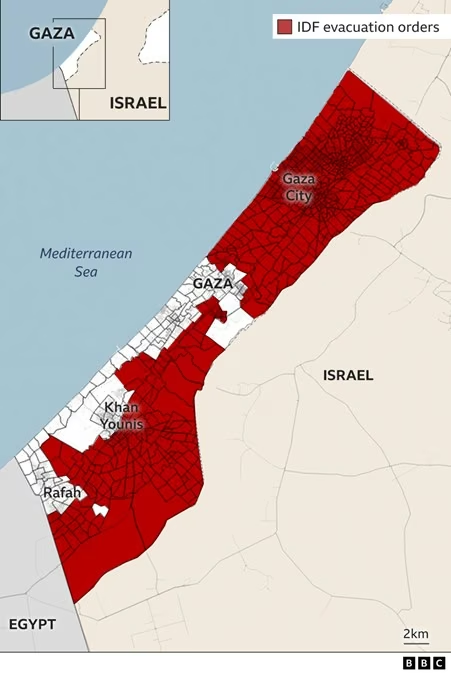
But there is another human cost – displacement – with civilians repeatedly instructed to move by the IDF.
The effects of the movement of people can be seen from space.
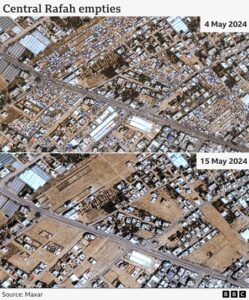
These waves of displacement began on 13 October, when the IDF told residents of the northern half of the strip to move south for their own “safety”.
BBC Verify has identified more than 130 social media posts like these shared by the IDF, detailing which areas were designated combat zones, routes to take out and where temporary pauses in fighting would take place.
In total, these often-overlapping posts amounted to about 60 evacuation orders covering more than 80% of the Gaza strip.
On many of the notices, BBC Verify has found key details to be unreadable and drawn boundaries inconsistent with the text.
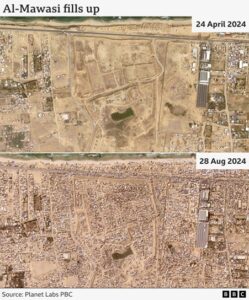
The IDF has designated a coastal area – al-Mawasi – in southern Gaza as a humanitarian zone. It still gets bombed. BBC Verify has analysed footage of 18 air strikes within the zone’s borders.
Our lives were beautiful – suddenly we had nothing
Satellite pictures show a huge bottleneck of people on Salah al-Din Street, after Israel ordered the effective depopulation of northern Gaza. Somewhere in the crowds moving down Salah al-Din, Gaza’s main north-south route, was Insaf Hassan Ali, her husband and two children, a boy of 11 and a girl of seven. So far, they have all survived, unlike many members of their extended family.
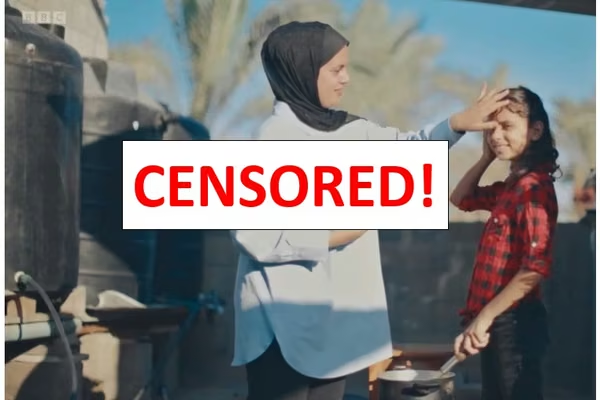
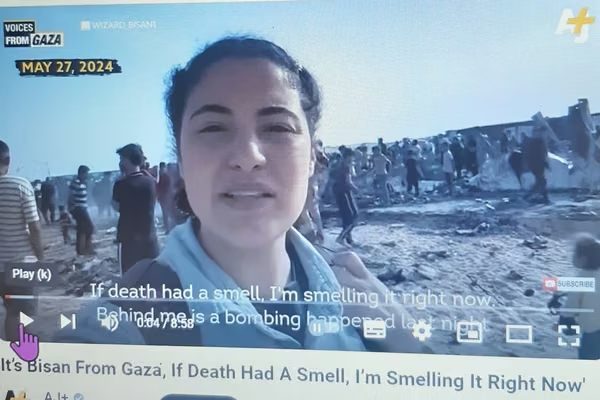
Israel does not allow journalists into Gaza to report freely. We assume that is because Israel does not want us to see what it has done there. We commissioned a trusted Palestinian freelancer inside Gaza to interview Insaf Ali and her son.
She spoke about the terrible fear they felt as they walked south, with perhaps one million others, on the orders of the Israeli army. Death was everywhere, she says.
“We were walking on Salah al-Din Street. A car in front of us was hit. We saw it, and it was burning… On the left, people were killed, and on the right, even the animals—donkeys were thrown around, they were bombed.
“We said, ‘That’s it, we’re done.’ We said, ‘now the rocket that is coming will be for us’.”
Insaf and her family had a comfortable middle-class life before the war. Since then, they have been displaced 15 times on the orders of Israel. Like millions of others, they are destitute, often hungry, living in a tent at al-Mawasi, a desolate area of sand dunes. Snakes, scorpions and venomous giant worms invade the tents and have to be swept out. As well as the risk of death in an air strike, they face hunger, disease and the faecal dust generated when millions of people do not have access to proper sanitation.
Insaf wept for her old life, and the people they have lost.
“Our lives were beautiful, and suddenly we had nothing—no clothes, no food, no essentials for life. Constantly being displaced is incredibly hard on my children’s health. They’ve had malnutrition and they have been infected with diseases, including amoebic dysentery and hepatitis.”
Insaf said that the beginning of months of Israeli bombing felt like the “horrors of judgement day”.
“Any mother would feel the same, anyone who owns something precious and is afraid it might slip from their hands at any moment. Each time we moved to a house, it would be bombed, and someone in our family would be killed.”
The only chance of making even small improvements in the lives of Insaf and her family and well over two million others in Gaza is to agree a ceasefire. If the killing stops, diplomats might have a window to stop the slide into a much wider catastrophe.
More disasters await in the future, if the war drags on and a new generation of Israelis and Palestinians cannot shake the hatred and horror many currently feel about the actions of the other side.
Insaf’s 11-year-old son, Anas Awad, has been deeply affected by everything he has seen.
“There’s no future for Gaza’s children. The friends I used to play with have been martyred. We used to run around together. May God have mercy on them. The mosque where I used to memorise the Quran has been bombed. My school has been bombed. So has the playground… everything has gone. I want peace. I wish I could return with my friends and play again. I wish we had a house, not a tent.”
“I don’t have friends anymore. Our whole life has turned to sand. When I go out to the prayer area, I feel anxious, and hesitant. I don’t feel right.”
His mother was listening.
“It has been the hardest year of my life. We saw sights we should not have seen – scattered bodies, the desperation of a grown man holding a bottle of water to drink for his children. Of course, our homes are no longer homes; they are just piles of sand, but we hope for the day when we can return.’
The law
UN humanitarian agencies have condemned both Israel and Hamas: “The parties’ conduct over the last year makes a mockery of their claim to adhere to international humanitarian law and the minimum standards of humanity that it demands.”
Both sides deny accusations they have broken the laws of war. Hamas claims it ordered its men not to kill Israeli civilians. Israel says it warns Palestinian civilians to get out of harm’s way but Hamas uses them as human shields.
Israel has been referred to the International Court of Justice, accused by South Africa of genocide. The chief prosecutor at the International Criminal Court has applied for arrest warrants on a range of war crimes charges for Yahya Sinwar of Hamas, and Israel’s Benjamin Netanyahu and Yoav Gallant.
Plunging into uncertainty
For Israelis the Hamas attacks on 7 October were a painful reminder of centuries of pogroms against Jews in Europe that culminated in the genocide carried out by Nazi Germany. In the first month of the war, the Israeli writer and former politician Avraham Burg explained the profound psychological impact on his country.
“We, the Jews,” he told me, “we believe that the state of Israel is the first and best immune system and protective system versus Jewish history. No more pogroms, no more Holocaust, no more mass murderers. And all of a sudden, all of it is back.”
Ghosts of the past tormented Palestinians as well. Raja Shehadeh, the celebrated Palestinian writer and human rights campaigner believes that Israel wanted to make another Nakba – another catastrophe: in his latest book What Does Israel Fear From Palestine? he writes “as the war progressed I could see that they meant every word and did not care about civilians, including children. In their eyes, as well as the eyes of most Israelis, all Gazans were guilty”.
No one can doubt Israel’s determination to defend its people, helped enormously by the might of the United States. It is clear though, that the war has shown that nobody can fool themselves that Palestinians will accept lives lived forever under an Israeli military occupation, without proper civil rights, freedom of movement and independence.
After generations of conflict Israelis and Palestinians are used to confronting each other. But they are also used to living alongside each other, however uncomfortably. When a ceasefire comes, and with a new generation of leaders, there will be chances to push again for peace.
But that is a more distant future. The rest of the year and into 2025, with a new president in the White House, are uncertain and full of danger.
For months after Hamas attacked Israel, the fear was that the war would spread, and get worse. Slowly, and then very quickly, it happened, after Israel’s devastating attacks on Hezbollah and Lebanon.
It is too late to say the Middle East is on the brink. Israel is facing off against Iran. The warring parties have plunged over it, and countries not yet directly involved are desperate not to be dragged over the edge.
As I write Israel has still not retaliated for Iran’s ballistic missile attack on 1 October. It has indicated that it intends to inflict a severe punishment. President Biden and his administration, Israel’s constant supplier of weapons and diplomatic support, are trying to calibrate a response that might offer Iran a way to stop the accelerating climb up the ladder of escalation, a phrase strategists use to describe the way wars speed from crisis to disaster.
The proximity of the US elections, along with Joe Biden’s steadfast support for Israel, despite his misgivings about the way it has been fighting, do not induce much optimism that the US will somehow finesse a way out.
The signals from Israel indicate that Netanyahu, Gallant, the generals of the IDF and the intelligence agencies believe they have the upper hand. October 7th was a disaster for them. All the major security and military chiefs, except the prime minister, apologised and some resigned. They had not planned for a war with Hamas. But planning for the war with Hezbollah started after the last one ended in 2006 in a humiliating stalemate for Israel. Hezbollah has suffered blows from which it might never recover.
So far Israel’s victories are tactical. To get to a strategic victory it would need to coerce its enemies into changing their behaviour. Hezbollah, even in its reduced state, is showing that it wants to fight on. Taking on Israeli infantry and tanks now that south Lebanon has once more been invaded might negate some of Israel’s advantages in air power and intelligence.
If Iran answers Israel’s retaliation with another wave of ballistic missiles other countries might get pulled in. In Iraq, Iran’s client militias could attack American interests. Two Israeli soldiers were killed by a drone that came from Iraq.
Saudi Arabia is also looking on nervously. Crown Prince Mohamed Bin Salman has made clear his view of the future. He would contemplate recognising Israel, but only if the Palestinians get a state in return and Saudi Arabia gets a security pact with the United States.
Joe Biden’s role, simultaneously trying to restrain Israel while supporting it with weapons, diplomacy and carrier strike groups, exposes the Americans to getting involved in a wider war with Iran. They don’t want that to happen, but Biden has pledged that he will come to Israel’s aid if it becomes necessary.
Israel’s assassination of Hassan Nasrallah, and the damage done to Iran’s strategy and its “axis of resistance” is fostering a new set of illusions among some in Israel and the United States. The dangerous idea is that this is a once-in-a-generation opportunity to reshape the Middle East by force, imposing order and neutering Israel’s enemies. Joe Biden – and his successor – should be wary of that.
The last time that restructuring the Middle East by force was contemplated seriously was after al-Qaeda’s 9/11 attacks on America, when US President George W Bush and Tony Blair, the UK’s prime minister, were getting ready to invade Iraq in 2003.
The invasion of Iraq did not purge the Middle East of violent extremism. It made matters worse.
The priority for those who want to stop this war should be a ceasefire in Gaza. It is the only chance to cool matters and to create a space for diplomacy. This year of war started in Gaza. Perhaps it can end there too.
Additional reporting: Kathy Long, Paul Brown, Benedict Garman and Mesut Ersoz




Well even a stopped-cock will be in the ball-park of being correct now and again, but it is difficult to understand why JVL would give Bowen a platform thereby normalising his history of Israeli colonialist violence enabling rhetoric.
One example a few years ago, occurred when ‘conflict?’ had once again broken out and Bowen reported Palestinians had started firing rockets at the town of Ashkelon. Despite Bowen, most informed critics at the time would have known these were actually homemade weapons, but significantly the fundamental nature of what was being contested was also omitted by Bowen. Ashkelon is one of a number of Israeli towns that over the decades has been whites-only – they’ve organised things so Black Jews cannot buy or rent property there. It doesn’t take much internet research to find out the town historically had a Palestinian population of 10,000. So, essentially white people turned up slaughtered and displaced 10k indigenous people, made the environment whites only – surely in miniature a metaphor for Israel as a project – and Bowen made its seem that either the Palestinians had started it, or this was a ‘on-the-one-hand & on-the-other-hand’ conflict.
Disgraceful!
See – “‘Ethiopian tenants? Out of the question”
https://www.ynetnews.com/articles/0,7340,L-3671185,00.html
Btw if Bowen had been a genuine public sector broadcaster – and the birds have flown on the BBC now being able to get away with that definition – he would have warned Black Britons of Israel’s unsafe whites-only spaces.
But this is what happens when you normalise foreign racism, you make it acceptable at home, and then Black Britons and the interests and safety of their citizenship, become second-class.
Thank you for posting this. I have always been grateful that Jeremy Bowen has the guts to speak the truth. I think some of his colleagues in the BBC also look to him to say what they can’t quite bring themselves to on air. Oh Jeremy Bowen!
Years ago after a previous outbreak of Israeli violence, Jeremy Bowen remarked “That for Israelis, 1968 is unfinished business” He was forced to retract by the BBC but remained in post. Mark Thomson when head of the BBC travelled to Tel Aviv to assure Ariel Sharon that the BBC was “on side”. S day or so later Olga Guerin was moved to repor from another region. Around his time a met a BBC correspondent who was asking to be moved from covering Israel as his reports were ignored.
Yes, he has the guts to say many important things about the regional players, Israel and its American backers, but he has virtually nothing to say about the British role. He would need to start by pointing out how we set the parameters for “100 years of unresolved conflict”, and are compounding our errors in the here and now. Since October 7th, the UK could have done sterling work for World peace by distancing ourselves from the American line. Of course, people of my generation have grown up with, and normalised, the Transatlantic Cringe (I mean ‘special relationship’), and cannot conceive of a World without it.
Bowen says that on October 7 “around 1,200 people, mostly Israeli civilians,” were killed.
According to France 24, based on Israeli sources, I believe, 1,139 people were killed, of whom 695 were Israeli civilians. I suppose that 61% of the dead counts as “most”, strictly speaking, but I suspect that most people would assume that “most” means at least 80%. This is yet another way in which the undoubted war crimes committed by the Palestinians are exaggerated, I believe.
I agree completely with Gavin. What is the point of this post? Yes Bowen is marginally better than many of his BBC colleagues but he is still within the establishment narrative e.g.
‘The Hamas offensive came out of well over a century of unresolved conflict.’ He means settler colonial ethnic cleansing and now genocide.
After Hamas burst through the thinly defended border, it inflicted the worst day the Israelis had suffered.
‘thinly defended’?
Around 1,200 people, mostly Israeli civilians, were killed.
‘no mention that 1/3 were military or of the Hannibal Directive etc’
Israel’s prime minister, Benjamin Netanyahu, phoned President Joe Biden and told him that “We’ve never seen such savagery in the history of the state”; not “since the Holocaust.”
‘nothing about the obscenity of the comparison – that Jews were killed in the holocaust because they were Jews, whereas Israelis were killed because they were oppressors or the fact that 3 times that number died in the Israeli support Argentinian Junta’s murder of Jews’
Israel saw the attacks by Hamas as a threat to its existence.
‘Of course it did since an end to the right of Israel to negate the Palestinian’s existence is fundamental to its ‘right to exist’
There wasn’t really much to praise about Bowen’s narrative was there?
I also agree with Gavin Lewis and Tony Greenstein. This piece teaches us nothing that has not been expressed far more clearly and honestly by others, with one possible exception: the precise limits of the currrent state of the Overton window of what can be said about the genocide by a BBC journalist.
This may be interesting in the context of a sociological study of the undoubted tensions which exist within the BBC, or a study of the psychology of corporate journalists, but that is hardly an adequate reason for JVL to post it.
I have just listened to R4 “The Media Show” and the interview with the
BBC ‘s Gaza Reporter – Rushdi Abualouf – who has had to leave Gaza to protect his family. He commented on the disproportionate number of Journalist deaths…
He also contrasts the treatment by the BBC of the Russia/Ukraine War with the war between war in Gaza.
There is also an TV interview with Abualouf
https://www.bbc.co.uk/news/videos/c8rdmrm7p72o
P.S. Note the time. I’ve just woken from a nightmare in which all the loudest voices in JVL were yelling at me for daring to find some hope in a compassionate voice attempting to pierce through the silence/vitriol/bigotry. 8 thumbs down must be a record!
If a journalist can’t redeem himself from past mistakes, what hope for Zionists to hold more than one idea in their heads about who deserves the world’s attention. This edition of JVL opinion felt like an episide of Elon Musk’s Planet X, which I don’t even do myself because nothing improves, no one stops the killing, the Nightmare continues.
Has there ever been so much bullshit rammed down people’s throats? Do they ever consider how much people may eventually loathe them for this? He has become tiny bit better than the rest of them, I suspect because he knows he’s been on the wrong side of history and feels a need to restore the balance. Just to hedge his bets. Maybe a bit worried about some kind of Nuremberg moment, but not too much. Yet. Unfortunately a very significant number of British people are still infected with the self deluded depravity of supremacism. It’s been quietly encouraged for decades now, apparently it’s our identity. Funnily enough as a child I found many things to be proud of that didn’t involve imperialist bullshit – the NHS for example. But apparently trampling on others is what makes us great. Is that so. Even their liberal consensus, this ever morphing ameobic blob of manufactured virtue, is now genocide adjacent. Those lost within it will swallow any pill to make the reality of what they have become go away. And these are the ones that would insist they are not right wing. For the sake of the UK I hope the brave souls struggling against this, thankfully not as few as they’d have us believe, constantly attacked smeared and belittled, I hope they win the argument. If they don’t I have little sympathy for the rest of them. Little England may well shrivel and disappear, sunk by collective stupidity, whilst they rage about whatever The Sun or The Mail has prescribed to keep them off the scent