
BBC editor’s libel case against Owen Jones falls at the first hurdle
JVL Introduction
We hadn’t realised quite how many times we have carried posts about our public broadcaster, the British Broadcasting Corporation, until we started to link to former articles. We stopped when we’d reached 20 posted fairly recently….
What it says matters, and we fully support the principle of an impartial national public service broadcaster.
Trouble is, quite how often the BBC seems to have failed, particularly in relation to its Middle East coverage.
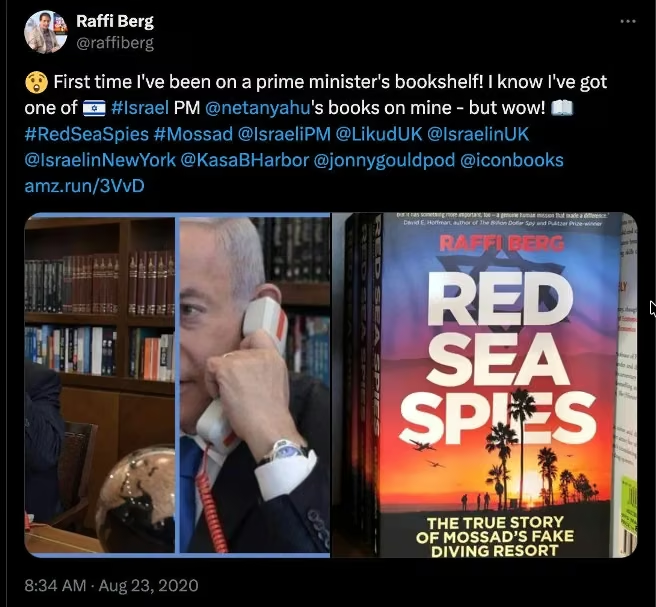
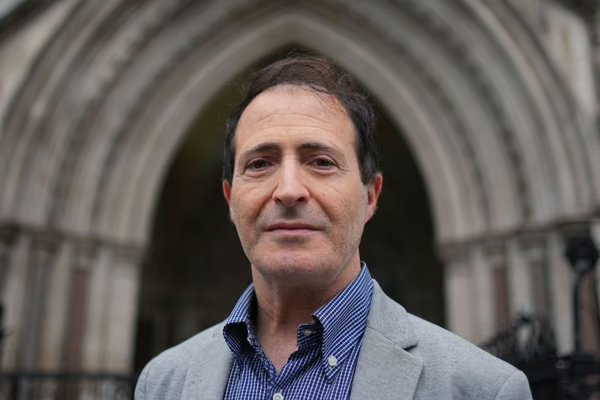
We report here on the case that its online Middle East editor, Raffi Berg, took against journalist Owen Jones.
Jonathan Cook is severely critical of Berg’s role, as indeed was Owen Jones in his podcast on what he called “civil War” at the BBC.
It is odd, to say the least that someone with such strongly held, publicly-stated, partisan views on Israel and Palestine as Berg’s should have a pivotal role in what is published on the topic. Or perhaps not.
As Cook suggests: “Most likely Berg was hired for the job because BBC executives were confident that his own take on events in the Middle East would largely keep “the Israelis” happy.”
In any event, Berg took Owen Jones to court for defamation, and Jones has won a resounding victory on the first round.
It remains to be seen if Berg will attempt to pursue what is clearly now a case for he is unlikely to win.
RK
This article was originally published by Jonathan Coo's substack on Fri 13 Mar 2026. Read the original here.
BBC editor's libel case against Owen Jones falls at the first hurdle. Here's why
Raffi Berg may be fighting for damages, but it’s really the BBC in the dock – for being utterly wedded to an editor whose objectivity on Israel is so clearly in question
Loading article text…



The BBC once had a formidable army of defenders willing to fight its battles with the government over funding it. It’s lost them – they feel the BBC no longer carries out its core function (providing honest, intelligent, impartial news coverage). BBC managers’ cowardice in defending honest journalism has needlessly put the organisation’s whole future at risk, I feel.
“Compare and contrast X and Y” is quite a good academic exercise. In that light, I’d ask you to compare and contrast the coverage of the war against Iran by both “Al Jazeera” and the BBC.
“Al Jazeera” is funded by the government of Qatar. Iranian drones and rockets are flying through Qatari airspace to hit American bases on its territory, much to the dismay and fury of Qatar’s government. “Al Jazeera” coverage of Iran’s strikes on Qatar, its strategy in fighting the war, the Iranian regime etc remains measured, insightful, detailed and unflinching. All aspects of the war and of the players’ perspectives get covered.
The BBC’s reporting starts from the viewpoints that Iran is a villainous threat to the Middle East as a whole; the Iranian public as a whole loathe the government they’ve got and back regime change; and the USA and Israel’s unprovoked attack on Iran might almost be excusable and doesn’t need to be mentioned again. There’s surprisingly little mention of Israel’s double tap attacks on Iranian civilians and their hospitals, schools and neighbourhoods, in spite of the parallels with Gaza. There seems to be little explanation why Iran is following the economic, political and military strategies it is.