
Panorama doubles down on demonising support for Palestine
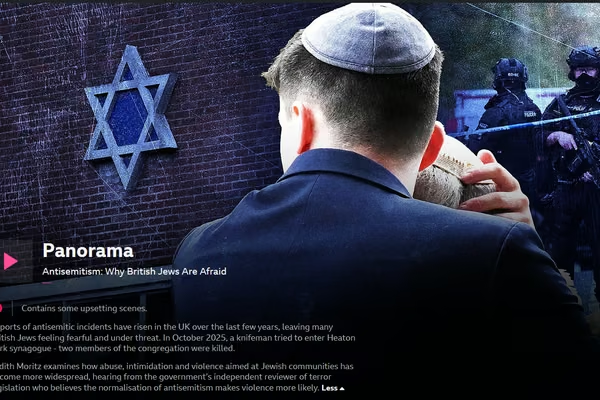
A month ago our media officer Naomi Wimborne-Idrissi wrote to the BBC asking for corrections to a Panorama programme, Antisemitism: Why British Jews Are Afraid, which misused police data to portray the Palestine solidarity movement as an incubator of violent hatred towards Jews. The reply now received from Executive Producer Leo Telling doubles down on the programme’s one-sided narrative, promoting pro-Israel arguments to justify excluding Palestinian and non- or anti-Zionist Jewish voices. He explicitly defends its focus on British Jews offended by language that they regard as antisemitic without paying any attention to the true motivation of the masses of people who support justice for Palestinians.
Leo Telling’s reply appears to have formed the template for responses received by numerous complainants to the BBC over the Panorama programme. We publish it here, below a detailed critique from Naomi Wimborne-Idrissi.
She concludes:
I sincerely hope the Panorama team, and BBC editorial generally, will reflect on the dangers inherent in treating British Jews as a homogenous bloc determined to restrict the right to protest for citizens who are critical of a rogue state which is becoming a pariah on the international scene. You are reinforcing a stereotype which increases the likelihood that misguided people enraged by what Israel is doing to Palestinians will retaliate against innocent Jews. It is well past time for the BBC to introduce some balance into its coverage by engaging regularly with non- and anti-Zionist Jews, as it does with Zionists.

Panorama doubles down on demonising support for Palestine
By Naomi Wimborne-Idrissi
Stage 1b complaint Reference CAS-8368580-Z4N3B4
Dear Leo,
Thank you for your response to my email. I will make use of the formal procedure to escalate my complaint to Stage 1b, but I wish to let you know why I found your reply unsatisfactory. Far from addressing my concerns (which I know I share with many other Jews), it doubled down on the very inadequacies I was attempting to highlight, producing yet more arguments to justify the idea – dangerously wrong in our view – that Jews should be fearful of Palestine solidarity protest.
Let me take it point by point.
- You claim the programme “took a careful look at the rise in antisemitism in the UK.” I dispute that claim.
It is true that there have been some dreadful attacks on Jews in the UK recently and that many are justly fearful as a result. It is also true that there are increasing instances of hostility to Jews particularly on social media, some of them drawing on traditional antisemitic tropes, particularly about Jewish power and influence, especially when that influence is perceived as defending the Israeli state and silencing people expressing outrage at the treatment of Palestinians. “A careful look” at this phenomenon would have explored the reasons for the conflation in many people’s minds between Jew and Israel, Judaism and Zionism. It would have challenged the lazy equation promoted in the definition of antisemitism insisted upon by pro-Israel lobbyists, including some of your interviewees. According to the IHRA non-legally binding working definition, it is antisemitic to hold all Jews responsible for what Israel does, but it is also antisemitic to allege racism in the foundation of the state of Israel or to challenge the assertion that Zionism is nothing but a benign expression of Jewish self-determination. While the former is indeed antisemitic, the latter are political positions which are shared by many Jews and carry no intrinsic antisemitic content. The pernicious impact of branding the expression of such views as threatening to Jews has been evident for several years, as explained in the Independent in 2019 by Antony Lerman, a scholarly expert in the subject. To make a programme about antisemitism trends without exploring this aspect is irresponsible and reproduces the bias of proponents of the IHRA definition – a bias that I maintain is consistent throughout the programme.
- You claim that the arrest figures quoted are supplied by the Metropolitan Police “who told Panorama that they are unable to break the figure down into specific offences.”
If true this indicates seriously inadequate investigative work on the part of the Panorama team. It took me no time at all to locate a BBC report from 12 November 2023, cited in my initial complaint, in which the Met gave details about the large number of far-right anti-Palestinian counter-protestors included in the figure of 145 arrested the day before.
The fact that more than 3,000 arrests have taken place since July last year, as a result of people like me joining static, non-violent civil disobedience protests entirely separate from the street demonstrations, is simply a matter of public record. There are numerous media reports citing police figures such as a BBC report on April 12 this year when the Met confirmed 523 arrests of people aged 18 to 87. The Met has also reported detaining more than 890 in Parliament Square in September 2025.
There was nothing to prevent Panorama examining the breakdown of arrests, other than a desire on the part of the programme makers to gloss over facts that undermine its hostile portrayal of pro-Palestinian activism. You also avoid other key questions – what were people arrested for? How many were charged or convicted? Were there any genuine cases of violence or incitement? Or were most of the arrestees carrying placards with images or slogans that are neither violent nor hateful but alleged by supporters of Israel to make them feel uncomfortable?
- You say the programme did not state or imply that all those arrested were detained for violent or hateful behaviour.
On the contrary, the presentation of the figures, spoken by Judith Moritz over a video showing police wrestling with a demonstrator on a street protest, followed immediately by a statement from Jonathan Hall: “There is open hatred on the streets”, makes a direct correlation between the protests and violent, hateful behaviour. This unwarranted connection is reinforced, as noted in my initial complaint, by a litany of examples of violent Nazi language on social media, from fascist Nick Fuentes among others, and a frightening story of an Israeli music composer being kidnapped by a gang intending to ransom him for money. Your response ignores my point that the context in which the arrest figures are presented is grossly misleading in the impression it gives of the pro-Palestine protests. It should be corrected.
- You defend the use of the misleading figures as an indication of the “scale of illegal behaviour which has occurred on these protests” and in doing so you present material not included in the programme in an attempt to justify its bias against the Palestine solidarity movement.
You choose your words carefully in noting that Palestine Action is “currently” proscribed under section 3 of the Terrorism Act 2000. The government’s decision last year to proscribe a direct action group, campaigning against injustice in the tradition of suffragettes and other trailblazers in British history, has caused outrage from civil liberties and free speech organisations, as noted in my original complaint. The government is appealing a high court ruling against the proscription which the illustrious signatories of this letter believe should be overturned. The Panorama programme made no reference at all to this major factor in any current discussion about pro-Palestine protest, but your references to it in your reply exhibit the very bias of which I am complaining.
You take a clear political position, justifying the proscription in your reference to the business targeted by Palestine Action in Stamford Hill and in your sensational report of the court judgement in the recent Elbit trial. You take at face value the Stamford Hill company’s statement that it is not connected to Elbit Systems, Palestine Action’s prime target, suggesting that the business was targeted because it is Jewish owned. You describe Samuel Corner’s conviction as if he was found guilty of a deliberate, brutal attack with a sledgehammer against a female police officer, when in fact he was convicted of GBH without intent – the result of a horrific accident occurring in a chaotic scuffle with police and security guards. You evoke British Jews’ fears of “the actions of Palestine Action”, yoking together disparate elements to justify those fears, even though there was no attack on Jews and no intentional assault.
- You dispute my analysis that the programme was biased in portraying support for Palestinians as fuelled by hate. I am baffled by your defence, that “the programme was not about support for Palestinians, it was about antisemitism and the effect on many British Jews of some language used at some protests.”
I can only interpret this as an admission that, in common with most BBC coverage of these issues, the programme focuses on British Jews offended by language that they regard as antisemitic without paying any attention to the true motivation of the masses of people who support justice for Palestinians. Please refer to my point 1 above on the misuse of a definition of antisemitism that makes it impossible to say anything critical of Israel or Zionism – the cause of decades of Palestinian suffering – without being condemned as an antisemite.
As noted in my original complaint, the tone of the programme was set from the start by Judith Moritz’s statement: ‘Protests against Israel’s actions in Gaza have fuelled fears about hate speech.’ It then set out to prove that those fears are justified, with quotes from Dave Rich, Jonathan Hall and Rabbi Julia Neuberger and other interviewees, between them painting a picture of Jews cowering in fear of violent Hamas supporting mobs using, in Julia Neuberger’s words, “the cover of criticising the actions of the Israeli government to be antisemitic…”
In so far as the programme dealt with “the effect on many British Jews of some language used at some protests” it presented audiences with testimony from Jews who felt threatened by certain flags, slogans or chants. But it made no attempt to explore the intent behind “Globalise the Intifada”, or “Zionism off campus”, or “activism around anti-Israel, anti-Zionist sentiment”. Instead, as noted in my initial complaint, audiences were told “many Jews” regard these as threats to them personally. There was no discussion about whether this perception was justified, and no acknowledgement of the views of many Jews who disagree and do not feel threatened at all.
It is true, as you say, that the programme was “not about support for Palestine”, in the sense that it made no attempt to help audiences understand the reasons for that support or inform viewers about the people who feel passionately about it. Instead it sent a consistent message that supporters of the Palestinian cause are a major source of danger to British Jews. This was not only biased, it was reprehensible fear-mongering from our public service broadcaster.
- You claim the programme “made it clear that some Jews attend the demonstrations for Gaza and that the majority of the people on those protests were motivated by their support for human rights and wanting peace.”
Neither of these claims are true. Judith Moritz noted fleetingly the presence of Jews on one demonstration, without any explanation and no attempt to “make clear” the relevance of their presence. A key contributor, Julia Neuberger, asserted without qualification that “MOSTLY” demonstrators were motivated by antisemitism. The programme made grudging concessions to the humanitarian motives of many demonstrators, but these were nullified by being interwoven with references to Islamic State terrorism, the Bondi beach massacre, arson attacks on Hatzola ambulances in Golden Green, killings at a Manchester synagogue and Jews describing feeling threatened and unsafe, building an unrelenting, one-sided picture of Jews being in danger due to the pro-Palestine protest movement.
- You justify the exclusion from the programme of Jews who oppose Israel and march in solidarity with Palestine on the grounds that the programme was focused on “the very many Jews who find the chants and placards that are openly displayed on the demonstrations to be threatening.” This is a clear admission of bias against supporters of Palestine.
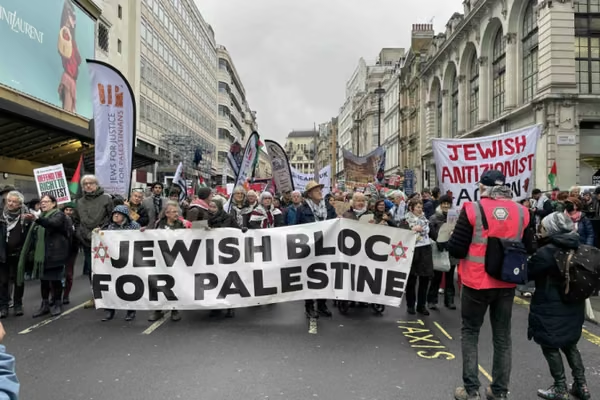
The only pro-Palestinian voices heard were those of Chris Nineham testifying to a House of Commons committee and the Palestine Solidarity Campaign in a short statement, both of them denying charges of racism. The clear implication was that racism is rife within the movement and its leaders need to be held to account for it. Fundamental to Panorama’s misrepresentation of the demonstrations is the failure to interview members of the Jewish Bloc, who testify in their hundreds to being visibly present, respectfully heard and warmly welcomed by non-Jewish marchers.
At no point was your audience offered any insight as to the motivation of any pro-Palestinian protester, Jewish or otherwise. They were repeatedly portrayed in demonised form as aligned with terrorists and Jew-haters. There was not a single reference to the underlying reasons for the protests – the devastation of Gaza for which the Israeli state is responsible, along with the mass civilian deaths, the tens of thousands of children killed and the grotesque expressions of anti-Palestinian racism emanating from the mouths of Israeli leaders, too often echoed by their supporters in the UK. It would not have been difficult to devote a few minutes to interviewing, for example, a Palestinian victim of Israel’s military campaign which has been the main target of the mass demonstrations, and one of the many eloquent Jewish scholars and campaigners who could have explained why many of us reject the portrayal of the demonstrations as “hate marches”.
- You justify the quotes from Hall, Neuberger and Rich accusing supporters of Palestine of being the source of attacks on Jews by referring to Home Office statistics suggesting that Jewish people are nine times more likely than Muslims to suffer religious hate crimes.
I have to question the skewed logic of this juxtaposition.
First, it is highly problematic to operate within a hierarchy of racisms in which the level of threat to one community is measured against that faced by another. If you are going down that route, you must acknowledge that hostility within the British population against Muslims, Black people, and particularly Roma, far outstrips that towards Jews.
As I said in my initial complaint, focusing on Jews as the most affected victims of the racist abuse which is becoming the norm in society, when the ether is awash with vile caricatures and “terrorist” tropes about Muslims, is another example of bias which can only exacerbate the situation.
Second, the picture presented by the stats you offer is grossly oversimplified. You refer to figures for religious hate crime, taking no account of the race hate experienced by Muslims.
As the Runnymede Trust makes clear in its recent report Islamophobia: the intensification of racism against Muslim communities in the UK, “Even though Muslims are not one race they are still racialised.”
It says: “With direct attacks on Muslims and mosques, this explosion of violence is linked to the ways that UK Muslim communities have been portrayed in relation to Gaza.”
The government’s own guidance on anti-Muslim hostility issued in March this year says, “our Muslim communities have faced growing hostility, discrimination, and hate”.
Third, while hostility and even violence towards Jews has risen, there is no justification for pinning the blame for this on the Palestine solidarity movement, as Hall, Neuberger and Rich do.
- You claim that the programme “was at pains to stress that criticism of the Israeli government or its actions is not antisemitism.”
But both the quotes you cite contain the assumption that critics of Israel are prejudiced “against Jewish people in general” (Itay Kashti) and that “ the hatred that you show spills over into actions like what happened at Heaton Park” (Yoni Finlay).
Their words hedge the permission to criticise with warnings not to do it in ways that Israel’s supporters interpret as hateful towards them. This brings us back to the pernicious influence of the IHRA definition which allows limited criticism of the actions of Israel’s government but condemns as antisemitic any challenge to the nature of the state or its Zionist ideology. All your interviewees regarded such forthright challenge as a threat to them as Jews. This is their subjective judgement. It is not inherent in most of the statements or actions they object to.
- You say that because a majority of Jews in the UK describe themselves as Zionist, it is understandable that they will be intimidated by chants of “Zionists off our campus”.
This is perverse logic. Those who feel intimidated do so because their adherence to the political ideology of Zionism is threatened. The fact that they feel intimidated is not evidence of a threat to their Jewishness. To suggest that it is means conflating Jewishness with Zionism. By promoting this ideological position you are perpetuating a misconception about views held by all Jews.
The opinion poll you refer to indicates that 64 percent of British Jews identify as Zionists. That means that 36 percent do not. Fully 12 percent identify as anti-Zionist. Among Jews in the 20-29 age bracket, 24 percent call themselves anti-Zionist and a further 20 percent non-Zionist. These figures are in the poll you are using to justify constructing a damning portrayal of the Palestine solidarity movement as threatening to British Jews. The programme’s bias is evident in the decision to exclude non- or anti-Zionist Jews. You are not only silencing a significant section of the Jewish population, you are misleading Panorama’s substantial audience into believing that British Jews collectively perceive opposition to Zionism as an existential threat.
- You accuse me of labelling data from the Institute for Jewish Policy Research as “dubious” but providing “no evidence or reasoning for this.”
This is not true. I said the use to which you put the data is dubious, as I have explained in point 10.
To conclude, I found your response to my complaint shallow and unconvincing. It evaded rather than addressed the points I made.
I sincerely hope the Panorama team, and BBC editorial generally, will reflect on the dangers inherent in treating British Jews as a homogenous bloc determined to restrict the right to protest for citizens who are critical of a rogue state which is becoming a pariah on the international scene. You are reinforcing a stereotype which increases the likelihood that misguided people enraged by what Israel is doing to Palestinians will retaliate against innocent Jews. It is well past time for the BBC to introduce some balance into its coverage by engaging regularly with non- and anti-Zionist Jews, as it does with Zionists.
Sincerely,
Naomi
BBC response to complaint about Antisemitism: Why British Jews are Afraid
From: BBC Complaints <[email protected]>
To: Naomi Wimborne-Idrissi
Sent: Wednesday, May 13, 2026 at 06:07:11 PM GMT+1
Subject: BBC Complaints – Case number CAS-8368580-Z4N3B4
Dear Naomi Wimborne-Idrissi,
Thank you for your email of April 27th and follow up on May 5th. I’m sorry that I haven’t responded sooner but I have been out of the office on annual leave. I have passed your email onto the wider production team as requested.
The BBC has a complaints procedure which is outlined here:
https://www.bbc.co.uk/contact/sites/default/files/2025-04/complaints_framework_march_2025_eng.pdf .
I am treating your email as a a complaint under this framework, please treat my reply as a Stage 1a response.
I’m sorry to hear that you believe the programme was inaccurate, biased and misleading. However, we cannot agree that it was any of those things, instead we believe it was an important and timely programme which took a careful look at the rise in antisemitism in the UK.
You take issue with our use of the number of protestors arrested; this is a figure supplied by the Metropolitan police (and clearly signposted as such by an on-screen caption) who told Panorama that they are unable to break the figure down into specific offences. The programme did not state or imply as you suggest that this meant that all these people were arrested for violent or hateful behaviour. It does however give a sense of the scale of illegal behaviour which has occurred on these protests including as you say, people who are offering their support for Palestine Action, an organisation currently proscribed under section 3 of the Terrorism Act 2000.
Notwithstanding the non-violent support that many have shown for the group, many British Jews report that they fear the actions of Palestine Action. Palestine Action activists attacked a Jewish owned business in Stamford Hill, an area known for its vibrant Jewish community, in an incident the Police are treating as racially aggravated. In a report you can read here, a spokesperson for the company, which requested anonymity for fear of further attacks, said it had no connection with the military technology company Elbit Systems that Palestine Action has also targeted. The spokesperson said that the incident had terrified employees, “I turned up this morning and saw the place vandalised. For Jewish people it is very, very scary now.”
A Palestine Action activist, Samuel Corner, has been convicted of inflicting grievous bodily harm on Sergeant Kate Evans, a female police officer he struck on the back with a sledgehammer when she was on the floor on all fours facing away from him.
You accuse the programme of bias, claiming that support for Palestinians was being ‘demonised as fuelled by hate’. We cannot agree with your analysis, the programme was not about support for Palestinians, it was about antisemitism and the effect on many British Jews of some language used at some protests. The limited references to protests made it clear that some Jews attend the demonstrations for Gaza and that the majority of the peoppeople on those protests were motivated by their support for human rights and wanting peace. The programme also approached the Palestine Solidarity Campaign and the Stop the War coalition who organise demonstrations, but neither wished to appear in the programme. However, as well as their statements we included an archive clip of Chris Nineham in the programme, who said:
I think there is a tiny minority of people who have had placards that we challenge. We have an operation, with our hundreds of stewards, to try and make sure that anyone who does this who holds placards or flags or anything, that could be construed as liable to inciting hatred, or of proscribed organisations, are talked to and removed and that has been a very effective operation.
The programme did not attempt to address the varying viewpoints on the situation in Gaza amongst British Jews, instead it reported on the very many Jews who find the chants and placards that are openly displayed on the demonstrations to be threatening, therefore we believe the contributors included in the programme were appropriate. Where specific allegations were made, the programme included responses from relevant parties, as with Chris Nineham above.
The factual underpinning of the programme were the Home Office statistics which show that per head of population religious hate crimes against Jewish people are around 9 times more prevalent than for Muslims. Since the attacks of October 7th there has been a steep rise in reported antisemitic crimes against Jewish peoplein this country, and it is against this background that we included the quotes from Jonathan Hall, Rabbi Julia Neuberger and Dave Rich which you quote.
The programme was at pains to stress that criticism of the Israeli government or its actions is not antisemitism, this point was made by Dave Rich and also by Itay Kashti who said:
There’s a lot of prejudice, against Jewish people in general, and Israel in particular. And people may like or not like their politics. In the same way, I don’t like the politics in Israel. You know, it’s fine. You can like or dislike the politics of the country. But it doesn’t mean you need to judge the individual people that come out of it on that basis.
Yoni Finlay also made a similar point:
There’s been so much hatred and so much anger towards the Jewish community for something that’s happening thousands of miles away. You’re allowed to criticise a government, you’re allowed to criticise a country, but when the actions and the words and the hatred that you show spills over into actions like what happened at Heaton Park on that morning, that’s a very different story.
You raise some issues about the nature of Jewish identity and Zionism. However, in a 29 minute film about antisemitism it was not possible to provide a detailed explanation of Zionism, what it does and doesn’t mean to Jews of different political persuasions and how those views have changed over time. We cannot agree that such an analysis of Zionism is fundamental to a programme which is about antisemitism and its rise in the UK. What is clear is that a majority of Jews in the UK (as measured in recent opinion polls: https://www.jpr.org.uk/reports/two-years-after-october-7-attacks-british-jewish-views-antisemitism-israel-and-jewish-life) describe themselves as Zionist, therefore when chants of “Zionists off our campus” are heard it is understandable that many Jews will be intimidated by this.
You say that the data from the Institute for Jewish Policy Research is “dubious” but provide no evidence or reasoning for this. You also say that the programme should have had a different editorial focus, but once again the factual underpinning for this programme and its editorial focus were the hate crime statistics published by the Home Office. Therefore, we cannot agree that our programme was “dangerously misleading” and “unbalanced” as you suggest.
I hope that I have been able to address the points you have raised.
Kind regards
Leo Telling
www.bbc.co.uk/complaints

To Naomi thank you for writing such a brilliantly eloquent letter to the makes of the Panorama programme. It is so disheartening that these one sided programmes are being shown as they are giving false impressions and then causing more problems for both Jews who support Palestine and the every one else standing up for Palestine. I am a Jewish socialist and am very grateful to people like you who put their head above the parapet and publicly decry the lies.
It is abundantly clear that the BBC is not only biased against peaceful pro-Palestinian and anti- genocide protests, but that its quality if journalism has fallen to the low bar of being propaganist for Israel’s wishes and members if the Jewish community who hold far-right views.
I am disgusted
Naomi’s response to the Panorama program is totally brilliant.
Naomi’s response is indeed brilliant and yet it will still end up in the BBC’s waste paper bin. The fact is that the BBC is institutionally Zionist because its whole foreign coverage from Ukraine to Palestine and beyond is framed by British Foreign Policy.
The World Service was even funded by the Foreign Office and at one time an MI5 had an office in Bush House vetting potential applicants.
Because the BBC Complaints System is wholly an internal affair there will never be redress within the system. The external regulator Ofcom is no better. One of the most shoddy and dishonest programes ‘Is Labour Anti-Semitic’ which should have been hauled over the coals and yet Ofcom simply refused to investigate it.
Today I understand that Margaret Hodge is destined for Ofcom and I’m sure she is going to cast a critical eye over pro-Israel reportage!
Internal BBC protests from reporters have had no effect either because the BBC is such a valuable asset as a State Propaganda arm which is seen as neutral.
I think that maybe we need a dedicated Campaign Against BBC Bias which can combine research of the kind Naomi did but also campaigning protests and demonstrations to call out the inherent bias in BBC coverage, not just about Palestine but racism in general and its longstanding bias against strikes and working class protests
Very well argued.
The British Broadcasting Complicity in Israel’s Genocide is beyond refute – what is astonishing is their willingness to continue such criminal conniving and gas lighting of humanitarian response – they seem to forget the seriousness of their failure to tell the truth .. lord Hawhaw was hung for treason after WWII
Thank you Naomi for your detailed, well-SUBSTANTIATED complaints to the BBC.
Their reply is deplorable, albeit not at all surprising.
I think it is about time we rejected with contempt the notion of any given social group “FEELING” threatened – rather than BEING threatened – as a criterion by which the legitimacy of a political/protest movement is judged.
White supremacists “FEEL” threatened by “The Great Replacement”; INCELs “FEEL” threatened by women; TERFs “FEEL” threatened by trans people; antisemites “FEEL” threatened by “The Elders of Zion”.
Ultimately, we’re engaged in a political struggle and we must engage the system on the streets – whether the powers that be (still) tolerate it (e.g. the Palestine solidarity marches), or even if if they don’t (e.g. ‘Lift the Ban on Palestine Action’ protests).
Naomi I fear that you are banging your head against a brick wall; however the eloquent and accurate way you argue your case is really inspiring and, for me a real support in clarifying my own understanding of the various issues involved, so thank you for that.
As always, so eloquent and intrinsic. Thank you, Naomi. It seems, significant sections of the BBC are, again, on a mission.
The BBC hasn’t a leg to stand on here. Their replies are full of “robust” bluster.
Disgusting response from the BBC to a well argued and evidenced complaint from a Jewish person. Don’t lose heart. They know they are lying.
And the BBC wonder why so many of us no longer pay their licence fee.. it was their coverage of Palestine in the 1980s that made me question EVERYTHING the BBC ” report” as “News” & as the years have gone by I’ve NEVER doubted that I’m RIGHT to question EVERYTHING MSM but ESPECIALLY BBC ” report ” as FACT.. we are fed a carefully curated narrative of Propaganda from Westminster to suit THEIR latest agenda & paymasters. The TRUTH is out there BUT it’s up to us to find it..
Thank you ever so much, Naomi, for your persistent and well argued verbal combat with the disgraceful disingenuous pro-zionist morons at the BBC.
brilliant Naomi sadly The BBC is what it is a very limited institution funded by us. Yet it takes very little attention to the public particularly if they support Palestine in any shape or form. I wonder for how long the BBC can remain one sided or detached calling it balanced when clearly it is not??
Thank you Naomi, such a brilliant response, and SO frustrating that, as others have said, the lies will continue.
‘Head against brick walls’ or not, it still has to be done. Well done Naomi. It’s easy to see why the LP were afraid of you being elected on the NEC and KS used on you his tried and tested method of dealing with dissent. I have also lodged with difficulty my objections to various examples of gross Israel bias in their output with similar dismissive responses. Given the makeup of the Beeb’s top appointees it is par for the course. Sad though that Panorama has been so comprehensively captured.
Leo Telling has been producer of some of the most obnoxious and biased Panorama programmes, such as “Is Labour antisemitic?”, collaborating with the infamous John Ware on many of these.
Maybe Telling will eventually get a medal for services to Zionism, as Ware did.