
Israel’s rule over the Palestinians has created a new Judaism
JVL Introduction
In a historically informed and nuanced study, Menachem Klein argues that Judaism is not an abstraction but is always tied to concrete social experience.
What we understand by Judaism today is post-Temple Judaism, a religion of exile which transformed what had existed before. It changed the modes of worship, the religious experience and the connection with God. Prayer and intensive study of the Holy Scriptures replaced animal sacrifices. It was a rabbinical revolution and its leaders supplanted the priests and the Levites as the social and religious elite.
It had a strong ethnocentric element, argues Klein, with the belief in the supremacy of its ethnic collective over other nations. In part this perception was compensation for the reality of Jews’ subordinate status. It was an ethnocentrism, a belief in its own supremacy, that lacked the force of a state and an apparatus for wielding control over non-Jews.
No longer: post 1967 things have been changing. Religion, messianism, state power, armed might – and an oppressed people to lord it over – all are fusing in a toxic mix.
“The Jewish challenge today,” concludes Klein, “both theological and practical, is to establish Jewish sovereignty without oppression.”
This article was originally published by Haaretz on Thu 6 Apr 2023. Read the original here.
Israel’s rule over the Palestinians has created a new Judaism
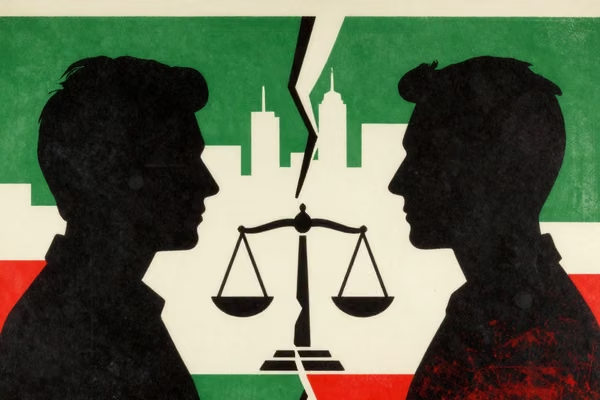
Supremacy, oppression, force – never before has the Jewish people engaged in such an explosive fusion of sovereignty and rule. Messianic fervor, once under the radar, is now rearing its head
Loading article text…






Don’t have time to read the article fully, as interesting as it might be. I find that I have to devote my time in asking: Does this in any way, try to justify the ethnic cleansing of Palestinians from swathes of Palestine in order to make way for illegal colonies established (mostly) by US Christian Zionist-backed, Jewish colonial-Zionist terrorists? End-of-times theology, as interpreted does not allow for Palestinians at all. They don’t exist, as Smotrich says. Christian Zionism needs to be challenged as much or more than Jewish Zionism.
It seems to me that the key to resolving the horrific dilemmas that Zionism has created for all of those Jews who are angered and confused by Israel’s exclusivist and segregationist politics lies in the last two sentences of this fascinating piece.
Having read all of the post I also agree with the comment here by Richard Snell – It seemed to me that the final challenge posed had been quietly emerging through the piece and recognises the inevitable route to the peace that has to come. I am reminded of the comment made by George Orwell that seems to relate to the current conflict in long term motion:
“The point is that we are all capable of believing things which we know to be untrue, and then, when we are finally proved wrong, impudently twisting the facts so as to show that we were right. Intellectually, it is possible to carry on this process for an indefinite time: the only check on it is that sooner or later a false belief bumps up against solid reality, usually on a battlefield.”
Unfortunately the JVL introduction misunderstands the real proposal underlying this rambling piece of reactionary nonsense. This is perhaps understandable because on a casual reading Klein’s piece is full of fine sounding rhetoric and superficially plausible, but seriously inaccurate, historical simplifications. Like all effective propaganda it contains important nuggets of truth.
However Klein uses language in the most slippery postmodern tradition of obfuscation. JVL’s introduction fails to notice this when it quotes his assertion that
“The Jewish challenge today, both theological and practical, is to establish Jewish sovereignty without oppression.”
What on earth does this fine sounding sentence mean? This is not in fact Klein’s “conclusion” as JVL asserts but is a sentence cited from the middle of the article. To find out what Klein REALLY means you need to read his final two paragraphs:
*As long as Jewish nationalism is bound up with Judaism as a historic religion and people, equality and partnership of non-Jews in sovereignty cannot be seen as just a secular phenomenon involving a division of power and government. One could of course argue against the self-determination of the State of Israel as a Jewish state, and endeavor to divorce it completely from historic Judaism and from the ideology and practice of Jewish supremacy. Separation of that kind would create an Israeli nation in which all the citizens are equal – a far-reaching move that has failed in the past, in society and in the Supreme Court.
Another possibility, which hasn’t yet been tried, is to find a Jewish theological and historic basis for sharing sovereignty with non-Jews. That challenge now awaits the opponents of Jewish supremacy.”
So Klein is clearly rejecting as unrealisable the obvious solution of a secular state of all its citizens. Now consider a Palestinian version of the same final verbiage.
“…..Another possibility, which hasn’t yet been tried, is to find an Islamic theological and historic basis for sharing sovereignty with non-Arabs. That challenge now awaits the opponents of Islamic supremacy.”
When combined with Klein’s Israeli Jewish version above that sounds like such an eminently just and practical solution for “sharing sovereignty” between the river and the sea, doesn’t it?
This is not really very surprising. On a charitable interpretation, Klein is an Israeli academic who, in common with so many of his peers, is struggling to reconcile long held inconsistent beliefs with the hammer blows inflicted on them by real events.