
A fundamentalist problem
Fundamentalist ideas are not unique to one religious tradition. They occur in many forms. Mike Cushman explores why they are on the rise and how they relate to a crisis in modernity and a loss of hope for a better future. They represent, instead, attempts to imagine the possibility of a retreat to an illusory less troubled past.

A discussion on Facebook thread on US fundamentalist preachers led me to write this.
Dear E
You say, “Europe is not burdened with the Bible literalism that gives life to this insane trajectory [of US susceptibility to fundamentalist preachers].” I agree, but my question is why is this so? I will attempt some tentative answers – this takes me to areas I haven’t reflected on enough before so what follows is a preliminary intervention.
Your earlier reference to the European experience of and reaction to fascism is thought provoking but I think we need to go further and consider reactions to modernity itself.

We can see the US as le grand projet of the European enlightenment – an enterprise to build an ever more perfect society free of the destructive history of European feudalism, the divine right of kings and authoritarianism. Thus, the US embrace of mystical religion is a reaction to failures of modernity in contrast to the critical and sceptical engagement of modernity that underlies the most interesting post-modern critiques. It is a retreat to pre-modern certainties of proclaimed dogma.
Europe’s interlude of fascism, and even more importantly Nazism, gave the continent a brutal experience of a pre-modern reaction to modernity and thus the wide adherence to social – and Christian- democratic models of modernity and belief in the possibility of progress and a substantial, but far from absolute, vaccination against religious fundamentalist certainties.
The US susceptibility to fundamentalist preachers is only one variety of the fundamentalist challenge to modernity. It is worth trying to do a preliminary taxonomy of the types of religious fundamentalism that are gathering force around the globe.
We can see Islamic fundamentalism as a reaction to the history of colonialism and a rejection of western models of modernity that provided the ideological infrastructure for colonialism and neo-colonialism. The struggle against imperialism was initially widely articulated through communism – originally an enlightenment project for progress. The corruption of communism in the Soviet Union (and later China and elsewhere) resulted in these communist sponsors endorsing and enabling corrupt and repressive regimes that provided little or nothing for the mass of the population and embedded a self-perpetuating kleptocracy (the actors who ruled may have changed from time to time and coup to coup but the structures of exploitation remained).
Orthodox Christian fundamentalism in Russia and its neighbours is similarly a reaction to the failures of soviet communism.
Jewish fundamentalism in Israel and supportive Jewish communities is rather different. Israel attempts to be a modern state but has moved its foundational belief away from a need for a safe haven after the shoah in a territory that modern Jews, even the secular ones who founded the Israeli state, claim a historical link to. The notion of sanctuary remains of course but even its advocates can only use it to justify Israel within pre-1967 borders. Occupation of the West Bank (Judea and Samaria in fundamentalist jargon) can only be ‘legitimised’ by reference to a biblical promise. The perceived need to employ this ‘promise’ moves fundamentalist Judaism from a minor current to the centre of state thinking. Jewish Israeli fundamentalism incorporates a central paradox; a would-be modern science-based state justified through mysticism.

Hindu fundamentalism of the BJP and the Modi-led BJP government has some similar characteristics to the Israeli version. It is an attempt to strengthen the Indian state by asserting a common identity on a highly diverse population. Like Israel, it manifests itself significantly against both its own Muslim minority and its Muslim neighbours but also against India’s Sikh citizens. The contradiction here is between Hindu mysticism (which incorporates a strong bias against consumerism) and the forceful promotion of neo-liberal economic models of market-denominated rationalities.
This brings us back to the American model. In contrast to Europe the incubus is communism rather than fascism. While Soviet communism distorted and corrupted the enlightenment project it incorporated it, it did not reject it. Marx saw his programme as the culmination of the enlightenment project of progress; the Soviet Union always maintained that it remained wedded to Marxism and claimed to be on the side of progress.
Rejection of fascism in Europe was a rejection of pre-modern tropes; rejection of communism in the US was a rejection of modernity and opened the path to far wider adoption of always present religious fundamentalist ideas. Unlike Hindu fundamentalism it did not have to confront a rejection of materialism – protestant belief co-evolved with capitalism and catholic belief embraced capitalist values many years ago; although the anti-capitalist and anti-consumerist threads of Catholicism still have some purchase and are somewhat articulated by Pope Francis.
Like Jewish Israeli fundamentalism, the American version justifies territorial seizure and in the US sanctifies it as manifest destiny. However, like the Israeli version it wishes to have a productive science-based economy while rejecting the basic tenets of science. The three central US science battlegrounds, climate change, evolution and abortion, each have different characteristics – although the opposing alliances on each issue are very similar.
Climate change denial is economically advantageous to many of its proponents. It is not difficult to see why Exxon or the coal industry or the Koch brothers spend large sums contesting it. The link to fundamentalism is that denial of climate change requires a suspicion of science that is afforded by fundamentalist belief. At its most basic, American protestant fundamentalism asserts that humans in general, and Americans, in particular, are the beneficiaries of God’s munificence and as he won’t allow us to be swept away by global warming so the science must be wrong. However, if science is so wrong here where can it be trusted?
Evolution has always been difficult for ardent believers from Soapy Sam, through William Jennings Bryan to contemporary evangelical preachers. Denial of evolution requires belief in ever more elaborate deceptions which are in conflict with Occam’s razor. It demands a belief in a god who demands ever more difficult acts of faith – accepting that a god would carefully place dinosaur bones in ever deeper strata that are most easily accounted for by evolution and a 4.5 billion year old earth. Accepting there has been a careful planting of misleading evidence is a necessity if s/he is to require us to reject the more straight-forward explanation in order to keep our belief pure and accept Genesis and the rest of the bible as literal and accurate history. The US economy requires scientifically competent professionals but some School Boards are requiring curricula that reject science in order to sustain their version of religious belief.
Opposition to abortion (and the associated issues around feminism and LGBT rights) is a rejection of the central tenet of the enlightenment: of the individual endowed with rights, rather lucidly proclaimed in the US declaration of independence and the amendments to the US constitution. The fundamentalists who most loudly announced their patriotism do so while contradicting the founding principles of their state – unless they believe the claim that “all men are created equal” is to be narrowly interpreted as bounded by one sex
A pessimistic view of the possibility of progress, and therefore a reluctant renunciation of the central promise of the enlightenment, does not require us to abandon the struggle for partial ameliorations of injustice and inequalities – indeed it makes individual action more pressing as we cannot rely on the immanent forces of history to solve our problems. It requires us to keep being forward looking and to maintain a critical acceptance of positivist science. While we may doubt simplistic versions of reality and truth and see reality as socially constructed and the object of interpretation, we do not doubt the validity of human experience; rather, we rather seek better means of understanding it.
We must keep making the arguments for some version of modernity. It is essential to reject the idea that, if only we would retreat to a religiously ordered fantasy past, we will find happiness on earth and contentment in paradise. Such ideas are bound up with an authoritarianism and denial of agency and creativity that will destroy us. The struggle against all varieties of religious fundamentalism, no matter what god(s) each seeks to appease, must be a major part of our public and private politics: our ability to lead fulfilling lives, and indeed the future of the global eco-system, depend on it.
With care
Mike

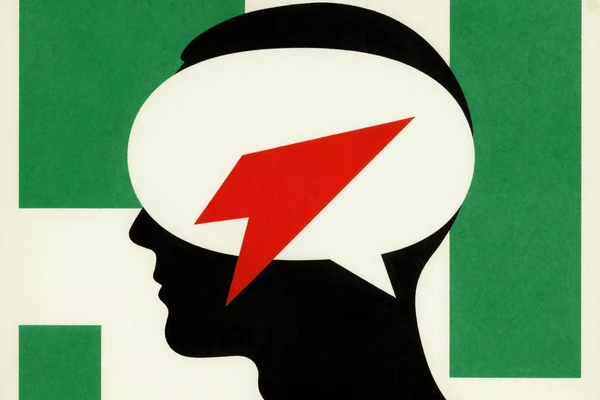









Fundamentalist ideologies and religions act as a cocoon, separating people from the outside world while giving the holder of the fundamentalist beliefs a sense of special importance.
But when taken up by groups of people the defensive nature of these beliefs becomes an offensive weapon. Its prime purpose is to justify the robbing, oppression, expulsion and killing of other groups for material or territorial gain.
After all, it can be much easier, quicker, to murder your neighbours than to build your own house or plough your own fields.
Its endemic within human society when people feel vulnerable, or when the consequences of ‘failure’ are as severe as they are in the US and any other society that has no safety net.
“a 4.5 million year old earth” = “a 4.5 [b]illion year old earth”? Still, better than 8,000 years old, I suppose! No need for publication [unless you disagree, of course!!]
What’s a billion or two (or four) between friends? Thanks, corrected
I have always found Malise Ruthven’s “Fundamentalism – The search for meaning” an excellent little book . Very readable but extremely inciteful.
Thanks Mike for your reflections too.
A previous post hits quite a few nails. Fundamentally, large parts of America are still uncivilised and uncivilised people can do major harm to each other and those with whom they disagree, without batting an eyelid. Any country which uses legalised murder i.e. capital punishment, and where citizens are allowed to carry guns to protect themselves from each other, is uncivilised. This preoccupation with violence as a way to solve problems or disputes, carries over into American foreign policy and has resulted in the many atrocities for which America has been responsible, including obliterating two Japanese cities with nuclear weapons.
Mike Cushman has written in a short article much thought provoking sensible reasoning as to the growth in fundamentalism across a spectrum of major religions. Les Hartop’s response comments are an equally reasoned human response to fear. He rightly points out that in the wrong hands this can be manipulated to become an ‘offensive weapon’ which tends to silence voices which should be heard which of course we know only too well has misled people into believe the converse of truth and denigrated genuine and decent human efforts. The collapse of journalistic investigations and gross media bias. Those responsible know exactly what they are doing playing one group off against another causing an Assault on Truth, a also the name of Peter Oborne’s book.
A fascinating discussion. My professional life was centred around Black communities in South London, initially of West Indian parentage and later of West African.
I was impressed by the role Black churches played in the communities and sought to understand the motivation. I found both admirable and worrying aspects to this as a Christian brought-up in a very liberal environment.
As far as Palestine is concerned, I note that many adherents will still use the Biblical term “Israelites” to describe Israelis, often subscribing to Zionist ideology concerning “God-given” lands- Canaan, Judaea, Samaria- and excluding Palestinians from the equation. Gideon, the Bronze Age Jewish leader, was told to by God to “cleanse” the lands of people whom we’d now refer to as Arabs. Even I, in my Methodist Sunday School was taught about him, though with no reference to his more questionable activities.
It fascinated me that at no stage did the adherents of these Black so -called Biblical- churches whom I met see a relationship between the Black struggle for freedom and justice and the rights of Palestinians. I suggest that this is a consequence of colonialism and slavery.
And , on my first visit in 2004, my return journey was on a plane where there were many members of Black churches in the UK returning home after Biblical tours of Israel. You can be certain that Palestinians had little to no contact with them.
There are always people who can only think in simple terms, black/white; good/bad; right/wrong – and it’s fed by news services that are more like strip comics. I wonder how much the popularity of strip comics, and the movies based upon them, have affected this tendency in the US?
However, I do particularly like the way Mike has highlighted the essential contradiction in the US, it’s a point I’ve tried to make, but never so elegantly: an economy that requires people with good scientific understanding in a society which rejects science – that just looks so stupid from here.
A good analysis. Having spent over 60 years of my professional life in a cutting-edge scientific environment, I am despondent with the reversion to legacy religions by so many of my fellow humans. The idea of enlightenment is endangered by the fundamentalism of these religions and unless we can reverse this trend by embracing scientific thought again, our current trajectory is likely to cause the extinction of our species.
Secular fundamentalism and extremism also exists – it’s not just a problem to be pinned to the door of religion. Nazism and Stalinism two cases in point – ”scientism” taken to the ultimate the robotic immorality of several of our governments and oppositions suggest to me that the moral compass provided at their core by all faiths and none are fundamental to rediscovering our humanity and are at the source of right-thinking people’s disquiet about current trends.