
The ‘good Jew’ is faithful to Israel – and an antisemite
JVL Introduction
Antony Lerman, author of Whatever Happened to Antisemitism? reviews a recent “important book” by Steven Friedman, showing how it contributes to our understanding of the damage done by the Israeli state’s efforts to cut off the struggle against antisemitism from that against other forms of racism.
In his book, Friedman demonstrates how the use of anti-racist language to defend racial domination distorts the meaning of what it is to be Jewish.
By exceptionalising antisemitism it has made anti-racism “a weapon in the hands of racial supremacy”, a process that has created ‘good Jews’ and ‘bad Jews’.
The ‘good Jew’ supports Israel uncritically, the ‘bad Jew’, is the ‘new antisemite’ who does not.
In his book Friedman turns this narrative on its head: “The ‘good Jews’ are now the antisemites and the ‘bad Jews’ are the identity they have left behind them.”
RK
24 June 2024: We link here to a video from South African Jews for a Free Palestine, described as “An online workshop with Steven Friedman”, in which the author talks about the book and its genesis.
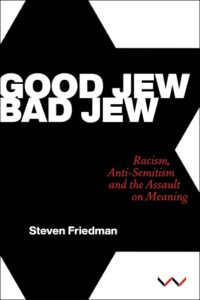 Good Jew, Bad Jew: Racism, Anti-Semitism and the Assault on Meaning
Steven Friedman, Johannesburg: Wits University Press, 2023
A review by Antony Lerman
All quotations in double quotes below are from the book under review.
Antisemitism in the past was generally treated a form of racism – racism towards Jews as Jews. Friedman, following Frantz Fanon, points out that “anti-Jewish racism and prejudice against black people (and Arabs and Asians) usually formed part of a package of bigotries which went together”. There has, for some time now, been a campaign to treat them as different kinds of things altogether.
Friedman’s important book discusses how the Israeli state and its supporters seek to prise them apart, “to turn the campaign against antisemitism from a rebellion against white supremacy into an endorsement of white Europeanness”, adding very usefully to the growing body of published research on this regrettable development, the origins of which stretch back more than forty years.
Of particular value and originality is his extensive discussion of what it means for Jewish identity, but also more broadly for the nature of Judaism itself today. The core focus of Good Jew, Bad Jew is the Israeli state’s particular role in deploying ethnonationalist, messianic Zionism to homogenise that identity and align Jewish religious practice with this Zionism, the only Zionism that has any agency in the world today. This is not to say that Friedman in any way ignores the significance for Palestinians of this internal Jewish angst. It is an important source of Israel’s impact on the lives and rights of the Palestinian people. His analysis provide further explanation of how apartheid took root from the earliest days of the Israeli state’s existence.
Branding opponents of the Israeli state as anti-Jewish racists exemplifies how anti-racism becomes a weapon in the hands of racial supremacy. Moreover, it gives Israel and Zionist idealogues licence to “distinguish between ‘real’ Jews and the rest (at least some of whom may find themselves accused of being antisemites)”. There are only ‘good’ Jews who attach their identity to the Israeli state and ‘bad’ ones who do not. ” “Fraternising with ‘bad Jews’ – or ‘the wrong Jews’ – is a great deal worse than expressing hostility to all Jews.”
Friedman quotes historian Avi Shlaim, responding to claims that all ‘real’ Jews support the Israeli state: “To treat Jews as a homogenous group is in fact an antisemitic trope.” As I also point out in my book, Whatever Happened to Antisemitism?, to reduce Jews to a singularity – which is the consequence of framing Israel as ‘the collective Jew’ – is a ‘classic antisemitic trope.’
For the ideologues of Zionism, their ‘Jewish state’ quickly turned from a cure for antisemitism to its cause when it was faced by the reality of Palestinian resistance. The Palestinians who wanted their land back were labelled the ‘new Nazis’. As Gideon Levy explained it in 2019, the demolition of ‘Gaza is permitted because of Auschwitz’. And so yet another reason was found for introducing the concept of the ‘new antisemitism’.
Friedman argues that:
“The claim that opposition to the Israeli state is ‘antisemitism’ has become the official view in Western Europe and North America…That antisemitism means not hatred of Jews but opposition to the Israeli state is now the mainstream position throughout the West”
He is right that this consensus is propped up by the IHRA working definition of antisemitism, which has become an article of Zionist faith, and is portrayed by Zionists as “what the Jewish community wants”. But if anything, this understates the influence of IHRA, which serves as holy writ cementing the equation of anti-Zionism and antisemitism well beyond Jewish populations, and is deeply embedded in governmental and civil society organisations around the world. These are often politically right-wing, many of them far right advocates of white supremacism with no compunction in deploying antisemitic tropes in domestic political struggles.
For Israel, itself having adopted the agenda and language of white nationalism, the global hard right is therefore, in Yair Wallach’s words, ‘now a natural and perhaps an inevitable choice’. So too is islamophobia.
If antisemitism is different from other racisms, as the proponents of the ‘new antisemitism’ insist, it is not inconsistent to denounce antisemitism while harbouring deep prejudices against just about everyone else. Claims of antisemitism are thus turned from a protest against racism to a blank cheque to harbour hostility against any group – except one.
It is only by separating out the ‘bad’ Jews from the ‘good’ that the Israeli state can turn a protest against racism (i.e. against anti-Palestinian racism) into one of its instruments. It is not enough for Jews who wish to avoid the charge that they are antisemites to support the Israeli state – they have to do this with the requisite degree of enthusiasm in the face of the ‘genocidal, antisemitic threat to the state’.
Friedman’s chapter on ‘What antisemitism really is’ brings us effectively back to earth, reminding us of the variety of forms of anti-Jewish hostility that held sway over the centuries before Wilhelm Marr and the advent of the notion of scientific racism, which ‘proved’ that Jews were to be feared and hated because they were racially predisposed to use clandestinely acquired power to their own advantage. Marr’s imperative was removing Jews from German society. Redefining antisemitism as ‘new antisemitism’, which makes hostility to Israel, including that expressed by ‘bad’ Jews, the only serious form of antisemitism today, thereby extending the pool of antisemites to such a degree that the word loses its value. As Friedman and others argue: if everything is antisemitism, nothing is.
The reality is, writes Friedman that:
“Jews have been accepted into the west”,. “[T]hey have become the role models for the same cultural arrogance and bigotry that once demonised them. According to this view, to oppose racism, cultural arrogance and the attitudes that underpinned colonization is the same as being hostile to Jews.”
In other words, Jews who are friends with the west, and those who agree with them, have not only come to terms with the antisemites, they have become them. Friedman concludes: “The ‘good Jews’ are now the antisemites and the ‘bad Jews’ are the identity they have left behind them.”
That identity was seen by Zionists as a major factor in the Jew-hatred Jewish communities experienced over many centuries. As a visibly different minority they were easily singled out for persecution. And they had very little power to ameliorate their situation. Zionism offered to bring this state of powerlessness – what Ben Gurion called ‘the unique destiny of a unique people’ – to an end. With the establishment of a Jewish state, a new era of Jewish history, until then characterised by Zionists as ‘just one bloody antisemitic act after another’, would begin. The lamentable centuries of diaspora would be negated.
Friedman thoroughly debunks this narrative, which he shows serves the purpose of validating the ‘good Jew’, ‘bad Jew’ dichotomy, and underpins the notion of the ‘new antisemitism’. The ‘old Jew’ – the diaspora Jew – without a state was powerless, while the ‘new Jew’, empowered by having a sovereign state, no longer had anything to fear from the Jewish people’s enemies.
The reality is that the powerlessness of not having a state is a misreading of history. “Jews in the two millennia in which they were stateless sometimes exercised real power… [D]espite appearances to the contrary, the contemporary Israeli state is not as powerful as it believes it is; it survives only at the behest of another state” – a truth so clearly evident in Israel’s failure to achieve victory in the devastating war in Gaza. “Democracy has offered Jews more safety and personal autonomy than an ethnic national state can,” Friedman writes. “As long as a state remains democratic, Jews are safe. Protecting democracy is thus a more credible strategy for Jewish survival than an ethnic state.”
While Zionism purports to rescue Jewishness from its diasporic fragility, Friedman is deeply sceptical about any such claim. “The Israeli state and its ‘good Jew’ supporters may be an expression not of Jewish selfhood,” Friedman says, “but of precisely the opposite’”
A central pillar of his argument relates to the Zionist labelling of ‘bad Jews’ as ‘self-hating’. They are not so described because they reject Jewish culture or the Jewish religion, but rather because anti-Zionist Jews are people ashamed of their Jewishness.
Friedman, drawing on the work of Daniel Boyarin, a scholar of the Jewish religion, turns this claim on its head. It was the ‘aggressive Zionists’ – the ‘good Jews’ – who rejected Jewishness, while the ‘bad Jews embraced it.
Zionists like Sigmund Freud and Theodor Herzl, he argues, were not looking for new ways to be Jewish, but for ways to be European. They were looking for new ways to assimilate, not to emphasise Jewish difference, or Jewish diversity. In effect, they saw Zionism as a way of ceasing to be Jewish. And while they were fully aware of Europe’s refusal to accept and include Jews, they saw Zionism as an essentialist project which emulated their essential and unchanging understanding of European culture. Zionism was not a rebellion against rejection, it was:
“an application form for membership to the European club from which Jews were excluded. Its exponents claimed to want to escape European domination but, in reality they wished to join their dominators.”
Friedman reinforces his argument by drawing parallels between the Israeli state’s Zionism and the Hindutva nationalism of Narendra Modi’s ruling Hindu BJP today. In both cases the ‘self-hating’ are “those who are said to have absorbed the sense of inferiority and are therefore alienated from their group”. The culture that dismisses violence as goyim naches, “the pleasures of the non-Jews, or the Indian response which refuses the violence and essentialism of the coloniser are not surrenders to domination. “They are its antithesis because they reject not only the physical and material power of the dominator but also the fundamentals of its world view.” The ‘good’ Hindus and Jews have absorbed the inferiority complex by becoming what they claim to reject. “It is hardly surprising then that both the Israeli state and Modi’s India are today key cogs in a right-wing international alliance of the like-minded.”
“It is they who are the “self-haters” because,” Friedman concludes, “it is they who have rejected crucial aspects of their heritage in their desire to become dominators.
While India’s politics and ethno-religious conflicts are a product of the legacy of British imperialism, the West more broadly, with the USA in the driving seat, bears great responsibility for what Friedman refers to as the “two religions [Islam and Judaism] and the nightmare the West caused”.
In the case of Islam, it was US president George Bush who first distinguished between ‘good’ and ‘bad’ Muslims after the 2001 attacks. The ‘bad’ were making war on the West, the ‘good’ were not. Influenced by the neo-conservatives, of whom the highly influential Professor Bernard Lewis, a scholar of Islam, was one, the West’s response was to urge ‘good’ Muslims to wage war against the fundamentalist ‘bad’ ones. Not that Bush was ever going to leave it to Muslims themselves to fight this terrorism – and we know how badly this ‘war on terror’, supported by a coalition of the willing, turned out.
As Friedman writes: “he was, in effect, remaking Muslims in the West’s image by insisting there is only one type of Islamic identity, that which won the West’s approval, was acceptable.” This essentialist approach flies in the face of the history of Islam. Failure to recognize this supports the view expressed by Mahmood Mamdani, author of Good Muslim, Bad Muslim, “that it was the USA that strengthened fundamentalist Islamists and enabled them to put their convictions into practice.”
This essentialism also lies at the heart of the ‘good Jew, bad Jew’ dichotomy. The ‘good Jews’ are true to an imagined eternal and essential Jewishness that politicians, religious figures and right-wing Jewish intellectuals promote and regard as the justification for Zionism. At the same time as Zionists rejected the Hebrew bible as a religious text, they increasingly turned to it as authentic history to justify their claims to the entire Holy Land. In doing so they laid the ground for Jewish fundamentalists – the messianic-inspired settler movement, the far-right revisionists and the Jewish fascists following in the footsteps of the late Meir Kahane – to achieve sole ownership of Zionism.
In his concluding chapters Friedman discusses the way in which the weaponisation of antisemitism, as it is manifested in the ‘good Jew, bad Jew’ discourse, has relevance far beyond the Jewish case. In his words: “The manipulation of antisemitism in the service of an ethnic nationalist state that defines itself in racist terms has important lessons for the state of race in the world in general.” More specifically he asserts that: “The most important focus of our analysis has been the way in which allegations of racism have been used, ironically to protect racism.”
For example, Black people in the USA were told that they brought discrimination upon themselves because they did not try hard enough to attain the level of western civilization – in effect to become ‘white’. Attitudes did change, with the introduction of affirmative action and other measures aimed at making equality between ethnic groups a reality. But opposition to this developed in the 1970s when critics alleged such policies were going too far, such that the dominant groups were now more in danger of experiencing racism. Than people of colour.
Thus, those traditionally seen as the objects of racial subjugation and violence were set up as today’s ‘real racists’, determined to take down white culture. But like ‘new antisemitism’ proponents, Friedman argues, “the proclaimers of white victimhood are concerned not with accuracy but with using invented claims of racism to ensure the dominant group remains in charge.” Integral to Zionism was the colonial mentality making colonisers the bearers of a civilization superior to that of the ‘natives’ – the Palestinians – thereby justifying Jewish dominance. When the Palestinians organised to resist this settler colonialism, they were accused of antisemitism. So, as the full story of Zionist ambition asserting Jews’ historical right to maintain a Jewish majority in the Israeli state in perpetuity emerged, it simultaneously deprived Palestinians of the right to freedom of speech about the ethnic cleansing and massacres they experienced.
Friedman quite rightly draws the parallels with South Africa and the ideology of the Afrikaner nationalists. However, I am not entirely persuaded that the analysis of the self-hatred charge levelled at non-conformist, anti-Zionist Jews can be applied more widely. Friedman gives President Thabo Mbeki as an example, asserting that when, in a parliamentary debate on AIDS, Mbeki complained that ‘bigots regarded black people as sub-human disease carriers’, but nonetheless accepted the power of the racial stereotype, he was demonstrating self-hatred. Recognising that power is not the same as expressing self-hatred as a personal trait. Moreover, there is much evidence that the very concept or psychological condition of self-hatred is bogus. Given that accusations of Jewish self-hatred are rightly acknowledged throughout the book as politically-motivated epithets, giving credence to the charge when levelled within other ethnic groups is highly problematic.
Although Friedman’s conclusions are, quite appropriately, deeply depressing, it is clear nonetheless that he regards the search for what he calls “a world free of racial, ethnic and cultural domination” as worth pursuing.
Israel is not the only country in the world where, constitutionally, the state is the property of a single group. It may, however, be unique in that the ideology of Zionism, which has this ‘principle’ at its core, is so widely regarded as a special case and legitimate on the grounds of the Israeli state having been born out of the ashes of the Holocaust. Such circumstances should make democratic citizenship – based on the assumption that the state is the property of all its citizens – essential in order ”to protect the rights of and respond to the wills of all”, as Friedman puts it. But the ascendency of the right in Israel has fundamentally rejected the idea since it threatens Jewish domination of the Palestinians. ‘Good Jews’, for whom the ethnic state is sacrosanct, and loyalty to it a religious imperative, are completely comfortable with this fusing of statehood and identity. The ‘bad Jews’, in opposing this and asserting democratic values, threaten the Zionist project from within.
Friedman makes it clear that Israel is not the only country in the grip of this racial essentialism. South Africa was, but is no longer. India is being dragged in that direction. And with it goes cultural conformity – imitating those they claim to reject by insisting on denial of differences within, or the degree to which what is claimed as culturally unique is in fact borrowed from others. “The anti-Zionist Jew and the Hindu who reaches out to Indian Muslims or Christians are at least as Jewish and Indian as those who try to turn their version of the culture into a weapon,” writes Friedman. “The same can be said of Africans – or Europeans or Asians – who believe they can be proud and authentic members of their groups while valuing the influences of others.”
It is impossible to read this persuasive book without being aware of the incongruities and ironies that flow from the advent of the new antisemitism and the ‘good Jew, bad Jew’ dichotomy and the judgementalism to which it has inevitably given rise. Friedman helpfully points out some of them in his concluding chapter (I summarise): Those who speak for Jews have become Aryans. Jews have been admitted to a club that the likes of Arthur de Gobineau, Houston Stewart Chamberlain and others laboured hard to ensure would never happen. ‘Good Jews’ who identify with a state in the Middle East have become no different from the rest of the West that once rejected Jews. These same good Jews would find it comforting to know that the ‘bad Jews’, with the rest of the human race, remain a threat to Western domination.’
It is a sobering to recall that nothing could be more Jewish than anti-Zionism. How bizarre that it should now be feared because of its alleged potential to trigger another Holocaust and bring down the West.

I am not Jewish but I will state this I have nothing but admiration for the jewish people who have stood up against things since day one, stating loudly ‘not in my name’ and making it clear that they understand NEVER AGAIN applies to all humanity.
As a teenager I read the graphic novel Maus and that aided my understanding of the Holocaust, when i learnt about it at secondary school; it also conveyed to me how a person can experience such terror yet be racist, I am speaking of the scene in which Art gives a lift to a black guy and his Dad is sadly and discreetly coming out with racist stuff.
I have enjoyed watching videos on YouTube and social media of Jewish people, worldwide who have reflected on their experiences with zionism and stated how accessing libraries and resources on the Internet enabled them to develop understanding and refuse the zionist ideology.
When it comes to Zionists….the manner in which they rant and rave, making the same comment “you are self hating jews”… it makes my jaw drop and is so revealling, it is a red flag, and I firmly believe that as much as I have this reaction, others worldwide have had so as well, knowing that such ideologies must be put in their place for us all to grow and truly learn from the 20th century.
The language used here needs refining.
Strictly speaking ‘antisemitism’ also applies to prejudice against Arabs, including Palestinians.
And whilst there is white supremacy the actual problem is colonialism and imperialism, which includes not just people defined as ‘white’. Both the USA and Britain have had non-white leaders, it did not change their imperialist drive.