
Reasons not to banish asylum seekers to Rwanda
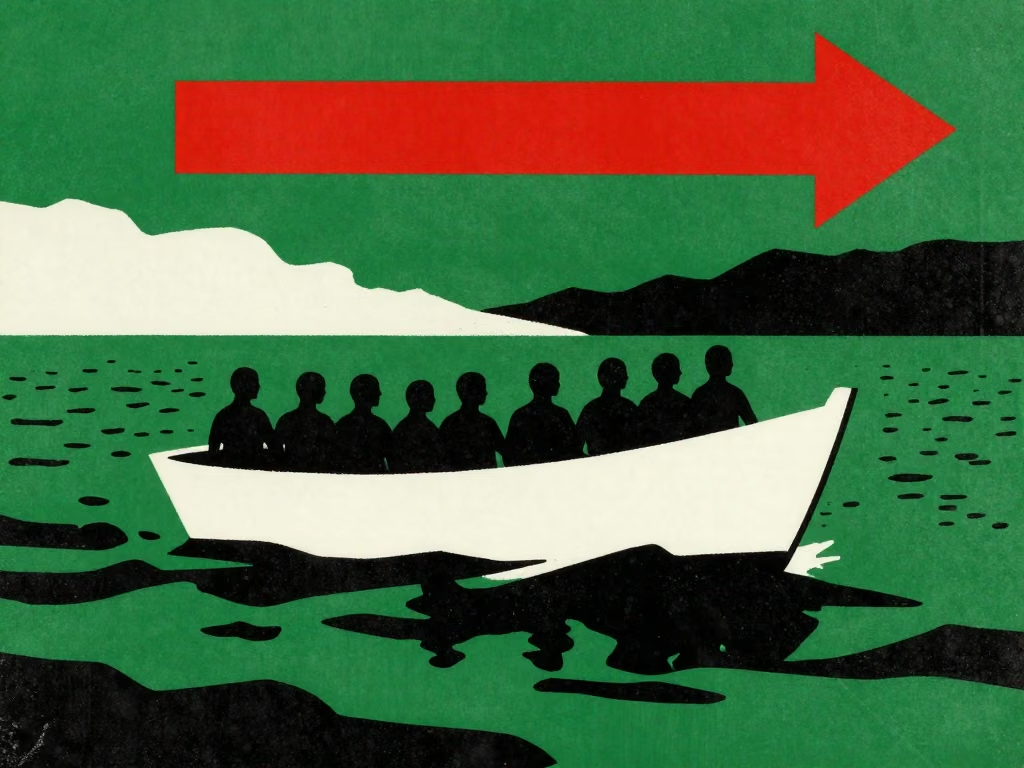
There are thousands of reasons to oppose the cruel proposals of the Tory government to send asylum seekers to Rwanda; those reasons are, above all, the tens of thousands of traumatised people threatened by these proposals. People like these:
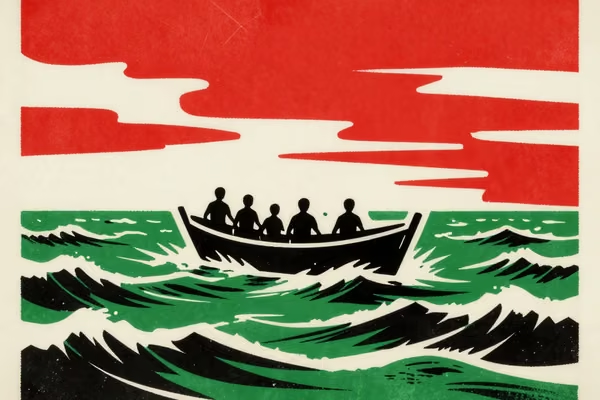
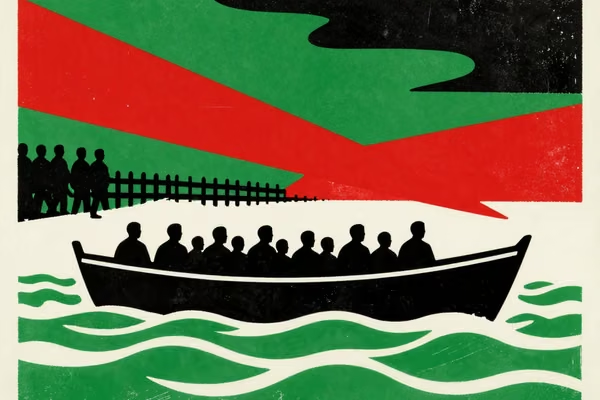
“Yesterday (13.04.22) 116 refugees in three boats came ashore at Dungeness. We understand that that everyone on the first two boats was from Syria, and the people in the the third were from Kurdistan and Afghanistan. There were a lot of women and children on the first two boats, including some children who were unaccompanied. Many people looked cold and exhausted, and some were upset and confused – some much that it tore at your heart to see them.
There was one family with a small boy and a lady who was just crying uncontrollably. She was obviously in shock, and kept saying how awful the crossing had been. I think she had a vitamin deficiency, and her little boy looked like he was in shock as well. I gave her a complete change of clothing, and by the time she had to leave, she said she was a lot better.
Working alongside our friends at Channel Rescue, we handed out packs with hats, gloves, sliders, socks and scarves. And oat bars – I deliberately got wrapped oat bars because it’s Ramadan and someone won’t necessarily want to eat straight away. Then we distributed water and blankets. The little kids loved the Easter eggs we gave them.
There was one lady who was diabetic. She was very unwell, and the others asked me if I had any chocolate, so I ran to a shop and got some Easter eggs! I gave her those, and then she was taken off the boat separately.
Watching the refugees when they got off the boat, you think about the journey they’ve been on – these guys today were on the boat for eight hours because they’d gone really far out. We try and make their arrival a little bit more pleasant considering what they’ve gone through, which is going to be hiding out for hours, hiding from police, in the freezing cold.
It’s difficult, because nobody explains what’s going to happen to them. So we explain the process. I tell them that they’re going to be searched, and have their things taken off them, and then they’ll have to get on the coach and go to the Kent intake unit.
The government is deliberately hostile to them, and they make their lives even harder. You’ve got amazing people that often have incredible skills that would be an absolute asset to the UK, who are treated appallingly.
After today’s horrible announcement about offshore processing, it felt extra-important to welcome these people to the UK. Anything that we can do to make the lives of people more bearable when they have already been through a really, really difficult time, is valuable – and now more than ever. Care4Calais writing on Facebook (To make a donation to Care4Calais visit here.)
So while so many remember that we are talking about people, traumatised people, the government seems hell bent on trying to make us think that refugees, asylum seekers and, indeed, economic migrants are “others”, not like “us”. But they are not different and we know – as does the government – that most people would do exactly the same if we found ourselves in similar dreadful circumstances.
At least 160 charities and campaign groups have condemned the plans as “shamefully cruel”; amongst them are the Joint Council on the Welfare of Immigrants, the Refugee Council and Unite the Union
UK government’s hypocrisy on human rights in Rwanda
Johnson justified the government’s plans: “This innovative approach, driven by our shared humanitarian impulse and made possible by Brexit freedoms, will provide safe and legal routes for asylum whilst disrupting the business model of the gangs”. Johnson even said this was “a new international standard” and Pritti Patel referred to it as “a world first” and managed to accuse other countries of sitting back and letting people die!
“The deal we have done [with Rwanda] is uncapped, and Rwanda will have the capacity to resettle tens of thousands of people in the years ahead. And let’s be clear, Rwanda is one of the safest countries in the world, globally recognised for its record of welcoming and integrating migrants,” (Johnson).
Johnson cited no evidence for this claim, especially remarkable considering that, at the United Nations just last year, the UK government demanded investigations into allegations of killings, disappearances and torture in Rwanda. When asked about the poor human rights record in Rwanda, where some groups have logged the torture of detainees, he said: “Rwanda has totally transformed. Over the last few decades it has totally transformed from what it was.” Guardian
And, despite the enormous difficulties of getting the right to stay in this country, the UK has granted protection to dozens fleeing Rwanda over the past decade
This is not even a longwinded approach to find those whom the government is willing to regard as eligible for asylum towards residency in the UK, instead, asylum seekers will have ‘one-way ticket’ to Rwanda and will not get refugee status in the UK
What will happen to those who are denied rights after processing? Where are they expected to go?
Political Opposition?
So far, there has been no statement from Keir Starmer about the inhumanity of the proposals: on BBC News (14.04.22) he said of the plans “they’re unworkable, they’re extortionate, they’re going to cost taxpayers billions of pounds and they just reflect a PM who’s got no grip and no answers to the questions that need answering”. Labour List cites him referring to the refugee plan being a desperate attempt to distract from partygate.
Tory Baroness Warsi has been much more forthright and “called the scheme inhumane and cynical. “This proposal of offshoring asylum seekers to Rwanda is ineffective and costly,” she said. “It’s also inhumane and shames our proud history as advocates of human rights and the refugee convention.” (see, eg The Guardian)
Rwanda’s record of “processing” refugees
Before considering its role in “processing” refugees, as well as its poor record on human rights and democracy, it is important to remember that Rwanda is a desperately poor country where, for example, only 57% of people have access to clean water within a 30 minute walk from home. (UNICEF Rwanda) Either refugees from the UK will be given better conditions, risking resentment from suffering Rwandans, or they will also have to endure great poverty and deprivation.
From 2014 Israel sent African refugees to Rwanda but ended their arrangements in 2018 after it emerged that asylum seekers ended up in the hands of people traffickers; there were stories of rape, torture, enslavement and torture as desperate asylum seekers fled north to try to get into Europe via the Med. (BBC News 14.04.22).
(See also these pieces: Sent to Rwanda by Israel: ‘We have no food or work. Don’t come here’, Rwanda’s history of receiving deportees raises concerns and UK asylum seekers sent to Rwanda? That takes punishment of fellow humans to a new level.
Illegal? Unworkable?
Johnson has already said that he expects legal challenges but rather as though this was an inconvenience to be swept away. However, along with other aspects of the Nationality and Borders Bill, this will place the UK outside of International Law and the International Conventions drawn up after World War Two that aimed to ensure that there would be safe havens for those fleeing persecution, so that another genocide akin to that of the Nazis, would not be repeated, at least not for want of escape routes.
Will these measures deter desperate people with family in the UK and who speak English? Will it stop the traffickers? As JVL’s Membership Secretary, Mike Cushman said in this letter to the Guardian : “Any people smuggler with a business plan will no longer tell asylum seekers to travel alone, get settled and then bring their families – the least risky strategy. Now they will say: “Bring your families now so that you will not be put on a plane to Rwanda.” The consequence: more children on dangerous boats; more children drowned in the Channel; then another crackpot scheme announced to “solve” the humanitarian disaster caused by the last plan.
The way to reduce the problem is to set up legal and accessible ways of claiming asylum abroad and reducing the need for desperate people to attempt desperate routes. That is the way to undermine the people smugglers who are exploiting market opportunities that the government has created.”
And, finally, to the costs: last year 28,536 people arrived via the Channel and this figure is likely to be exceeded this year. Despite the draconian hurdles long since introduced into the process as part of the hostile environment, over half of those claiming asylum are successful. The much criticised and finally abandoned Australian scheme on which this is modelled has cost billions, and it is likely that the UK numbers will almost certainly be higher.
We do ask why the government can’t find the money to support people in this country facing the worst cost of living crisis for decades and why can’t the government ensure decent homes for all, including for those seeking asylum? Shortages are not inevitable but are a political choice. The costs for this offshoring scheme will be enormous. The human cost is possibly incalculable but the Australian experience gives us some idea of human and financial costs.
Although, unlike the original Australian scheme, the UK government currently says it will not send children and families to Rwanda. mental health is a key factor Médecins Sans Frontières Australia. For the Australian government, the annual cost, per person, of detaining and/or processing refugees and asylum seekers has been estimated as follows:
- almost $3.4m to hold someone offshore in Nauru or Papua New Guinea;
- $362,000 to hold someone in detention in Australia; and
- $4,429 for an asylum seeker to live in the community on a bridging visa while their claim is processed.
The Refugee Council of Australia has compiled a detailed list of offshore processing costs by category, and notes that processing asylum seekers offshore has cost the Australian government $8.3 billion between 2014 and 2020. Costs | Factsheet | Kaldor Centre (unsw.edu.au)
In February 2021 Madeline Gleeson from the Kaldor Centre of Australia made a submission to the United Kingdom House of Commons detailing the economic and human costs of Australia’s offshore processing model. Clearly facts about the human and the financial costs from several years of experience, meant nothing to this government.
The Australian figures highlight how much cheaper it is for asylum seekers to be supported in the community as well as being much better for mental health and also notes “Studies have shown that refugees can bring material, cultural and demographic benefits to the communities in which they settle. While refugees may find it difficult to get jobs initially, over time their labour participation rate increases and they can make a significant economic contribution. This contribution can be facilitated by appropriate policy responses.”
And another thing….

We say no banishment of refugees and asylum seekers – not to Rwanda and not to anywhere else.
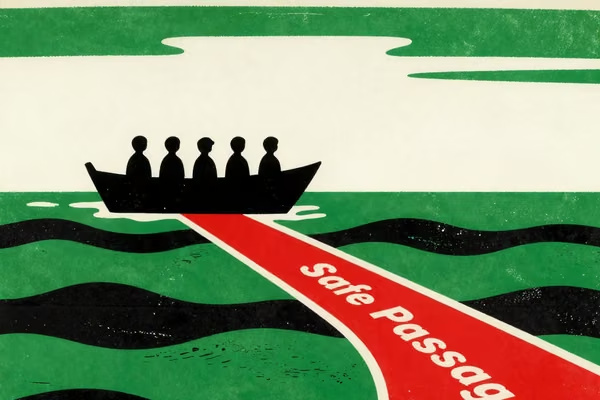
Safe routes and speedy and humane procedures for all.
























Excellent article. The behaviour of this Government, endorsed apparently by a considerable section of the population, is despicable … unspeakably and quite deliberately cruel, callous and cynical. And, as Leah rightly points out, Keir Starmer provides a totally ineffective, if not non-existent, opposition. It is totally shameful (and surely until now would have seemed inconceivable) that the UK Government could dream up such a heartless, scurrilous and merciless policy.
We are concentrating on the government but there are 2 parties to this – Rwanda too.
Paul Ngame’s neo-colonial dictatorship did this before when it agreed to Netanyahu off loading Israel’s Black African refugees to Rwanda. He was forced to backtrack after the refugees themselves held demonstrations outside Rwanda’s Embassy in Tel Aviv.
I suggest if we are serious about this we should not hold futile and tokenistic demonstrations outside the Home Office but outside the Rwandan Embassy in London. They are the weak link in the chain
The Nazis considered deporting Jews to Madagascar.
Eerie parallels:
https://en.wikipedia.org/wiki/Madagascar_Plan
Kier Starmer continues to beat the tory drum, only a little more softly. It seems his concerns are about the cost and workability of this system, without even a passing reference to the inhumanity or the suffering it will cause. One assumes were it cheaper and easier to operate he’d support it. I thought he was supposed to be a human rights lawyer.
This tory government are abominable, unfortunately HMO seem little better.
Thank you for this piece Leah.
On of the most ridiculous and ironic aspects of this whole (not quite) unbelievable idea is that of the two people behind it, Johnson was born in the USA (sorry, Bruce!) and Patel’s parents were refugees from Uganda.
Nothing like succeeding in life, then pulling the ladder up, eh?
“Either refugees from the UK will be given better conditions, risking resentment from suffering Rwandans, or they will also have to endure great poverty and deprivation”. There’s no win with this one. I think it will unravel.
As a life long Labour Party supporter I am incredibly disappointed by Kier Starmers response to this cruel and divisive proposition.
That horrible little entitled and privileged specimen Reece Mogg and his cronies should be ashamed of themselves for supporting this truly inhumane idea.
Shame on them all.