
No deportations to Rwanda
JVL Introduction
We endorse the strong condemnation issued by the Jewish Socialists’ Group in response to the government’s inhumane and illegal threat to transport asylum seekers to Rwanda.
And we repost an article by Enver Solomon, chief executive of the Refugee Council, which explains how government proposals take punishment of fellow humans to a new level, treating them as “no more than human cargo to be shipped thousands of miles away so they are out of sight and out of mind”.
These supplement our earlier statement and reposting of the Jewish Council for Racial Equality pesach response in which they say “Such a policy would be a cruel, moral failure, and an appalling abdication of responsibility. It is utterly shameful that the government is choosing to punish, not protect, people fleeing conflict and persecution.”
Statement on the Rwanda Plan
Jewish Socialists’ Group, 20 April 2022
The government’s threat to transport to Rwanda refugees who don’t arrive by the almost non-existent “safe and legal routes” will criminalise them and is a direct attack on their human rights. It is also racist in terms of which refugees it is targeting. This flows directly from the logic of immigration controls and the hostile environment, which criminalise people on the basis of the colour of their skin, the language they speak, their religious beliefs, where they or their parents were born, and whether they are deemed to embrace so-called British values.
Announcing the plan, Boris Johnson described the UK as “a beacon of openness and generosity”, citing Jewish refugees from Tsarist Russia among various communities that have been “welcomed”. This is another of his lies. His Tory predecessors passed the Aliens Act of 1905 that turned thousands of Jews fleeing pogroms away (most on “health” grounds, claiming they would be a burden). They rounded up and deported back to Russia many others if they were wandering the streets without means of support, six months or more after they had arrived. Thirty years later they barred entry to Britain to many desperate people fleeing Nazi persecution. They did, reluctantly, admit a few thousand children, but not their parents. This Kindertransport was organised entirely by private individuals and charities. The British state contributed nothing towards saving those lives.
Pandering to far-right racist/nationalist themes, Johnson also targeted what he called an “army of politically motivated lawyers”. This is how he describes the people defending the human rights of all refugees. The Labour leadership’s immediate and instinctive response was weak and evasive. Shadow Home Secretary, Yvette Cooper, listed the problems with the plan in this order: “extortionate”; “unworkable”; and “unethical” – as if the main problem was financial. “Unethical” should be first, not an afterthought. When Cooper was Shadow Home Secretary during David Cameron’s government, she often tried to outflank his racist immigration policies, saying that they were not effective enough in “protecting our borders”.
With Labour’s Front Bench failing to offer a principled, humanitarian lead, it falls to human rights defenders and grassroots anti-racists to block this plan from being implemented.
The Jewish Socialists’ Group is opposed to the detention, deportation and forced transportation of refugees and migrants to anywhere in the world. Rwanda’s own human rights record is under scrutiny with allegations of violations of rights to a fair trial, enforced disappearances, torture and excessive use of force, including the killing of refugees demonstrating for their rights.
A precedent for the transportation of refugees to Rwanda was set by a secret deal with Israel, which deported around 4,000 people between 2014 and 2017, though it seems that many of them were smuggled out again within days of their arrival.
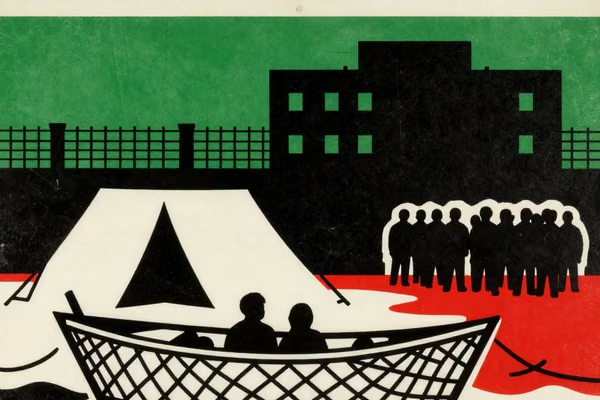
This is not the first time that poor and war-torn countries have been paid to shoulder Europe’s responsibilities for refugees arriving at its borders, to the detriment of the countries concerned as well as to the refugees. Libya is operating “a shadow immigration system” to keep refugees out of Europe. This includes capturing African migrants and incarcerating them in secret prisons where they have been subject to torture, rape, extortion and trafficking.
In the 1990s, the EU (of which the UK was then a member) financed the building of detention centres in Lithuania to prevent the entry of migrants coming into Europe from Asia via Russia and the Baltic states. Carrying this out was made a condition for Lithuania to join the EU.
The Jewish Socialists’ Group is implacably opposed to the government’s latest scheme to transport refugees out of the country and will stand with other communities and organisations to block it and challenge other manifestations of the Hostile Environment.
In particular, we will encourage people from across the Jewish community to engage in this struggle and remember our roots and often bitter experiences as a refugee and migrant people. Neither the Board of Deputies nor the Chief Rabbi have yet commented on the Rwanda plan to spirit refugees out of the country where they had hoped to gain sanctuary, but we urge all Jewish bodies who care about racism, injustice and the abuse of human rights, to speak out now.
UK asylum seekers sent to Rwanda? That takes punishment of fellow humans to a new level
Enver Solomon, the Guardian, 14 April 2022
The government wants to pay large sums of your money to a system already proven to be cruel and ineffective
Since the Russian invasion of Ukraine, the heartbreaking stories of families torn apart and desperate women and children fleeing violence and atrocities have reminded us all of the brutal reality faced by refugees escaping conflict and oppression all over the world.
The British public have shown remarkable compassion and understanding in wanting to offer a warm welcome to all Ukrainians seeking sanctuary in the UK.
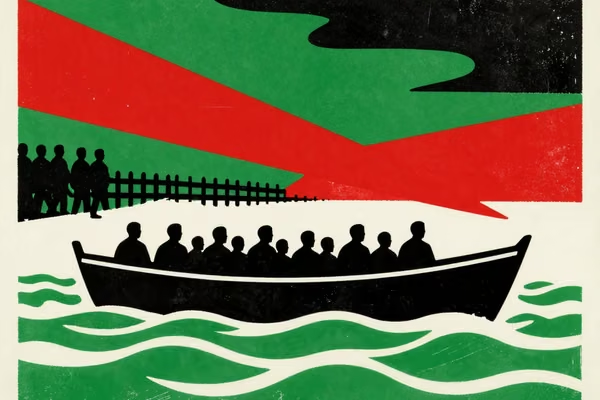
But instead of harnessing this compassion for refugees and making Britain a nation of sanctuary – as the Scottish government has pledged to do – Boris Johnson’s administration in England has chosen to effectively offshore people seeking asylum to Rwanda; to treat them as no more than human cargo to be shipped thousands of miles away so they are out of sight and out of mind.
The Home Office says the focus will be on single men and women, including survivors of torture and trafficking, who will in effect be forcibly removed by being given a choice of either a one-way ticket into the Rwandan asylum system or fleeing into the hands of people smugglers again. They would no longer be given a fair hearing on UK soil – and would be penalised for having, through no fault of their own, taken the wrong route to safety. It takes the government’s desire to punish and expel our fellow human beings to another level.
Under its cruel nationality and borders bill, which will next week return to the Commons after being defeated for a second time by the Lords, those coming across the Channel would be criminalised and could face imprisonment for up to four years.
Rwanda already hosts around 140,000 refugees in six refugee camps. The country’s president, Paul Kagame, regularly speaks about his commitment to refugee protection, having himself been a refugee in Uganda. However, the country has a poor human rights record, is a source country for many refugees who fear political persecution and torture by the Kagame regime, and has been accused of engaging in assassination attempts against Rwandan exiles abroad. If you were a Ukrainian refugee or an Afghan fleeing the Taliban, you certainly wouldn’t want to be sent to Rwanda.
Sending people fleeing oppression and violence from Afghanistan, the Middle East or even Europe to Rwanda is not only cruel, but as a policy it is ridiculous. Only a quarter of asylum applicants in the UK in 2021 were from African countries, so there is no economic development case for sending people to their home continents. And as Professor Alexander Betts of Oxford University notes, contrary to popular belief, very few refugees move on from host countries in Africa. Research from his team from Kenya suggests that while just 8% of refugees will leave their temporary homes in camps and cities in any given year, most will move within east Africa, and just 0.1% will move to Europe.
Britain is not the first country to make a deal with Rwanda. Israel sent Eritrean and Sudanese asylum seekers to Rwanda under a policy that was eventually abandoned following international and domestic criticism and protests. A study by German academics found they weren’t given the opportunity to apply for asylum – and were forced to embark on dangerous journeys at the hands of people smugglers to get to safety elsewhere.
When Australia sought to send people seeking asylum to neighbouring pacific island nations Papua New Guinea and Nauru, the policy was a failure. A review of the sorry episode by the University of NSW in Sydney concluded it didn’t deter people taking dangerous journeys or do anything to break the business model of people smugglers. Instead it incurred huge financial cost for taxpayers, triggered multiple legal challenges and led to “systemic cruelty” with people taking their own lives and self-harming. Over the past decade, Australian government data suggests that just more than 3,000 asylum seekers have been outsourced, at a total cost of over £1bn, and most were ultimately recognised as refugees.
And let’s not forget that the people the government is seeking to offshore are not all illegal economic migrants, as it claims, but are mainly those who have escaped bloodshed and terror. They are exercising their right under the UN refugee convention, which the UK was a founding signatory of, to seek asylum in a country of their choosing.
Government data shows that those coming across the Channel are mainly from 10 countries, including Iran, Iraq, Syria, Yemen, Sudan, Eritrea and Afghanistan, where persecution and oppression are not uncommon. Overall, around two-thirds are actually granted refugee status or protection in the UK.
There is little to suggest the government’s plans to send people seeking asylum to Rwanda will be a success for them individually, or for the government in terms of deterring people from making dangerous journeys at the hands of people smugglers. There are, of course, better ways to create a fair, humane and orderly asylum system. It is possible to demonstrate control while protecting the most vulnerable. Doing so has two main elements.
First, protection in host countries around the world must be strengthened. In a globalised world, if the UK is serious about reducing the need for refugees to take dangerous journeys, it should invest in humanitarian and development aid for them in countries where people flee from. In east Africa, it should support countries such as Rwanda, Kenya, and Uganda to better protect the refugees that they already host.
Instead of spending millions of pounds of taxpayers’ money on transferring refugees thousands of miles away, we could allocate that money to assist hundreds of thousands of refugees before they risk their lives by travelling to the UK. Based on Australia’s failed experience, offshoring one asylum seeker for one year is likely to cost the same as supporting thousands of refugees already in situ for a year.
Second, and most importantly, the government should adopt effective policies that will actually address the Channel crossings. It should invest in fair and effective asylum processing when people arrive, on both the beaches in France and in the UK. At the end of last year, more than 100,000 people were waiting for an outcome on their initial claim for asylum – and of them 62,000 had been waiting for more than six months. The fact that initially no more than a few hundred will actually be sent to Rwanda suggests the government is hedging its bets in the knowledge that it may not deliver what it hopes, and be quietly shelved as happened in Australia.
We should also offer humanitarian visas from assessment centres set up at British embassies elsewhere in Europe, including France and other key “hotspots”, to enable people in need to travel without resorting to smuggling networks. And critically, we should work multilaterally – not with remote countries such as Rwanda, but through an effective bilateral agreement with France and our EU neighbours.
There are many ways to achieve effective borders while protecting vulnerable refugees. They need not rely on criminalising men, women and children who reach our shores, or on paying large sums of taxpayers’ money to other countries to run schemes that are proven to be cruel and ineffective.
- Enver Solomon is chief executive of the Refugee Council. Alexander Betts, professor of forced migration and international affairs at the University of Oxford, also contributed to this article





















Thank you for showing some reasonable and humane alternatives. And cost benefit analysis.
Excellent comments from the Jewish Socialists’ Group and Enver Solomon. During the Spanish Civil War, Basque children were sent for safety to England after Guernica. The government refused to accept them, until individuals end volunteer organisations took responsibility. The descendants of these children still live among us. So the reminder that Johnson ‘s government is acting in the same manner as its predecessors did over Russian Jews fleeing Tsarist pogroms is spot on. Plus ca change.
Did JVL readers notice that a legal challenge to the Rwanda scheme has ALREADY been mounted by an asylum seeker? The “Independent” had an article on this challenge.
Legal experts have told the “Guardian” that legal challenges to this scheme are likely to be successful.