
Rosh Hashanah 5783: Reflections and briefing from JCORE
JVL Introduction
The latest JCore (Jewish Council for Racial Equality) Newsletter frames its New Year greetings for a happy and sweet new year within the grim reality of last year having “been one of the most bruising years for refugee and asylum policy in memory”.
It asks us to reflect on what the consequences of “the cruel Nationality and Borders Act” and “the shameful Rwanda plan” would have been for Jewish refugees in the 1930s.
Below we repost its 5783 Rosh Hashanah briefing, a richly detailed and carefully referenced document, full of hard information and analysis which will be of immense value in any campaigning for rights for refugees and asylum seekers.
Rosh Hashanah 5783: Reflections and briefing from JCORE
You can download this briefing as a PDF here.
In a strange and sometimes disturbing coincidence, High Holy Days in recent years have often followed tumultuous events for refugees and asylum seekers. As we approached Rosh Hashanah in 2021, heartbreaking scenes of Afghans desperately attempting to escape from Kabul airport dominated headlines. And six years earlier in 2015, as the shocking image of Alan Kurdi’s death confronted the world, the words “Who [shall perish] by water” in the Unetanneh Tokef gained tragic new relevance.
Kurdi’s death saw an initial outpouring of compassion. But seven years on, this has increasingly given way to apathy and hostility to those seeking sanctuary. This year’s Rosh Hashanah comes amidst a context of increasingly regressive responses to immigration and asylum – in 2022, it’s perhaps domestic legislation which should disturb us most.
5782 was often a bruising year for policy developments. The Nationality and Borders Act, which passed into law earlier this year, will fundamentally change the UK’s asylum system. The new law divides refugees into two classes. Those who arrive irregularly, in absence of accessible safe routes, will face criminalization, restricted family reunion rights and the threat of offshore processing. It’s alarming to think what consequences such measures would have had for Jewish refugees fleeing mainland Europe in the 1930s.
The government’s shameful plans to deport asylum seekers to Rwanda continues this worrying trend of deterrence over protection. And disturbingly, this appalling abdication of responsibility is setting an international precedent. In recent weeks, Denmark has signed a deal which could see 1,000 asylum seekers sent to the East African country every year.
During this period of reflection, we must consider parallels between our community’s personal and historic refugee experience, and the context for asylum seekers today. This month’s unveiling of a new Kindertransport memorial statue in Harwich reminds us of why this country must continue to ‘welcome the stranger’. And while circumstances are different today, it should also provide a warning of the consequences of failing to protect those fleeing persecution.
On a brighter note, our community has shown incredible compassion and solidarity to those displaced by the two major refugee crises in the past year. It’s critical that this spirit is renewed in 5783. But when we reflect on the opportunity for new beginnings a fresh year brings, we must consider how this is denied to many displaced people in the UK. It’s appalling that more than a year on, 9,500 Afghan refugees remain stuck in limbo in bridging hotels. And there can be no sweetness in the New Year for the asylum seekers served with deportation notices to Rwanda last month.
The sound of Shofar blasts in 2022 must focus our commitment to defending refugee rights in the coming year, and strengthen our calls for a kinder, more just asylum system, which moves on from the mistakes of the past.
What are the main issues our community should take action on in 5783?
1. The Rwanda plan
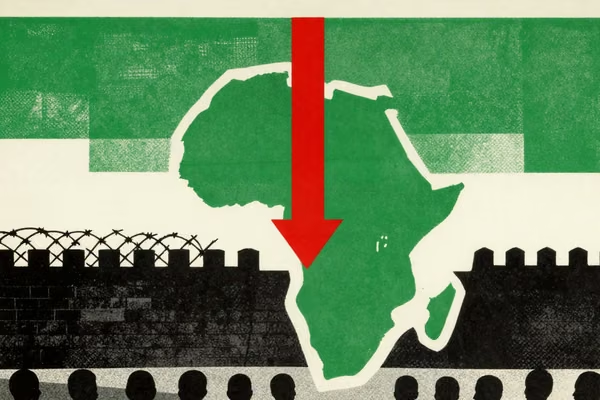
In April 2022, the government announced appalling plans to deport people seeking asylum in the UK to Rwanda. Despite an 11th hour ECHR intervention stopping the first Rwanda deportation flight in June 2022, the new Prime Minister has pledged to support and expand the policy.
The plans are…
- Morally bankrupt. It’s unthinkable that the government plans to ship people who have fled torture, conflict and persecution 4,000 miles to a country with an appalling human rights record. Shockingly, Rwanda is a source country for people seeking asylum in the UK on grounds of sexual orientation – it is not a safe country for LGBTQ+ people to be exiled to. Recent disclosures also reveal that the UK High Commissioner to Rwanda advised against signing a deal, due to fears that refugees could be forced into joining the country’s army.
- Legally dubious. The UNHCR has labelled the plans as an “egregious breach of international law and refugee law”. There is no obligation in the Refugee Convention for refugees to claim asylum in the first safe country they reach – but both the Rwanda Plan and Nationality and Borders Act punish those unable to directly travel to the UK. And as the Law Society has highlighted, exiling asylum seekers to Rwanda also risks violating the principle of non-refoulement, which prohibits states from returning a person to a place where their “life or freedom would be threatened”.
- A shameful abdication of responsibility. Developing countries already host 83% of the world’s refugees: it’s shocking that the UK, the 6th richest country in the world, is seeking to deport asylum seekers to a poor African nation.
Want to take action?
- Download our briefing to get the facts
- Use our template letter and urge your MP to speak up against the plans
2. Act now for Rwandan refugees
The scenes at Kabul airport in August 2021 were particularly poignant for the Jewish community. Many of us will have family members who were forced to flee from persecution with little notice.
At the time, the UK government pledged that Afghan refugees would be given a ‘warm welcome’. But more than twelve months on from the Taliban’s takeover, this promise has turned cold.
Inaccessible and narrow safe routes
The UK has launched two resettlement schemes for Afghans. But these remain plagued with issues, and are inaccessible for the vast majority of Afghans. As a consequence, those who want to reach safety in this country are often forced to take dangerous, clandestine journeys. Shamefully, Afghans are the joint largest nationality of asylum seekers crossing the Channel so far in 2022 – and under the Rwanda plan, those with no other choice than taking such perilous journeys could face deportation.
Want to take action?
- Download our briefing to find out more about the Afghan resettlement schemes
- Write to your MP and demand that the warm welcome promised is delivered
3: Rights for refugees and asylum seekers: lifting the ban, and family reunion
Even prior to the cost of living crisis, asylum seekers were being forced into destitution. So it’s appalling that during this difficult time, people seeking asylum in the UK are banned from working and forced to live on just £40.85 a week. For asylum seekers housed in full-board accommodation, the situation is even worse: a weekly allowance of just £8.24 is provided. It’s therefore critical that the government lifts the ban on asylum seekers working, and urgently raises asylum support rates.
Dividing refugee families also compounds individual suffering. Refugees in the UK must be given the chance to rebuild their lives, with their family members.
Three urgent actions the government should take to bring refugee families together…
- Allow child refugees in the UK to sponsor their parents
In a fantastic campaign win, the UK’s immigration rules were recently expanded so that refugees in the UK can sponsor their adult children to join them in safety. But unaccompanied child refugees in the UK are still unable to sponsor their parents – the government must right this wrong.
- Give all Afghans resettled in the UK family reunion rights
In 2021, the government pledged that Afghans resettled through Operation Pitting would be able to subsequently bring family members to the UK. But this promise has been broken. Those evacuated in August 2021 have been granted indefinite leave to remain, not refugee status, meaning they have lesser family reunification rights. All people resettled through ‘bespoke’ schemes must be given full refugee status and allowed to reunite with their families.
- Scrap rules on differential treatment
The Nationality and Borders Act makes it far harder for asylum seekers forced into taking irregular routes to the UK to later reunite with their families. An estimated 3,500 people could be impacted by this change. As the Families Together coalition highlights, women and children, who made up around 90% of those using family reunion routes to reach the UK in recent years, will be disproportionately affected. Australia’s implementation of a similar policy preceded a rise in child and women refugees using boats to reach the country. If the government wants to prevent more people being pushed into dangerous cross-Channel journeys, it must scrap these measures.
Want to take action?
- Join the campaigns to #LiftTheBan and bring Families Together, and consider asking your synagogue or movement to join the coalitions.
Questions to consider…
- As Jews, do we have a particular responsibility to speak out and defend refugee rights?
- What connections do we see between Jewish teaching, and contemporary social issues?
- How can we best draw on Jewish values to address increasing hostility towards asylum seekers and refugees?
- Is there value in drawing comparisons between our personal and historical refugee experience, and the present day context?
- What more can we do as a community to help refugees in 5783? What can we do to mobilise our community, to make our shared voice as loud as possible?
- What role would we like our communal leadership to take in responding to these issues? And what can we ask them to take action on in the coming year?
The Jewish Council for Racial Equality www.jcore.org.uk Charity 1132666











Comments are now closed.