
US campuses in the forefront of solidarity with Palestine
JVL Introduction
Student protest in support of Palestine is rocking US campuses in what some have likened to a repeat of the 1968 student rebellion. We bring together a few reports and analyses of what is going on: Al Jazeera and Sky videos, and a few articles.
Julian Epp spoke to spoke to students at more than a dozen schools about the repression they are experiencing: Columbia, Brown, Yale, Michigan, Cornell, UC Berkeley, MIT, Cincinnati, McGill, CUNY, Swarthmore, Rutgers, Stanford, Rice and Washington.
Tom Hurwitz looks back to his arrest at Columbia in 1968 and compares it with today.
Al Jazeera asks if the protest is going global.
We’d also draw attention to Mark Mazower’s The Week that rocked Columbia in the FT.
RK
Al Jazeeera reports
US students are protesting against: Israel’s military operations in the Gaza strip | Inside Story
Sky News reports
Gaza protests: On the frontline of US campus chaos
Campus protests for Gaza are proliferating — and so is the repression
With calls for divestment spreading this past week, students share how dozens of U.S. colleges are cracking down on pro-Palestine demonstrations.
Julian Epp, +972 in partnership with the Nation, April 26, 2024
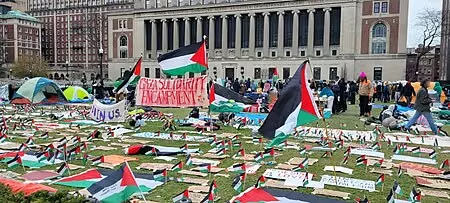
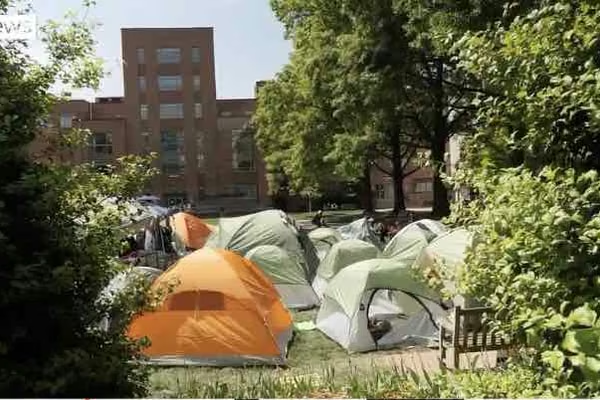
On April 17, students at Columbia University formed a “Gaza Solidarity Encampment” on the campus’s East Butler Lawn calling for the school to divest from companies that profit from the occupation in Palestine. Their tents stood for two days before the administration suspended more than 100 participating students and asked the NYPD to dismantle the encampment. Unsurprisingly, the repression only increased the size and scope of the protest.
In short order, students at dozens of other colleges — including the University of Minnesota, the University of Pittsburgh, Berkeley, and Yale — have established similar encampments in a widening showdown over campus speech and the war in Gaza. Administrations are responding in different ways. On April 24, officers in riot gear at the University of Texas, Austin, blocked the path of protesters and arrested at least 34 people for refusing to disperse.
Since October, universities have suspended student groups, curbed academic speech, and called the police on peaceful protesters on campuses coast to coast. With calls for divestment only growing louder, we asked students nationwide to share how their schools have responded to protests calling for a ceasefire and in support of Palestine.
Subscribe to The Landline
+972’s weekly newsletter
Columbia University — Ava Young-Stoner
Since October 7, Columbia University has responded to pro-Palestine students and faculty with punitive measures like suspending Students for Justice in Palestine (SJP) and Jewish Voice for Peace (JVP) — an action for which the New York Civil Liberties Union and Palestine Legal filed a lawsuit against the school — rewriting policies about student protests, and restricting campus access to university-affiliates only, which severely inhibits students’ freedom of movement and expression.
Barnard College, an affiliate of the university, has followed suit by changing its student code of conduct, censoring pro-Palestine language from a faculty website, and banning students from putting any decorations on their dorm’s doors, a policy enacted after at least 19 students faced disciplinary proceedings for their involvement in a campus protest. In between these measures against students, pro-Palestine professor Abdul Kayum Ahmed received a letter of non-renewal after a “Wall Street Journal” article accused him of “political indoctrination” in the classroom, based on a video in which he labeled Israel a “colonial settler state.”
On April 4, four vocally pro-Palestine students were suspended and given eviction notices for their campus housing, seemingly in relation to an unauthorized campus event and failure to comply with university-hired private investigators. One of the suspended students, Aidan Parisi, shared with me that since receiving their suspension notice, they have not received a comprehensive file about the additional details of their suspension, nor a date on which a hearing will be scheduled to determine whether they will be welcomed back as a student or dismissed.
Despite the administration’s numerous attempts to silence student activists, on April 17, hundreds of Columbia students came together to establish their Gaza Solidarity Encampment in the center of campus — a highly visible protest meant to resemble similar actions done on campus in the 1960s over Columbia’s financial involvement in the Vietnam War. By April 18, university President Minouche Shafik requested NYPD officers to clear the encampment, leading to the arrests of over 100 students, followed by their immediate suspension. This has led to immense pushback from students, alumni, and faculty, yet the university still threatened to call the National Guard against protesting students on April 23, according to Columbia SJP.
As the protest continues and is echoed coast to coast, Columbia has been consistently hostile to the press, and on April 21, university public safety officers tried to force student radio correspondents — who have covered the protest every day since it began — off the air.
Brown University — Nicholas Miller
Since October 7, the Brown campus has seen a series of escalating student protests calling for the university to divest its endowment from companies that support the Israeli government. The administration has so far refused demands for divestment — and punished student protesters in the process.
In November, the university had 20 Jewish students who held a sit-in in the administration building arrested for trespassing, promising to pursue criminal charges against them. But on the eve of the students’ arraignment, the university requested that the city of Providence drop the charges. The decision was intended to ease campus tensions after a Palestinian student at Brown was shot the previous weekend in Burlington, Vermont.
In December, dozens of other students held another administration building sit-in. Brown again had these students arrested and has continued to pursue charges against them; they were arraigned in February, pleading not guilty to willful trespassing.
Last month, the administration placed these students on probation, a status under which additional conduct violations by the student would be “scrutinized more heavily and sanctioned more seriously.” As part of their punishment, the students from the second sit-in were ordered to write a statement about how their actions contradicted the university’s values or create informational material about the university’s protest policy. The 20 Jewish protesters of the original sit-in were not placed on probation, but were directed to write a 10-page paper individually or as a group about the university’s divestment process.
Since the two sit-ins, the administration has repeatedly promised harsher punishments for protesters, including “more significant criminal misdemeanor charges.” On April 24, about 80 students began a tent encampment on the central campus green. In an e-mail the previous day, the administration warned that participation in encampments could result in discipline up to and including suspension from the institution. Brown’s repression of pro-Palestinian protests shows little signs of ending anytime soon.
Yale University — Maggie Grether
On Monday, April 22, Yale Police entered a pro-divestment encampment on campus and arrested 44 student protesters.
The arrests came one week after students began protesting on Beinecke Plaza, located at the center of Yale campus, under the name “Occupy Beinecke.” The protesters have two demands: that Yale disclose its holdings and that it divest from military arms manufacturers — most immediately any that supply weapons to the Israeli military.
The night before, some 600 people filled the plaza as organizers urged students to gather to protect the encampment. (Organizers timed the Occupy Beinecke demonstration to coincide with the semester’s final meeting of the Yale Corporation, which took place Saturday.) Protesters linked arms and encircled the collection of some 40 tents, chanting and singing “We Shall Not Be Moved.” That night, university administration offered organizers a meeting with two members of the Board of Trustees if they left and took all their belongings. Organizers, who say the university gave them 10 minutes to accept the deal, refused, saying they would not leave the plaza without a promise of disclosure or divestment.
An organizer with Occupy Beinecke, who requested anonymity out of concern for her safety, said she believes that demands for divestment at Yale are particularly important because the university’s endowment strategy holds huge influence in institutional investment. “I don’t want to attend a school that is complicit in the destruction of every school in Gaza,” she said. “And that is about Yale taking a moral stance against scholasticide.”
YPD began arresting students at 7 a.m. on Monday. While Occupy Beinecke organizers said administration promised that there would be three dispersal or arrest warnings, police only issued one. Protesters were arrested for criminal trespassing, a Class A misdemeanor.
Adam Nussbaum, a student with Occupy Beinecke and Jews for Ceasefire, pointed to Yale’s 2018 divestment from assault weapons retailers as precedent for the divestment student protesters demand now. “It makes me deeply uncomfortable to see the disconnect between my university’s rhetoric and posturing toward growth and knowledge production, and their material connections to weapons manufacturing, which produces death in Palestine, the United States, and across the world.”
University of Michigan — Nat Leach
On Nov. 17, University of Michigan students rallied in the Diag and occupied the Ruthven Administration building that houses President Santa Ono’s office. More than 40 students were arrested after occupants were denied food, water, and access to the bathroom. When a student fainted, police delayed medics from entering. One undergraduate was thrown to the ground by campus police and had her hijab ripped off.
Less than two weeks later, President Ono authorized the cancellation of a Student Government Referendum on a resolution that called for UMich to divest. The administration lied, blaming TAHRIR — a coalition of 80 organizations fighting for divestment from Israel — for sending an “unauthorized” e-mail, though it had been preapproved by a UM staff member and followed CSG’s campaign rules. As a result, two undergraduate hijabis were doxxed.
Since then, two graduate students and one Jewish undergraduate have also been doxxed. Police have visited students’ homes, once to seize electronics and sample DNA and another to retroactively issue a trespass warning for protesting the Honors Commencement just as the Black Action Movement did in 1970. One student was arrested at a regents’ meeting while entering and another arbitrarily stopped and reminded that they and 45 others face pending charges — including potential felonies — for their involvement in the protest on Nov. 17.
Representatives of the TAHRIR Coalition have not yet had a face-to-face meeting with Santa Ono as requested. Instead, he has allowed campus police to brutalize us and enabled the active endangerment of his students. Although not yet implemented, a “Disruptive Action Policy” was proposed and drafted that would have banned all forms of protest at the University of Michigan. The regents have assured that further crackdown will come.
Cornell University — Meher Bhatia
In an academic year in which Cornell University has boldly proclaimed “Freedom of Expression” as its central theme, the university’s actions seem to have contradicted this pledge.
Since October 7, Cornell has been a hotbed of dissent. In the weeks following, the campus witnessed a surge of protests, die-ins, and occupations of campus buildings by pro-Palestine students demanding the divestment of Cornell’s financial ties to defense contractors directly involved in the Israeli military’s attacks on Gaza and the West Bank.
With the onset of a new semester, Cornell administration issued a new Interim Expressive Activity policy in January, imposing stringent regulations on student demonstrations. Under the new rules, any outdoor gatherings exceeding 50 individuals on Cornell’s Ithaca campus required prior registration. The approval of the use of “amplified sound,” such as megaphones, was restricted to a narrow window of noon to 1 p.m., and limited to designated areas on campus. All posters were to be dated and include the name of the sponsoring Cornell organization.
The new rules have been openly condemned by Cornell faculty senators and student assembly members alike, many of whom have called out the policy’s blatant restrictions on freedom of expression and complete lack of input from the shared structures of university governance. The backlash caused the administration to backtrack on some of its restrictions — they now “strongly encourage” prior registration for protests, for example — while others remain.
University of California, Berkeley — Amber X. Chen
On April 22, UC Berkeley became the first college in California to establish a Gaza Solidarity Encampment. In response, university spokesperson Dan Mogulof told “The Daily Californian” that the university would “take the steps necessary to ensure the protest does not disrupt the university’s operations” and reiterated that “there are no plans to change the university’s investment policies and practices” through divestment.
The birthplace of the Free Speech Movement, UC Berkeley has a well-deserved reputation for student activism. It’s no surprise then that students have organized daily protests outside historic Sather Gate, calling for an end to the university’s $2 billion investment in BlackRock, which has substantial holdings in weapons manufacturers that arm the Israeli military.
Yet the UC Berkeley administration continues to hold pro-Palestinian protesters to a double standard.
Since October 7, Chancellor Carol Christ has released a series of statements claiming that the university’s utmost priority is freedom of expression, but the university doesn’t uphold its values when it proposes changing campus policies to hinder “disruptive” protests at Sather Gate (what is a protest if not disruptive?) or when it fails to condemn the harassment faced by pro-Palestinian student activists to the same extent that it condemns antisemitism. Also troubling was an incident after a student-led protest against a talk by Ran Bar-Yoshafat, a former soldier in the Israeli army, when UC Berkeley allowed university police to publicly release photos of individual protesters in an attempt to identify those who had allegedly “committed one or more criminal acts.”
UC Berkeley has profited enormously from its brand as an engaged home for activism and free expression. But recall that the Free Speech Movement was launched against oppressive university policies and violently repressed by university police. The students have always fought to uphold these values — not UC Berkeley.
Massachusetts Institute of Technology — Richard Solomon
The Massachusetts Institute of Technology has reacted harshly to student protests supporting a ceasefire in Gaza, reflecting the institute’s long-standing ties to Israel. Since 2008, MIT laboratories have recieved millions of dollars in funding from the Israeli Defense Ministry to conduct research in ballistics targeting, surveillance, cyberwarfare, and drone technology. The university hosts events to connect students and faculty to weapons manufacturers like Elbit, Raytheon, Caterpillar, and BAE Systems, which supply the Israeli military with its drones, D9 bulldozers, fighter jets, and artillery. Lockheed Martin even sponsors a $150,000 seed fund, administered by MIT, to connect students with its weapons laboratories and offices in Israel.
The institute’s response to growing calls from students and faculty to divest and adopt a clear, principled position on Palestine has been repressive. The MIT Coalition Against Apartheid (CAA), representing over 15 student groups, has held walkouts, vigils, teach-ins, and sit-ins on several occasions since October 7, most conspicuously on Nov. 7 and Feb. 12, when MIT students staged a sit-in. In response, administrators threatened participating students with suspension. MIT police have shut down scheduled teaching events and failed to intervene when provocateurs harass, and in some cases assault, pro-Palestine students. On Feb. 13, president Sally Kornbluth sent a campus-wide letter formally suspending the CAA under a highly selective enforcement of rules; the CAA website was shut-down, 13 student organizers were formally sanctioned, and graduate workers were denied rights to union representation in the disciplinary process.
The MIT community has not gone down gently. On March 23, undergraduates voted by a 2-1 margin in a campus-wide referendum to call for a ceasefire in Gaza, stand with student organizers for Palestine, and cut research ties with the Israeli military. On April 19, members of the MIT Graduate Student Union voted by over 70 percent to adopt a similar resolution. Thousands have signed a “No Science for Apartheid” pledge. Starting April 21, MIT students have organized a Scientists Against Genocide encampment, vowing to continue until the MIT corporation capitulates to the majority will of its community and the demands of conscience.
University of Cincinnati — Zurie Pope
Unlike some other campuses, the University of Cincinnati hasn’t been overtly repressive in its treatment of pro-Palestine organizers. Instead, our environment is quietly hostile. Everyone involved in SJP and allied organizations understands the reputational risk such affiliations pose. Faculty are reportedly worried about damaging their careers by advising the club. A colleague of mine who works for our school newspaper feared that their column would cause them to be ostracized by their peers. And while UC SJP is allowed to protest, they’re often accompanied by significant police presence.
This isn’t to say that Ohio’s government isn’t strongly opposed to pro-Palestine organizers. In 2016, Governor John Kasich signed a law that prohibited Ohio state agencies from doing business with entities boycotting Israel, and Senate Bill 83 would have banned all boycott, divestment, and sanction activity at Ohio colleges.
The suppression on campus is more subtle. It’s the feeling that makes someone decide not attend a SJP rally because they may lose friends, or choose not to speak out on social media because of possible harassment. It’s the second thought that causes you to remove your name from a petition. It’s the constant, unspoken fear of future repercussions: employers who won’t hire you, jobs you’ll be fired from, doors that will shut in your face — the end result of a political climate that equates advocacy with terrorism.
McGill University — Emma Bainbridge
In the fall semester, 78 percent of students voted for a Policy Against Genocide in Palestine, which would require the Student Union to publicly show solidarity with Palestine and lobby the university to cut ties with companies and institutions complicit in Israel’s ongoing oppression of Palestinians. The Union revealed that the McGill administration pressured them to remove the referendum question, but before the university could act, an external lawsuit was filed against the Student Union by an anonymous student backed by B’nai Brith Canada, which is currently delaying the adoption of the policy.
McGill currently invests in companies such as Lockheed Martin, Chevron, Textron, and BAE Systems that provide Israel with military technology and advanced weaponry. Students are calling for McGill to cut ties with Israeli institutions, including ending courses that heavily subsidize students to visit Israel and work with Israeli tech startups.
Despite McGill’s resistance to address its complicity in genocide, students remain steadfast in their fight for divestment and academic boycott of Israeli apartheid. Students resorted to more disruptive tactics, such as blockading classrooms and buildings, and even starting a hunger strike. In response, McGill has publicly threatened protesting students with arrest. For the hunger strikers, McGill has largely ignored their demands and refused to meet with them. To date, two hunger strikers have already been hospitalized after refusing food for over 30 days.
City University of New York — Luca Saeed
Students at the City University of New York (CUNY) say that the repression they are experiencing on campus for their pro-Palestinian advocacy starts with Governor Kathy Hochul. Hochul sent a letter to university presidents across New York in December that threatened legal action against universities for failing to discipline “antisemitism and calls for genocide of the Jewish people.” Despite calling for peace, students involved with SJP at the City College of New York said that the college administration directly threatened them with suspension after Hochul’s letter.
Haderqa Arzoo, a CCNY sophomore and the vice president of the school’s SJP, says her group has faced a series of seemingly arbitrary enforcements of previously unknown school rules. During one outdoor protest in which her group was listing the names of dead Palestinians, Arzoo says that campus security arrested members of her group for using a sound system, which had never previously been a grounds for citation.
Sara Abdulaziz, a senior at Hunter College and the president of her campus’s Palestinian Solidarity Alliance, says the administration clearly stands with pro-Israel students and faculty. Her group recently held a sit-in at Hunter that was authorized by campus security, and made sure that no entrances were blocked and that students were silent and peaceful. Despite the group’s not breaking any school rules, an administration official approached her and warned her of disciplinary action. Afterward, Abdulaziz received an e-mail threatening her with suspension and consequences for her student group. Meanwhile, a Hunter professor, Tamy Ben-Tor, released a video mocking Palestinians and received no such sanctions, even as a different Hunter professor, Lisa Hoffman, was fired for tweeting that she would refuse to work with pro-Israeli faculty.
Swarthmore College — Lucy Tobier
At Swarthmore, pro-Palestinian protests initially went without much administrative push-back. But after a three-week sit-in in December — ensnaring the center of campus and disrupting tours — the administration acted quickly to establish that it would tolerate no further disruption of business as usual. The ongoing encampment, started on April 22, received a similar response of conditional tolerance and lack of support from the administration.
Participating students have been disciplined by the administration, but not at the clear level of suspension or expulsion, and faculty who moved their classes to the occupied hall received phone calls from upper administration attempting to dissuade them.
Ambiguity around what behavior is and is not allowed is widespread. Messaging changes from month to month, and students receive conduct warnings for actions that have been accepted in past protests. Emails from the president declared the chant “From the river to the sea” to be a “direct threat against Jews,” but administrators refused to clarify if students participating in the chant would be in violation of school rules. And for the first time, banners and posters hung on the typical campus walls were removed due to “code of conduct” violations.
Platforms for protest messaging, such as bulletin boards and social media, have been left largely open. Because of this, the language of protest has remained active since October 7. But the administration has claimed this prevalence — monthly rallies and putting up posters — as threatening to Jewish students and subject to investigation. However, others have seen it as a continuation of the school’s activist past, from the 1969 Civil Rights to the 1982 anti-Apartheid to the 2019 anti-sexual assault protests.
The administration’s response has raised questions around what acceptable protesting looks like and how committed Swarthmore is to its values of free speech and advocacy. Despite the school’s Quaker history, the administration has not shied away from criticism of nonviolent activism. For Swarthmore’s administration, peaceful protest has largely been redefined as protest which in no way interrupts the daily functioning of the institution.
Rutgers University — Luke Spaltro
In December, Rutgers was the first public university in the United States to suspend its chapter of SJP. While the chapter was reinstated after a massive solidarity campaign in which 150 student organizations, and dozens of community organizations, collectively denounced the decision, the administration has continued to silence calls for divestment.
The recent events surrounding the Center of Islamic Life at Rutgers University (CILRU) exemplify this. The CILRU is a private institution that serves the Rutgers Muslim community and has become a safe space for Palestinians; however, despite the CILRU’s being private property, the administration washed pro-Palestine chalkings off of its sidewalk. Just this month, a man broke into the CILRU on the beginning of Eid, vandalized a Qur’an, and stole a Palestinian flag. When SJP planned a walkout both in solidarity with the CILRU and in support of a nationwide strike, the Rutgers administration again threatened the organization with suspension, claiming the unapproved protest “could be held accountable for disruption, damages, or violence.” The event was canceled.
While the Rutgers administration has continued to silence those who speak in support of Palestine, it has also advocated for continued “engagement, not isolation” regarding Israel — a policy that parallels the failure of the Reagan administration’s “constructive engagement” with South Africa.
By suppressing Palestinian voices, normalizing relationships with Tel Aviv University and Israel, and refusing to denounce the killing of over 34,000 people in Gaza, the administration has created an environment in which the violence against Palestinians and Muslims abroad has reproduced itself on campus.
Stanford University — Isaac Lozano
In October, students at Stanford staged a sit-in at the school’s White Plaza in solidarity with Palestinians in Gaza. After 120 days, it became the longest sit-in protest in school history. But in February, the university issued a 12-hour notice ordering sit-in protesters to remove themselves and their belongings. More than 500 students and community members gathered to defend the camp, demanding that the university reverse its shutdown of peaceful protest. The students ultimately came to an agreement with the university to end the sit-in and begin negotiations, in an attempt to make Stanford call for a ceasefire and to divest from companies invested in the Israeli occupation.
But pro-Palestinian students continue to face a barrage of verbal and physical threats. In November, an Arab Muslim student was injured in a hit-and-run on the Stanford campus. The incident was treated as a potential hate crime and denounced by the university, but its other public statements have been less than consistent. In December, Stanford rightfully condemned “any calls for genocide of Jews or any other group.” What was missing — besides the identification of Palestinians in the statement — was a similar condemnation of the genocide unfolding in Gaza. The university’s rhetoric reflects a double standard in which murderous acts are recognized and criticized, unless the State of Israel is the perpetrator.
Rice University — Neha Kohli
I’ve called Rice University my home for the past two years, so I never expected the level of harassment and suppression that I experienced as my residential college’s senator after introducing a resolution calling for divestment from companies complicit in the ongoing genocide in Gaza.
Two days after introducing the resolution, I received an e-mail informing me that I was under investigation for discrimination. The e-mail ordered me to “do everything in my power” to stop the vote on the resolution under threat of disciplinary consequences — all due to a complaint from a single fellow student. It has been more than three weeks since the proposal of the resolution, and yet no progress on the investigation has been made. There was popular support, and it likely would have passed had it not been tabled by the administration because of the discrimination complaint.
Over the past three weeks, I have been stalked, found racist notes left on my car, and received text messages and calls with violent threats. Rice University has given legitimacy to a hateful and violent campaign by tabling the pro-Palestine resolution — all while doing nothing to ensure the safety of organizers on campus. Rice’s administration has not responded in any way to protect me.
I am hardly the only one experiencing threats and intimidation at Rice. Fellow students have been harassed while tabling for Rice University SJP; they have been followed, threatened, and removed from club positions without support from the administration, while “discrimination” complaints are weaponized against pro-Palestine students to suppress the voice of the student body.
As a group of student advocates, our goal is peace in the form of an end to the ongoing violence abroad, in Texas, and across our nation. But in order to achieve this peace, our voices must first be heard.
Washington University in St. Louis — Daniel Cázares
Last November, I was called into a student conduct meeting where I was shown surveillance camera footage of myself putting up pro-Palestine flyers and received a warning from the university administration. It’s unsurprising that tools ostensibly meant to ensure student safety — such as surveillance camera footage, swipe access data, and student conduct processes — are used by the university to police students for taping paper to a wall. Truly surprising, however, was that the university did nothing to protect the safety of pro-Palestinian students when they were harassed, stalked, or had their tires slashed.
“A student followed me around a campus building for over half an hour,” said Sonal Churiwal, who coauthored a pro-Palestine divestment resolution at WashU. “I didn’t feel like I could walk across campus safely.”
Student conduct policies and violations are often wielded as a weapon of fear and intimidation by the university. WashU, like many zones of whiteness and wealth, prefers an eerie silence enforced through threats of violence over the lively harmonies of free speech.
On March 19, the Student Union passed a resolution demanding that the university divest from Boeing — the largest employer of WashU alumni — given the weapons manufacturer’s role in arming the Israeli military. After the resolution had passed, the limit of the Student Union’s power over the process of divestment had been reached. But WashU Chancellor Andrew Martin rejected the possibility of divestment outright. When asked if a “divestment or unaffiliation” from Boeing could ever happen, Martin replied with a simple “No.”
The next step the community took was direct action and escalation, making our demands for divestment clear. On April 13, we began a sit-in and disruption of an admissions event, to which the administration responded with armed officers, 12 arrests, and three suspensions. I was one of three students suspended for the crime of speaking out against our university’s continued complicity in genocide, and now I’m banned from campus under the threat of arrest.
___________
This article was first published in The Nation. Read it here.
Julian Epp is an editor for StudentNation, an online section of The Nation magazine written by young people.
Our team has been devastated by the horrific events of this latest war. The world is reeling from Israel’s unprecedented onslaught on Gaza, inflicting mass devastation and death upon besieged Palestinians, as well as the atrocious attack and kidnappings by Hamas in Israel on October 7. Our hearts are with all the people and communities facing this violence.
We are in an extraordinarily dangerous era in Israel-Palestine. The bloodshed has reached extreme levels of brutality and threatens to engulf the entire region. Emboldened settlers in the West Bank, backed by the army, are seizing the opportunity to intensify their attacks on Palestinians. The most far-right government in Israel’s history is ramping up its policing of dissent, using the cover of war to silence Palestinian citizens and left-wing Jews who object to its policies.
This escalation has a very clear context, one that +972 has spent the past 14 years covering: Israeli society’s growing racism and militarism, entrenched occupation and apartheid, and a normalized siege on Gaza.
We are well positioned to cover this perilous moment – but we need your help to do it. This terrible period will challenge the humanity of all of those working for a better future in this land. Palestinians and Israelis are already organizing and strategizing to put up the fight of their lives.
Can we count on your support ? +972 Magazine is a leading media voice of this movement, a desperately needed platform where Palestinian and Israeli journalists, activists, and thinkers can report on and analyze what is happening, guided by humanism, equality, and justice. Join us.
I was arrested protesting at Columbia in ’68. Today’s student encampments carry on a proud, brave tradition
Like the Vietnam War was nearly six decades ago, to many students, Israel’s assault on Gaza feels deeply personal
Tom Hurwitz Forward, April 26, 2024
The Columbia campus was locked when I went to teach a class at the journalism school this February, with uniformed guards checking ID’s and police standing by. The by-then regular procedure was invoked whenever a demonstration against the Israeli war in Gaza was expected, but it was the first time I’d directly experienced it. It wouldn’t be the last.
Seeing what was clearly already an extreme response to student speech — long before Columbia’s president, Nemak Shafik, called in police to arrest nonviolent protesters last week — I couldn’t help but cast my mind back to another time, when I was an undergraduate at Columbia College.
Almost exactly 56 years ago, in 1968, I was engaged in the occupation of one of five buildings on campus with hundreds of my fellow Columbia University students. I was helping to occupy the Mathematics Building, known as the home of the strikers with the strongest convictions. We wanted Columbia to cease its research into weapons for the war in Vietnam, a war that had already killed more than a million Vietnamese and tens of thousands of Americans, and was tearing out the heart of our country. And we were dedicated to stopping Columbia from building a new gym in Morningside Park, which would make the only park in South Harlem effectively useless for its residents.
The administration, which had failed for years to listen to our peaceful protests, eventually called the police to drive us, many bleeding, out of our buildings one awful night. They made more than 700 arrests. I was one of them.
And yet, in the end, we won. By the fall semester, all of our demands were met.
There are differences between then and now. Our demonstrations posed a much greater challenge to the university’s normal operations: The ensuing unrest blew the roof off the campus, effectively stopping the regular functioning of the university for the rest of the spring. Today, the students have set up tent encampments on the lawns of the campus, out of the walkways, impeding nothing. We were proudly militant, they are proudly non-violent.
Yet there are many similarities between us.
A distant war, made personal
The Gaza war is characterized by killing at a massive, almost industrial scale, as was Vietnam before it. Both led to an explosion of anger around longstanding issues of race and colonialism, and set a fire in the hearts of young people. And while most students at American universities are not at risk of being roped into war — as many of us were, with the draft looming over us in ’68 — for many, the war in Gaza hits home in personal and sometimes unexpected ways.
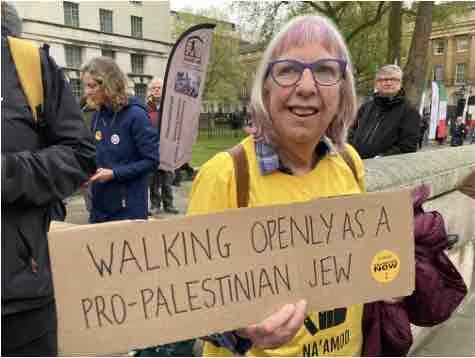
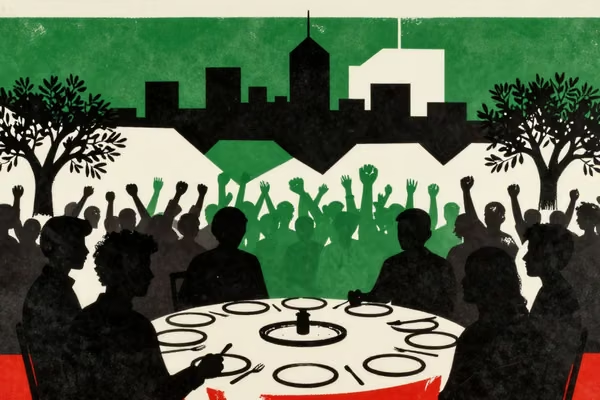
Across the country, the pro-Palestinian demonstrations are full of Jewish students. On the first night of Passover, Jewish pro-Palestinian demonstrators held a Seder at the tents on Columbia’s South Lawn. Young people who grew up learning of Israel as a democratic and peace-loving haven for Jews now see hypocrisy in that image, held against the treatment of Palestinians in Gaza and the occupied West Bank. The horrifying death of more than an estimated 34,000 people in Gaza during Israel’s assault has turned that transformation of perspective into a profound drive to protest.
Working together in ’68, as we built our almost six-day-long society in our “communes” — named after the Paris Commune of 1871 — the ’68 protesters lived out a vision of what a fully cooperative, non-alienated community might be. We slept on hard floors and ate food contributed by the neighborhood, held endless meetings, and grew to love one another. The demonstrators on today’s campuses are doing the same. They are learning to live together, the competitive academic culture falling away in the heat of collective struggle for higher ends. They are held together by their common cause, their bravery and their sacrifice.
Both then and now, the university administration has leaned on procedural regulations, such as limiting where demonstrations are allowed to take place, to repress student groups and discipline leaders it wants to silence for political reasons. Students for Justice in Palestine and Jewish Voice for Peace were embargoed last October, as if Shafik and her advisors were reading from the disgraced playbook of Grayson Kirk, the former Columbia president who called in the NYPD on me and my peers. The administration has since kept applying discipline, without recognizing the legitimacy of the issues raised by the students, and without negotiating or treating them as reasonable adversaries.
Growing divisions — and solidarity
It should have been no surprise that the unlistened-to students of our current era reacted like those in ’68, by slowly escalating their protests. But it’s a surprise that, in nearly six decades, the administration hasn’t learned that calling in the cops doesn’t quell protests; it helps them take on a brilliant life of their own.
Now, as it was in our day, the campus is divided. Critics of our movement used buzzwords, like “communists,” “anarchists” and “hippies,” to reduce us protesters to enemies to be feared and dismissed. They tried to obscure the demands we made on a blameworthy institution.
Today, charges of “antisemitism” and students “feeling unsafe” are used in an attempt to cloud real issues and grievances.
At first the university was split, for and against us. Only the brutality of the NYPD as it cleared the campus exposed the sclerotic authority of the administration that called them in. Then, as now, that action prompted a wave of new solidarity. In ’68, Columbia students rallied together around our cause; today, encampments inspired by Columbia have sprung up around the country.
Name-calling as a repressive tactic
The criticism of today’s protest movement is more complicated than that in 1968. Allegations of antisemitism, in particular, carry even more baggage than the specter of communism, in part because of the visceral emotional reaction they can spark in Jews: Even a vibration of antisemitism, real or imputed, can lead to immediate fear. And it’s true that in several videos making the rounds online, random partisans in the streets outside Columbia can be seen using anti-Jewish insults. Yet there have been vanishingly few real examples of on-campus antisemitism at Columbia that originated from demonstrators.
That doesn’t make the fears some Jewish students feel less real. But it does call into question their validity. This situation demands the question: Why should we guarantee an academic culture with no challenges to long-held beliefs, for instance, that the State of Israel and being Jewish are synonymous?
This tension brings into question the narrative that various officials have spun around those fears. The demonstrations, the public is told, have been beset by antisemitic threats and rhetoric. From the first days of the protests, media stories across the country led with that assumption. Wealthy university funders have withdrawn contributions. Speaker of the House Mike Johnson and his cohort descended on the campus to command the cameras while masses of students, who refute his claims, are pictured as a faceless mob. (Other politicians, like Rep. Alexandria Ocasio-Cortez, have visited not to grandstand, but to get to actually know the protesters now shaping our national discourse.)
Both now and in ’68, attacks of name-calling seek to stop the public from taking the protests seriously. The cries of antisemitism have been militarized by those speaking about them on national television. It is the old red-baiting pattern that uses a fear-producing buzz-word as a smokescreen to obscure real issues and justified protests.
Now, here we are. Rejecting officials’ condemnation, the student protests have spread like a storm across the United States and around the world. Just like in 1968, Columbia University has become the seed of a vast outpouring of student feeling that gives voice to an even more vast sentiment among the youth that a terrible injustice must be redressed. In our day, our protests hastened the end of the Vietnam War and continued to raise the issue of racism. We will see if these students also help to change the world that they have inherited.
_________
Tom Hurwitz is an award-winning documentary filmmaker with a career spanning over 50 years. He lives in Manhattan.
The views and opinions expressed in this article are the author’s own and do not necessarily reflect those of the Forward.
EXPLAINER
Are US campus protests against Israel’s war on Gaza going global?
From France to Australia, university students are part of pro-Palestine protests as Columbia students continue encampments.
Al Jazeera, 26th April 2024
Clashes between students and police officers have been reported all over the United States during intensifying university protests.
What started as the Gaza solidarity encampment at Columbia University, where students are camping inside campus to push their institute to divest from companies linked to Israel, has since spread to campuses in California, Texas and other states.
Now, more than 20 universities in the US are protesting against Israel’s war on Gaza, where Israel’s military offensive has killed more than 34,000 people and its blockade has caused starvation.
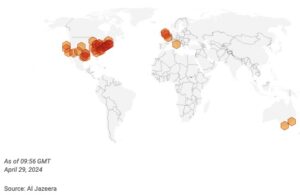
But the protests are not limited to the US, as students worldwide have been demonstrating in support of Gaza since the outbreak of the war on October 7. Following the Columbia encampments, the protests have further spread to universities from France to Australia. Here is all you need to know about student protests for Gaza outside of the US:
Which global universities are holding pro-Palestine protests?
- In Paris, France, Sorbonne University students have taken to the streets. Additionally, the Palestine Committee from Sciences Po, is organising a protest where students set up about 10 tents on Wednesday. Despite a police crackdown, the protesters regathered on Thursday.
- In Australia, students from the University of Sydney set up pro-Palestine encampments on Tuesday, and they were continuing to protest on Friday. Also, University of Melbourne students pitched tents on the south lawn of their main campus on Thursday.
- In Italy, Rome, students from Sapienza University organised demonstrations, sit-ins and hunger strikes on April 17 and April 18.
- Since April 19 night, students from the University of Warwick’s group Warwick Stands With Palestine have occupied the campus piazza located in England, United Kingdom. In Leicester, England, a protest broke out on Monday in which students from the University of Leicester Palestine Society also participated.
- Last month, students from the University of Leeds occupied a campus building in protest against the university’s involvement with Israel.
What are the demands of student protesters outside the US?
Hicham, a student protesting at Sciences Po, which is also called the Paris Institute of Political Studies, told Al Jazeera, “We have a few demands but one of them is to start investigating all of the ties they [Sciences Po] have with the state of Israel, which [are] academic and financial”.
He added that it has become “extremely hard” to talk about Palestine in France due to the way police respond.
The organisers additionally want Sciences Po to condemn Israel’s actions.
Sorbonne students are calling on the French government to help Palestinians.
The University of Sydney students are demanding that their institute cut ties with Israeli universities and arms manufacturers, the Sydney Morning Herald reported.
The Warwick students have demanded that the university divest from companies that they have identified are funding “genocide” perpetrated by Israel, Warwick’s student-run newspaper, The Boar, reported. The Boar quoted an unnamed student protester saying that, while the US protests had invigorated them, they were planning to take action regardless.
The protest in Leicester on Monday was outside the Elbit Systems UK drone factory, calling for the factory’s shutdown. The student protesters at Leeds last month demanded the suspension of Jewish chaplain Zecharia Deutsch who served in the Israeli army during the war on Gaza.
Is there a police crackdown on pro-Palestine protesters outside the US?
On Wednesday, police broke up the Sciences Po demonstration after the institute made “numerous attempts” to evacuate the students peacefully, AFP reported.
The institute’s Palestine Committee released a statement on Thursday saying the protesters were “carried out of the school by more than 50 members of the security forces,” adding that “around 100” police officers were “also waiting for them outside”.
Hicham said that he and his fellow students had been occupying their school for three days. “We went to one building, they [the university] called the cops on us, we had to get out, so we went to the main historical building,” he said.
“But I think the more repression happens, the more people are mobilising,” he said. “We were maybe 300 people before, [but] now we’re 600.”
The students at Sorbonne were also surrounded by riot police, as shown in an Al Jazeera video from Thursday.
“This will continue as long as we don’t have an open and serious conversation about the issue,” a student from Sorbonne University told Al Jazeera.
Eraldo Souza dos Santos, a historian who specialises in the global history of social movements at the Pantheon-Sorbonne University in Paris, said police crackdowns had become more common in response to protests in France in recent years. “It is increasingly the government and the police response to civil disobedience, especially under [President Emmanuel] Macron,” he said.
He noted that in 2018, more than 2,500 riot police officers were mobilised to clear a ZAD (“Zone a Defendre” – or, zone to defend) set up by members of an anarchist anti-capitalist and environmental movement which had occupied fields close to the village of Notre-Dame-des-Landes in northern France in an effort to block construction of a new airport. Police fired teargas at the group. “Politicians from the centre to the far right have since said that the ZAD was a ‘zone of lawlessness’ and that it must not be allowed to happen again,” Souza dos Santos said.
“The ZAD has since been mobilised in French political rhetoric to justify early crackdowns on social movements like the one we saw at Sciences Po.”
- Awaiting permission
An interview with Nadia Abu El-Haj
New York Review of Books Newsletter, 27th April 2024
On December 24, 2023, the NYR Online published an essay by Nadia Abu El-Haj about the crackdown on pro-Palestinian speech at Columbia University and Barnard College, where she holds the Ann Whitney Olin professorship in the anthropology department and codirects the Center for Palestine Studies. “Since the start of the latest Israel–Palestine war,” she wrote, “it has become all but de rigueur for universities to censor speech criticizing Zionism and the Israeli state—especially when student groups are involved.” By appealing to “extraordinarily broadly construed” interpretations of words like “safety,” “security,” and “intimidation,” she argued, Columbia and other schools were making “an end-run around the university’s First Amendment principles—its foundational commitments to freedom of expression.”
That essay was occasioned by Columbia’s decision in November to suspend two student groups, Students for Justice in Palestine (SJP) and Jewish Voice for Peace (JVP). Now the tactic that Abu El-Haj analyzed has surged back to the center of public life. On the morning of Wednesday, April 17, a group of Columbia undergraduates set up a constellation of tents on one of the campus’s central lawns and resolved to stay until the university divested from “companies and institutions that profit from Israeli apartheid, genocide, and occupation in Palestine.” The same day the university’s president, Minouche Shafik, told Congress that she had “absolutely no hesitation in enforcing” Columbia’s newly tightened policies regulating events, demonstrations, and speech. The following afternoon she made good on her word by calling in the police, who cleared the encampment and arrested more than a hundred students. In her letter to the NYPD she used the word “safety” four times.
Since then the Columbia encampment has reemerged—and with it more than forty others at schools around the country. Harsh police repression has often greeted these protests as well; at NYU and Emory, faculty members have been arrested along with their students. On Friday I called Abu El-Haj to discuss these latest developments. We spoke about the past ten days at Columbia, the erosion of faculty governance, the rhetoric of safety and security, and the future of the student movement. Our conversation has been edited for length and clarity.

Max Nelson: What has it been like to be on campus this past week?
Nadia Abu El-Haj: It’s been hard. The students set up the encampment overnight on Wednesday of last week. This was the same day that President Shafik testified before Congress about the alleged crisis of antisemitism on campus. I came early in the morning, and the police had already started making threats, first that they would clear the camp at 11 AM, then that they would come in at 1:30 PM. So a few other faculty and I spent the whole day there. The students were very calm. They gave talks, listened to music, had a teach-in or two. But the threat of the police intervention hung over everything.
I went home at one in the morning. The next day, in the early afternoon, we got a heads-up that the police were coming in. I walked back over to the encampment. At that point it wasn’t just the students inside; there must have been a thousand students surrounding them. I was right up against the hedge that encloses the lawn, and there were six layers of students behind me. It was disturbing and scary. This was the riot police: they came in with their helmets and billy clubs.
The first thing the police did was surround the encampment facing outwards. I wasn’t worried that the students inside the encampment would, so to speak, do anything to get themselves beaten up. They were very well prepared. They sat there. They knew what they were going to do. But the students around the encampment had not prepared for this, and they were really upset. Not all of them were there because of pro-Palestine politics. Many were there because calling the police onto campus was just so over-the-top. I kept thinking that if one of those students outside the encampment decided to try to push through the line of police, all hell would break loose. Thankfully, that didn’t happen. The only reason we didn’t descend into violence that day was that the students remained calm. They were the only adults in the room, all of them.
This was political theater directed at Congress. The Columbia administration had promised a crackdown, and the day after testifying, President Shafik calls in the police—for the first time since 1968. But on what planet did they think bringing in riot police was going to calm the campus down? I can’t vouch for this, but I was told by someone who’s connected with the upper echelons of the administration that they were shocked that the faculty was so upset by the decision to call in the police. But that decision was the last straw: it galvanized faculty who otherwise not only had no involvement in pro-Palestine politics but in some cases actively disagreed with the students. Under the banner of the American Association of University Professors at both Barnard and Columbia, faculty have organized a demonstration and criticized both presidents.
Far from solving the problem, once the riot police arrested the students and Columbia staff cleared the initial encampment, students moved to an adjacent lawn and set up an encampment much bigger than the first one. It’s unbelievably well organized. There’s a food area; people are going around picking up trash; they have a code of conduct that you have to consent to before you come in, including prohibitions on harassment, littering, drugs, and alcohol. It’s extremely calm and somewhat festive. The tension on campus comes from the constant threat of whether they’re going to call the police in again—although as of now I don’t think that will happen—and from the militarization and demonstrations outside its gates.
House Speaker Mike Johnson’s visit brought even more attention to Columbia. His depiction of the campus as a dangerous, antisemitic place has been broadcast around the country. The campus was overrun by every possible news outlet that day, from the more mainstream ones to Fox News to dubious folks with press cards. The founder of the Proud Boys was there, hovering around the encampment. And Thursday night there was a rally outside the campus gates that had been organized by white Christian nationalists. They were very aggressive, trying to scale the gates, yelling “go back to Gaza,” calling students inside “monkeys.”
In sum, it has been tense, but not because of students. A few days ago, five students came into the encampment with a huge Israeli flag and posters with pictures of the hostages. They were asked to agree to the code of conduct, they agreed, and they came in. They stayed for two hours. Nobody bothered them, and they didn’t bother anybody. It’s really not unsafe.
Students are very upset about both the police and the terms of the suspensions. Barnard’s president, Laura Rosenbury, not only suspended students; she evicted them from their dorms. When they were released from jail late at night last Thursday, they turned on their phones to discover that they had been evicted. We had to find them places to sleep—at 11 PM and 12 AM, at one in the morning. They were literally put out on the streets. To be fair, Columbia has been less harsh: suspended students can be in their dorms and go to the dining hall, just not anywhere else on campus.
How did that extreme response break from the usual administrative requirements for suspension?
First of all, in order to charge students with trespassing on their own campus, you need to suspend them. They needed to have been suspended before the police came in. That procedure was mostly not followed. Barnard started suspending people beforehand, but most students got their interim suspensions after they were arrested and charged. It’s not clear, then, whether it was even legal. From what I’ve been told, one reason that the administrations were not able to suspend the students until after the arrests was that—with the exception of some prominent organizers the Barnard deans knew—they didn’t have the names of most participants. I am not sure how they compiled the names in the end, whether it was from the police or some other source.
More broadly, the administration is not following rules that for decades governed student conduct on either side of the street. On the Barnard side, as the Columbia Daily Spectator reported, the college unilaterally changed its Student Code of Conduct webpage—it is unclear precisely when—so that students are no longer allowed to have a lawyer at conduct hearings. On the Columbia side, they recently moved disciplinary hearings out of the normal channel, which would go through the University Judicial Board, and handed them over to the Center for Student Success and Intervention. In doing so they deprived students of the right to have a lawyer, and they’ve hired lawyers from Debevoise & Plimpton to handle the cases. The problem all year has been that the administrations are making up rules as they go along, often without even announcing the changes. We, as faculty members, find out that the rules have changed when the students get hauled into a procedure that didn’t exist before.
Columbia has a Senate, and after 1968 they set up a system of procedures, one of which is that the administration must consult with the Senate before calling police onto campus. Senate approval is not absolutely binding, but it’s the norm, the only exception being “clear and present danger.” That is, I suspect, why President Shafik used that language to describe the encampment in her letters to the Columbia community and the NYPD. She had approached the Senate to get approval, and its Executive Committee unanimously said no. Shafik called in the cops anyway. And then, after the arrests, the NYPD’s chief of patrol suggested that he wasn’t sure why the police were called in, that the students “were saying what they wanted to say in a peaceful manner.”
In your article from this past December you made the prescient argument that the administration was relying on slippery uses of the concept of “safety” to justify suppressing pro-Palestine speech. How have you seen that rhetoric of safety play out in recent weeks?
It’s how we got here. The rhetoric of safety—and very specifically the safety of “Jewish students”—has been driving the crackdown. Shafik has never met with the students in Jewish Voice for Peace and Students for Justice in Palestine. The administration simply suspended the organizations. They keep punishing them. The Task Force on Antisemitism has been operating without a definition of the word itself, which means, first of all, that any report of antisemitism is taken at face value. My guess is that the vast majority of the alleged incidents of antisemitism are simply pro-Palestinian demonstrations and speech. In reality we have no idea how widespread antisemitism is on campus, since no one has actually tried to parse the incidents that students, based on how they feel, have labeled antisemitic.
Let me be clear: I’ve heard of some incidents on campus of antisemitic name-calling. I also know that someone drew a swastika in the School of International and Public Affairs building. I don’t doubt that there are instances of antisemitism. I’ve also heard many reports of Muslim students having their hijabs pulled off, or of students wearing keffiyehs being called terrorists, and anti-Zionist Jewish students being cursed at and called kapos by their fellow Jewish students. This stuff is going to go on around the edges. But it’s essential to recognize that harassment is not happening to Jewish students alone, and that it’s not as rampant on campus as press coverage suggests.
To return to the question of what does and doesn’t count as evidence of antisemitism: the Task Force has held “listening sessions” with students, inviting them to discuss their experiences of antisemitism on campus. In several instances Jewish students have gone in, argued that they are not experiencing antisemitism, and asked the committee to distinguish between antisemitism and anti-Zionism, only for members of the Task Force to shut them down. The response has been, in effect: We are not interested in your politics. We’re interested in your experience. These students were saying, “but this is my experience; I’m telling you, I don’t think this is antisemitism,” and their feelings, their experiences, have been dismissed.
David Schizer, who cochairs the Task Force, suggested during the congressional hearings that there was a problem of “consistency.” Whereas conservative students are urged not to “articulate a particular position because it makes others feel uncomfortable,” when discomfort is expressed by Jewish students, “that kind of language has not been applied.” But if it’s only a matter of consistency, why has there been no significant response to the harassment and, at times, actual danger that Muslim and Palestinian students have reported? I have a student who was threatened in her apartment by someone who found her address, and we could barely get a response from the same administration that claims to care about everyone’s safety.
Schizer and others suggest that in every other instance of potentially hateful speech, what students feel has been the determining factor. The inconsistency is that this has not been the case for Jewish students. I think that misrepresents the situation in two ways. First, until now, nobody was simply taken at their word. Certainly, there have been conversations in the past about rhetoric and how it makes certain students feel. But ordinarily, if a student feels unsafe or discriminated against or harassed, they go to the Equal Opportunity and Affirmative Action office, which then investigates the report. There has to be evidence. You don’t take anybody’s report at face value, whether it’s sexual harassment under Title IX or racial discrimination and harassment under Title VI. I spent two years on a committee at Barnard trying to figure out how we were going to think about free speech and academic freedom in relation to this challenge, and we were unanimous that how students feel is not the criterion. It can be investigated, but it is not evidence of harassment or discrimination prima facie.
Second, the institution’s current response to charges of antisemitism around pro-Palestine protest is far more serious than any of its responses to other charges of systematic racism have been over the years. When have they ever put so many resources into investigating alleged racism? There has never been a task force on anti-Black racism at Columbia, for example. That doesn’t mean there isn’t antisemitism. It means that Black students have never been able to galvanize an institutional response anywhere near this scale, nor have Palestinian or Arab or Muslim students, or any other racial or religious minority. Contrary to what Schizer suggests, then, the university’s response to charges of antisemitism is far more robust, at an institutional level, than anything we have ever seen before, at least during my twenty-plus years as a professor here.
Since Shafik sent in the police, we’ve seen students around the country set up encampments on their campuses, calling on their institutions to divest from companies implicated in Israel’s war on Gaza. It’s become a much broader movement. What do you make of that development?
If the students in the encampment at Columbia walked away today, they would still have won. It’s an extraordinary victory. They have shaken up Columbia and Barnard at an administrative level in a very serious way. They have stoked faculty opposition to the administration’s behavior. Most importantly, they’ve launched a national and, increasingly, an international movement. What I find shocking is the number of police crackdowns around the country to break up their own student encampments—because it worked so well at Columbia? You have to wonder, do these administrations learn nothing? Do they really think this is going to make students back down, rather than mobilize further?
I think something is going to come out of all this. Even if you don’t agree with the students’ politics, you need to recognize that this is a serious political movement and that they’re doing an awfully good job. It’s a generation that understands the genocide in Gaza as the great moral crisis of our time, and bringing the riot police onto Columbia’s campus was the final spark.





CORRECTION
Across the MSM it’s being reported that that police are ‘clashing’ with students. This is nonsense. Police are attacking students.
Essential reports — jaw dropping , detailed repression. How can we JVL members express our fullest support and solidarity?
The quote’s from “Tortoise”:-
“Generational shifts. The campus protests have revealed shifts in US opinion on Israel that have been developing for years. A 2023 Gallup poll found net sympathy towards Israel at +46 points among those born between 1946 and 1964; that drops to -2 among those born after 1980. In a 2021 survey of Jewish voters, respondents under 40 were twice as likely to agree that Israel is committing genocide against the Palestinians as those over 64”.
So it’ll be an Armageddon type struggle between the university “old guard” (administrators and donors, with huge vested interests to protect) and the students (without whom the universities cannot fulfil their function nor fund themselves).
“Tortoise” suggests the university “powers that be” won’t win the battle.
My personal view is that the current generation of students will change the paradigm (at huge cost to themselves) but the fruits of their work will mostly be enjoyed by a later generation of students and academics. The furore on campus will presumably drive even more profoundly negative feelings towards Israel.