
Pro-Palestinian occupation at Sciences Po in Paris
JVL Introduction
Hysteria broke out among France’s political elite when students at the prestigious research university Sciences Po in Paris launched a partial occupation.
Nicolas Niarchos describes the situation in an article below reposted from the Nation.
The European Union of Jewish Students (EUJS) has been prominent in trying to smear the protesters – and indeed pro-Palestinian students for a long time now.
David Cronin expands on the role of the EUJS, often working closely with the European Union’s coordinator against antisemitism, Katharina von Schnurbein who has been pressing hard for the UN to adopt the IHRA working definition of antisemitism.
RK
The Occupation and Reoccupation of Sciences Po
Paris has felt surprisingly apolitical these last few months. But something changed: Students occupied one of France’s most elite universities.
Nicolas Niarchos, the Nation, 29th April 2024
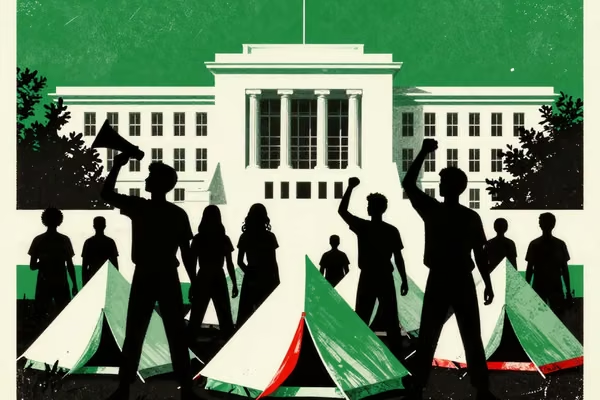
Paris—Last Thursday night, at one end of the Rue St.-Guillaume, a trio of students, their faces wrapped in keffiyehs, plastic tubs of takeout in their hands, nervously stood sentry. One of them, who declined to give her name, told me that Sciences Po, an elite university known for its political science and economics faculties, was being occupied by its students. There were two groups of students watching for the police, or counterprotesters, at each end of the street. “They sent the police in to break the occupation last night,” she said. It had been the first use of police force to break a student protest in Sciences Po history. “But now we have reoccupied.”
Students around the world are taking over campuses to protest the Israeli assault on Gaza, which has killed at least 30,000 Palestinians, following the killings of more than 1,200 Israelis on October 7. Paris, which has seen protests like anywhere else in the world, with activists rallying in solidarity with Israel and Palestine, has at times felt surprisingly apolitical these last few months. I live close to the Rue St.-Guillaume, and have seen the walls around Sciences Po blossom with flyers demanding the return of Israeli hostages and Free Palestine graffiti—but also with anti-Iranian banners and posters demanding the decolonization of Africa. I have documented several protests there since October 7. They have usually been brief and have numbered not more than a few dozen students. But last week, something seemed to change.
There had been stirrings in March, when a student action group called the Palestine Committee seized a lecture hall and “rebaptized” it “Gaza.” What happened next was the subject of some debate, and it briefly seemed to dampen protests at the school: A member of a Jewish student group alleged that she was not allowed to enter a debate because of her pro-Israel stance.
The highest level of French politics professed itself shocked. Gabriel Attal, the prime minister, and Sylvie Retailleau, the education minister, called a meeting with Sciences Po’s board. “I will never let a French university become the mouthpiece for a North American ideology which, under the guise of modernity, promotes intolerance, rejects debate, and curbs freedom of expression,” Attal, who is a Sciences Po alum, told France’s parliament. Sciences Po has particularly close connections with the French political class—President Emmanuel Macron holds a masters from the school.

It turned out that Attal had rushed to conclusions: The student was the only member of a Jewish student group who was not allowed in, and she was reportedly not allowed because she was harassing other students. Sciences Po professors wrote an open letter to the government condemning meddling with academic freedoms and decrying intolerance on all sides.
Wednesday’s action was an “escalation,” as Louise, a 22-year-old student coordinator for Sciences Po’s Palestine Committee, put it. The student groups were demanding that the university condemn Israel and sever ties with Israeli universities, with which it offered joint degree programs. “May I remind your readers that there are no universities left in Gaza? They have all been razed to the ground,” Louise told me. “This is unacceptable. And this is why we’re here today.” (Students I spoke to refused to give their last names because they worried they would be “targeted by the far right.”)
“We were definitely inspired by what is happening at Columbia, at Yale, and at Harvard,” she said, referencing the Gaza solidarity encampments at US universities. Around 50 percent of students at Sciences Po are from outside of France. “The students here are more sensibilized, because there are a lot of internationals here,” said Laurent, a mustachioed 65-year-old retired teacher who had joined the protest. “This is a breath of fresh air.”
Eduardo, a 23-year old masters’ student from Argentina, told me that he thought Sciences Po stifles protest more than universities in Latin American countries. “Criticism has been suppressed,” he said.
The Wednesday occupation was brief. It began in the mid-afternoon with a sit-in of around 60 students. (The Palestine Committee numbers around 100 students, the group says.) The university, led by an interim administration under Jean Bassères, decided to crack down. (The university’s president was dismissed in March after he was referred to a criminal court for domestic battery.) At around 12:50 am on Thursday, members of the Compagnies Républicaines de Sécurité (CRS), a riot-busting wing of the French police, pulled them out of the campus as they, by all accounts, were kicking and screaming “Free Palestine.”
The crackdown galvanized the protesters. By Thursday evening, the students were back on campus, hanging out of the windows, chanting “We are all the children of Gaza” until the early hours. They slept in the classrooms. Just before seven, the noise of voices—“We are here to stay, we won’t move”—rose with the dawn along the street. It was trash day, and during the night students had piled plastic trash bins—including one from my building—along with electric bikes, bits of wood, and metal barriers in front of the university doors. The barricades were up. A small group of students sat in the road, occasionally sending up supplies to their comrades in shopping bags pulled up by a daisy-chain of knotted-together keffiyehs.

By midday, the crowd had swollen. Someone had taped a series of demands to the front of the university, a “95 Theses” for the Gaza age, if you will: “We demand that Sciences Po mobilize in defense of the rights of Palestinians, take a position, and break its partnerships with complicit Israeli universities, as it did with Russian universities at the moment of the invasion of Ukraine.” The police had arrived, positioning patrol cars at each end of the Rue St.-Guillaume. “All I can tell you is that there’s a protest by the students of Sciences Po,” one of the officers told me. “Go and ask them what happens next.”
The windows at the front of the university opened, and a student in a face-mask addressed the crowd in British-accented English. The Palestine Committee was negotiating with the administration, he said. He had little faith that the negotiations would succeed. “It’s very hard,” he said. “We have to sleep on wooden floors.” He asked for deodorant and toothpaste—the students already had lots of food.
By the mid-afternoon, the barricades had been dismantled, but the school remained closed. Perhaps a thousand people had massed. The CRS had gathered at the end of the street. The security guards shrugged when I asked them when they thought the protest would end. I asked Eduardo, who had come to the protest sporting a new keffiyeh (“I bought it for ten euros”), what would happen to the Israeli students who were currently studying at Sciences Po if all ties were broken. “They should stay here and continue studying,” he said. “It’s not their fault.”
The French right has seized on the movement at Sciences Po as “virulent wokeism,” “hysteria,” and, most importantly, a loincloth for antisemitism. On Saturday, Attal called it a “shocking spectacle” caused by “a virulent minority.” On the front page of Saturday’s edition of the center-right newspaper Le Figaro, Yves Thréard criticized the French left, and especially Jean-Luc Mélenchon, who called the students “the honor of the country.” “For this ‘engineer of chaos,’ this Islamo-leftist mold is a godsend as he looks for new constituencies,” Thréard wrote. “Sciences Po is a drunken boat, for years it has been at the mercy of all the winds of identitarian contestation, decolonialism, intersectionality, anti-capitalism.”
According to the centrist paper Le Monde, the university has taken steps to stop antisemitism: Late last year, a student who had been posting antisemitic messages online was referred to the authorities by the university, and four others were disciplined for comments made on Whatsapp. I asked Eduardo whether he had seen antisemitism on campus. “This narrative is absolutely not true,” he said. “You have many Jewish students here.” In the crowd, a few students walked around holding posters that read “I am Jewish, and I want a ceasefire,” high-fiving other students in keffiyehs.
Toward the end of the afternoon, a group of masked counterprotesters gathered under an Israeli flag at the intersection with the Boulevard Saint-Germain. The CRS, who now seemed to outnumber the protesters, pushed the two groups apart, leading the pro-Israel group down the boulevard, where they briefly blocked traffic. “Our objective is to get them out of the boulevard and onto the sidewalk,” a CRS commandant said. A group of tourists with US accents sitting at the historic Café de Flore stood to salute them.
Just past Les Deux Magots, another “literary” café where tourists queue for $10 cappuccinos, a man waving a Palestinian flag began shouting at them and the CRS pushed him away. “Terrorist!” the pro-Israelis shouted. One of the protesters, who also only wanted to be identified by his first name, Eric, reserved some choice words for journalists before telling me, “I’m here for kids who are stuck in tunnels deep in the Middle East.” The police then insisted that Eric and his group of protesters descend into the metro. “And don’t come back,” the commandant said.
Back at Sciences Po, the police were slowly pushing groups of protesters down the streets. A dark-haired woman threw pink peony petals on the protesters from a balcony. The students continued to make speeches. “Their tactic is to wear us down,” the British-accented organizer said from the window. “We’re staying here, we won’t move.”
A bit after dinner, the noise quieted down. A light rain had begun to fall. The university and the Palestine Committee had agreed to dialogue this week. Groups of students chanted “Free Palestine” as they were led by the CRS out of the building and past my window. “Do you think they’ll be back tomorrow?” a CRS officer wondered, taking off his helmet. His colleague shrugged.
It is almost May in Paris, the time of the year when memories of 1968 hang in the air. “Who knows, this could be the start of something, but then again, I always get these things wrong,” Laurent, the teacher, had told me.
By midnight, the only noise on the Rue St.-Guillaume was a party of 40-somethings at Le Basile, the bar on the corner, belting out tunes by Céline Dion.
Smears must not deter students from acting against genocide
David Cronin, Lobby Watch, the Electornic Intifada, 30th April 2024
Heaven forbid that students would skip class to try and stop a genocide.
Such a message is being sent by the French political elite – horrified that protests in solidarity with Palestinians have been held at SciencesPo, a well-known Paris university.
No doubt fearing that such protests will spread, Israel’s supporters are alleging they have an ulterior motive.
As the European Union of Jewish Students (EUJS) is prominent in efforts to smear protesters, an examination of the group’s policies and philosophy – if that’s the right word – is necessary.
Far from being dedicated to preventing bigotry, the EUJS explicitly defines itself as Zionist. It is, therefore, wedded to the ideology undergirding the dispossession of Palestinians in the 1940s and the genocide being perpetrated against them at this very moment.
The EUJS betrayed its real agenda in a summary of a recent discussion it held with other pro-Israel lobby groups. That summary showed that one of its biggest concerns is anti-Zionism in universities.
1/2🧵The EUJS President @emma_hallali & Board met today with leaders of @uejf, @le_crif, @consistoiredefrance, @ajc_paris & AJC Europe. The rich exchange covered topics from the prospect of European elections, the breakthrough of extremism, and antizionism on University campuses pic.twitter.com/jbqyc5AITb
— EUJS – European Union of Jewish Students (@EUJS) March 1, 2024
Because Zionism is premised on giving Palestinians an inferior status to Israeli Jews, opposing Zionism is a duty for everyone who genuinely cares about justice and equality.
Anti-Zionism is completely distinct from anti-Semitism – hatred of Jews based on their religion or ethnicity.
Being clear about the differences between anti-Zionism and anti-Semitism is essential, not least because groups such as the EUJS portray them as synonymous.
🇺🇳 EUJS President @Emma_Hallali addressing the @UN_HRC in Geneva 🇺🇳
She exposed the dramatic situation of Jewish experience on campuses, reaffirming that anti-Zionism is antisemitism.
🗣️ « It is time to put an end to the masquerade the Durban declaration is. »#HRC55 pic.twitter.com/FTFTZWqrUt
— EUJS – European Union of Jewish Students (@EUJS) March 28, 2024
Emma Hallali, the EUJS president, has lately been claiming that Palestine solidarity protests in universities make it impossible for Jews to lead “a normal student life.”
L'éducation est un droit fondamental. Refuser ce droit aux juifs nous rappelle le plus sombre chapitre de l'histoire #européenne. La différence aujourd'hui en 🇪🇺 est que les autorités défendent les droits des minorités. Dans l'attente d'une action claire des autorités @sciencespo https://t.co/bqDl9QDvhu
— 🎗️(((k schnurbein))) (@kschnurbein) March 13, 2024
The inference that the hidden objective of the protests is to turn campuses into a hostile environment for Jews must be exposed as dishonest.
Sinister game
Whereas the protests are aimed at halting the genocide in Gaza, the EUJS is playing a sinister game by insisting that all self-respecting Jews have to side with Israel, the state carrying out that genocide.
In January, the EUJS issued a statement criticizing anti-Zionist organizations such as Jewish Voice for Peace.
(1/2) EUJS' stand against Anti-Zionist Jewish groups and their damage to our Jewish community⚠️
"Anti-Zionism actively advocates for the dismantling of the State of Israel and denies the right of the Jewish people to self-determination"
Full statement: https://t.co/bvQNe9D6YX pic.twitter.com/YanDDgPrFe
— EUJS – European Union of Jewish Students (@EUJS) January 22, 2024
The statement contended that the actions of such groups “risk perpetuating harmful stereotypes and misconceptions about the Jewish community, leading to increased prejudice and discrimination.”
The opposite is actually the case.
Anti-Zionist Jewish groups demonstrate that the Jewish community is not monolithic. A significant number of Jews are outraged by Israel’s crimes and determined to speak out against them.
If anyone is perpetuating harmful stereotypes, it is the EUJS and its suggestion that the only Jews who should be listened to are those backing Israel.
Shamefully, the European Union treats the EUJS as being representative of all Jewish students.
The EUJS received almost $900,000 in funding from the European Union during 2022.
The EUJS enjoys particularly close relations with
Listening to first hand experiences of #antisemitism on campuses & threats/attacks on Jewish students in the aftermath of 7/10 is extremely concerning.
When Jews do not feel safe, their right to education is hampered. Unacceptable!
Univ leadership must act decisively!@EUJS pic.twitter.com/pG8lLp04eg
— Katharina von Schnurbein (@EUAntisemitism) March 19, 2024
Although von Schnurbein’s formal job description does not mention Israel even once, she acts as a propagandist for Israel.
She has been amplifying the lie that Hamas committed mass rapes on and following 7 October. That hoax is being used as a pretext for the genocide which Israel is perpetrating in Gaza.
Von Schnurbein has spoken lately about there being a “tsunami of anti-Semitism” in Europe.
As you gather around the Seder table may you draw strength from the story of liberation of the Israelites from slavery & hope that those still in captivity will soon fill the #emptychairs at your table.#ChagPesachSameach!
#LetThemGoNow pic.twitter.com/paZGo6LEw0
— Katharina von Schnurbein (@EUAntisemitism) April 22, 2024
Her choice of words should be questioned. Von Schnurbein has frequently conflated antipathy toward Zionism with anti-Jewish hatred.
Von Schnurbein complained recently that a conference on the forthcoming European Parliament elections was “hijacked in a way that Jews no longer feel safe.”
Shocking & unacceptable that debate @Europarl_EN about #EUelections is hijacked in a way that Jews no longer feel safe. At a time when we need to build bridges, this creates polarization & breaks alliances @Youth_Forum
Full solidarity with @Emma_Hallali and @EUJS delegation. 🙌 https://t.co/WOXqnhm0cs
— 🎗️(((k schnurbein))) (@kschnurbein) April 14, 2024
Her complaint was based on how the slogan “free Palestine” was chanted and the EUJS delegation was described as “fascists” by some participants in the conference. The video of the incident posted by the EUJS does not indicate that there was any threat whatsoever to the safety of its delegation at the conference.
EUJS Statement on the Outrageous Level Up! Closing Plenary Events
In a space where everyone should have felt safe, Jewish students, once again, felt threatened. pic.twitter.com/kQPE466UAS
— EUJS – European Union of Jewish Students (@EUJS) April 13, 2024
Instead, the video shows that the EUJS sought to shut down a discussion about the situation in Gaza, even though it is a matter of urgency.
If the EUJS had its way, students would either remain silent as Palestinians get slaughtered or applaud Israel, the state carrying out the slaughter.
Fortunately, young and not-so-young people on both sides of the Atlantic are refusing to be bullied or intimidated by Israel’s supporters. The defiance displayed on campuses is a source of hope in these bleak times.
David Cronin is an associate editor of The Electronic Intifada. His books include Balfour’s Shadow: A Century of British Support for Zionism and Israel and Europe’s Alliance with Israel: Aiding the Occupation.

“Jewish students no longer feel safe”, “Jews feel threatened in London”, so go the headlines, and although we may regard them as neuroses and not reality-based, as Paul Jay said recently (https://tinyurl.com/37pevkhx ) ‘History didn’t begin on October 7th, obviously, but also history didn’t begin in 1948, ‘cos there’s another side to this, which is several thousand years of the hatred of Jewish people, it weighs on the brains of many living Jews like a nightmare … and you can’t discount it [even tho it’s no excuse for Israeli war crimes].
So I’m thinking, if how we ‘re putting the case against genocide is experienced as existentially threatening by a significant number of Jews, perhaps we’re doing it wrong. Studies show that strongly emotionally held beliefs are psychologically resistant to rational arguments, tending to be held even more strongly when challenged by established facts.
I regard what’s happening in university campuses in the USA, together with the hostile reactions against them, as a clash of cosmic heroisms. Life is short, death awaits, and what we learned in infancy was reinforced variously in adulthood, namely that in a universe pitilessly indifferent to us, we’re puny, and so we strive to make our lives significant for a world of meaning. We rarely say to ourselves that’s what we’re doing in our projects, but beneath consciousness, it is.
Zionism and anti-Zionism are both, in psychodynamic existential terms, symbolic immortality projects. It’s all too easy to trap ourselves in cooperating with our opponents in an escalation of violence.
Heroism can be wonderfully creative, as history shows, but it can also be utterly destructive, as the 20th century showed, when heroism became identified with the totalitarian charismatic.
The students are heroes and so are those who march each week against violent oppression. But it could backfire if inadvertenly it feeds the violence of clashing heroisms and the just cause is lost.
JVL is a Nazi organisation that hates Judiasm and the Jewish religon , there members want Jews who are religious to be killed and buthchered by their Hamas allies. Theyie the JVL is a Marxist organisation of aethist pigs and Jew haters who love to give aid to all Jew haters , You hate synagoges, the Talmud and the Torah
V interesting analysis by Brian. But how do we find other means, if we give up heroic struggle narratives? Lobbying and triangulating have both been disastrous surely. And focus-group thinking even worse …
Is it really not possible to take or support nonviolent direct action without losing all nuance and empathy? Can we deny that many advances in human emancipation have even had a violent component? NB Gandhi said it is better to resist oppression violently than not to resist at all. He just thought nonviolent resistance was better because it can mobilise more people and involves each person taking full responsibility for their action…
I really welcome this discussion and want to know seriously how, Brian, you think that Palestinian liberation can proceed if our solidarity activism is making potentially fatal mistakes. If you know ways of getting through to the other side of this horror, please let us know!
I have never felt comfortable by the use of the word “heroism”. In situations where people see injustice, they act not just emotionally, but moved by being informed of the situation and the desire to be true to the principles they hold, especially in matters that deal with historical crisis. There is also a deep conviction of acting as conscientious human beings that cannot remain indifferent to their fellow human beings’ suffering. In situations that demand immediate action like saving someone who is in danger, there is a more natural reaction to act and save that person, which is deep in our subconscious, but when one sees injustice consciously committed by powerful forces, the reaction to act is much more complex.
“EUJS Statement on the Outrageous Level Up! Closing Plenary Events
In a space where everyone should have felt safe, Jewish students, once again, felt threatened.”
So: “Jewish students, once again, felt threatened.” So threatened in France, that to even discuss the continuing plight of Palestinians of all ages being somewhat more than ‘feeling threatened’ ie being actually killed by the thousands, actually being made homeless, surviving children actually being made orphans, with no end other than the complete destruction of their homeland in sight and the prospect of survivors being expelled from Palestine to enable the destruction of Rafah. And if they don’t leave, death awaits. It puts the ‘feeling threatened’ fears of those attending into perspective.
When Brian Robinson talks about “several thousand years of the hatred of Jewish people” he makes it seem like its some kind of original sin, and as if Palestinians are somehow responsible for Jewish suffering.
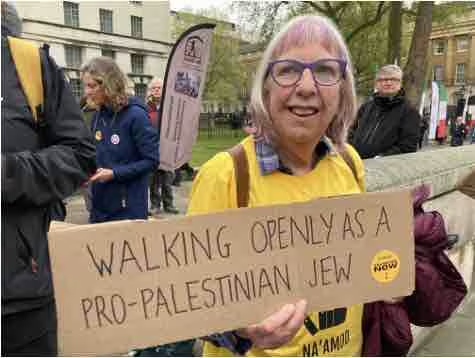
I find the above analysis confusing and muddle headed. My only agreement is with the point that some Jews feel threatened by recent developments and that there is centuries old background to that fear. However the humanitarian based protest against Israel’s genocide is not ‘doing it wrong’. There is an implied notion of equality here between the defence of militant Zionism and the defence of the Palestinian people. The way forward does not lie in changing our tactics, rather it requires us to double up our peaceful campaigning; reinforcing the point that we are not antisemitic; that many of us are Jews and crucially condemning the ‘community influencers’ who specialise in maliciously stoking the fears of Jewish people that there is an existential threat where none exists.