
Remembering Picasso
JVL Introduction
Jacob Ecclestone does well to remind us all of how deep the split now is – between our political elites and their carefully calibrated calculations about how many millimetres they dare step from what they anticipate Joe Biden might say tomorrow, and popular sentiment in the country as a whole.
These demonstrations in the ancient market town of Diss are not organised by parties, unions or churches. Those on them are simply ordinary people who feel moral revulsion at what they see and hear on their mobile and television screens every day.
Today was the 21st Saturday since these vigils began on Christmas Eve 2023.
As Ecclestone says: “We intend to keep protesting. We are for life against death, for peace against war.”
RK
Remembering Picasso
Day by day, Israel’s genocide of the Palestinian people stirs ever greater protests across the world – London, Washington, New York, Columbia University…… and Diss.
On one level that may seem offensive – a joke in bad taste to include a small medieval town in Norfolk in a list of huge demonstrations in cities and famous universities. But the issue is too horrible for flippancy.
What is happening in Diss – and probably thousands of other unreported protests across the globe – is just as important as the big demonstrations because it points to a potentially historic shift in the attitudes of ordinary people. After all, big cities seethe with politics all the time; rural backwaters do not.
Diss lies on the southern edge of Norfolk in a parliamentary constituency which has provided a trouble-free perch for a succession of dull and lazy Tory MPs for the last 75 years. Political activity in Diss is a thing of the past. A century ago the agricultural workers’ union was fighting for better pay and conditions and seeking to overthrow the reactionary triumvirate of landlord, squire and parson, but all of that is long forgotten. Politics in Diss has scarcely lifted an eyebrow for decades ….. until Gaza.
Events and images over the last six months have brought a remarkable change. Every Saturday morning for the last 21 weeks, the half-timbered buildings in the centre of town have been the backdrop for a political demonstration concerning life and death in a foreign land: between 20 and 30 people – mostly middle-class and white-haired – have gathered to call for a ceasefire and to condemn the killing of civilians by the Israel Defence Force, a military machine which describes itself without irony as the “most moral army” in the world
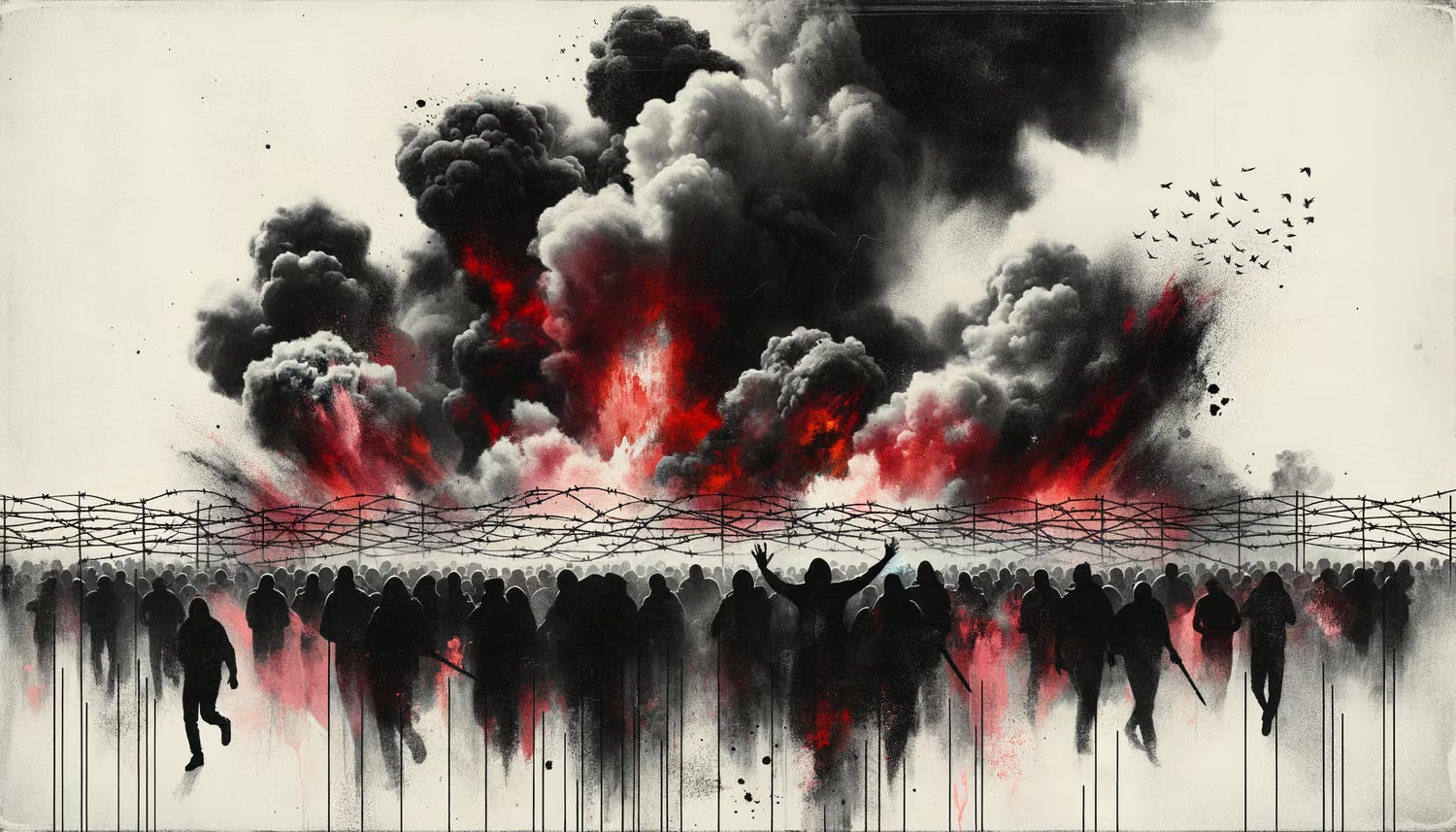
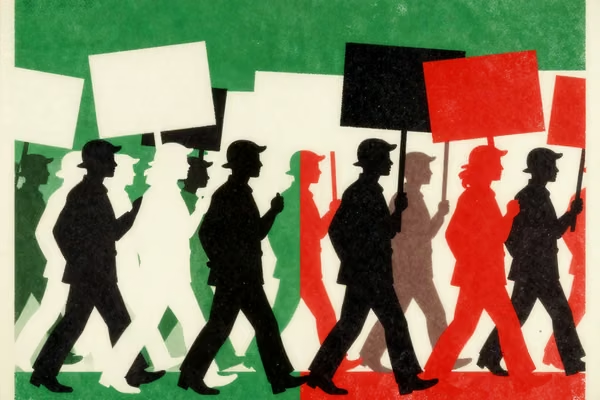
Our protests have been deliberately quiet. There is no chanting of slogans, no speeches, no waving of flags – just a group of ordinary people standing together, holding homemade placards bearing witness to their opposition to genocide, to the destruction of hospitals and schools and refugee centres and, above all, to the slaughter of children. Diss has never seen anything like it.
The local weekly newspaper, the Diss Express, has covered the protests with admirable fairness and accuracy and published many letters from readers. Indeed, its coverage puts Britain’s national newspapers and broadcasting companies to shame. The mainstream media boast interminably of their vital role in underpinning British democracy, and yet – when faced by events in Gaza and the West Bank – they give virtually no voice to those who object to the slaughter, preferring to focus their attention on the rights of people who feel offended by so-called “hate marches”.
The centre of Diss on a Saturday morning can hardly be described as buzzing, but week by week the line of people holding notices calling for a ceasefire, or an end to “genocide” and “apartheid” is having an effect. To begin with, most people walking by would try to avoid eye contact: heads would go down and the step quicken. But as the weeks pass and the pictures of injured and dying children continue to appear almost daily, the atmosphere has subtly changed.
It has changed because, for the first time in human history, the victims are recording their own misery and destruction, and the results are seen on billions of mobile phones across the globe.
One result is that slowly, sometimes awkwardly, people are approaching us to say “thank you” or they put out a hand to shake in support. There are a few who disapprove – like the wife of a local minister who snarled “What about Hamas?” or the woman who said she didn’t care about how many children were killed. But such comments are rare. Most people will look and read and walk on; some will show their support but only a handful seem to get angry.
Given the scale of the lying and murder and destruction which is taking place in Palestine, the weekly vigil in Diss might be thought trivial and pointless. On one level that may be true. Our actions will not intimidate or deter Netanyahu or Ben Gvir. But small demonstrations in towns like Diss are being held across the world. Politicians and journalists and military pundits can dismiss them as of no account, but we should take heart from these tiny protests because there are reasons to see them as part of an historic shift in the way humanity behaves.
As a boy, I attended a remarkable political event in Sheffield city hall in November 1950 when Pablo Picasso added his voice to a world wide call for peace and nuclear disarmament. An international conference was shut down by the then Labour government when it refused entry visas to hundreds of delegates from overseas – designating people like Paul Robeson and Dmitri Shostakovich as threats to our “national security”. *
But ordinary people have continued to demonstrate against nuclear weapons and war: against Britain’s support for apartheid in South Africa and against America’s war in Vietnam. Perhaps the biggest demonstration in our political history gathered to oppose a Labour government’s support for war in Iraq, which was closely followed by yet more wars in Afghanistan and Libya and Syria. British governments have ignored all such protests, cynically confident that what happens in “small countries about which we know little” do not influence domestic elections.
But Israel’s attempt to crush the Palestinian people is different and it will most certainly influence our general election later this year. First, because public opinion is not so easy to manipulate when people have a mobile phone and can decide for themselves where to look for information.
It has been obvious for years that our mass media are dying dinosaurs, increasingly distrusted even by the few who still buy them or watch their broadcasts. Conventional, mainstream journalism is at a low ebb simply because people are not fools and they sense when they are being lied to. Our national press and most of our broadcasters are not overly concerned with truth.
The second reason why we are experiencing a shift in attitudes to Israel and the genocide now taking place is that traditional political organisations no longer command the respect or control that they have enjoyed in the past. Both the Labour and Conservative parties are misjudging the depth of public anguish over the scale of killing in Gaza. The sheer number of healthcare workers, journalists, teachers, ordinary civilians and children killed is shocking to all. It is not the political parties or the trade unions who are bringing people out on to the streets but simple humanity. Ordinary people feel moral revulsion at what they see and hear on their phone and television screens day after day after day.
This is perhaps the most significant aspect of the demonstrations we hold in Diss: they are not organised by political parties – indeed, I doubt whether many of the people who attend are members of either Labour or Conservatives parties; our weekly vigils are not supported or attended by any of the local Christian clergy (to their shame) and only one or two of the people who take part in the protests have any connection with local churches. We have yet to see any police presence, and we have yet to see a single counter-demonstrator.
We intend to keep protesting. We are for life against death, for peace against war.
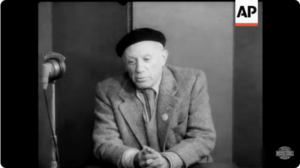
* Addressing the Sheffield conference in his native Spanish, Picasso said:
 Dear friends, you will allow me at the opening of this magnificent meeting to recall a personal memory. My father who lived in Barcelona was an animal painter. He loved to depict birds and particularly doves. As his life was waning, he began to allow me to use his paint brushes and used to ask me to paint in the feet of the doves for him, a very delicate work which he could no longer do. When he found out that I could do it fairly well, he gave his paint brushes to me, and I have succeeded him in the family of painters.
What joy he would feel if he were still alive to see that my too humble doves have circled the world.
In this way I have contributed, within my powers and with the same conviction which I have put into my art, to the struggle for the finest and most just of all causes.
I am for life against death, for peace against war.”
Here is a very snide Movietone news report of the time:
ENDS




I was in Diss centre some months ago and almost fell over from surprise and joy when a demonstration supporting the people of Gaza passed me by. I have just checked the local paper – which gave a very sympathetic coverage about three weeks ago – and even gives the time to arrive in the town centre – 10 am – so I will know when to be there next Saturday!
Well done Diss. You choose to display the humanity that most of us feel, you are definitely not alone.
Very encouraging to read. Solidarity with protesters in Diss.
Picasso was a sadistic, misogynist monster. To cite just one account of many, https://www.theparisreview.org/blog/2017/11/09/how-picasso-bled-the-women-in-his-life-for-art/ but there’s also a Guardian piece if you want to google. Same old story, can we separate the work from the man, or woman? Even with Einstein, can we? Maybe in that last case we have to (though you might ask why). But it’s surprising to find such a gushing tribute to Picasso here, especially when the connection with the main story is so marginal.
@Brian Robinson : 11th May 2024 at 21:40
Can we separate the misogyny from ‘Guernica’?
Can we separate today’s mores, from living through the barbarity of The Spanish Civil War?
I have no idea if, in later life, Picasso regretted his mistreatment of women, but for The Paris Review and The Guardian the story would make good copy.
Superb….out here in the shires things are beginning to move too. Those who think that Gaza will have no impact on politics in the UK are wrong. It is a sea change and the author of this article is right. We have to go back 50 years to feel the anger that is rising.
Many thanks to Jake Ecclestone for giving us an insight into the thinking of people in a small town in Norfolk. I believe it accurately reflects how opinion about Israel’s most recent, most horrific assault on Palestine is shifting in the wider population.
Thank you, I’ll be sharing this with my friends and relations in Norfolk and hoping they may join in! To continue the small-town theme I have photos of four women standing in Chesham with placards, one of them is Jewish and the daughter of refugees. In Hemel Hempstead there is a longstanding stall collecting for MAP, which used to be lucky to get £50 every Saturday. Since October local people have been putting in many, many hundreds each time, and often shaking hands and calling out their support. Jake is right, this movement is reaching so much more widely that anything most of us have seen in our lifetimes.
I stand with Jacob and others every Saturday in Diss Market Place. It feels like a profound event in its own right, but what Jacob describes about the reaction of the public is very noticeable to me. In the past I have helped on stalls in Diss town centre, for the Corbyn Labour Party and for Amnesty International. I have never before seen so many people take so much notice – mostly taking their time to read our many placards.
Yes, the feeling is truly deep, across the world
Thank you, Jacob, for writing about our weekly demonstrations in Diss against the ongoing genocide. There are many who are unable to reach the cities to join in the large protests and who value the opportunity to stand in quiet but powerful solidarity with the Palestinians each week. Most of us are within walking or cycling distance of the town centre but we have regular comrades join us from Walsham le Willows, Bungay and, more recently, Thetford where word of us has reached. We achieved our greatest reach last Saturday when we were joined by one from New Zealand and two more from Thailand. Everyone grateful for the opportunity to make a public stand. Everyone wishing there was no need to be there each week.
Have just read that Trinity College, Dublin has decided to divest from Israeli firms following their student protests. We should all press for BDS here. But I want to say, I too, along with my wife stand in silent vigil, with our home-made posters, with Jacob and comrades each Saturday morning in Diss. Having been alerted to the vigil by a friend, as we don’t live in Diss, we have been attending for a few months now, and pledge to continue. Thanks to Jane for organising this weekly stand for Gaza and Palestine. The ‘good Lord Cameron (raised from the dead by Sunak) feels that our export contibution to Israel’s arsenal of killing weapons is tiny and so it’s OK to carry on being complicit in the on-going massacre.
I was a bit late reading this article. What a positive article that has renewed my belief in humanity. I know Diss well and I feel like jumping in the car to come down tomorrow to offer support. Unfortunately my days of jumping are over but I hope my relatives who live not far will make a visit. Great admiration. Just watched the Israeli defence at the ICJ….the observer shouting out ‘lies’ was very brave, but oh so true, I couldn’t believe the mistruths coming out of such a young mouth.