
As state violence rages, Palestinians in the South Hebron Hills remain steadfast
JVL Introduction
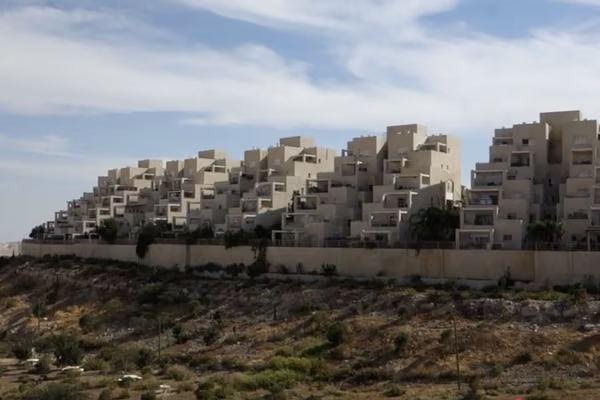
We have often reported on the violence routinely suffered by the villagers of the South Hebron hills as violent Israeli settlers harass and humiliate them, aided and abetted by soldiers in the IDF as this report from ‘The Pickle’ shows. Within the report there is a particular focus on the many examples of attacks and constant harassment experienced by villagers from Umm Al-Khair from settlers of Carmel Settlement, built merely yards away from the village in perhaps the closest proximity of any West Bank settlements. We can barely imagine the impact for people trying to live their lives, but it is necessary to try.
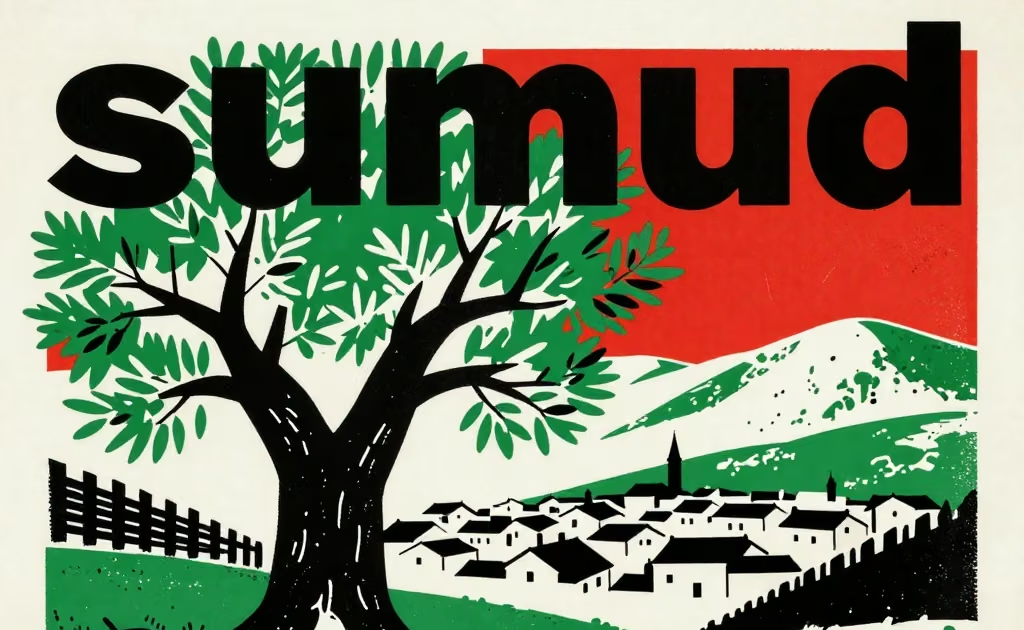
The intolerable situation for Palestinians in the South Hebron Hills is seemingly endless, with Palestinan sumud – steadfastness – tested to its limits. In at least one of the hamlets in this area – Zanuta – the situation became unbearable after threats and attacks ramped up exponentially following October 7th. The residents there have, finally, left their homes. The determination of the people of the South Hebron Hills to remain on their lands is profound, but how much longer can they hold on?
LL
The Pickle’s Intro
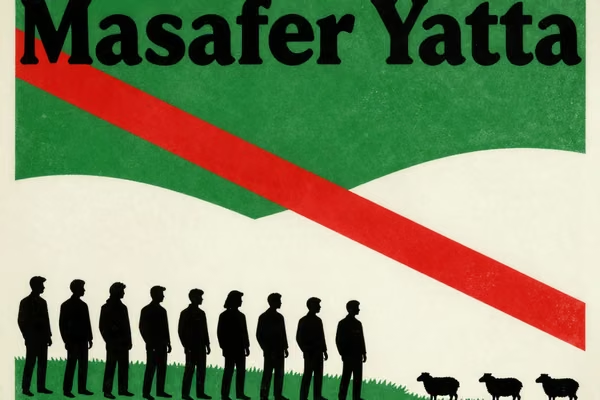
Last week, hundreds of people gathered in the Palestinian village of Tuwani to watch a screening of No Other Land, an international award-winning documentary film directed by Basel Adra, Hamdan Balal, Yuval Abraham, and Rachel Szor. The film follows the daily efforts of Adra to resist and document the occupation in his home village of Tuwani and in the neighbouring villages that make up Masafer Yatta, or the South Hebron Hills.
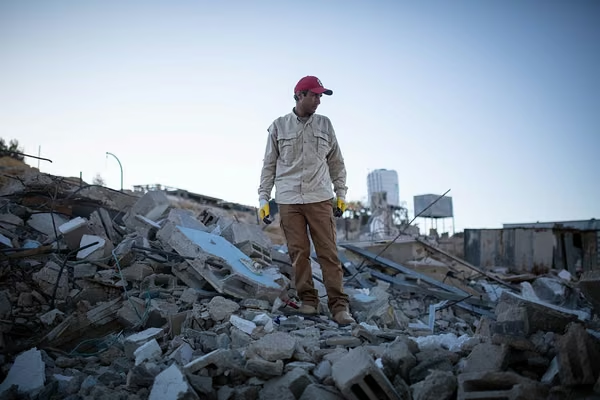
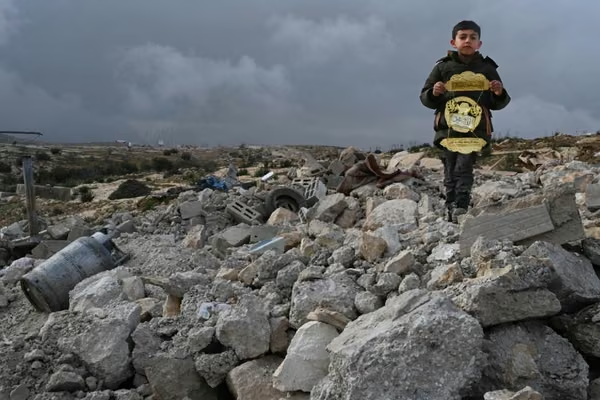
Located in Area C of the occupied West Bank, for decades Masafer Yatta has been subject to vicious settler-state violence on a daily basis. In 2022, the Israeli High Court sided with the state in green-lighting the expulsion of the entire resident Palestinian population of the area, numbering over 1,000 in total, because the Israeli army has declared the area to be a live-fire training zone.
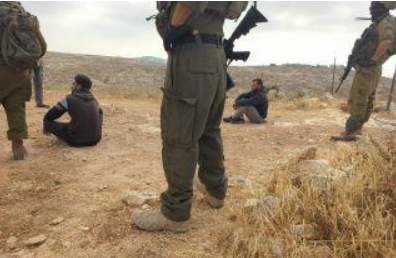
One can barely imagine what raw emotion must have been in the air of this particular screening: it has been a devastating few months for Palestinians in the West Bank, and in Masafer Yatta in particular. In the last week alone, soldiers arrested a village resident and an activist before firing shots in the air; settler gangs attacked residents and pushed shepherds off their land; and over a dozen masked soldiers raided a village at night, forcefully searching houses and terrorising families.
And so, at a time like this, the screening of No Other Land in Tuwani is perhaps a perfect embodiment of sumud. Roughly translating to steadfastness, sumud is a Palestinian notion of nonviolent resistance, of carrying on in the face of a regime that seeks to make life unlivable. Adra summarises the meaning of sumud when, in the overture to the film’s trailer, he is heard saying, of his resolve not to let Masafer Yatta die quietly: “I started to film when we started to end.”
As No Other Land demonstrates, film, literature and art are capable of bringing us closer to the reality of pain and suffering on the ground – but perhaps only so close. Awdah Al-Hathaleen, a prominent activist in the area wrote on social media of the events this week: “You cannot imagine the amount of suffering that we are enduring, the amount of oppression that we are experiencing, the amount of helplessness that we feel as we live through all of these attacks.”
Indeed, one can barely imagine, though what might it mean to try and come close, to shoulder even a fraction of that helplessness? For some decades now, international and Israeli solidarity activists have spent time resisting alongside Palestinians in the South Hebron Hills, bearing witness to the horrors of occupation and apartheid. In this week’s Pickle, Aman Abhishek, an activist and researcher currently based in the region, gives us an insight into some of those horrors, as he reports on daily life, struggle and sumud in Masafer Yatta ▼
As state violence rages, Palestinians in the South Hebron Hills remain steadfast
Across the West Bank, Hamas’ 7 October attack has become the latest pretext for accelerating the ethnic cleansing of Palestinians
Somehow, 5-year-old Watan slept through the raid. At around midnight on 2 November, some 30 Israeli soldiers flooded his village of Umm Al-Khair in the South Hebron Hills region of the occupied West Bank, allegedly to search for weapons.
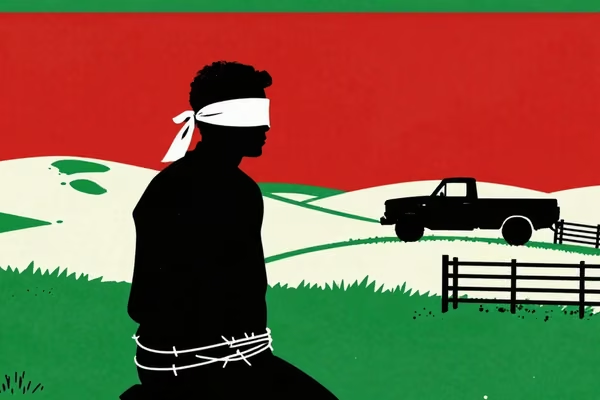
In Watan’s house, the soldiers found clothes and blankets in the cupboards, which they threw on the ground. In one room they found sacks of grains, which they spilled everywhere. They ransacked the kitchen, throwing food, bottles and dishes on the countertops and the floor. They blindfolded Watan’s uncle and tied his hands behind his back without giving a reason for doing so. But the soldiers didn’t find any weapons, and eventually they left.
The next morning, Watan woke up and noticed the disarray. “Who did this?” he asked his father, Awdah Hathaleen. “Your mother was searching for something and was in a bad mood,” Awdah replied.
A few weeks later, Israeli soldiers returned to Umm Al-Khair at night. This time they blindfolded and handcuffed Watan’s teenage cousin, Ahmad*, sat him in the back of their military vehicle and drove off. For almost 24 hours, nobody knew where this child was taken, and on what grounds.
Ahmad eventually phoned his family, telling them that he had been freed, although he didn’t know where he was. When the family found him at last, they learned that he had been beaten throughout the night, denied food and water, and prevented from using the bathroom. They discovered bruises on his face and all over his body. He was unable to walk properly and his behaviour was different in the following days. “He is out of reality,” Awdah said. “You talk to him and you feel that his thoughts are elsewhere.”
I saw Ahmad in December, a week after this incident. As always, he greeted me with a smile and a hug, but he did not ask me to play football as he usually does. I asked him how he was doing. He showed me his bruises which had not yet healed. He assured me that he was doing better than before, and I hoped that he was being truthful.
The Israeli soldiers returned a few weeks later, this time during the day. They put the entire village on lockdown again, searching the houses, the rooms, the kitchens, and the cupboards, wreaking havoc everywhere they went. They arrested Watan’s uncle, Eid Hathaleen, a prominent Palestinian activist, confiscating the cameras he uses to document human rights violations, as well as his laptop and other electronic equipment.
Pictures of Eid’s arrest circulated in small anti-occupation circles on social media: wearing his characteristic cap, he appeared calm as he was led into a military vehicle by masked Israeli soldiers. Unlike Ahmad, he had been arrested many times before.
Eid was released later that night. A photograph depicted him standing on a dirt road, smiling at the camera and displaying his release documents. In the background, the floodlights from the nearby settlement of Carmel, pointed in the direction of Palestinian villages, are piercing through the dark, a bit too brightly. It would take Eid three weeks to get his electronic devices back, to connect to the outside world and resume his work again.
And last month, the occupation came after the dead. Settlers from Carmel destroyed – for the third time – a monument honouring Watan’s great uncle, Haj Suleiman, who was killed by an Israeli police tow truck two years ago as he peacefully protested Israeli incursions into the village. Watan’s uncle, Tariq Hathaleen said: “We will rebuild the monument, not just once, but as many times as it takes. His memory is etched into the fabric of our struggle, and no amount of destruction can erase the legacy of his bravery.”
Unofficial violence, official agendas
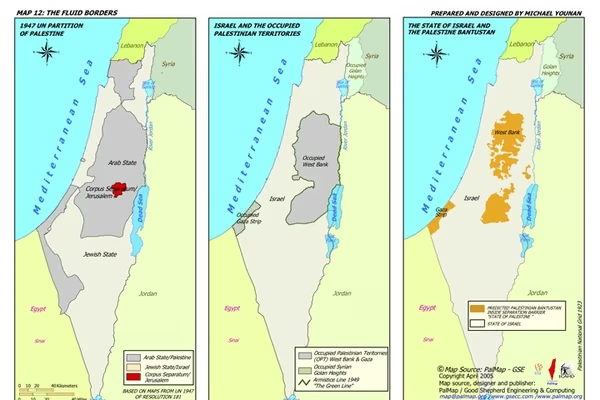
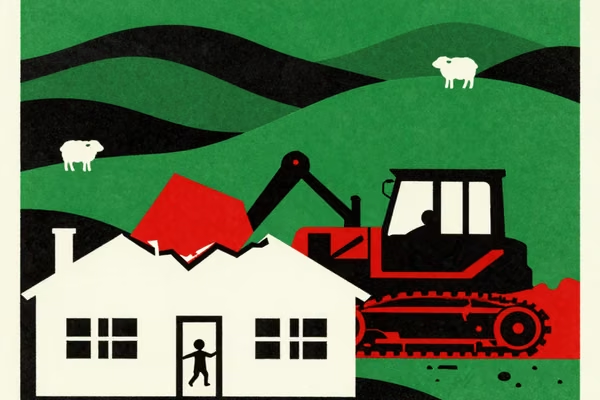
Such is the reality for the Palestinian agricultural communities scattered across Area C – the roughly 60% of the West Bank under full Israeli control, in which approximately 300,000 Palestinians live surrounded by some half a million Israeli settlers. For decades, Israel’s state apparatus has been working to forcibly displace Palestinians from this region into the denser cities and towns of the Palestinian Authority-controlled Area A, and expropriating as much land as possible in the process. It is an impulse that goes back to the 1948 Nakba: maximum land with minimum Palestinians, and using violence to create that reality.
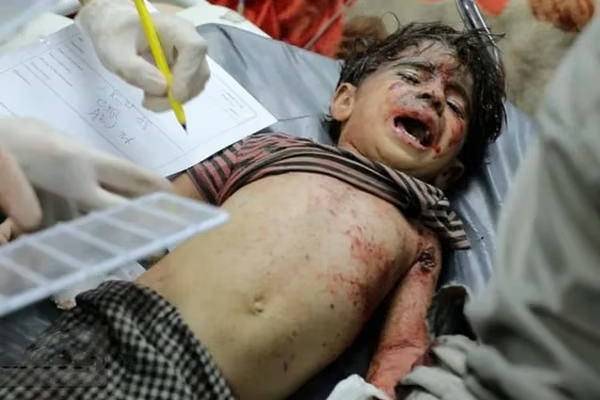
Across the West Bank, Hamas’ 7 October attack has become the latest pretext for accelerating the ethnic cleansing of Palestinians. For months, settler-soldier militias have been giving ultimatums to numerous Palestinian communities: leave within 24 hours or be killed. Some communities faced brutal attacks with soldiers and armed settlers opening fire on Palestinians, kidnapping and torturing them and destroying their property. Army raids, detentions and arrests became even more frequent, while the severe restrictions imposed on Palestinians’ freedom of movement endangered the livelihoods of thousands.
The results have been clear to see: Out of the nearly 2,000 Palestinians displaced due to settler violence since 2022, 43% were within the 30 days following October 7.
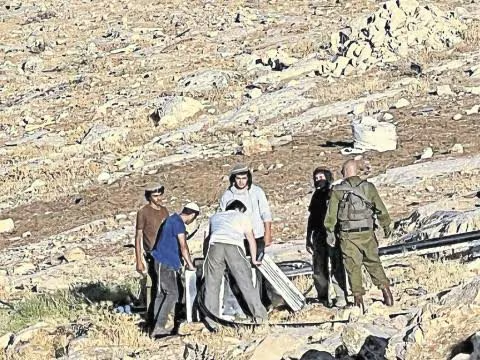
However, “settler violence” is something of a misnomer: it is merely one of the most visible manifestations of state policy. Israeli authorities rarely take action against violent settlers despite evidence; often settler violence occurs in the presence of soldiers and with soldiers’ active participation; and the state violently confiscates land from Palestinians for the benefit of settlers. As the Israeli human rights organisation B’Tselem puts it: “The combination of state violence and nominally unofficial violence allows Israel to have it both ways: maintain plausible deniability and blame the violence on settlers rather than on the military” – all while advancing Palestinian dispossession.
The violence faced by Palestinians living in Area C usually receives international attention when a certain threshold is crossed, such as a lethal attack or the expulsion of a community. In these instances, settler violence is often cast as extremist and fringe, rather than as a form of government policy. The recent wave of Western sanctions on a handful of violent settlers — and not the array of institutions supporting them — illustrates how the international community, too, is unwilling to address the root of the problem.
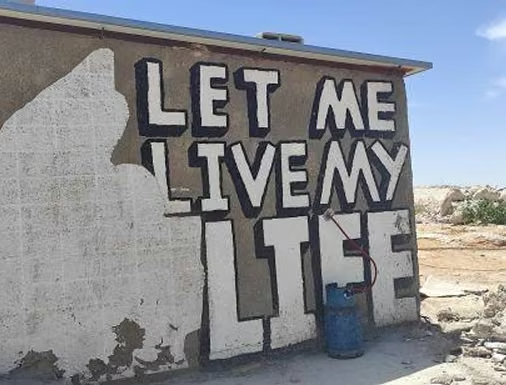
The international attention and news coverage waxes and wanes, but the dispossession of Palestinians continues regardless. And while Palestinians organise demonstrations and fight legal battles to resist, just continuing to live on their land with steadfastness — sumud, in Palestinian parlance — becomes a major act of defiance in itself.
Putting up hurdles
For about two decades, a rather small but steady stream of Israeli and international anti-occupation activists have bolstered Palestinians’ efforts of sumud and resistance by spending time in Palestinian communities that are subject to severe Israeli state-settler violence, such as in the South Hebron Hills and the Jordan Valley. Here, they build relationships with the residents, bear witness, and document the daily injustices of the occupation.
Some activists spend days, even months, living in these communities if the threat of settler and army violence is particularly high, or the community’s expulsion seems imminent. Their presence is useful for several reasons: it can deter some of the most severe violence towards Palestinians, while their documentation can aid with legal proceedings, human rights advocacy, and amplifying the reality on the ground to an international audience. As such, they put up additional hurdles for Israeli soldiers and settlers to act with total impunity — work that many activists refer to as “protective presence”.
For Tariq, this work is essential in order for Israelis and internationals to fully understand the difficulties the Palestinian residents face on a daily basis. “There is hearing about something, seeing it through a screen, and then living it. Those who have lived alongside Palestinians have discovered the truth, and they will remember it till the last day of their life.”
A routine activity of this solidarity work involves accompanying Palestinian shepherds as they take their sheep out to graze, and farmers when they go out to harvest olives or work in the fields. Shepherding and farming being the historical way of life and a major source of income for most of these agricultural communities, it is spiritually and practically crucial that the shepherds and farmers are able to go out onto their lands.
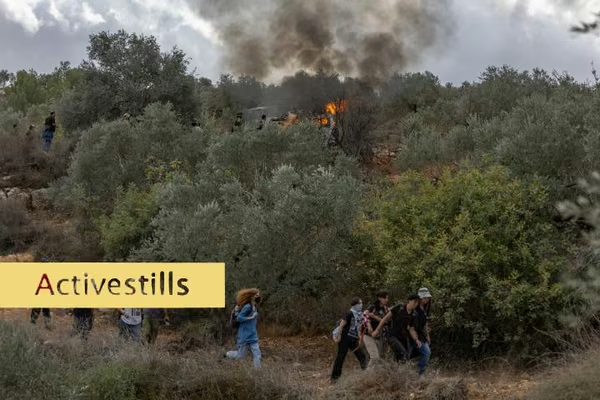
On a quiet day, there will be time to drink tea, a conversation to be had, and the landscape to admire. On a difficult day, a settler might show up, threaten and abuse the Palestinians and activists, and fly a drone, for his amusement, weaponising the buzzing noise to scatter the herd; or soldiers might detain the shepherds, or prevent them from entering grazing lands through an ad-hoc military order. On very difficult days, settlers might attack and severely injure the Palestinians and activists, or Israeli authorities might arrest them.
Israel’s apartheid policies become starkly evident when Israeli activists are detained or arrested together with Palestinians. Palestinians can be placed in administrative detention – incarceration without a trial or charge, on the basis of undisclosed evidence. If a trial is held, it takes place in a military court, in Hebrew, with a conviction rate of nearly 100%.
In contrast, Israeli and, for the most part, international activists cannot be detained for arbitrarily long periods, and must be taken to trial in a civilian court, where the hearing is relatively fair and evidence is taken into consideration. This disparity manifests in cases of settler attacks too: Israeli activists can potentially take an attacking settler to civilian court, whereas soldiers are more likely to arrest or detain the Palestinian than take any action against the settler.
Watan’s village has welcomed Israeli and international anti-occupation activists for close to two decades. With settler violence escalating in recent years, there are more communities in need than there are activists. Even before 7 October, Palestinians would say that the situation last year was already the worst it had ever been.
Data gathered by the UN reflects this reality. In the months leading up to 7 October, incidents of settler violence had already reached their highest daily average since 2006 – a rate of three incidents per day. After 7 October, the rate increased to over five incidents per day. In comparison, there were two attacks per day in 2022, and one in 2021.
Watan’s village has managed to resist an expulsion so far. Sitting in the room where activists sleep at night, Awdah told me while pouring hot tea: “The occupation is not going to end tomorrow. It will take generations to end it, but we will not give up.” The tea was golden-red, sweet and comforting.
*This name has been changed out of concern for the person’s safety.
Aman Abhishek is a PhD candidate in media studies at the University of Wisconsin-Madison.







How have Palestinians survived treatment such as this for so long, and why has the world observed and accepted, even casting the perpetrators as the victims? The Palestinians are titans. And the Israeli occupiers will it seems ignore anything which goes against the long term aim of Israel’s government and too many of Israeli citizens, to wipe out, deny the existence of, even a Palestinian people or State, so establishing an entirely Jewish State. Where else in the world does a similar case of decades of subjugation and denial of rights and ever shrinking homeland exist, perpetrated in plain sight by one people over another? Should their untrammelled power over the Palestinians persist, first BDS, but if unsuccessful, then what other than intervention than by a UN force? It is surely that serious.