
Sanctions against Israel are needed NOW
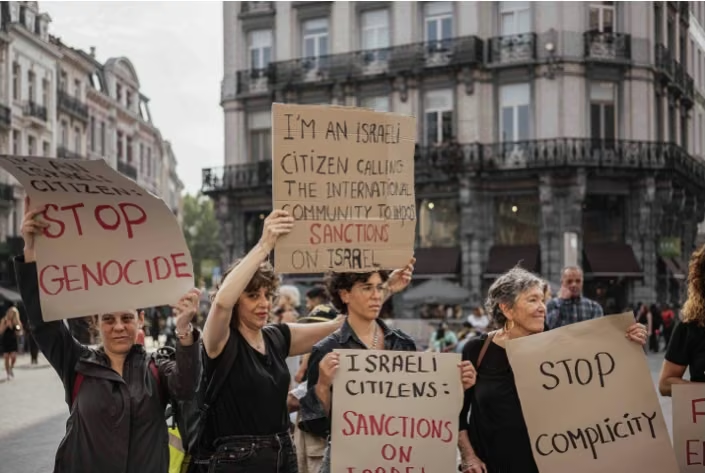
JVL Introduction
The clatter of condemnations of Israel’s genocide by mass starvation in Gaza is now deafening.
But the question remains: what, precisely, should be done?
A number of recent reports, articles and open letters have included a range of possible sanctions and we reproduce three of them of them below: from 58 former EU ambassadors, from Francesca Albanese and from Tom Dannenbaum & Alex de Waal (the latter a renowned expert on famine).
The latter is a careful analytical account of the legal and moral obligations of states and what particular states might do.
Some are obvious and there is inevitably a lot of overlap, but we hope readers will find this compilation useful.
RK
1. Open Letter by 58 former European Union ambassadors calling for immediate and effective measures against Israel’s unlawful actions in Gaza and the West Ban
We welcome the recent condemnation of Israel’s actions in Gaza and the West Bank by 28 Foreign Ministers, including 20 EU Member States, but words are not enough. We call urgently on all EU leaders and governments, especially those who prevented the Foreign Affairs Council, 15 July, from acting against Israel’s egregious humanitarian and human rights violations, to take all necessary and feasible measures under international, European, and national law to bring these atrocities to an end.
Action should comprise the following:
1. Resume international aid deliveries immediately at scale and flood the Gaza strip with humanitarian supplies, in full respect of the core principles of international humanitarian law.
2. Suspend with immediate effect all arms and dual use exports to Israel.
3. Ban trade with Israel’s illegal settlements in occupied Palestinian territory and prohibit EU and member states’ commercial and investment relations with any entity or company doing business in or benefiting from Israel’s illegal settlements.
4. Suspend all preferential commercial arrangements for Israel under the Association Agreement.
5. Cancel Israel’s participation in Horizon Europe and all dual use research, academic and technology programmes of the EU.
6. Impose targeted sanctions on Israeli Ministers, government officials, military commanders, and violent settlers responsible for war crimes, crimes against humanity, facilitating genocide and carrying out State-sanctioned terrorism.
7. Support international and national judicial mechanisms – including the International Criminal Court and domestic courts under universal jurisdiction – to bring perpetrators to justice.
8. Provide political, legal, and financial support to Palestinian civilian victims, human rights defenders, and humanitarian organizations operating under impossible conditions.
9. Recognize Palestinian statehood on the occasion of the UN conference in New York of 28/29 July, to create the necessary prerequisite for a two-state solution.
On 17 July, the Day of International Criminal Justice, the European External Action Service recalled that in regard to crimes against humanity, war crimes, genocides… “history has too many moments when silence followed horror…”
The world will remember how the EU and its member states respond to this catastrophic tragedy.
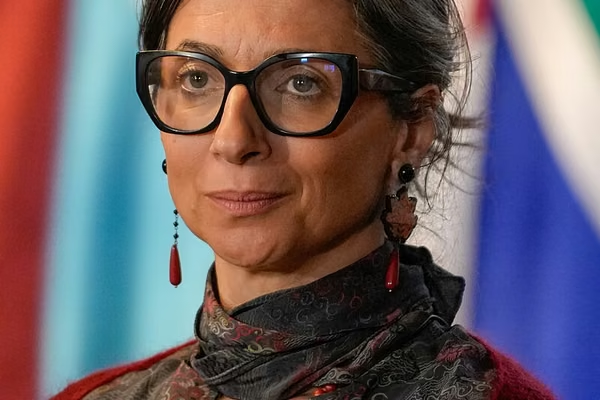
2. Francesca Albanese, From economy of occupation to economy of genocide
Special Rapporteur’s report to the 59th session of the UN Human Rights Council
Recommendations
94. The Special Rapporteur urges Member States:
(a) To impose sanctions and a full arms embargo on Israel, including all existing agreements and dual-use items such as technology and civilian heavy machinery;
(b) To suspend/prevent all trade agreements and investment relations, – and impose sanctions, including asset freezes, on entities and individuals involved in activities that may endanger the Palestinians;
(c) To enforce accountability, ensuring that corporate entities face legal consequences for their involvement in serious violations of international law.
95. The Special Rapporteur urges corporate entities:
(a) To promptly cease all business activities and terminate relationships directly linked with, contributing to and causing human rights violations and international crimes against the Palestinian people, in accordance with international corporate responsibilities and the law of self-determination;
(b) To pay reparations to the Palestinian people, including in the form of an apartheid wealth tax along the lines of post-Apartheid South Africa.
96. The Special Rapporteur urges the International Criminal Court and national judiciaries to investigate and prosecute corporate executives and/or corporate entities for their part in the commission of international crimes and laundering of the proceeds from those crimes.
97. The Special Rapporteur urges the United Nations:
(a) To comply with the International Court of Justice Advisory Opinion of 2024;
(b) To include all entities involved in Israeli unlawful occupation in the United Nations database (to be accessible on the OHCHR website).
98.The Special Rapporteur urges trade Unions, lawyers, civil society and ordinary citizens to press for boycotts, divestments, sanctions, justice for Palestine and accountability at international and domestic levels; together we can end these unspeakable crimes.
99. This report is written at the cusp of a profound and tumultuous transformation. Globally witnessed atrocities require urgent accountability and justice, which demands diplomatic, economic, and legal action against those who have maintained and profited from an economy of occupation turned genocidal. What comes next, depends on all of us.
3. Time Has Run Out: Mass Starvation in Gaza and the Global Imperative
Tom Dannenbaum and Alex de Waal
30 July 2025
Third-Party States’ Duties
This is the final section of a long analysis which can be read here.
Faced with this prospect [of mass starvation], what must States do?
The answer will include actions along several dimensions. Most obviously, those Sates that have knowingly (or, on an alternative legal interpretation, purposefully) made a significant contribution to existing violations — and thus bear some level of existing complicit liability — must cease those contributions immediately. (ILC, ARSIWA, art. 16(a) art. 30, & Commentary pp.66 (para. 5), pp. 88, 115 (para. 11); Bosnian Genocide, ICJ (2007), paras. 420-21). Equally importantly, particularly given duration of the harm in contexts of mass starvation, these complicit States must discharge their reparative obligations with respect to harms to which they made a causal contribution (ILC, ARSIWA, art. 31).
More broadly, all States are bound by the duties to ensure respect for IHL, to prevent genocide, and to cooperate to bring violations to an end. Where the risk or danger of an ongoing violation is sufficient (as it surely is here), they must “do everything reasonably in their power to prevent and bring [ongoing IHL] violations to an end” and must “employ all means reasonably available to them” to prevent genocide or bring it to an end. (ICRC 2016 Commentary, para. 154; Bosnian Genocide, ICJ (2007), para. 430).
This raises two questions. The first is how to conceive of the path to bringing the ongoing violations in Gaza to an end. The second is what kind of contribution any specific State must make to that objective.
As noted above, although directly binding only on Israel, the ICJ’s orders from last year provide concrete guidance in response to the first of these questions, at least as it might have been answered in mid-2024. Israel’s manifest failure to live up to the ICJ’s orders has been the most important factor in the deterioration of conditions of life in Gaza and the prospect of a precipitously worse trajectory today. In principle, then, the order’s import has only intensified.
And yet, under the momentum of the descent into mass starvation, the measures required by the ICJ a year ago are now plainly inadequate. There is a sense in which that momentum blurs the traditional legal distinction between prevention and reparation. The ongoing violation is not neatly time bound. Some who are alive today have passed the point of no return. Others among the starving need far more than nutrition—they need a careful, medically supervised process of refeeding. Still others may need long-term medical support due to the impacts of acute malnutrition on cognitive and central nervous functioning. As the physical, psychological, and societal impacts of starvation reverberate into the future, a strong case can be made that the work of prevention, and of cooperating to bring serious jus cogens violations to an end, must follow.
On that line of reasoning, third-party States cannot satisfy their preventive duties merely by seeking to influence Israel to open the gates and allow unfettered humanitarian access (although that they must do). They must also deploy their leverage towards a more comprehensive objective — one that demands that Israel facilitate and ensure the full-spectrum recovery of Palestinians in Gaza from the brink of physical and social destruction.
Implicit in the IPC Alert is the imperative of better information, which means a release on harsh restrictions to accessing suffering Gazan populations. In order for an appropriate and effective response to implement the variety of crucial actions detailed below, humanitarian workers and States who support them with funds and diplomatic action need sufficient information to identify and locate the most critical needs. There is also a general imperative to establishing, with comprehensive data, the full extent of the crisis so as accurately determine whether it is an IPC-5 Famine, and assess the trajectory of the humanitarian emergency and necessary responses. This requires unhindered humanitarian data gathering and reporting by international journalists, both of which are currently highly restricted.
Concretely, those suffering malnutrition in Gaza do not simply need food; they need nutritional balance, the expansion of intensive and therapeutic feeding centers for acutely malnourished children, and the regeneration of food systems. Palestinians in Gaza do not simply need medical aid; they need permanent and stable institutions of medical care that can provide the backbone of sustainable recovery, rehabilitation, and individual and collective survival in the coming years. These cannot be dismissed as ideal, but unrealistic goals. They are the bare minimum objectives if the destructive conditions of life that are present today are not to briefly abate only return in ever more virulent form every time the crossings are closed.
What it means for any given State to act towards these objectives will vary according to the form and degree of its ability to impact actions by Israel (Bosnian Genocide, ICJ (2007), para 430). In the domain of duties to ensure respect for IHL, prevent genocide, and bring violations to an end, States “remain in principle free to choose between different possible measures” (ICRC, 2016 Commentary, para. 165; similarly ILC, ARSIWA, Commentary p.114 (para. 3)). However, as the “gravity of the breach” rises, the intensity of the obligation to prevent it is also enhanced, arguably narrowing State discretion regarding what that might entail. (ICRC, 2016 Commentary, para. 165). Here, that gravity manifests both in the present acute crisis and in the multifaceted future harm that has already been set in motion.
In a statement striking for its rarity in the practice of the International Committee of the Red Cross (ICRC), the organization’s president Mirjana Spoljaric recently insisted that States “must do more,” warning that “every political hesitation” in failing to bring the “abhorrent” practice of “extreme deprivation” and indiscriminate attacks in Gaza to an immediate and decisive end “will forever be judged as a collective failure to preserve humanity in war.” In a similar vein, UN High Commissioner for Human Rights Volker Türk urged governments to put “all possible pressure on the Israeli Government to end the carnage in Gaza – permanently.” He even suggested, “[c]ountries that fail to use their leverage” in this context “may be complicit in international crimes.”
Each State must determine for itself what levers it can deploy. Plainly, the time for strongly worded statements or calls for Israel to “deliver on its pledges” is over. Equally, States must immediately cease any contributions to, or encouragement of, the ongoing catastrophe in Gaza, including through the transfer of arms (ICRC 2016 commentary para. 162) and dual-use supplies. Other forms of leverage, such as suspending the EU Association Agreement should also be deployed with a view to inducing Israel to allow the necessary full-spectrum response. And States must act to quash the growing climate of impunity in this context, ending public equivocation regarding whether they would execute arrest warrants such as those issued by the ICC, responding collectively to those that fail to uphold that duty, denying overflight permission to wanted individuals, and moving with urgency to activate the EU Blocking Statute to protect ICC officials and others from U.S. sanctions aimed at the Court’s work in the Palestine situation.
Warnings of mass starvation, as intolerable human suffering and as a crime, have been consistent, reliable, and increasingly urgent. Failing to act on these warnings is, at the very minimum, a shameful abandonment of humanity. For those involved or complicit in starvation crimes in Gaza, legal reckonings must follow.
For those deliberating about the appropriate response, this is not the moment for equivocation. It is not the time for symbolic gestures such as air drops. It is time for comprehensive, full-spectrum, sustainable, and coordinated humanitarian action. States globally must act without delay on that imperative.
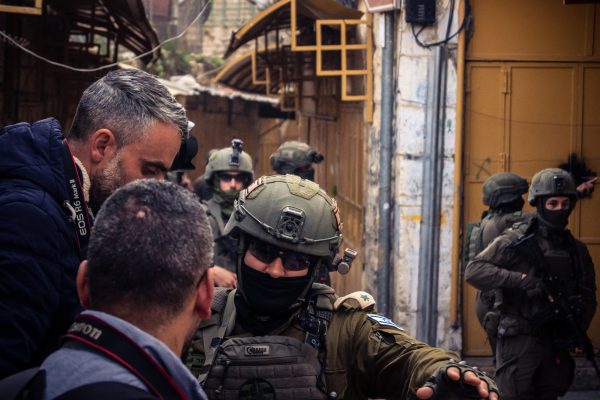



Stopping Israel’s genocide by encouraging more and more IDF soldiers to refuse to fight is part of the answer, I think.
Doing this would be “pushing at an open door”, given the low morale in the IDF. Particularly as the Israeli government has on several occasions left it to veterans’ organisations (charities) to fund the legal support of IDF soldiers facing arrest and trial in foreign courts because of what they allegedly did in Gaza.
There’s already a deep chasm between the IDF and the Israeli government – the former saying the IDF is near breaking point, Hamas can’t be defeated and the only way of bringing the hostages home is to negotiate their release, the latter obstinately refusing to hear them.
At least 896 IDF soldiers have been killed (some say the death toll is much higher). There’ve also been 5 IDF suicides within a fortnight. Thousands of IDF soldiers are said to be suffering from mental health problems as well as other injuries. Some units are 50% under strength; reservists refusing call-up. The IDF has recently threatened individual “refuseniks” with prison sentences – after fierce public protests they had to abandon that effort to re-establish army discipline.
In your dreams Linda. We, the Jewish people are not suicidal and our young people know that they must defend our homeland whatever their politics. The terrible death toll is accurately reported, unlike the Gazans’ figures from nowhere which don’t even distinguish between the terrorists and others. Every life lost is a tragedy, even Arab terrorists have mothers albeit some who rejoice in their son’s death. In the most costly Yom Kippur War we lost well over 3,000 of the finest of our Jewish people when the Israeli population was 1/3 what it is today and in the Hamas Gaza terrorist massacre of Jews on 7 October 2023 and since, over 2,000 lives have been lost more than half murdered on 7 October, mostly civilians. Terrible, shocking, even in proportion but the achievements in destroying Hezbullah, Hamas, Iran’s nuclear program and getting potentially better neighbours in Syria is astounding. Israel will prevail and the Jewish people pray for the safe return of the kidnapped hostages but without committing national suicide.
No, Jaye; Israel is not only destroying the Palestinians but also Israel. Until May this year I was a Zionist by default – owing to being a Holocaust Child Survivor – but what Israel has been doing for the past twenty months or so is the betrayal of Jewish values and increases antisemitism all over the world. You state that Jewish people are not suicidal; however, Israel is now committing suicide for itself as well as for Jews everywhere.
Mistakes have been made in prosecuting the war Agnes, as they always are, but I think you’ll find that Israel will emerge stronger albeit at a terrible cost. We can all criticise, as we do, but armchair generals are a dime a dozen and my grading of Netanyahu goes from 0 to 10 to 0 to 10 to 0 regularly, so I’m no political or military genius either. However like almost every Jew on earth I am a Zionist, not fickle and not by default, and every Jew knows deep down that without a strong Jewish State we’re as vulnerable as we were in the 1930s, which is why our enemies try so hard to destroy the State. Yes, JVL members know this and our young people in the IDF know it too. As in any democracy there is much vocal criticism of government actions and some take it to the extreme, not unheard of in wartime in democracies. However Linda mistakenly believes (hopes?) that the Jewish/Druze/Bedouin soldiers of the IDF won’t be motivated to do their duty. Wrong! As anyone who has friends or relatives in Israel knows, the young people will vigorously defend their homeland and their loved ones, and this includes making it more difficult for terrorists to try and butcher us again. Survival is critical for every Jew in and outside of Israel. This is the main point I was trying to make in my earlier post.
Jaye is entitled to his opinion but not to claim his opinion is shared by all Jews.
His claim that “However like almost every Jew on earth I am a Zionist,” is contradicted by authoritative survey evidence. According to Jewish Policy Research surveys close to one third of UK Jews do not identify as Zionist.
In the USA the presence of many Jewish students in the campus encampments and the strong Jewish support for Mandami in the New York mayoral primary shows that support for Zionism is slipping fast there as well
Mike, we’ll see when the dust settles because surveys have inbuilt bias in what and how they’re asked, and by whom and when and through what medium, and who they define as a Jew. Empirical evidence also proves nothing but it’s the best I have to go on. I know a large number of fellow Jews, as I have all my life, hundreds for sure who I rub shoulders with on various occasions . Many are very active as are their children and grandchildren and many don’t bother with anything, but the only 2 I’ve ever come across years ago who aren’t enthusiastic about the importance of a Jewish State, are still the only 2 I know of who hold this view and even their long-held views are not filled with hate. No-one else has changed their positive opinion of, or commitment to the importance of Zionism despite deep criticisms of many things. The criticisms are because Israel is so dear to us.
May I nominate Jaye’s “Mistakes have been made in prosecuting the war Agnes, as they always are, but I think you’ll find that Israel will emerge stronger albeit at a terrible cost.” as both biggest understatement and example of wishful thinking re. Israel’s treatment of Palestinians to date, and any other country it feels is a problem? Also “As in any democracy …….” infers it describes Israel. In claiming that for Israel, with its separate laws for differing categories of Israelis, proves just how immune from acceptance of facts he is. I offer my sympathy to Jaye for inhabiting the Jewish bubble with similar blinkered “Israel right or wrong” views. Does he not accept that there is a large number of Jewish people, including holocaust survivors and their descendants, who take part in the huge marches regularly held in London in support of Palestinians?