
“Judeophobia: A History” – a review
JVL Introduction
Deborah Maccoby provides a helpful summary and critique of Shomo Sands’new slim volume Judeophobia: A History. Sands has a reputation as an enfant terrible as well as a historian and this book is likely to ruffle feathers.
Perhaps more than usual in that the book we have is a translation of a work first published in 2020, provocative in its own right, to which an Afterword has been added which introduces an additional level of provocation.
Maccoby rates the book highly as “a fascinating and convincing outline of the continuum between European pre-modern religious Christian Judeophobia, modern racialist Judeophobia and Zionism/Israel.”
An example of one of Sands’ aperçus:
“Anyone can see that living for centuries in close proximity to neighbours who are convinced that you murdered the son of their God is liable to generate an identity that is, at the very least, closed-off and anxiety-ridden.”
She rates the Afterword not so much. For not only does Sands reasonably amend his conclusion to the original work about Judeophobia being on the wane, arguing that “Israel… is now, more than ever, generating what is, in some respects, a new form of Judeophobia” – he treats the argument that Israel has committed a genocide in Gaza as evidence of this new Judeophobia rather than as assessment based on the evidence, made by an overwhelming number of genocide scholars and human rights researchers.
RK
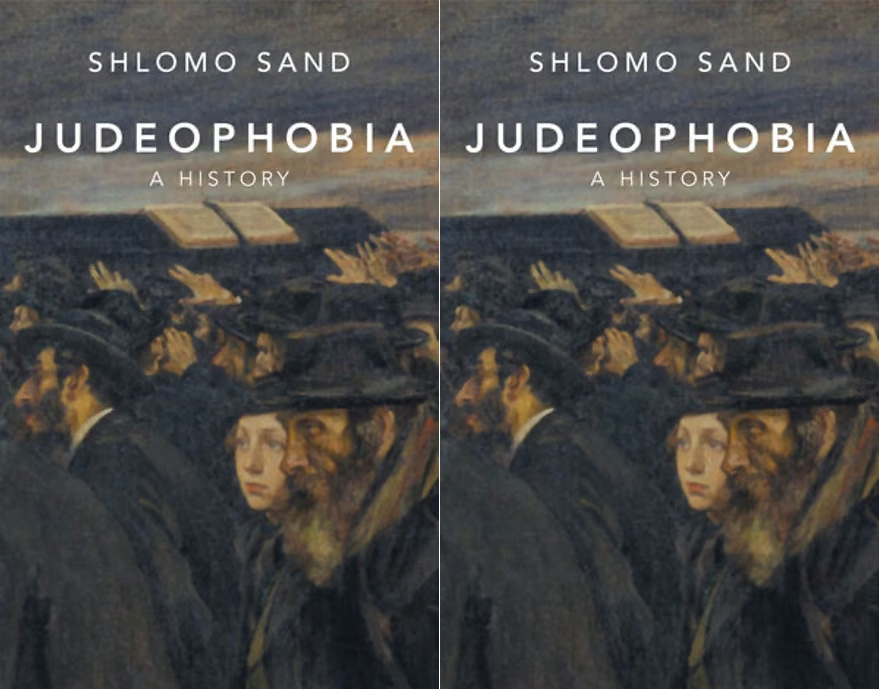
Judeophobia: A History
by Shlomo Sand, translated by Robin Mackay, Polity Press, 2026, 130pp.
Reviewed by Deborah Maccoby
Whenever Israel comes under heightened international criticism, a spate of books appears on “the New Anti-Semitism”, a concept that portrays Israel as “the Jew among the nations”, inheriting the role of persecuted scapegoat that was the fate of Jews in Europe in the past. Shlomo Sand specifically distances himself from these books, pointing out that they exploit the history of Jewish suffering in order to get Israel off the hook:
“My intention was not to produce yet another piece of writing about ‘anti-Semitism’, with the suffering of my ancestors serving as an alibi for the fact that I belong to one people that oppresses another. My principal aim in writing this text was to examine the origins of hatred of the Jews, and to clarify the reasons why it has been so enduring in the European culture which shamelessly defines itself today as ‘Judeo-Christian’” (p. 123).
Why is this book called Judeophobia, rather than the more usual Anti-Semitism? Sand explains at the beginning:
“Given that there is no such thing as a Semitic race, and no such thing as an Aryan race, the roots of the term “anti-Semitism” lie in an essentialist swindle, mainly perpetrated by populist politicians seeking to give ‘scientific’ substance to an age-old phobia” (p.4).
The term “Judeophobia” reflects not only Sand’s central rejection of the idea, in any sense, of the Jews as a race, but also his view that there is no radical break between the religious Christian Judeophobia that reached its peak in the Middle Ages and the secularized, racialized Judeophobia of the 19th and 20th centuries. He writes of the word “anti-Semitism”:
“This term was coined in the mid-nineteenth century, at a time when the formalization of biological racialization was reaching its high point, marking what, in my view, was not a decisive epistemological break in the history of hostility towards Jews but a significant new phase” (p. 4).
In his opening chapter, Sand sums up his “central argument”:
“The central argument of this work will be that the Jewish faith was not the progenitor of Christianity but that, contrary to what the chronology might suggest, the character and attitudes of the Jewish minority were shaped by the Christianity within which they lived” (pp.2-3).
Sand identifies the crucial Christian text as the passage in the Gospel of Matthew (27: 24-25) in which the Roman governor, Pontius Pilate, washes his hands of guilt for Christ’s crucifixion[1], after which, according to the Gospel, “All the people answered: ‘His blood is on us and on our children!’” (quoted on p. 14) – the basis of centuries of terrible hatred and persecution of Jews. Sand points out:
“Anyone can see that living for centuries in close proximity to neighbours who are convinced that you murdered the son of their God is liable to generate an identity that is, at the very least, closed-off and anxiety-ridden.”
He also describes this identity in terms of “intransigence” and sums up the general outlook as that of “a community under siege” (p. 3).
In his second chapter, Sand reiterates facts – which were long known to scholars but had never got through to the popular mind — that he first set out in his controversial book The Invention of the Jewish People (2008; first published in English 2009). Here he pointed out that: a) there was no exile of the Jews by the Romans, who never deported whole peoples; b) before the rise of Christianity, Judaism was an outward-looking, actively proselytizing religion that was immensely popular; c) by the first century CE, the majority of Jews were living outside Palestine, in communities that had originally been non-Jewish but had converted to Judaism.
In Chapter 3, Sand points out that the early Church Fathers, particularly Augustine, defined the Jews as “an accursed people-race, cast out by the Romans, driven from their homeland, and scattered across the world to bear witness to their sins and their blindness” (p. 18). Sand describes this Christian myth as “a doxa[2] of the Western world which would be perpetuated until the 1960s” and became “a kind of abstract knowledge that nothing could budge” (p. 19). Introducing the book’s central theme of the myth of the “people-race”, he points out that, even though the word “race” is applied to the Jews in the New Testament, there is “no biological meaning to it, still less a national dimension”, but adds that “these concepts nevertheless mark, if only indirectly, an origin, and contribute to the hierarchical image of human groups that are essentially different” (p. 17). Sand continues in this section:
“Even when the all-powerful hegemony of Christianity began to decline in the eighteenth century, the doxa concerning the Jews remained in place not only in the popular consciousness of the masses, but also, as we shall see, among ‘enlightened’ intellectuals. The nationalism that was to come would receive and relay the anti-Jewish stigma quite naturally, finding it perfectly easy to use it to its own advantage” (p. 19).
Chapters 4 to 9 take us into the eras of humanist, Reformation and Enlightenment Europe, focusing on various “enlightened” intellectuals, such as Erasmus, Luther and Voltaire, who were Judeophobic and put forward, in some sense, an idea of Jews as a separate race (though Sand always provides a balance, pointing out that Rousseau was sympathetic to the Jews and that Luther in his early revolutionary days was pro-Jewish). From there, Sand takes us into the nineteenth century age of nationalism – an age that also saw the emergence of so-called “scientific” theories of race. Sand’s outline, though brief (the book is a long-form essay, not a comprehensive history), is full of fascinating and recondite stories and facts[3] and thought-provoking analyses and speculations about the diverse nature of Judeophobia in different eras and countries. To take just one instance, he suggests that the reason that mystical ideas of race took root particularly in Germany was that Germany came so late to a national identity; the lack of “any magnificent, common uniform past gave rise to national aspirations based more upon an imaginary ‘organic’ origin than upon a political and cultural present” (pp. 51-52).
In Chapter 9, entitled “The Dreyfus Affair and the Birth of Zionism”, Sand describes the shock that the false conviction and Judeophobic public execration of Dreyfus in 1894, occurring in Paris, “the embodiment and historical symbol of progress and Enlightenment”, gave to those who had believed in “linear progress” (p. 73). Only a few months later, Sand points out (p. 74), Herzl embarked on his book The Jewish State.
In the next chapter, which takes us to the Holocaust, the catastrophic culmination of the millennia-long demonization and racialization of the Jews in Europe, Sand brings out the crucial difference (already mentioned earlier in the book on pp. 19-20) between religious Christian and modern secular racialised Judeophobia, despite the continuity between them: Christianity needed the continued existence of the Jews as witnesses to the truth of Christianity, and also because of the Christian belief that the Second Coming of Christ would only occur after their conversion. In contrast, racialised secular European Judeophobia ended up demanding their extermination.
The final part of the book is devoted to the issue of Zionism, as the next stage in the continuum — in great contrast to most recent histories of anti-Semitism, which portray it as a continuum leading up to contemporary left-wing anti-Zionism. In Chapter 15, the book’s final chapter, entitled: “Is Anti-Zionism the New ‘Anti-Semitism’?”, Sand concludes:
“any generalization aimed at describing anti-Zionism as a new anti-Semitism is not only idiotic, it it is also dangerous, as it is likely to reheat the smouldering embers of old Judeophobia” (p. 122).
At the end of his first chapter, Sand wrote:
“In the final section … I raise a question that may well offend many readers: to what extent has Zionism, born as a distressed response to modern Judeophobia, ended up mirroring it? To what extent, by a complex dialectical process, has Zionism inherited the ideological foundations that have always been characteristic of the persecutors of the Jews?” (p. 6).
These questions can be unpacked in two ways: First, to what extent did Zionists internalise the Judeophobia of their persecutors? Second, to what extent, in their attitudes and behaviour towards Palestinians, have Israeli Jews been imitating their own persecutors?
In Chapter 11, Sand points out that after Emancipation “the Jews of Europe were attracted by national cultures” and “explicitly refused to define themselves as a race.” Zionism therefore, which, as Sand emphasizes, was for a long time very much a minority movement, represented a regression similar to the regressive Judeophobia to which Zionism was a response: “many Zionists expressed an entirely different point of view: the Judeophobic discourse of the secular Christian tradition served as the initial postulate for their invention of a Jewish people” (p. 85). Zionism thus meant a return to the closed-off outlook of the “community under siege”. Sand sums up the ideas of some early pre-Herzlian Zionists, such as Moses Hess, who wrote in his book Rome and Jerusalem: “The Jewish race is one of the primary races of mankind that has retained its integrity” (quoted on p. 87) and Nathan Birnbaum, who wrote: “In the uniqueness of race, the uniqueness of the nation is unfolded” (quoted on p. 88). Sand goes on to describe some of the “dominant voices in the growing racialist camp” of early political Zionists, such as Max Nordau and Ze’ev Jabotinsky. Most chillingly of all, Sand tells the story of the meeting in 1933 between Arthur Ruppin — described by Sand as “the orchestrator of the acquisition of Arab land destined to be transferred to Jews” (p. 92) – and Hans Gunther, described by Sand as “the leading theorist of the doctrine of race” in the Nazi Party, who “later became the ‘architect’ of the extermination of the Gypsies”. It is not known what Ruppin and Gunther discussed; but Sand points out that Gunther “had a high regard for Zionism”, while “in his publications and correspondence prior to their meeting, Ruppin hailed Gunther as an authority in the field of physical anthropology and eugenics and praised him effusively” (p. 94).
In the final chapters of the book, as published in Israel in Hebrew in 2020, Sand concludes that, even while Judeophobia in Europe is now on the wane (Chapter 14), the Christian Judeophobic myth of the Jewish “people-race” has been fully taken over by Israeli Jews in order to justify Israel’s rule over another people. Chapter 12 describes, in Sand’s typically amusing and ironic style, the ludicrous and futile attempts, since the 1970s, by Israeli geneticists – aided by geneticists in Yeshiva University in New York – to identify a “Jewish gene”. Chapter 13 explains the political reason for these efforts: the aim of mobilizing the Jewish communities of the world to view the Jewish State as the state of all the Jews in the world, who constitute one “people-race”, and to lobby their governments in support of Israel’s Occupation and Israel’s “demonization and alienation” (p. 123) of the Palestinians.
_______________
In this translation now issued in English, Sand has added an Afterword about October 7 and Israel’s subsequent onslaught against Gaza. I have a couple of quibbles (set out in my footnotes) about the 2020 book, but on the whole find it a fascinating and convincing outline of the continuum between European pre-modern religious Christian Judeophobia, modern racialist Judeophobia and Zionism/Israel.
But I have serious problems with the Afterword. Sand corrects his conclusion in Chapter 14 of the 2020 book that Judeophobia is on the wane. He comments:
“It is the irony of history that Israel, which many of its founders saw as a response and a solution to anti-Jewish hatred and violence in Europe, is now, more than ever, generating what is, in some respects, a new form of Judeophobia” (p. 127).
It seems to me to be true that Judeophobia is now on the rise, fuelled by Israel’s onslaught against Gaza. This claim is borne out especially by the recent attacks on a synagogue in Manchester and on a Chanukah celebration on Bondi Beach in Australia. But I have serious problems with Sand’s implication in the Afterword that the widespread description of Israel’s onslaught as a genocide is part of this new form of Judeophobia.
Sand criticizes “the flourishing of viewpoints that saw Israel’s war of revenge as an attempt at an actual genocide of the Palestinian people” (p. 129). Of course, revenge has been one motive behind Israel’s onslaught; but Sand completely ignores Israel’s opportunistic aim of finishing off the job of 1948 and getting rid of the inhabitants of Gaza once and for all. As commentators such as Norman Finkelstein[4], Avi Shlaim and Jamie Stern-Weiner[5] have argued, Israel first aimed at ethnic cleansing; when this proved impossible, Israel turned to genocide. The word “war” is completely inappropriate to an onslaught that has overwhelmingly targeted civilians. Elsewhere in the Afterword, Sand writes of “Israel’s disproportionate response” (p. 127). As Norman Finkelstein puts it in a published extract — discussing the September 2025 UN Report on Gaza — from his forthcoming book Gaza’s Gravediggers:
“A disproportionate attack presupposes that a legitimate military site was targeted but an excessive number of civilians were killed. The report found, however, that, overwhelmingly, it was Gaza’s civilian population and infrastructure that were targeted. Indeed, the massive death and destruction were proportionate to Israel’s genocidal goal.”[6]
October 7 and Israel’s onslaught against Gaza are hardly appropriate issues for a mere Afterword or Postscript. In this 2026 English translation, in my view, Sand should have made what is now the Afterword into the final chapter of his history. He never answers the question he posed at the end of his first chapter: “To what extent … has Zionism inherited the ideological foundations that have always been characteristic of the persecutors of the Jews?” Israel’s genocide against Gaza was not inevitable, just as the Holocaust was not inevitable. But Sand’s historical outline of European Judeophobia and the European Christian myth of the “people-race” does help to explain (though of course not to excuse) the genocidal catastrophe in Gaza that we have witnessed and are still witnessing. It is as though, as an Israeli, Sand cannot bear to face up to the final act of his own book. He never answers the question: “to what extent” has Israel imitated the persecutors of the Jews? In not providing this answer – indeed by denying the charge of genocide against Israel — he has, in my view, failed to bring his history (which in the 2020 book tends to tail off towards the end) to its real climactic and catastrophic conclusion.[7]
Footnotes
[1] Sand makes some puzzling references to Jesus himself; for instance, he writes: “Jesus and his apostles were … Jews who later freely chose to become Christians” (p. 39). Sand seems unaware of the wealth of evidence that indicates that Jesus never intended to found a new religion; that he regarded himself as the human, Jewish Messiah/King who would, with the help of God, overthrow the Roman Empire and inaugurate the Messianic Age; and that he was crucified by the Romans (aided by the High Priest and his henchmen, who were collaborators with Rome) for political sedition. According to this well-established view, the Gospels as we have them were written by Gentile-Christian editors working on original source-material (now lost) to take the blame for Jesus’s death away from the Romans and place it on the Jews (this is clearly illustrated in Matthew 27: 24-25). See S. G. F. Brandon, Jesus and the Zealots (Manchester, 1967) and The Trial of Jesus of Nazareth (London, 1968), Paul Winter, On the Trial of Jesus (Berlin, 1961) and Hyam Maccoby, Revolution in Judea: Jesus and the Jewish Resistance (New York, 1980).
[2] Greek for “commonly accepted belief or opinion”. Emphasis in original
[3] One fact, however, that needs correction and clarification is Sand’s claim, in the section about Jews in medieval England, that Edward I’s “decree of expulsion has not been rescinded to this day” (p. 31). In his classic work A History of the Jews in England (1941:Third Edition, Oxford, 1964), Cecil Roth describes a Conference held in Whitehall on December 4, 1655 to discuss the readmission of the Jews to England: “The two juristic experts in attendance … pronounced that, contrary to the general impression, there was no law which forbade the return of the Jews to England (for the expulsion of 1290 had been an act of royal prerogative, and applied only to the persons immediately concerned)” (op. cit., pp. 162-163). The Conference never reached a decision; but Roth writes that “there is evidence” that, on June 25, 1656, the Council of State “considered favourably” a petition by a group of Spanish and Portuguese Jewish merchants who had settled in London to be allowed to practise their religion freely. Roth writes: “The Jews had not been recalled to England, but their presence there was henceforth considered legitimate” (ibid., p.166). After the Restoration, Charles II’s Privy Council, in response to another petition, authorized the residence of the Jews in England (ibid., p. 171). Roth comments that, if there had been a formal readmission of the Jews to England under Cromwell, Charles II, though he was personally sympathetic towards the Jews, might have been forced to rescind it: “Nothing had been formally effected. There was nothing, therefore, to reverse; and the Cromwellian settlement was allowed to remain simply because it was so casual, and so elusive, as to defy attack” (ibid.).
[4] See, for instance, this video discussion with Chris Hedges:
[5] See Avi Shlaim, Genocide in Gaza: Israel’s Long War on Palestine, The Irish Pages Press, 2024, chapter entitled “Israel’s Road to Genocide”, co-authored with Jamie Stern Weiner. This chapter is reproduced on the Jewish Voice for Liberation website here.
Shlaim and Stern-Weiner list in detail the “dehumanising language” (op. cit., p. 290), used by members of the Netanyahu government. Citing the Oxford English Dictionary’s definition of genocide, they write: “Israel continued to indiscriminately target civilians and civilian infrastructure with overwhelming force in order to render uninhabitable an area most of whose inhabitants were unable to leave. How else to describe this policy except as ‘a deliberate and systematic killing or persecution’ intended to ‘partially or wholly destroy’ the people of Gaza?” (op. cit., p. 305).
[6] A Comment on the New UN Report on Gaza, 22 Sep 2025. See also Finkelstein’s Gaza’s Gravediggers: An Inquiry into Corruption in High Places
[7] I also find very problematic Sand’s implication, at the end of the Afterword, that the worldwide Gaza protest marches could be Judeophobic: “Is there still a thin thread connecting those who believed, and believe still, that Jews are responsible for the crucifixion of Christ to the many who repeatedly chant the ambiguous slogan, ‘From the river to the sea, Palestine will be free’?” (p. 130). According to interviews carried out by the Observer, however, most of the demonstrators view the slogan “From the river to the sea/Palestine will be free” as simply meaning equal rights for Israeli Jews and Palestinian Arabs in the area of historic Palestine, between the Jordan and the Mediterranean, whether in two states, one state or anything in between. There is no particular political agenda; some of those interviewed support a two-state solution. The salient point for most of the demonstrators is that Israeli Jews will no longer dominate and Palestinian Arabs will not be subordinate and confined to ghettos. See this JVL piece.
There is, however, a valid point to be made here about the strategic problems caused by the ambiguity of the slogan. His own suggested rewording – “From the river to the sea, everybody must be equal and free “ — would be preferable (though I think it should be more rhythmical; maybe: “From the river to the sea/All must free and equal be”?) See another JVL piece featuring a report of a speech given by Norman Finkelstein.
But the last sentence of the Afterword (and thus the very last sentence of the whole book) is: “Only on the day that this slogan [‘From the river to the sea/Palestine will be free’] is replaced with ‘From the river to the sea, everybody must be equal and free’ will we begin to move towards a possible solution to this long and painful conflict” (p. 130). The implication here is that the Gaza protest marches are the main block to a move towards a possible solution. It is perfectly clear, however, that the main block is the intransigence of the Israeli government, supported in this regard by much of the Israeli people. Ironically, Sand’s whole book has traced the history that has led up to this intransigence.



I have to confess that I was less impressed by Sand’s Judeophobia than Deborah. Sands treats us to what Salo Baron described as the ‘the lachrymose conception of Jewish history’.
I do not find the use of ‘Judeophobia’ useful. Was anti-Jewish racism really a product of the fear of Jews or the killing of Christ?
This is to view anti-Semitism as a product of religious ideology rather than material circumstances. It explains nothing which is why Sand fails to understand the break between modern and medieval/Christian anti-Semitism.
‘Judeophobia’ was first used by Leon Pinsker an early Zionist in Autoemancipation. Pinsker described Judeophobia as a mental disease which ‘having been inherited for two thousand years is incurable.’
In other words anti-Semitism is a permanent eternal condition, the Zionist prescription. I would suggest that there was a sharp break between feudal and modern anti-Semitism.
For Luther, once a Jew converted that was the end of it. For Hitler, the Jewish Question was racial, not religious. Hence Christian Jews.
Feudal anti-Semitism was at its base economic. The massacre at York in 1890 was owing to the indebtedness of the peasants who after the mass suicide proceeded to burn the records of their debts.
Under feudalism anti-Semitism came from below. The anti-Semitism of the modern era came from above.
Even the Zionist Professor Robert Wistrich, recognised that ‘opposition to anti-Semitism had become a badge of honor for the [German] workers movement’ between 1881 and 1884.’
I am unconvinced that replacing ‘anti-Semitism’ by ‘Judeophobia’ adds anything to our understanding of anti-Jewish racism. Like Barnaby Raine I use the hyphenated version because there was ‘Semitism’ – the belief that European Jews were Semites i.e. aliens.
I find Sand’s regression on Zionism disturbing. Not only does he refuse to accept the genocide of the Palestinians but he attributes the 1948 war to the Arab refusal to accept Partition.
[cut to our limit of 300 words – admin]
excellent; a long over-due argument.
A book about modern Christianity and its relationship to Judaism might be usefu? Especially the fall of Christianity in Britain – I doubt whether many here anymore blame Jewish people for the death of Christ – and the rise of evangelical Christianity in the US and its support for Israel.
PS our chant since ‘23 has been: From the river to the sea – Justice and Equality! It scans better. 😊
Re Tony’s objection to viewing “anti-Semitism as a product of religious ideology rather than material circumstances” — I can’t see why it can’t be both. The material circumstances were produced by the religious ideology. Christians regarded lending money at interest as an accursed occupation, which was nonetheless necessary for the economy, so they forced the Jews , as, in the Christian view, a religiously accursed people, to take on this accursed occupation — and then hated them for it. Similarly, of course there are major differences between religious anti-Semitism and secular racialized anti-Semitism; but at the same time there is continuity. Hitler could never have perpetrated the Holocaust if two millennia of Christian demonization of Jews hadn’t paved the ground.
In reply to Jan Plummer: ever since the Holocaust, there has been a very fruitful dialogue between Christians and Jews in relation to Christian anti-Semitism and its responsibility for the Holocaust; a dialogue that has led to a change of direction for Christianity and real reconciliation between Christians and Jews. The American Jewish theologian Marc Ellis — who sadly died last year — has written a lot about this; he also points out that what he calls “the ecumenical dialogue” has often turned into what he calls “the ecumenical deal”, by which Christians feel unable to condemn Israel because they are afraid of upsetting Jewish communities. And of course, Christian Zionists support Israel, while also harbouring anti-Semitic beliefs about Armageddon leading to the conversion of Jews, while those who don’t convert will go to hell.
From the river to the sea/Justice and Equality sounds the best slogan to me.