
Israel’s road to genocide
JVL Introduction
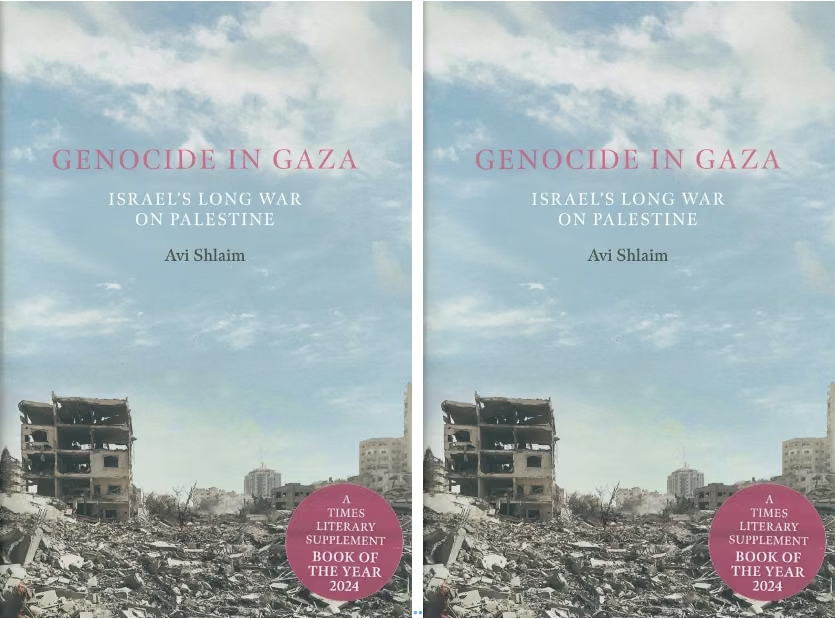
Professor Avi Shlaim’s recent book, Genocide in Gaza: Israel’s Long War on Palestine, has just been published.
One chapter was co-authored with Jamie Stern-Weiner, who has a PhD in Middle East Studies from the University of Oxford. His most recent edited book is Deluge: Gaza and Israel from Crisis to Cataclysm (OR Books, 2024). You can read a review of it on our website here.
We are delighted to repost this co-authored, meticulously referenced chapter in full below, courtesy of The Irish Pages Press.
“In the chapter,” say the authors “we document the genocidal character of Israel’s ongoing onslaught and argue that it represents a logical (though not inevitable) culmination of dynamics that have figured centrally in Israel’s policy objectives and political culture since before the establishment of the State.”
The book can be ordered directly at the publisher’s website here.
(Online orders on this website are preferable and highly advantageous to the publisher, which receives only 20 percent of the cover price from Amazon)
RK
The road to genocide
Israel’s actions have been driven by a genocidal logic integral to its
settler-colonial project in Palestine, signalling a tragedy foretold.
– Francesca Albanese 89
Doctrines of ethnic nationalism proliferated in nineteenth-century Europe. They divided humanity into primordial groups and advocated that political borders should so far as possible trace the boundaries separating these groups. Every extant nation should have its state and each state should be nationally homogeneous. Modern Zionism applied these premises to Europe’s “Jewish Question” and reached an analogous conclusion. Zionist theoreticians argued that Jews in Europe were culturally stifled as well as physically persecuted on account of their anomalous position as a stateless nation. From this diagnosis it followed that the only viable remedy to the twin threats of assimilation and antisemitism was to normalise the Jewish condition by establishing a Jewish state. The Zionist mainstream settled on Palestine as the location of this state because of the territory’s resonance in Jewish history and culture. How large should the state be, what should be its character, how could it be realised – such questions provoked heated controversies within the Zionist movement. But almost the full spectrum of Zionist opinion cohered around the essential goal of establishing a state in Palestine populated by an overwhelming Jewish demographic majority.90
This objective almost inevitably provoked conflict in Palestine between Zionist newcomers and the territory’s existing inhabitants, who were overwhelmingly not Jewish. Palestinian Arabs had no political stake in an endeavour that sought, as the leading Zionist diplomat Chaim Weizmann put it, to render Palestine “as Jewish as England is English”.91 On the contrary, Palestinians reasonably feared that Zionism could succeed only by dispossessing them of house and homeland. Palestinian opposition to Zionism was therefore as comprehensive as it was consistent. This fundamental clash of interests was spotlighted by Ze’ev Jabotinsky, the ever-candid leader of Revisionist Zionism. In his seminal 1923 article, “The Iron Wall”, Jabotinsky argued that Palestinians would never “voluntarily consent to the realisation of Zionism” because “every native population in the world resists colonists”. This meant “Zionist colonisation must either stop, or else proceed regardless of the native population” behind “a power that is independent” of them.92 Zionism for many Jews was a movement for collective assertion as well as defence through national self-determination. Zionism for Palestinians was a violent colonial imposition.
— JEWS IN, ARABS OUT —
Writing in 1965, the Palestinian scholar and diplomat Fayez Sayegh identified a “divergence of Zionism from the norm of European colonization”. Whereas European settlers had often subjugated native peoples in order to exploit them, the Zionist project sought to evict the native inhabitants of Palestine in order to replace them.93 The Australian historian Patrick Wolfe later drew this same distinction between franchise colonialism “dependent on native labour” and settler colonialism “premised on the elimination of native societies”.94 The Zionist movement was a case of settler colonialism because it ultimately prized Palestinian land not labour as it sought not to subordinate Palestinians but to supplant them. Mass expulsion (or “transfer”) of the Palestinians was therefore, as the Israeli historian Benny Morris writes, “inbuilt into Zionism”. On the one hand, “a Jewish state could not have arisen without a major displacement of Arab population”; on the other hand, “this aim automatically produced resistance among the Arabs which, in turn, persuaded” Zionist leaders “that a hostile Arab majority or large minority could not remain in place if a Jewish state was to arise or safely endure.”95
In his presentation on Zionism before the November 1975 General Assembly of the United Nations, Sayegh conjured a vivid comparison. “As in the beating of a heart”, he said, the Zionist project comprised “two inextricable rhythmic operations”: the “pumping-in” of Jews to Palestine and the “pumping-out” of Palestine’s non-Jewish inhabitants.96 This twofold dynamic of Jewish expansion and Palestinian displacement has formed a relentless if irregular pulse animating more than a century of Zionist-Arab conflict. It began already under the British Mandate. Between 1917 and 1947, the Zionist movement brought hundreds of thousands of Jews from Europe into Palestine, increasing the Jewish presence there from below 10 percent to nearly one third of the population. To facilitate Jewish colonisation, Zionist organisations energetically purchased land in Palestine. By 1947, more than 10 percent of the cultivable area was in Jewish hands.97These territorial acquisitions often displaced Arab residents, usually to other locations in Palestine. Even as this “succession of microcosmic transfers” directly dislocated only a minority of Palestinians, still, the “piecemeal eviction” of tenant farmers both reflected “the underlying thrust” of Zionist ideology – the substitution of one people for another – and foreshadowed its catastrophic consummation.98
In a 1938 diary entry, the leader of the Jewish community in Palestine (the Yishuv) and later Israel’s first prime minister, David Ben-Gurion, underlined the “necessity” of “removing the Arabs from our midst”. But he recognised that timing was critical. “What is inconceivable in normal times”, he wrote, “is possible in revolutionary times.” 99 When the 1948 Arab-Israel War broke out, Zionist forces seized the opportunity to bring about what Ben-Gurion euphemistically referred to as “great changes in the composition of the population of the country”. 100 During the war, some 700,000 Palestinians – two-thirds of the population – fled or were driven from their homes in what became Israel. Historians debate the extent to which this displacement unfolded according to a central plan. What cannot plausibly be denied is that Zionist massacres as well as expulsions were a major catalyst of Palestinian flight, that Zionist leaders welcomed the exodus, and that military commanders carried out evictions within an ideological context that had broadly legitimated population transfer as a strategic desideratum. 101
After the dust settled, Israeli authorities moved to consolidate Jewish domination within the new state whose expanded boundaries (established by armistice agreements in 1949 and known as the “Green Line”) encompassed 78 percent of historic Palestine. Israel refused to allow the return of Palestinians displaced during the war and killed thousands of unarmed refugees who made the attempt.102 Multiple Arab communities within Israel were expelled long after the war was over, 103 while more than four hundred Palestinian villages, towns, and neighbourhoods inside Israel were destroyed to make way for Jewish settlement. Property owned by Palestinian refugees as well as Palestinians who remained to become citizens of Israel was systematically confiscated. This vast expropriation left the Israeli state in possession or control of fully 93 percent of the land within the Green Line, which authorities allocated almost exclusively for use by Jews. In the half-century after independence, the state established more than seven hundred Jewish localities and zero Arab localities, excepting several townships built to facilitate the concentration and dispossession of Bedouin Arabs. Even as Israeli administrators relentlessly promoted Jewish immigration, they directed Jewish settlement strategically to encircle Arab villages and restrict the Arab minority to “small enclaves”. The overarching policy was to “Judaize” the entire territory by “concentrating the Arabs and dispersing the Jews.”104
— ROUND TWO —
Israel conquered the remaining 22 percent of Mandate Palestine in the June 1967 Arab-Israel War. The same dynamic of Jewish expansion, Arab displacement – Sayegh’s “rhythmic operations” – then played out in the occupied West Bank (including East Jerusalem) and Gaza Strip. In the aftermath of the war, Israeli prime minister Levi Eshkol likened these occupied Palestinian territories (OPT) to a dowry and their Arab residents to a bride. “The trouble is”, Eshkol lamented, “the dowry is followed by a bride whom we don’t want.” 105 The 1967 War lasted only six days and Israel did not initiate hostilities with the primary objective of territorial expansion.106 Even so, by November 1967, about 200,000 Palestinians from the West Bank and 35,000 from Gaza – above 20 percent of the occupied Palestinian population – were in exile. The Israeli cabinet did not issue orders for an ethnic cleansing. But during the war and in its wake, Israeli leaders welcomed Palestinian flight and took measures calculated to expedite it, while military units directly cleared and demolished Palestinian settlements along the Green Line. “I hope they all go”, Defence Minister Moshe Dayan enthused. The threat of international censure eventually compelled Israel to formally authorise the return of displaced West Bankers. In practice, authorities kept the vast majority out. 107 To the same demographic end, Israeli authorities refused to recognise as residents of the OPT approximately 270,000 Palestinians who were outside the West Bank and Gaza when the occupation began. Over the next half-century, Israel revoked the OPT residency rights of another quarter-million Palestinians, mostly after they travelled abroad. 108
From 1967, Israel extended its Judaizing policy from the area within the Green Line to the occupied territories. Over nearly six decades, successive Israeli administrations implanted more than 700,000 Jews in some 350 colonies established across the OPT. Israeli planners recognised and the International Court of Justice (ICJ) affirmed that this policy was a flagrant violation of the Fourth Geneva Convention, which stipulated that an “Occupying Power shall not deport or transfer parts of its own civilian population into the territory it occupies.” Jewish settlers benefited from government subsidies and the state allocated over 40 percent of the West Bank for their use. Meanwhile, Israel expropriated more than one-third of the West Bank from Palestinians, virtually barred Palestinians from building houses or infrastructure in nearly two thirds of the West Bank, and pushed out Palestinian communities from areas earmarked for Jewish expansion. It was a similar story in Gaza, where Israel took control of nearly 60 percent of the land by 1990 and allocated one-quarter of the Strip for use by Jewish settlers even as they comprised just a half-percent of Gaza’s population. 109 A formidable phalanx of Israeli civil and military institutions was deployed to maximise Jewish control in the OPT and, simultaneously, to concentrate and confine Palestinians in dozens of crowded enclaves, disconnected from one another, with development outside them effectively banned.110 In July 2024, the ICJ found that Israel’s “discriminatory policies and practices” in the West Bank and East Jerusalem – including its “settlement policy” and “encirclement of Palestinian communities into enclaves” – constituted unlawful “racial segregation and apartheid”.111
From the outset, then, a central thrust of Zionist policy has been, as Human Rights Watch neatly summarises, to “maximise the number of Jews, as well as the land available to them” in areas desired for Jewish settlement, and at the same time to “minimise the number of Palestinians and the land available to them.”112 This demographic project unfolded inter alia through various forms of population transfer. Transfer was often preemptive, as when Israel prohibited Palestinians from entering, living in, or building on vast swaths of land in Palestine. Transfer was also retroactive, as when Israel demolished or expropriated the property of displaced Palestinians, prevented refugee return, and revoked Palestinian residency rights. And, on occasion, transfer was brutally direct, as in the wholesale expulsions of the 1948 Nakba. Israeli policy typically worked to concentrate Palestinians in dependent enclaves within Palestine, but when opportunities arose for displacement abroad, in 1948 and to a lesser extent in 1967, Israeli leaders exploited them. The endeavour to forcibly substitute one group of people for another is the essence of settler colonialism. In Israel – where a “virtual consensus” favouring transfer crystallised in the late 1930s, where almost all leaders after 1948 opposed Palestinian refugee return, where all governments since 1967 have participated in colonising the OPT, and where “almost all” civilian as well as military authorities are involved in enforcing “apartheid against Palestinians” – the settler-colonial impulse is not confined to one political party or ideological tendency but pervades and penetrates the state.113
— CONTAINING RESISTANCE —
As Jabotinsky prophesied, expanding Jewish settlement frequently provoked Palestinian opposition as well as resistance. Such opposition was typically overruled by means of discriminatory administration while resistance was suppressed by force. In the Mandate period, the Zionist leadership rejected the democratic principle of majority rule in Palestine so long as Jews comprised a minority, on the correct assumption that an Arab electoral majority would vote to end Jewish immigration and settlement. Between 1936 and 1939, British armed forces along with Jewish paramilitaries viciously crushed a Palestinian national revolt. After the 1948 War, Israel subjected some 90 percent of its Arab citizens to military rule. This emergency regime facilitated the destruction of Arab property and expropriation of Arab land until it was lifted in 1966, by which time the state’s demographic objectives within the Green Line had been substantially accomplished.114 The pattern repeated in the OPT from the following year. Palestinians in the West Bank and Gaza Strip have lived under Israeli military rule since 1967: three-quarters of Israel’s lifespan as a state. The occupation has been enforced through harsh repression including deportation, arbitrary detention, collective punishment, and unlawful killings. By one estimate, Israel jailed more than 800,000 Palestinians from the OPT between 1967 and 2016; those detained were “routinely subjected to torture”.115
From the mid-2000s, Israel’s control policy in the West Bank relied on carrots as much as sticks. A subordinate “Palestinian Authority” (PA) patrolled and administered the main Palestinian population centres on Israel’s behalf. The PA’s economic dependence on Israel and the United States induced its political compliance, while broader public quiescence was purchased through foreign subventions – distributed by the PA to a bloated civil service and authoritarian security apparatus – as well as Israeli permits enabling tens of thousands of Palestinians to work for higher incomes in Israel.116 In Gaza, the emphasis lay heavier on the stick. Israeli officials had long viewed the enclave – crowded with impoverished refugees from the 1948 expulsion and their descendants – as a hotbed of resistance. After a mass civil revolt against Israeli military rule spread from Gaza across the OPT, beginning in December 1987 (the first intifada), Israel crushed the uprising then strengthened its grip on Gaza through various forms of confinement. By 2004, the head of Israel’s National Security Council could describe Gaza as “a huge concentration camp”.117In January 2006, the Islamic Resistance Movement, Hamas, won parliamentary elections in Gaza and the West Bank. Israel and its allies responded by subjecting the occupied Palestinian population – already enduring the “worst economic depression in modern history” – to “possibly the most rigorous form of international sanctions imposed in modern times”.118 When Hamas seized control in Gaza the following year, Israel tightened the screws further as it put Gaza under a closure regime that has been enforced with varying degrees of intensity ever since.119
The siege extinguished Gaza’s economy and reduced its people to penury. “The idea is to put the Palestinians on a diet”, a senior Israeli official explained, “but not to make them die of hunger.”120 An Israeli officer stationed on the Gaza border distilled his mission there: “no development, no prosperity, only humanitarian dependency.”121 The unemployment rate soared to among the highest in the world, four-fifths of the population were forced to rely on humanitarian assistance, three-quarters became dependent on food aid, more than half faced “acute food insecurity”, and over 96 percent of the groundwater became unsafe for human consumption. The head of the United Nations agency for Palestinian refugees, UNRWA, observed in 2008 that “Gaza is on the threshold of becoming the first territory to be intentionally reduced to a state of abject destitution, with the knowledge, acquiescence and – some would say – encouragement of the international community.”122 The UN warned in 2015 that the cumulative impact of this induced humanitarian crisis might render Gaza “unlivable” within a half-decade. Israeli military intelligence agreed, whereas a subsequent UN analysis judged the projection overly optimistic.123 By 2018, Israel had reduced Gaza to what the UN high commissioner for human rights called a “toxic slum”, in which above two million people – half of them children – were “caged” from “birth to death”.124 “If there is a hell on earth”, UN Secretary-General António Guterres said in May 2021, “it is the lives of children in Gaza.”125
Many in Gaza did not share this vision for their future, and so Israel found it prudent every few years to violently discipline them – what Israeli officials termed “mowing the lawn”. Some of these onslaughts responded to resistance emanating from Gaza: armed, as when Hamas fired projectiles into Israel in May 2021 following settler encroachments in occupied East Jerusalem, or unarmed, as in early 2018, when Palestinians demonstrated peacefully along Gaza’s perimeter fence – scores were killed and thousands injured by Israeli snipers arrayed on the other side. But Israel’s most devastating offensives, in 2008 and 2014, were motivated by broader political objectives: to inspire fear in the Arab world and to thwart Hamas “peace offensives” that threatened to make Israel’s rejectionist diplomatic posture – its refusal to withdraw from Palestinian territory in exchange for peace – untenable.126 In the 2014 assault alone, Operation Protective Edge, approximately 1,600 civilians in Gaza were killed, including 550 children, and 18,000 homes were destroyed.
By October 2023, Israel had firmly entrenched what the Israeli human rights group B’Tselem characterised as a “regime of Jewish supremacy from the Jordan River to the Mediterranean Sea”.127 The coalition guidelines of the 37th Israeli government, formed the preceding year and led by Prime Minister Benjamin Netanyahu, stipulated that “the Jewish people have an exclusive and inalienable right to all parts of the Land of Israel” – including the OPT – and committed to Jewish “settlement” across this territory. Large parts of the West Bank had been formally or de facto annexed, Jewish colonies were expanding at an unprecedented rate, the people of Gaza were trapped in suffocating stasis behind a prison fence, their compatriots in the West Bank were squeezed into dependent enclaves, and the Palestinian cause had all-but-vanished from Arab and international diplomatic agendas. In his September 2023 address to the UN General Assembly, Netanyahu hailed the bilateral agreements reached in 2020 and 2021 between Israel and four Arab states – the United Arab Emirates, Bahrain, Sudan, and Morocco – as a “pivot of history”, anticipated a “historic” treaty with Saudi Arabia, and ridiculed the “so-called experts” who had maintained that Israel-Arab normalisation was predicated on peace with the Palestinians. On the ground, Israeli officials knew the “humanitarian condition in Gaza” was “progressively deteriorating” – this being an intended policy outcome – and could predict that, “if it blows up, it’ll be in Israel’s direction.”128 But they apparently believed that, by oscillating “between [military] operations and providing that level of aid to Gaza” sufficient to prevent its complete “collapse”, Palestinian eruptions could be contained within tolerable limits. Hamas will “rise up from time to time and hit us”, Israel’s former national security advisor acknowledged in 2018, but it can’t do any “real damage”.129 The people of Gaza could be left to fester in their cage. Netanyahu boasted that Israel was entering a new “age of peace” without compromise, and Palestinians – who made up “only 2% of the Arab world” – had no “veto over the process”.
— “WHAT WAS WILL NOT BE”: —
— GAZA CRISIS AND OPPORTUNITY —
On 7 October 2023, Netanyahu’s confidence was revealed as complacency when Hamas-led militants burst the gates of Gaza, overwhelmed multiple military installations, then rampaged across southern Israel.130 Unaffiliated residents of Gaza joined in. The operation was shocking in its boldness, the ensuing massacre for its brutality. Analysis by the Agence France-Presse (AFP) found that nearly 1,200 people were killed in the attack, overwhelmingly civilians, and 250 were taken hostage. If these figures are correct, this means Palestinians killed more Israelis in one day than during the five years of the second intifada, inclusive of the bloody suicide bombings. The shock of the casualties was compounded by the military and intelligence vulnerabilities Hamas exposed. A poorly resourced militia, constrained within a besieged and intensely surveilled ghetto, brushed past Israel’s high-tech ramparts, overpowered the Israel Defence Forces (IDF) Gaza Division, and ran rampant for hours unimpeded by any coordinated military response. “We spend billions and billions on gathering intelligence on Hamas”, a former senior official on Israel’s National Security Council rued. “Then, in a second… everything collapsed like dominoes.”131 The Hamas assault marked the first time since Israel’s war of independence that Israeli territory was seized in battle and, all told, the “most traumatic day” in Israel’s seventy-five-year history.132
In retaliation for the Hamas operation and massacre, Israel turned Gaza into a howling wasteland. The onslaught was dubbed Operation Swords of Iron. Between October 2023 and July 2024, Israeli forces killed upward of forty thousand people, most of them women, children, and the elderly.133 The reported death toll included almost as many children as were killed across all the world’s conflict zones over the preceding three years combined.134 Gazan hospitals developed the acronym “WCNSF” – Wounded Child No Surviving Family – as hundreds of extended family units were wiped out.135 Fully 90 percent of the population – 1.9 million people, including an estimated 800,000 children – was internally displaced, most multiple times and some up to ten times.136 Gazans were being shunted around like “human pinballs”, UN Secretary-General Guterres decried, “ricocheting between ever-smaller slivers of the south, without any of the basics for survival”.137 Israel set records for killing UN staff, health workers, and journalists;138 littered Gaza with more unexploded bombs than anywhere in the world since the Second World War;139 and, according to former UN assistant secretary-general for human rights Andrew Gilmour, probably inflicted the “highest kill rate” of any military since the 1994 Rwandan genocide.140 Gaza became “the most dangerous place in the world to be a child” (UNICEF), “the most dangerous place for aid workers in the world” (International Crisis Group), “the most dangerous place to be a civilian” (International Rescue Committee), and, indeed, “the most dangerous place in the world” period (ACLED). 141
Targeting Palestinian civilians and civilian infrastructure was not in itself a novelty. A UN inquiry found that Israel’s 2008 offensive, which visited upon Gaza what Amnesty International described as “22 days of death and destruction”, was a “deliberately disproportionate attack designed to punish, humiliate and terrorise a civilian population.”142 Five years later, Israeli soldiers confessedly inflicted “destruction on a whole other level” in Gaza as they unleashed “an insane amount of firepower” while “shooting at anything that moves – and also at what isn’t moving”.143 In 2018, IDF snipers responded to overwhelmingly unarmed demonstrations along Gaza’s perimeter fence by intentionally targeting children, journalists, health workers, and disabled persons with live ammunition.144 Indeed, long before October 2023, every political and military official in charge of Operation Swords of Iron – Prime Minister Netanyahu, Defence Minister Yoav Gallant, IDF Chief of Staff Herzi Halevi, Emergency War Cabinet member Benny Gantz, and their key advisors – was on record endorsing the intentional targeting of civilians as a tenet of Israel’s military doctrine.145 After October 2023, however, the scale of destruction qualitatively increased: from 100–120 targets bombed per day (2014) to 430 targets bombed per day (October 2023),146 from 305 buildings damaged per day (2014) to 743 buildings damaged per day (October 2023–January 2024),147 and from 2.5 million tonnes of rubble generated (2014) to over 39 million tonnes of rubble generated (May 2024) – thirteen times the combined debris generated by all previous conflicts in Gaza since 2008.148 The American military historian Robert Pape concluded in January 2024 that Israel’s ongoing assault amounted to “one of the most intense civilian punishment campaigns in history”.149
This radical ramping up of violence reflected a qualitative change in Israeli policy. Israel had previously sought to contain Hamas within an impoverished Gaza sealed off from the West Bank, Israel, Egypt, and the wider world. The 7 October assault made this “conflict management” approach a dead letter. But with crisis came opportunity. Israeli leaders had long been alive to the need for calibrating Israel’s use of force to the political limits set by international public opinion. In 2008, Israel moved to break an unwanted ceasefire with Hamas on 4 November, when Americans were preoccupied with the presidential election of Barack Obama.150 More generally, a 2018 study found, “Israel authorities appear to time their attacks” on Palestinians so as to minimise the likelihood of coverage in US newscasts.151 Netanyahu himself is acutely sensitive to these dynamics. “Israel, when it fights, is subject to international pressures”, he explained in a 2006 interview. “In the televised age”, the “kinds of wars that we fight” are “not sustainable beyond a few weeks”.152 Following the Tiananmen Square massacre in 1989, Netanyahu – then deputy foreign minister – lamented that Israel had not carried out “large-scale” expulsions of Palestinians from the OPT while global media focused elsewhere.153 And during Israel’s summer 2014 assault on Gaza, Netanyahu seemingly decided to launch a ground invasion when international attention was diverted by the downing of a Malaysian airliner over Ukraine.154
The unqualified support extended Israel by the US, Britain, and the European Union following the Hamas attack signalled an unbuckling of external constraints. It was interpreted by Israeli planners as a green light to transform the “strategic reality” in Gaza and “change the Middle East”. 155 Former national security advisor Meir Ben Shabbat argued that “the scale of the attack by Hamas provides legitimacy for Israel to take extraordinary measures.”156 An influential military think-tank advised that strong “international legitimacy and freedom of offensive action for Israel” now “enables high aggressiveness”.157 An unnamed political source informed veteran correspondent Ben Caspit that Israel “must take advantage of the opportunity” to “go all out”.158 And former parliamentarian Ofer Shelah, considered a dove, urged that Israel exploit the unprecedented “global legitimacy for any type of action” to unleash an “unprecedented degree of power”.159 Israeli leaders had long despaired of their Gaza headache – Prime Minister Yitzhak Rabin famously wished it would “sink into the sea”160 – and after 7 October saw the prospect of a permanent cure. Israel’s strategy accordingly shifted from mowing the lawn in Gaza to salting the earth; from perpetually deferring the Gaza question to definitively resolving it. Israel would “act with full force” to “change the face of reality in the Gaza Strip for the coming fifty years”, Defence Minister Gallant pledged. “What was will not be.”161
— FROM DISPLACEMENT —
— TO DESTRUCTION —
Since 2008, almost every escalation in Gaza had been triggered by Israel. By contrast, the 2023 hostilities, like the so-called Unity Intifada of May 2021, were initiated by Hamas, which by all accounts caught Israel unprepared. The Israeli response was accordingly characterised by an unusual degree of dissensus and improvisation. But a broad spectrum of elite opinion soon converged around two basic options. At the more extreme end were calls for annihilation. A British jurist representing Israel subsequently attempted to downplay examples of bloodthirsty statements by Israeli officials as a few “random quotes” of merely “rhetorical” significance.162 In truth, as researchers like Yaniv Cogan have diligently catalogued, demands for the destruction of Gaza echoed across Israel’s political spectrum and down through civil society.163 Lawmakers from Israel’s governing coalition called for “crushing Gaza on all its inhabitants” and “flattening” Gaza “without mercy”. They demanded that the “civilian population” in Gaza “leave the world” and that the IDF impose “one sentence for everyone there – death”.164 Senior politicians underscored that “there are no innocents” in Gaza; “it’s an entire nation out there that is responsible.”165 A deputy speaker of Israel’s parliament bluntly enjoined, “Burn Gaza now nothing less!” while a parliamentarian from the ruling Likud Party – and former minister of public diplomacy – urged her followers to “invest your energy on one thing: wiping Gaza off the face of the earth.” Those “Gazan monsters” who do not flee abroad, she clarified, should “die horribly” at the hands of “a vengeful and cruel IDF… Anything less than that is immoral”.166 Opposition legislators chimed in: “there are no innocents in Gaza”, “the children in Gaza have brought this upon themselves!”167
Israeli media, meanwhile, were saturated with demands to “erase” Gaza and turn it into a “slaughterhouse”, its inhabitants “without exception… exterminated”.168 One prominent television presenter enthused that “there are already more refugees and more dead in the Gaza Strip than there were in the original Nakba in 1948” and urged that “this important process must not be interrupted”. A journalist for one of Israel’s most widely circulated newspapers opined that “every baby [in Gaza] will grow to become a terrorist. Erase, kill, destroy, annihilate.” A TV talking head defined “victory” in Gaza as “annihilation + deportation + occupation + judahization of the area + annexation.” An award-winning news anchor informed viewers that “Gaza should be erased”.169 “Do not leave a stone upon a stone in Gaza”, former Likud MK Moshe Feiglin fulminated in a nationally broadcast interview. “Complete incineration. No more hope… Annihilate Gaza now! Now!”170 To be sure, Israel’s Gaza policy also had its critics: a deputy mayor of Jerusalem charged that, if political leaders truly cared, “there would have been 150,000 dead already” in Gaza and “not a single building… left standing”. One municipal leader fantasised that Gaza would end up resembling Auschwitz.171
Popular songs released in Israel since October 2023 featured such lyrics as “Good morning Gaza, another day, another dead Nazi… no survivors” and “We got into Gaza, we’ll get out only when it’s gone… you have no bread or water. Oh, and you don’t have a home either.” One ditty on “turning Gaza into a parking lot” was performed for schoolchildren; another promising that “within a year we will annihilate everyone” was sung by children in a video circulated online by Israel’s national broadcaster.172 The IDF Operations Directorate ran a social media channel entitled “72 Virgins – Uncensored” which published hundreds of posts in Hebrew. These included images of Palestinian captives and corpses captioned “exterminating the roaches”; footage of an Israeli soldier allegedly dipping machine gun bullets in pork fat, captioned “you won’t get your virgins”; and video of an Israeli vehicle repeatedly driving over the body of a Palestinian militant, captioned “flatten them”.173 Likud MK Moshe Sa’ada observed a shift in Israeli public opinion with respect to Palestinians. Even left-wing kibbutzniks, he said, “are telling you to exterminate them”.174 The decimation of Gaza was no secret – Israel being a small country with a civilian army that is representative of and entrenched in civil society, whose soldiers effectively livestreamed the ransacking on social media175 – yet nine-tenths of Israeli Jews surveyed answered that Israel’s operation was “about right” or had “not gone far enough”.176 Amidst this “genocide fever”,177 Prime Minister Netanyahu repeatedly invoked the Biblical injunction to “Remember… Amalek”178 – referencing a divine command to “smite” the enemy of Israel “and utterly destroy all that they have, and spare them not; but slay both man and woman, infant and suckling, ox and sheep, camel and ass.”179 According to B’Tselem, this was “a dog whistle that anyone who has gone through Israel’s educational system will recognise” as an order to “wipe out Gaza”.180 Netanyahu’s colleagues followed his lead as they evoked Amalek to oppose “any humanitarian gesture” for Gaza’s civilians, demand the “total annihilation” of population centres, and advocate that Gaza be targeted with nuclear weapons.181 In July 2024, long after he and other senior officials had been censured by the ICJ for their dehumanising language, Defence Minister Gallant hailed the indiscriminate demolition of a Palestinian town as indexing the achievements of Israel’s war against “Amalek”.182 It would seem that IDF forces operating in Gaza received the message loud and clear: one group in uniform filmed themselves chanting “we know our motto: there are no uninvolved civilians” and “wipe off the seed of Amalek”; another soldier recorded a video thanking God “we killed tens of thousands of Amalekites”.183
Alongside this chorus for annihilation, many officials advocated that Gaza’s population be evicted. Thinning Gaza’s population had long been an Israeli desideratum. After Israel conquered the Strip in 1967, the Eshkol government attempted to transfer large numbers of refugees from Gaza to Jordan, Egypt, the Gulf, and Latin America. Officials relied on economic incentives – keeping unemployment and poverty in Gaza high, then paying individuals to leave – for fear that a directly forced expulsion would put in jeopardy US support. The scheme foundered in the face of Jordanian obstruction as well as the emergence of popular resistance in Gaza.184 More generally, as the first part of this chapter showed, Zionist institutions have consistently employed various forms of population transfer to facilitate Jewish colonisation in Palestine. This process was typically gradual and piecemeal, while Palestinian opposition was usually overcome through a combination of economic appeasement and military repression. Whenever Palestinian resistance escalated above a tolerable threshold, however, as during the second intifada, the idea of expelling Palestinians en masse regained salience in Israeli public and political discourse.185 This pattern became visible again after 7 October. Just as Ben-Gurion in 1938 foresaw emptying Palestine of its Arab population amid the fog of war, so the Netanyahu government in 2023 attempted to exploit global indignation over the Hamas attacks to drive out the people of Gaza.
Calls for ethnic cleansing came from the highest echelons of Israel’s political and military establishments. Cabinet ministers argued for encouraging Palestinians in Gaza “to leave” (Jerusalem Affairs and Heritage Minister Amichai Eliyahu), “the voluntary emigration of Gaza Arabs to the countries of the world” (Finance Minister Bezalel Smotrich), the “voluntary resettlement” of Gazans “outside of the Strip” (Intelligence Minister Gila Gamliel), and “the emigration of Gaza residents” (Interior Minister Itamar Ben Gvir).186 Prime Minister Netanyahu himself commanded “the residents of Gaza: Leave now”, reportedly instructed a close advisor to prepare a plan to reduce Gaza’s population to the “minimum possible”, and affirmed he was working to find countries willing to absorb Gaza refugees.187 Lawmakers from Israel’s governing coalition urged a “Nakba” that would “scatter” Gazans around the world or else to a “refuge city” in the Sinai desert. “It must be emphasised that relocation is for those in Gaza who desire to leave”, a senior Likud figure winkingly caveated – albeit “anyone who stays”, his parliamentary colleague clarified, “bears full responsibility for what will happen to him”. For any bleeding-hearts who objected, another coalition Knesset member pointed out that expulsion was a venerable Zionist tradition: “you fled? Don’t come back. Just like in Tel Aviv, just like in many more places in the State of Israel.”188 One is almost nostalgic for the days when Israeli spokespeople denied the 1948 expulsion instead of braying for its sequel. On 13 October 2023, Israel’s Ministry of Intelligence produced an official document recommending that Israel solicit US support for evacuating the civilian population of Gaza to Egypt. 189 “We may be about to see massive ethnic cleansing”, one EU diplomat warned.190 As Israel drove the entire population of northern Gaza toward the Egyptian border, Israeli officials reportedly proposed that Egypt’s World Bank debt be forgiven in exchange for hosting Gazan refugees while US Secretary of State Antony Blinken attempted to procure Arab government support for establishing “humanitarian corridors” into the Sinai. Egyptian authorities in particular refused to cooperate and, as of July 2024, continued to obstruct Palestinian flight.
One frequently cited rationale for these policies was the need to restore Israel’s “deterrence capacity” vis-á-vis its regional adversaries, notably Hezbollah in Lebanon. Gaza has often served Israel as a demonstrative punching bag. In August 1955, IDF Chief of Staff Moshe Dayan argued that even “minor” Israeli reprisal operations in Gaza and elsewhere along the border were “very important” because of “their impact on the Arab assessment of Israel’s strength – and on Israel’s belief in her own strength”.191 More recently, then-foreign minister Tzipi Livni bragged that Israel went “wild” in its 2008–2009 assault on Gaza. In so doing, a former senior Israeli security official explained, Israel showed “Hamas, Iran and the region” that it could be “as lunatic as any of them”.192 After the debacle of 7 October, Israeli officials sought to revive regional terror – if not of the IDF’s military prowess, then at any rate of its deranged potency against civilians. “Hizbullah will only be deterred if it sees not only destruction in Gaza City, but a humanitarian disaster and absolute governmental chaos”, one influential strategist argued. “We will obliterate civilian infrastructure”, an IDF officer promised, because “Hezbollah feeds off our apprehension to land a decisive strike”. The whole of Gaza “has to look like Beit Hanoun”, an IDF company commander explained, referring to a town in northern Gaza levelled by Israel, so “there will be fear [among] all the surrounding nations”. 193
A cruder motivation was revenge. On 7 October, Prime Minister Netanyahu pledged that Israel “will forcefully avenge this dark day” and quoted from Haim Bialik’s poem on the Kishinev pogrom: “Revenge for the blood of a little child has [not] yet been devised by Satan.” Alas, Netanyahu omitted the poet’s preceding line: “And cursed be the man who says: Avenge!” Netanyahu’s wife, Sara, expressed “hope” for “a very great revenge”, while an officer in the IDF 162nd Armoured Division hailed vengeance as an “important value”. “I’ll give it to you straight”, another IDF soldier admitted. “We are all out for revenge.”194 Already on 10 October, B’Tselem warned that a “criminal policy of revenge is underway”. Carmi Gillon, a former head of Israel’s Shin Bet security service, agreed that Israel had “embarked on a war of revenge” and considered this wholly legitimate.195 Soldiers operating in Gaza justified everything from property destruction and looting to indiscriminate killing in these terms.196 A third rationale, fringe at first but increasingly voluble as Israel’s campaign dragged on, was a desire to re-establish the Jewish settlements in Gaza dismantled in the unilateral disengagement of 2005. Even as Netanyahu himself dismissed the prospect, one-third of his cabinet reportedly endorsed it while an energised minority of IDF soldiers appeared inspired by the vision. 197
Whether Israeli decision-makers favoured annihilation or expulsion, and whether they did so for reasons of deterrence, vengeance, or settlement, the policy upshot and practical bottom-line was the same: Gaza was to be rendered permanently uninhabitable. Israel resolved to inflict what the IDF spokesperson termed a “massacre that collapses the Gaza Strip upon its residents” and reduce Gaza, as one Israeli defence official put it, “into a city of tents”. “We are now rolling out the Gaza Nakba”, Minister of Agriculture Avi Dichter explained. “Gaza Nakba 2023. That’s how it’ll end.” Hamas’s leader “made a mistake”, Defence Minister Gallant declared, and sealed the “fate of Gaza”. Even if Hamas agreed to return Israeli hostages, a former acting head of Israel’s Civil Administration and counterterrorism advisor to multiple Israeli prime ministers assured, “Gaza will be turned into piles of ruins”. “Nothing left”, the Civil Administration’s serving deputy head summarised. “Whoever returns here, if he returns here later, will see here scorched earth. No houses, no agriculture, no nothing. They have no future.”198 IDF Major General (Reserve) Giora Eiland – the former head of Israel’s National Security Council, former IDF operations chief, and sometime advisor to Defence Minister Gallant – most clearly articulated the operative policy. In a series of articles and interviews, he argued that Israel should “create a humanitarian crisis in Gaza”, compelling the “entire population” to flee into exile while rendering Gaza “temporarily, or permanently, unfit for living”. Israel should impose “a dramatic, continuous, and strict siege” as well as systematically destroying critical health and water infrastructure so that Gaza will become “a place where no human being can exist”. The civilian population would be given two choices: “to stay and to starve, or to leave”.199
— GAZA APOCALYPSE —
B’Tselem observed that Eiland’s prescriptions were “an accurate reflection” of “the strategy pursued” in Gaza, where Israel unleashed “one of the most intense bombing campaigns in history” upon a population of two million people, half of them children, trapped in a crowded enclave less than one-quarter the size of Greater London.200 In the first week alone, Israel dropped more bombs on Gaza than the US did in Afghanistan each year between 2008 and 2019.201 By June 2024, Israel had carpeted Gaza with more than seventy thousand tonnes of explosives, surpassing the combined weight of bombs dropped on London, Dresden, and Hamburg in all of World War II.202 Every population centre was pulverised. North Gaza was left “an uninhabitable moonscape” as broad swaths of the territory were erased. “Beit Hanoun is not only dead”, a correspondent for Le Monde reported in November. “Beit Hanoun no longer exists.”203 Some 70 percent of Jabaliya refugee camp was destroyed, according to Palestinian officials.204 The largest urban concentration, Gaza City, became a “wasteland” stalked by “hunger and chaos” as critical infrastructure was “ravaged” and “whole districts” were “razed to the ground”.205 Among them were the upmarket Rimal quarter, substantially “reduced to rubble”, and long-suffering Shujai’ya, where “nearly every building” for “block after block” was “flattened”. Nine months into the onslaught, Israel continued to bombard Gaza City neighbourhoods long since reduced to “disaster zones with 85 percent of buildings destroyed”.206 Farther south, the city of Khan Younis was “flattened”, “utterly destroyed”, “devastated”. “The damage to infrastructure is insane”, one UN official based in Gaza reported. “In Khan Younis, there is not one building untouched.”207 In May 2024, “Gaza’s last refuge” became “Israel’s next target” as Israel defied international outrage to assault Rafah. The southern border city was “shredded” as Israeli forces left it “unrecognizable”, “an empty husk”, a “flattened wasteland”.208
By mid-2024, between 40 and 60 percent of all structures in Gaza had been damaged or destroyed,209 including more than 60 percent of homes, 85 percent of school buildings, 80 percent of health facilities, 80 percent of commercial facilities, 60 percent of cultural heritage sites, 60 percent of cropland, and every university. Some 60 percent of Gaza’s roads, electricity distribution network, and water infrastructure was damaged or destroyed, including two-thirds of waste treatment and management facilities.210 In Gaza City, three-quarters of all buildings, 90 percent of water wells, and all brackish or seawater desalination plants were damaged or destroyed.211 “There is no Gaza”, a right-wing Israeli pundit who embedded with IDF forces in the Strip reported back. “Everything is in ruins, everything is over.” Israeli troops operating in Gaza also expressed satisfaction with the wreckage inflicted: “Gaza is in fucking ruins. What a wonderful view”, “Shujai’ya should remain in ruins for eternity”, “Shujai’ya – rest in peace… 30 houses [gone]… How beautiful.” “Tell me, when you see Gaza like this, up in flames, what do you feel?” a commander stationed in Jabaliya was asked. “That we are finally destroying Hamas”, he replied. “Everyone here is an enemy!”212 “I can count on one hand the cases we were told not to shoot”, an officer who served in the IDF Operations Directorate attested. “Even with sensitive things like schools, [approval] feels like only a formality.”213 “Yes, we set fire to houses. To as many as possible”, the director of one of Israel’s governing parties who did active duty in Gaza after 7 October acknowledged. “And we are proud of it.” 214
In what might have been a first in the annals of modern warfare, Israeli forces systematically targeted hospitals as they “completely obliterated” Gaza’s healthcare infrastructure.215 In northern Gaza, CNN reported, at least twenty of twenty-two hospitals were damaged or destroyed over the first two months of Israel’s offensive. Fourteen were directly hit.216 Foreign doctors volunteering in Gaza returned with horror stories about Israel “deliberately targeting” healthcare workers, vehicles, and buildings.217 As the indiscriminate bombing of Gaza caused unrelenting “mass casualty events”218 – including from weapons designed to maximise injuries and deaths219 – Israeli restrictions on fuel and humanitarian aid forced medics to perform brain surgeries, amputations, and C-sections without anaesthetic, sedatives, gloves, disinfectant, or even clean water.220 “We do surgeries while the injuries are covered with flies”, a doctor in Beit Lahiya testified. “The whole hospital is full of blood and insects.”221 By January 2024, more than one thousand children had undergone the amputation of one or both legs, many without anaesthetic.222 Already in October, Giora Eiland had warned that Israeli fuel restrictions would cause babies in Gazan hospitals to “die in incubators” and urged that Israel “not give in on this issue”. The authorities proved their mettle as premature babies in Al-Shifa Hospital duly perished.223 This still did not satisfy one Likud lawmaker who lamented that, while soldiers were rounding up “150 terrorists” in Al-Shifa’s orthopaedic department, “300 terrorists were born in the maternity ward.”224 As headlines like “UN Rights Chief ‘Horrified’ by Mass Grave Reports at Gaza Hospitals” (BBC), “Gaza’s Largest Hospital Is ‘Death Zone’ With Mass Grave at the Door” (Sky News), and “A Senior Gazan Doctor Died During Israeli Detention. Officials Refuse to Explain How” (Ha’aretz) became routine, the UN World Health Organisation (WHO) informed in March 2024 that only ten of thirty-six large-scale hospitals across Gaza were even “minimally functional”.225 After the IDF “systematically dismantled hospital after hospital”, Medicins Sans Frontieres (MSF) reported in July, “there is no health system to speak of left.”226 The incessant bullets, bulldozing, and bombardment were accompanied and compounded by a lethal blockade. At the outset of Israel’s offensive, Defence Minister Gallant announced “a complete siege” on Gaza. “There will be no electricity, no food, no water, no fuel… We are fighting human animals and we are acting accordingly.”227 “Israel has imposed a total blockade on Gaza: no electricity, no water, just damage”, the Coordinator of Government in the Territories (COGAT) echoed. “Hamas became ISIS and the citizens of Gaza are celebrating… Human beasts are dealt with accordingly.”228 Israel blocked all aid as well as commercial traffic into Gaza until 21 October and “vastly reduced” it thereafter. When supplies did enter their effective distribution was prevented by repeated Israeli strikes on civilians gathered to receive them and, more generally, by the hellish conditions Israel had wrought.229 These restrictions were “catastrophic” for a population that – thanks to decades of economic strangulation by Israel – relied on imports as well as external aid to survive.230 The amount of water available for each person per day in Gaza shrunk by 94 percent to less than one-third the internationally accepted minimum standard for basic survival in emergencies.231 By April 2024, international agencies reported that famine was “imminent” in northern Gaza while the entire population was experiencing acute food insecurity – the “highest share” ever recorded.232 Conditions improved somewhat the following month when Israeli restrictions loosened in concession to international pressure,233 but a “high risk of Famine” persisted.234 Meanwhile, by obstructing humanitarian assistance, dismantling critical sewage, water, and health infrastructure, and concentrating hundreds of thousands of people in “overcrowded spaces” that were “unfit for human habitation”, Israel created in Gaza the “perfect environment” for the transmission of disease.235 Giora Eiland had again anticipated this scenario when he enthused, back in November, that “severe epidemics in the south of the Strip will hasten our victory.” Finance Minister Smotrich circulated Eiland’s comments and endorsed their “every word”.236 By the end of June 2024, nearly one million cases of acute respiratory infection and over half a million cases of diarrhoea had been reported. Poliovirus – an infectious disease that can cause fatal paralysis – was detected in multiple sewage samples the following month.237 UN experts repeatedly warned that spreading disease could eventually increase the death toll in Gaza by “multiples”.238
— THE CRIME OF CRIMES —
In the opening weeks of Israel’s offensive, UN human rights officials as well as academic experts sounded the alarm that a genocide was unfolding. 239 This concern came to global notice in December 2023, when the government of South Africa instituted historic proceedings at the ICJ accusing Israel of “committing genocide”.240 The following month, in a decision as politically remarkable as it was devastating for Israel’s international legitimacy, the Court found by fifteen votes to two that South Africa’s charge of genocide was plausible.241 South Africa brought its case on the basis of the 1948 Genocide Convention. This defined the crime of genocide as “any of the following acts committed with intent to destroy, in whole or in part, a national, ethnical, racial or religious group, as such: (a) Killing members of the group; (b) Causing serious bodily or mental harm to members of the group; (c) Deliberately inflicting on the group conditions of life calculated to bring about its physical destruction in whole or in part; (d) Imposing measures intended to prevent births within the group; (e) Forcibly transferring children of the group to another group.” The Convention definition has been widely criticised by scholars on various grounds, including that its roster of victim groups is arbitrarily narrow, that it focuses on “physical” to the omission of cultural and social destruction, and that its drafters excluded acts of population transfer for purely opportunistic reasons.242 Furthermore, ICJ jurisprudence has established that, “in order to infer the existence” of genocidal intent “from a pattern of conduct”, this must be “the only inference that could reasonably be drawn from the acts in question.”243 This is a formidable threshold to meet when genocide unfolds in the context of war, since posited military objectives can almost always be adduced as providing alternative rationales.
Beyond the legal context, the Oxford English Dictionary provides a more intuitive grasp of the concept. It defines genocide as the “deliberate and systematic killing or persecution of people from a particular group identified as having a shared ethnicity, nationality, etc., with the intention of partially or wholly destroying that group.”244 Israel has spent more than seventy-five years progressively confining Palestinians within, and when possible displacing them from, their homeland. After 7 October, Israel seized the political opportunity created by the Hamas atrocities to drive out Gaza’s population. To this end, Israel unleashed unprecedented firepower with the candid objective of making Gaza permanently uninhabitable. By systematically destroying the prerequisites for human civilisation in Gaza while corralling its desperate population into unliveable encampments along the southern border, Israel hoped to force civilians to flee en masse across the border. When Egypt refused to open the gates, Israel did not significantly change course but continued its onslaught. Put otherwise, Israel continued to indiscriminately target civilians and civilian infrastructure with overwhelming force in order to render uninhabitable an area most of whose inhabitants were unable to leave. How else to describe this policy except as a “deliberate and systematic killing or persecution” intended to “partially or wholly destroy” the people of Gaza?
The conclusions of the Independent International Commission of Inquiry into Israel’s conduct in Gaza merit careful consideration in view of the OED definition quoted above. The Commission found that Israel had “intentionally” directed “attacks against the civilian population” of Gaza, including “children” as well as displaced persons sheltering in “designated safe zones”; “intentionally” caused “the near total destruction of civilian objects across the densely populated Gaza Strip”; “forcibly transferred the civilian population” from northern Gaza to the south with a view to its permanent displacement; “destroyed the water and electricity infrastructure in the Gaza Strip and much of the other key infrastructures… indispensable to the survival of the civilian population there”; and employed “starvation of civilians as a method of warfare” by “cutting off access to food, water, shelter and medical care and wilfully impeding relief supplies.” Israel’s “victims were overwhelmingly civilians”, in an attack that “was directed against the civilian population” as a whole, as Israel committed against part of Gaza’s civilian population “the crime against humanity of extermination”.245 By July 2024, more than 100,000 Gazans, and perhaps three times as many, had fled to Egypt.246 Disease was spreading. Correspondence published in prestigious medical journal The Lancet conservatively estimated that direct and indirect deaths from the conflict to that point could eventually reach 186,000, or 8 percent of Gaza’s population.247 The “extensive destruction” inflicted meant there was “no prospect of the return of the great majority of displaced residents of northern Gaza and Khan Younis in the foreseeable future.”248 Indeed, UN agencies estimated it would take fifteen years just to clear the rubble.249 A senior UN aid official summarised Israel’s achievement thus: “Gaza has simply become uninhabitable.”250
“The question of genocide”, Patrick Wolfe observed, “is never far from discussions of settler colonialism.”251 The project to establish a state for newcomers in an area already populated by others inherently presumes a displacement of the indigenous inhabitants. Where expulsion fails, elimination offers an alternative route to the same end. As the legal scholar William Schabas writes, “genocide is the last resort of the frustrated ethnic cleanser.”252 The first part of this chapter showed that Israel is constitutionally antagonistic toward the Palestinian presence in Palestine; has continuously resorted to demographic engineering to reduce, contain, and overwhelm that presence; and has reflexively resorted to lethal repression to overcome the resistance such measures almost inevitably provoked. Given this record, it was not surprising when, as the chapter’s second part documented, Israel responded to the 7 October massacre by inflicting overwhelming force on Gaza’s civilian population with the intention of expelling it abroad. That response was consonant with, and rooted in, decades of consistent state practice and ideology. This is not to say the Gaza genocide was inevitable. Had the people of Gaza resigned themselves from despair to life in an open-air prison, or proven unable to muster the resources and ingenuity to challenge this fate, Israel would doubtless have been content to let them rot there in perpetuity. Meanwhile, the Zionist quest for a stable Jewish majority has at times led Israeli leaders as well as public opinion to oppose territorial expansion or support a political resolution of the conflict through partition.253
Brigadier General Shlomo Brom, a former deputy to Israel’s national security advisor, interpreted the events of 7 October as proof that Israel’s strategy of force vis-à-vis the Palestinians had failed. “It is absurd to hope that Israel can indefinitely contain with its military might… millions of Palestinians who claim the right to self-determination and a free, normal life”, Brom wrote in the immediate aftermath of the Hamas attack. “Eventually the oppressed will rise against their oppressor.” But Brom’s was an isolated voice. In general, the policy combining territorial expansion with ethnic supremacy was not discredited but doubled down on. As the IDF laid waste to Gaza, a large majority of lawmakers in the Knesset voted to classify “the establishment of a Palestinian state” as “an existential threat to the State of Israel” while government authorities accelerated land expropriation, Jewish settlement, and the forcible transfer of Palestinian communities in the West Bank.254 After 7 October, as before it, Israel appeared determined to render its conflict with the Palestinians zero sum. In the long run, this could only end by reducing the sum of either Palestinians or Israelis in Palestine to zero, one way or the other.
Endnotes
- Francesca Albanese, Anatomy of a Genocide: Report of the Special Rapporteur on the Situation of Human Rights in the Palestinian Territories Occupied Since 1967, UN Human Rights Council A/HRC/55/73 (25 March 2024), para. 7.
- Norman G. Finkelstein, Image and Reality of the Israel-Palestine Conflict, second ed. (London: Verso, 2003), pp. 7–11.
- Avi Shlaim, The Iron Wall: Israel and the Arab World, updated ed. (London: Penguin, 2014), p. 10.
- Ze’ev Jabotinsky, “The Iron Wall”, en.jabotinsky.org (4 November 1923).
- Fayez A. Sayegh, Zionist Colonialism in Palestine (Beirut: Palestine Liberation Organization Research Centre, 1965), pp. 24–25.
- Patrick Wolfe, Settler Colonialism and the Transformation of Anthropology: The Politics and Poetics of an Ethnographic Event (London and New York: Cassell, 1999), pp. 1–2.
- Benny Morris, The Birth of the Palestinian Refugee Problem Revisited (Cambridge: Cambridge University Press, 2004), p. 60.
- UN General Assembly Official Records, A/PV.2400 (10 November 1975), para. 248.
- Gershon Shafir, Land, Labor and the Origins of the Israeli-Palestinian Conflict, 1882–1914, updated ed. (Berkeley: University of California Press, 1996), p. 198.
- Morris, Birth, pp. 42, 588.
- Morris, Birth, pp. 47–48.
- Shlomo Ben-Ami, Scars of War, Wounds of Peace: The Israeli-Arab Tragedy (Oxford: Oxford University Press, 2006), p. 45.
- Avi Shlaim, “The Debate About 1948”, International Journal of Middle East Studies 27.3 (1995), pp. 287–304; Iron Wall, pp. 32–33.
- Benny Morris, Israel’s Border Wars, 1949–1956: Arab Infiltration, Israeli Retaliation, and the Countdown to the Suez War (Oxford: Clarendon Press, 1993), pp. 137, 416.
- Sabri Jiryis, The Arabs in Israel (New York and London: Monthly Review Press, 1976), pp. 81–82.
- Oren Yiftachel, Ethnocracy: Land and Identity Politics in Israel/Palestine (Pennsylvania: University of Pennsylvania Press, 2006), pp. 108, 110, 137–140, 143, 199.
- Avi Raz, The Bride and the Dowry: Israel, Jordan, and the Palestinians in the Aftermath of the June 1967 War (New Haven and London: Yale University Press, 2012), p. 3.
- Shlaim, Iron Wall, p. 258.
- Raz, Bride, pp. 103–115, 125–134, 270.
- Human Rights Watch (HRW), A Threshold Crossed: Israeli Authorities and the Crimes of Apartheid and Persecution (April 2021), p. 16.
- Sara Roy, The Gaza Strip: The Political Economy of De-development, third ed. (Washington, DC: Institute for Palestine Studies, 2016), pp. 175–176. 41
- B’Tselem, A Regime of Jewish Supremacy from the Jordan River to the Mediterranean Sea: This Is Apartheid (January 2021), p. 5.
- Legal Consequences Arising from the Policies and Practices of Israel in the Occupied Palestinian Territory, Including East Jerusalem, Advisory Opinion, ICJ Reports 2024, pp. 64–65, paras. 224–229 (quotes at 225, 227). Emphasis in original.
- HRW, Threshold, p. 10.
- Benny Morris, Righteous Victims: A History of the Zionist-Arab Conflict, 1881–2001 (New York: Vintage, 2001), p. 253 (“consensus”). B’Tselem, Land Grab: Israel’s Settlement Policy in the West Bank (May 2002), p. 11 (governments). Amnesty International, Israel’s Apartheid Against Palestinians: Cruel System of Domination and a Crime Against Humanity (2022), p. 12 (“all”).
- Shira Robinson, Citizen Strangers: Palestinians and the Birth of Israel’s Liberal Settler State (California: Stanford University Press, 2013), pp. 35–36, 39, 41–42, 48. Yotam Berger, “Declassified: Israel Made Sure Arabs Couldn’t Return to Their Villages”, Ha’aretz (27 May 2019).
- Amnesty International, Apartheid, pp. 107–108, 245.
- Musa Abuhashhash, “The Quiet Front: Reflections from the West Bank”, in Jamie Stern-Weiner ed., Deluge: Gaza and Israel from Crisis to Cataclysm (New York and London: OR Books, 2024), pp. 149–151.
- Quoted in US Ambassador to Israel, Daniel C. Kurtzer, “Israeli Officials Brief Djerejian on Improved Regional Security Situation; Unilateral Disengagement Plans”, 04TELAVIV1952_a (31 March 2004), Wikileaks.
- Sara Roy, “‘A Dubai on the Mediterranean’”, London Review of Books 27.21 (3 November 2005) (“depression”). United Nations Special Rapporteur John Dugard, Situation of Human Rights in the Palestinian Territories Occupied Since 1967 (27 September 2006), para. 70 (“sanctions”).
- Sara Roy, “Econocide in Gaza”, in Stern-Weiner, Deluge.
- Dov Weisglass quoted in Conal Urquhart, “Gaza on Brink of Implosion as Aid Cut-Off Starts to Bite”, Observer (16 April 2006).
- International Crisis Group, After Gaza (2 August 2007), p. 24, footnote 210.
- Karen Koning AbuZayd, “This Brutal Siege of Gaza Can Only Breed Violence”, Guardian (23 January 2008).
- UN Conference on Trade and Development, Report on UNCTAD Assistance to the Palestinian People: Developments in the Economy of the Occupied Palestinian Territory (6 July 2015), p. 12 (“unlivable”). “IDF Intel Chief Warns Despair in Gaza Could Explode Toward Israel”, timesofisrael.com (24 February 2016) (agreed). UN Country Team in the Occupied Palestinian Territory (UNOPT), Gaza Ten Years Later (July 2017), pp. 2–3, 28 (optimistic).
- Tom Miles, “U.N. Sets Up Human Rights Probe into Gaza Killings, to Israel’s Fury”, reuters.com (18 May 2018).
- “Gaza Children Living in ‘Hell on Earth’ Secretary-General Tells General Assembly, as Calls for End to Violence Crescendo, News of Israel-Hamas Ceasefire Breaks”, GA/12325, press.un.org (20 May 2021).
- Norman G. Finkelstein, Gaza: An Inquest into Its Martyrdom (Berkeley: University of California Press, 2018), pp. 17–38, 212–214.
- B’Tselem, Apartheid, p. 1.
- “IDF Intel Chief ”.
- Yaakov Amidror, “Finding a Humanitarian Solution to the Gaza Prob lem”, jiss.org.il (8 July 2018) (“operations”) [Hebrew].Yaakov Amidror, “Yaakov Amidror: ‘Whoever Proposes to Occupy Gaza Is Talking Non sense’”, Ma’ariv (15 August 2018) (“rise”) [Hebrew].
130 Independent Commission of Inquiry, Detailed Findings on Attacks Carried Out On and After 7 October 2023 in Israel, A/HRC/56/CRP.3 (10 June 2024).
- Yoel Guzansky quoted in Ronen Bergman and Patrick Kingsley, “How Israel’s Feared Security Services Failed to Stop Hamas’s Attack”, New York Times (10 October 2023).
- Mouin Rabbani, “Gaza Apocalypse”, securityincontext.com (26 January 2024).
- UN OCHA, “Gaza Strip: Reported Impact Snapshot, Day 278”, ochaopt.org (10 July 2024).
- Based on Save the Children, “Gaza: 3,195 Children Killed in Three Weeks Surpasses Annual Number of Children Killed in Conflict Zones Since 2019”, savethechildren.org.uk (29 October 2023).
- Kate Nicholson, “Doctor Reveals New Medical Acronym ‘Unique to Gaza’ to Describe Particular War Victim”, huffingtonpost.co.uk (6 November 2023). Mai Khaled et al., “How the Loss of Entire Families Is Ravaging the Social Fabric of Gaza”, Financial Times (13 December 2023).
- Save the Children, “12,000 Children a Day Forcibly Displaced in Gaza, as New ‘Evacuation Orders’ Issued to Civilians”, savethechildren.org.uk (22 December 2023) (children). UNRWA, “Situation Report 106 on the Situation in the Gaza Strip and the West Bank, Including East Jerusalem”, unrwa.org (7 May 2024) (multiple). Andrea De Domenico, head of UN OCHA in the OPT, quoted in AFP, “About 90% of People in Gaza Displaced Since War Began, Says UN Agency”, theguardian. com (July 3, 2024) (ten).
- US Vetoes Resolution on Gaza Which Called For “Immediate Humanitarian Ceasefire”, news.un.org (8 December 2023).
- Hoda Osman et al., “Israel’s War on Gaza Is the Deadliest Conflict on Record for Journalists”, theintercept.com (25 June 2024) (journalists). Medical Aid for Palestinians, “500 Healthcare Workers Killed During Israel’s Military Assault on Gaza”, map.org.uk (26 June 2024) (health). UN Secretary-General António Guterres, “As Civilians in Gaza Are Pushed into ‘Ever Deeper Circles of Hell’, Donors Must Act Now to Protect UN Palestine Refugee Agency, Secretary-General Urges Pledging Conference”, press.un.org (12 July 2024) (UN).
- Charles Birch (United Nations Mine Action Service) interviewed by Isaac Chotiner, “Gaza’s Unexploded-Bomb Crisis”, New Yorker (8 May 2024).
- “UN Official Deems Kill Rates in Gaza Highest in the World Since Rwandan Genocide”, middleastmonitor.com (21 February 2024).
- UNICEF, “Gaza: The World’s Most Dangerous Place to Be a Child”, unicef.org (19 December 2023). International Rescue Committee, “Gaza: Continuous Israeli Attacks on Aid Workers Are Severely Hampering Life-Saving Aid Efforts, Warns the IRC”, rescue.org (4 April 2024). International Crisis Group, “Israel Has Made Gaza the Deadliest Place for Aid Workers”, crisisgroup.org (7 May 2024). ACLED, “Palestine Is Now the Most Dangeorus Place in the World”, acleddata.com (31 July 2024).
- Amnesty International, Israel/Gaza: Operation “Cast Lead”: 22 Days of Death and Destruction (July 2009). Report of the United Nations Fact-Finding Mission on the Gaza Conflict, A/HRC/12/48 (25 September 2009), para. 1893.
- Breaking the Silence, This Is How We Fought in Gaza: Soldiers’ Testimonies and Photographs from Operation “Protective Edge” 2014 (May 2015), pp. 66, 101, 166.
- Report of the Detailed Findings of the UN Commission of Inquiry on the Protests in the Occupied Palestinian Territory, A/HRC/40/CRP.2 (18 March 2019), paras. 518–519, 526, 536–537.
- Yaniv Cogan, “Targeting Civilians: Its Logic in Gaza and Israel”, in Stern-Weiner, Deluge, pp. 100–105.
- Philip Webber and Stuart Parkinson, “Gaza: One of the Most Intense Bombardments in History?” sgr.org.uk (13 March 2024), using Israeli military data.
- Independent International Commission of Inquiry on the Occupied Palestinian Territory, including East Jerusalem, and Israel [International Commission of Inquiry], Detailed Findings on the Military Operations and Attacks Carried Out in the Occupied Palestinian Territory from 7 October to 31 December 2023, A/HRC/56/CRP.4 (10 June 2024), para. 58.
- UN Environment Program, Environmental Impact of the Conflict in Gaza: Preliminary Assessment of Environmental Impacts (June 2024), p. 23.
- Julia Frankel, “Israel’s Military Campaign in Gaza Seen as Among the Most Destructive in Recent History, Experts Say”, apnews.com (11 January 2024).
- Finkelstein, Gaza, pp. 35–36.
- Ruben Durante and Ekaterina Zhuravskaya, “Attack When the World Is Not Watching? US News and the Israeli-Palestinian Conflict”, Journal of Political Economy 126.3 (2018), pp. 1085–1133.
- Benjamin Netanyahu on HBO’s Real Time with Bill Maher (8 September 2006).
- Menachem Shalev, “‘Use Political Opportunities’. Netanyahu Recom mends Large-Scale Expulsions”, Jerusalem Post (19 November 1989).
- Finkelstein, Gaza, p. 215.
- Israel Prime Minister Benjamin Netanyahu, post by @IsraeliPM on X (formerly Twitter), 9 October 2023 (“change”). Emergency War Cabinet Member Benny Gantz quoted in James Shotter et al., “Israel’s New Unity Government Pledges to Change ‘Strategic Reality’ in Gaza”, Financial Times (11 October 2023) (“reality”).
- Meir Ben Shabbat, “Israel Must Make It Clear: The Era of Surgical Strikes Is Over”, Israel Hayom (8 October 2023).
- Tamir Hayman, “Israel at War: An Unprecedented Event and a Strategic Change of Direction”, inss.org.il (8 October 2023).
- Ben Caspit, “Israel’s Cruel Dilemma as It Embarks on Ground Operation in Gaza”, al-monitor.com (13 October 2023).
- Ofer Shelah, “Where Do We Go from Here?” inss.org.il (11 October 2023).
- Quoted in David Landau, “Rabin Expresses His Frustration with Pal estinian Stance in Talks”, JTA Daily News Bulletin 70.171 (4 September 1992), p. 2
- Israel Defence Minister Yoav Gallant quoted in Yoav Zitun, “Gallant: ‘We Will Change Reality in Gaza for the Next 50 Years’”, ynet.co.il (7 October 2023) [Hebrew].
- Application of the Convention on the Prevention and Punishment of the Crime of Genocide in the Gaza Strip (South Africa v. Israel), Public Sitting Verbatim Record of 12 January 2024, ICJ Reports 2024, paras. 40, 49.
- A compendium of incriminating statements by Israeli political and military leaders, as well as rank-and-file soldiers, has been compiled by Yaniv Cogan, with assistance from Jamie Stern-Weiner. As of July 2024, it ran to hundreds of entries. This section draws on that unpublished database. Cogan also contributed or verified most of the Hebrew translations that follow.
- Likud MK Revital “Tally” Gotliv (10 October 2023) quoted in Al-Haq, “Statements by Israeli Officials, Soldiers and Civil Society on Genocide”, alhaq.org, p. 9 (“flattening”). Israel Energy Minister (from 1 January 2024, Foreign Minister) Israel Katz, post on X (formerly Twitter), 13 October 2023 (“leave”). Likud MK Eliyahu Revivo (1 November 2023) quoted in Al-Haq, “Statements”, p. 13 (“crushing”). Otzma Yehudit MK and Judicial Selection Committee member Yitzhak Kroizer quoted in Editorial, “Fire Israel’s Far Right”, Ha’aretz (6 November 2023) (“death”).
- Israeli President Isaac Herzog (13 October 2023), quoted in Chris McGreal, “The Language Being Used to Describe Palestinians Is Genocidal”, Guardian (16 October 2023) (“nation”). Israel National Security Minister Itamar Ben-Gvir, “At the Height of the Fighting: The IDF Tightened the Regulations for the Use of Fire in the Gaza Strip”, now14.co.il (30 December 2023) (“innocents”) [Hebrew].
- Likud MK Galit Distel Atbaryan, post on X (formerly Twitter), 1 November 2023 (“monsters”) [Hebrew]. Knesset Deputy Speaker and Likud MK Nissim Vaturi, post on X (formerly Twitter), 17 November 2023 (“Burn”) [Hebrew].
- Yesh Atid MK Meirav Ben Ari on 16 October 2023, quoted in Jonathan Ofir, “Israeli Politician: ‘The Children of Gaza Have Bought This Upon Themselves’”, mondoweiss.net (18 October 2023). Yisrael Beytenu leader and former Israel Defence Minister Avigdor Lieberman, post on X (formerly Twitter), 30 November 2023 (“innocents”) [Hebrew].
- South Africa v. Israel, Application Instituting Proceedings of 29 December 2023, ICJ Reports 2024, pp. 66–67, para. 106.
- “Letter from the Permanent Representative of South Africa to the United Nations Addressed to the President of the Security Council”, S/2024/419 (29 May 2024), Annex III, pp. 17–22, paras. 19–24.
- Former Likud MK Moshe Feiglin interviewed on Channel 14, translated by @YehudaShaul on X (formerly Twitter), 11 November 2023 [Hebrew].
- Jerusalem Deputy Mayor Arieh King (17 October 2023), recorded and translated by @YehudaShaul on X (formerly Twitter), 11 November 2023 [Hebrew]. 103FM, “Israel Should Make Gaza Look Like Auschwitz Museum – Council Head”, jpost.com (19 December 2023).
- Ali Abunimah, “Watch: Israeli Children Sing, ‘We Will Annihilate Everyone’ in Gaza”, electronicintifada.net (19 November 2023). “Letter from South Africa”, Annex III, pp. 25–26, paras. 32–33.
- Yaniv Kubovich, “Graphic Videos and Incitement: How the IDF Is Misleading Israelis on Telegram”, Ha’aretz (12 December 2023).
- Likud MK Moshe Sa’ada on Channel 14, recorded and translated by @ireallyhateyou on X (formerly Twitter), 3 January 2024 [Hebrew].
- Younis Tirawi and Eran Maoz, “Inside Israel’s InstaGenocide”, zeteo. com (10 June 2024); “May Gaza Burn: The Flood of Genocidal Rhetoric from Israel’s Soldiers”, zeteo.com (13 June 2024).
- Laura Silver and Maria Smerkovich, “Israeli Views of the Israel-Hamas War”, pewresearch.org (30 May 2024). Author correspondence with Pew researchers (24 July 2024), on file.
- Diana Buttu, “A Diary of a Palestinian Living in Israel”, zeteo.com (7 May 2024).
- Israel Ministry of Foreign Affairs, “Statement by PM Netanyahu”, gov.il (20 October 2023). “PM in Missive to Troops: ‘Our Dear Heroes, I Am Confident in Our Complete Victory’”, timesofisrael.com (3 November 2023).
- 1 Samuel 15:3.
- B’Tselem, Manufacturing Famine: Israel Is Committing the War Crime of Starvation in the Gaza Strip (April 2024), p. 11.
- Likud MK Revital “Tally” Gotliv, “Tally Gotliv: ‘If I Were Prime Minister I Would Erase Gaza’”, ice.co.il (12 October 2023) (nuclear) [Hebrew]. Likud MK Boaz Bismuth, “MK Boas Bismuth: ‘There Is No Space for Any Humanitarian Gesture – The Memory of Amalek Must Be Obliterated’”, inn.co.il (16 October 2023) (“humanitarian”) [Hebrew]. Finance Minister Bezalel Smotrich quoted in “Letter from South Africa”, Annex I, pp. 20–21, para. 12.
- South Africa v. Israel, Order of 26 January 2024, ICJ Reports 2024, p. 17, paras. 50–52 (censured). Divrei HaKnesset, 25th Knesset, Session No. 191 (10 July 2024), pp. 9 (“Amalek”), 35 (demolition) [Hebrew].
- “Letter from South Africa”, Annex II, p. 21, paras. 14–15.
- Raz, Bride, pp. 268–270. Omri Shafer Raviv, “Israeli Emigration Pol icies in the Gaza Strip: Crafting Demography and Forming Control in the Aftermath of the 1967 War”, Middle Eastern Studies 57.2 (2021), pp. 342–356.
- See, e.g., Oren Yiftachel, “The Shrinking Space of Citizenship”, in Joel Benin and Rebecca L. Stein eds., The Struggle for Sovereignty: Palestine and Israel, 1993–2005 (California: Stanford University Press, 2006), pp. 169–171.
- Bezalel Smotrich, post on Facebook, 14 November 2023 [Hebrew]. Gila Gamliel, “Victory Is an Opportunity for Israel in the Midst of Crisis”, jpost.com (19 November 2023). Itamar Ben Gvir, post on X (formerly Twitter), 1 January 2024 [Hebrew]. Amichai Eliyahu quoted in 103FM, “After Attacking Gallant: Minister Eliyahu’s Plan Regarding the Future of the Gaza Strip”, Ma’ariv (5 January 2024) [Hebrew].
- Israel Prime Minister Benjamin Netanyahu, “Statement by Prime Minister Benjamin Netanyahu”, gov.il (7 October 2023) (“Leave”). Mati Tuchfeld, “The Prime Minister’s Plan for the Citizens of the Gaza Strip: The Direction – Out”, Israel Hayom (30 November 2023) (“minimum”) [Hebrew]. Ma’ariv Online, “Confrontation Between Danon and Netanyahu: ‘It Is Unacceptable That the Head of the National Security Council Should Contradict the Government’s Position’”, Ma’ariv (25 December 2023) (absorb) [Hebrew].
- Likud MK Ariel Kallner, post on X (formerly Twitter), 7 October 2023 (“Nakba”) [Hebrew]. Likud MK Amit Halevy, “This Is How We Will Return to Gaza”, olam-katan.co.il (11 October 2023) (“responsibility”) [Hebrew]. Yisrael Beytenu MK and former Israel Defence Minister Avigdor Lieberman quoted in Moran Azulay, “Liberman: Let the Gazans Establish a Refuge City in the Sinai”, ynetnews.com (17 October 2023) (“refuge”). Yesh Atid MK, former deputy head of the Mossad, and former head of the Knesset National Security Commission Ram Ben Barak speaking on Channel 12, posted by @ItamarCohen100 on X (formerly Twitter), 1 November 2023 (“scatter”) [Hebrew]. Likud MK Danny Danon (appointed ambassador of Israel to the UN in June 2024), “What Does the Day After the War Look Like in Gaza? A Likud Party Official’s Perspective”, Newsweek (15 December 2023) (“relocation”). Religious Zionism MK Zvi Sukkot, chairman of the Subcommittee on Judea and Samara to the Knesset Foreign Affairs and Defence Committee in video posted by @KnessetT on X (formerly Twitter), 3 January 2024 (“Tel Aviv”) [Hebrew].
- Yuval Abraham, “Expel All Palestinians from Gaza, Recommends Israeli Gov’t Ministry”, 972mag.com (30 October 2023). Abraham notes that the Intelligence Ministry is not very influential.
- Quoted in Gideon Rachman, “Western Diplomats Are Walking an Impossible Tightrope with Israel”, Financial Times (13 October 2023).
- Mordechai Bar-On, The Gates of Gaza: Israel’s Road to Suez and Back, 1955–1957 (New York: St. Martin’s Press, 1995), pp. 80, 217.
- Finkelstein, Gaza, p. 66.
- IDF officer quoted in Yossi Yehoshua, “No Time to Waste: Hamas Must Feel Israeli Wrath Immediately”, ynetnews.com (9 October 2023) (“obliterate”). Giora Eiland, “The Military, Moral and Political Challenge”, ynet.co.il (28 October 2023) (“chaos”) [Hebrew]. IDF Company Commander Major Yair Ben David in video posted by @YinonMagal on X (formerly Twitter), 19 December 2023 (“Beit Hanoun”) [Hebrew].
- Netanyahu, “Statement” (“avenge”). Sara Netanyahu quoted by @Israel Galey on X (formerly Twitter), 10 October 2023 (“hope”) [Hebrew]. IDF soldier quoted in Dion Nissenbaum et al., “Scene of Massacre Becomes Staging Ground for Israel’s Invasion of Gaza. ‘I Am Looking for Revenge’”, Wall Street Journal (11 October 2023) (“straight”). IDF Colonel Erez Eshel featured in “‘Revenge Is an Important Value’: Our Reporter Joined Our Forces on Manoeuvres in the Heart of Gaza”, now14.co.il (4 November 2023) (“value”) [Hebrew].
- B’Tselem, “Revenge Policy in Motion; Israel Committing War Crimes in Gaza”, btselem.org (10 October 2023). “Former Shin Bet Chief: The IDF Only Remains in Gaza Because of the Hostages”, israelnationalnews.com (1 February 2024).
- Yaniv Kubovich, “Israeli Army Occupies Gaza Homes – Then Burns Them Down”, Ha’aretz (31 January 2024).Yagil Levy, “Israeli Soldiers’ Looting in Gaza Is Part of the Revenge”, Ha’aretz (19 February 2024). Secunder Kermani, “Israeli Soldier Speaks Out on War in Gaza”, channel4.com (24 April 2024). Oren Ziv, “‘I’m Bored, So I Shoot’: The Israeli Army’s Approval of Free-For-All Violence in Gaza”, 972mag.com (8 July 2024).
- Tovah Lazaroff, “‘Resettling Gaza Was Never in the Cards’, PM Netanyahu Says in a CNN Interview”, jpost.com (22 May 2024) (Netanyahu). Tirawi and Maoz, “Insta-Genocide” (soldiers). Yarden Michaeli and Avi Scharf, “Road to Redemption: How Israel’s War Against Hamas Turned Into a Springboard for Jewish Settlement in Gaza”, Ha’aretz (8 July 2024) (one-third).
- Stacey Eldridge, “‘City of Tents’: Israeli Defence Official Vows Every Building in Gaza Will Be Destroyed in ‘Ground Manoeuvre’”, skynews.com.au (12 October 2023) (“tents”). IDF Spokesperson Daniel Hagari, “Watch the IDF Spokesperson’s Statement”, idf.il (31 October 2023) (“massacre”) [Hebrew]. Emanuel Fabian, “Gallant Warns ‘Mistake’ by Hezbollah Chief ‘Will Seal the Fate of Lebanon’”, timesofisrael.com (4 November 2023) (“fate”). Deputy Head of the Civil Administration and Deputy Defence Establishment Comptroller Brigadier General Yogev Bar Sheshet featured in “‘Revenge Is an Important Value’: Our Reporter Joined Our Forces on Manoeuvres in the Heart of Gaza”, now14.co.il (4 November 2023) (“scorched”) [Hebrew]. Former Acting Head of Israel’s Civil Administration Yigal Carmon quoted in Dor Levinter, “‘Southern Gaza Will Become a Huge Refugee Camp. The Rest Will Become a Memorial Site, Like Normandy. It Will Be a Closed Military Area and the Fighting Will Not Stop’”, epoch.org.il (7 November 2023) (“ruins”) [Hebrew]. Michael Hauser Tov, “‘We’re Rolling Out Nakba 2023’, Israeli Minister Says on Northern Gaza Strip Evacuation”, Ha’aretz (12 November 2023) (“Nakba”).
- Giora Eiland, “This Is Not Revenge. It’s Either Us or Them”, ynet.co.il (10 October 2023) (“unfit”) [Hebrew]; “It’s Time to Rip Off the Hamas Band-Aid”, ynetnews.com (12 October 2023) (“crisis”, “entire”, “exist”); “‘A New Turning Point in the History of the State of Israel. Most People Don’t Understand That’”, fathomjournal.org (October 2023) (“siege”, “starve”).
- Robert Pape, “Israel’s Failed Bombing Campaign in Gaza”, Foreign Affairs (6 December 2023) (“intense”). B’Tselem, “Humanitarian Catastrophe as Policy”, btselem.org (7 December 2023).
- Marc Garlasco, post on X (formerly Twitter), 12 October 2023.
- Robert Pape, “Hamas Is Winning”, Foreign Affairs (21 June 2024).
- Jean-Philippe Rémy, “Inside Gaza with the Israeli Army as It Hunts for Hamas Tunnels”, Le Monde Diplomatique (19 November 2023). Isabel Debre, “Gaza Has Become a Moonscape in War. When the Battles Stop, Many Fear It Will Remain Uninhabitable”, apnews.com (23 November 2023).
- Nagham Mohanna, “Israeli Forces Withdraw After 20-day Operation Destroys 70 Per Cent of Gaza’s Jabalia Camp”, thenationalnews.com (31 May 2024).
- Mehul Srivastava and Alan Smith, “Visual Analysis: The Wastelands in Gaza’s Two Biggest Cities”, Financial Times (21 December 2023) (“wasteland”). Samuel Forey and Louis Imbert, “Gaza City Has Been Reduced to Hunger and Chaos”, Le Monde Diplomatique (7 March 2024) (“hunger”, “ravaged”). Visual Journalism Team, “Gaza Strip in Maps: How Life Has Changed”, bbc.co.uk (22 March 2024) (“razed”).
- Mai Khaled et al., “How Israeli Air Strikes Destroyed a Busy Neighbourhood in Gaza”, Financial Times (25 October 2023) (Rimal). “‘We Have Nothing’: Palestinians Return to Utter Destruction in Gaza City After Israeli Withdrawal”, apnews.com (11 July 2024) (Shuja’iya). UN World Food Programme, “WFP Palestine Emergency Response: Situation Report 27”, reliefweb.int (18 July 2024), p. 2 (“disaster”).
- Sebastian Usher, “Gazans Return to Scenes of Devastation in Khan Younis”, bbc.co.uk (8 April 2024) (“devastated”). Anas Baba and Daniel Estrin, “A First Glimpse of Khan Younis, A Gaza City Now Lying in Ruins”, npr.org (10 April 2024) (“destroyed”). UN OCHA, “Gaza – Khan Younis Destruction”, unocha.org (23 May 2024) (“flattened” – quoting UN OCHA Humanitarian Affairs Officer Yasmina Guerda). Jason Burke, “Clearing Gaza of Almost 40m Tonnes of War Rubble Will Take Years, Says UN”, Guardian (15 July 2024) (“insane”).
- Adam Goldman, “In Rafah, We Saw Destruction and the Limits of Israel’s Gaza Strategy”, New York Times (7 July 2024) (“shredded”). Jeremy Diamond, “Israel Says Its Operation in Rafah Is ‘Limited’. Fighting There Has Left Parts of It Unrecognizable”, edition.cnn.com (7 July 2024) (“unrecognizable”). Dov Lieber, “On the Ground in Rafah: Flattened Buildings and a Shattered Gateway”, Wall Street Journal (7 July 2024) (“wasteland”). Matt Bradley and Chantal Da Silva, “Devastated Rafah a Ghost Town as Cease-Fire and Hostage Release Talks Go On”, nbcnews.com (8 July 2024) (“husk”).
- Based on UN Satellite Centre (UNOSAT), “Gaza Strip 7th Comprehensive Damage Assessment”, unosat.org (31 May 2024) (40 percent). Decentralized Damage Mapping Group, conflict-damage.org, update on 3 July 2024 (60 percent).
- World Bank, European Union, and United Nations, Gaza Strip Interim Damage Assessment (29 March 2024), pp. 1 (health), 13 (cultural), 15 (roads, electricity, water), 16 (waste). “UN Experts Deeply Concerned over ‘Scholasticide’ in Gaza”, ohchr.org (18 April 2024) (university). UN OCHA, “Day 278” (homes, school, commercial).
- Decentralized Damage Mapping Group, conflict-damage.org, update on 3 July 2024 (three-quarters). Oxfam, Water War Crimes: How Israel Has Weaponised Water in Its Military Campaign in Gaza (July 2024), p. 6 (wells).
- Yinon Magal (16 November 2023), quoted in Cogan, “Targeting Civilians”, p. 99 (“over”). Lieutenant Colonel Oren Schindler, serving as commander of IDF battalion 74 in Gaza, quoted in Hagai Segal, “‘They Won’t Be Able to Return Here for At Least a Hundred Years’: An In-Depth Tour of Shujai’ya”, Makor Rishon (16 December 2023) (“sand”) [Hebrew]. Deputy Commander of IDF battalion 749 in video posted by @yonibmen on X (formerly Twitter), 20 December 2023 (“beautiful”) [Hebrew]. Lieutenant Colonel Israel Rosenfried interviewed by Kan Digital, “‘This Whole Valley Is Full of Launchers’: Docutime in the Heart of Gaza”, youtube.com (uploaded 26 December 2023) (“enemy”) [Hebrew]. IDF soldier Hay Deree in video posted by @ytirawi on X (formerly Twitter), 13 February 2024 (“wonderful”) [Hebrew].
- Ziv, “Bored”.
- Religious Zionism Party CEO Yehoda Vald, post on X (formerly Twitter), 1 February 2024 (“proud”) [Hebrew].
- “Gaza: UN Expert Condemns ‘Unrelenting War’ on Health System Amid Airstrikes on Hospitals and Health Workers”, ohchr.org (7 December 2023) (“obliterated”). Frances Vinall and Mohamad El Chamaa, “Mapping the Damage to Gaza’s Hospitals: Battered, Abandoned and Raided”, Washington Post (21 May 2024) (targeted).
- Katie Polgalse et al., “How Gaza’s Hospitals Became Battlegrounds”, edition.cnn.com (12 January 2024).
- Geneva Abdul, “‘They’re Targeting Healthcare Workers’: Airstrikes a Constant Fear for UK Doctors in Gaza”, Guardian (7 April 2024 – quoting British surgeon Professor Nick Maynard).
- International Committee of the Red Cross, “Gaza: Repeated Mass Casualty Events Put Hospitals Under Severe Strain”, icrc.org (18 July 2024). Javid Abdelmoneim, “A Day in the Life at the Last Remaining Hospital in Southern Gaza”, msf.org (22 July 2024).
- Chris McGreal, “Israeli Weapons Packed with Shrapnel Causing Devastating Injuries to Children in Gaza, Doctors Say”, Guardian (11 July 2024).
- Amber Harouda et al., “As Gaza Hospitals Collapse, Medical Workers Face the Hardest Choices”, New York Times (6 November 2023). Netta Ahituv, “The Chilling Testimony of a US Neurosurgeon Who Went to Gaza to Save Lives”, Ha’aretz (9 May 2024).
- Quoted in Cogan, “Targeting Civilians”, p. 98.
- Save the Children, “Gaza: More Than 10 Children a Day Lose a Limb in Three Months of Brutal Conflict”, savethechildren.net (7 January 2024).
- “Gaza City: Babies Dying in Hospital Amid Scenes of Devastation”, news.un.org (13 November 2023). Cogan, “Targeting Civilians”, p. 107.
- Likud MK Amit Halevy in video posted by @ytirawi on X (formerly Twitter), 8 July 2024.
- World Health Organisation quoted in AFP, “WHO Says 9,000 Patients Need Emergency Evacuation from Gaza”, france24.com (30 March 2024).
- MSF, “Five Facts About the War in Gaza”, doctorswithoutborders.org (24 July 2024).
- No Comment TV, “‘We Are Fighting Human Animals’ Said Israeli Defence Minister Yoav Gallant”, youtube.com (10 October 2023).
- COGAT Major General Ghassan Alian, post by @cogatonline on X (formerly Twitter), 10 October 2023.
- Airwars Staff, “Two Weeks Under Scrutiny: Patterns of Harm Reported in Gaza Following ICJ Ruling”, airwars.org (26 February 2024). UN Human Rights Office in Occupied Palestinian Territory, “UN Human Rights Office Strongly Deplores Killing of at least 112 Palestinians During Food Aid Distribution in Gaza City”, un.org (1 March 2024).
- Roy, De-development. Independent Commission of Inquiry, Detailed Findings, A/HRC/56/CRP.4, paras. 282, 300.
- Oxfam, Water, p. 5.
- Integrated Food Security Phase Classification (IPC), “Gaza Strip: IPC Acute Food Insecurity | November 2023–February 2024”, ipcinfo.org (21 December 2023), p. 1 (“highest”). IPC, “The Gaza Strip: IPC Acute Food Insecurity Analysis 15 February–15 July 2024”, ipcinfo.org (18 March 2024), p. 1 (“imminent”).
- In March and April, the ICJ, USAID, and chief prosecutor of the International Criminal Court had publicly asserted that famine was present in Gaza. Israeli leaders later explained that supply of humanitarian essentials to Gaza was increased to maintain “international legitimacy” for the “war”. Israel Defence Minister Yoav Gallant, Divrei HaKnesset, 25th Knesset, Session No. 191 (10 July 2024), p. 16 [Hebrew].
- IPC, Famine Review Committee: Gaza Strip, June 2024: Conclusions and Recommendations (25 June 2024), pp. 1–3.
- Independent Commission of Inquiry, Detailed Findings, A/HRC/56/ CRP.4, para. 479 (“overcrowded”). Daniel Johnson, “Polio Stalks Gazans as ‘Anarchy’ Spreads, Humanitarians Warn”, news.un.org (19 July 2024) (“perfect”).
- “Letter from South Africa”, Annex I, pp. 18–19, para. 12.
- WHO Director-General Tedros Adhanom Ghebreyesus, post on X (formerly Twitter), 19 July 2024 (poliovirus). WHO, Public Health Situation Analysis (22 July 2024), p. 16 (cases).
- Henry Mance, “UN Aid Chief Martin Griffiths: ‘The War in Gaza Isn’t Halfway Through’”, Financial Times (18 December 2023).
- Raz Segal, “A Textbook Case of Genocide”, Jewish Currents (13 October 2023). “Gaza: UN Experts Decry Bombing of Hospitals and Schools as Crimes Against Humanity, Call for Prevention of Genocide”, un.org (19 October 2023).
- South Africa v. Israel, Application Institution Proceedings, ICJ Reports 2024, p. 1, para. 1.
- South Africa v. Israel, Order of 26 January 2024, ICJ Reports 2024, pp. 24–25, para. 86.
- Martin Shaw, What Is Genocide? second ed. (Cambridge: Polity Press, 2015), chap. 3.
- Application of the Convention on the Prevention and Punishment of the Crime of Genocide (Croatia v. Serbia), Judgment of 3 February 2015, ICJ Reports 2015, p. 67, para. 148. Emphasis added.
- Oxford English Dictionary, s.v. “genocide (n.)”, July 2023, https://doi. org/ 10.1093/OED/1052801400.
- International Commission of Inquiry, Detailed Findings, A/HRC/56/ CRP.4, paras. 420, 422, 427, 434, 437–438, 450, 451, 458, 464, 468. According to Commission Chair Navi Pillay, the scope of its mandate meant it was not open for the Commission to accuse Israel of genocide. Juan Cole, “UN Human Rights Commission: Israel’s Is Among Most Criminal Armies in the World, Clear Intention of Forcible Dislocation”, juancole.com (20 June 2024).
- AFP, “About 90% of People in Gaza Displaced Since War Began, Says UN Agency”, Guardian (3 July 2024). “Optimistic Plans for Post-War Gaza Have Little Basis in Reality”, Economist (18 July 2024).
- Rasha Khatib et al., “(Correspondence) Counting the Dead in Gaza: Difficult but Essential”, The Lancet 404.10449 (20 July 2024), pp. 237–238.
- International Commission of Inquiry, Detailed Findings, A/HRC/56/ CRP.4, para. 136.
- McGreal, “Clearing”.
- AP, “UN Warns Gaza Is Now ‘Uninhabitable’ as War Continues”, Guardian (6 January 2024).
- Patrick Wolfe, “Settler Colonialism and the Elimination of the Native”, Journal of Genocide Research 8.4 (2006), p. 387.
- William A. Schabas, Genocide in International Law: The Crime of Crimes, second ed. (Cambridge: Cambridge University Press, 2009), p. 234.
- Ian S. Lustick, “The Red Thread of Israel’s ‘Demographic Problem’”, Middle East Policy 26.1 (2019), pp. 142–143, 146–147.
- Peace Now, While We Were At War: The Israeli Government’s Annexation Revolution in the West Bank Since October 7th, peacenow.org.il (July 2024) (settlement). Noa Shpigel, “With Gantz’s Backing, Israel’s Parliament Passes Resolution Opposing Palestinian Statehood”, Ha’aretz (18 July 2024) (“threat”). B’Tselem, “Forcible Transfer of Isolated Palestinian Communities and Families in Area C Under Cover of Gaza Fighting”, btselem.org (19 October 2023, updated 17 April 2024).
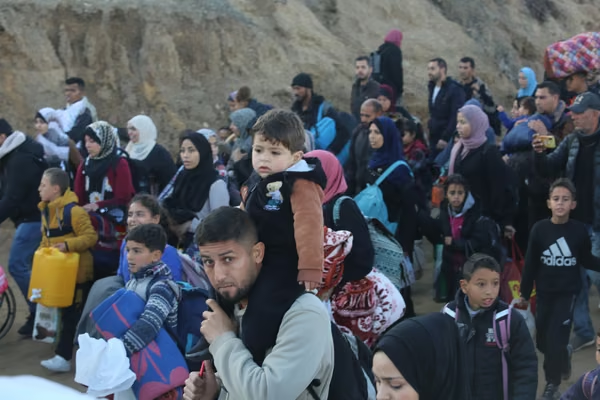
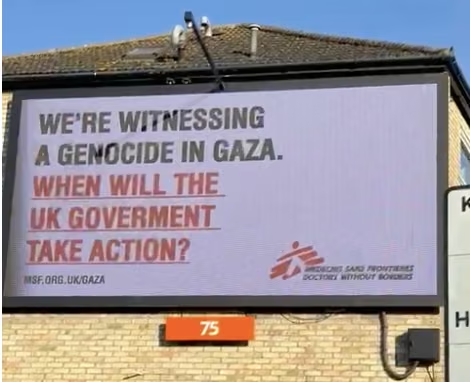
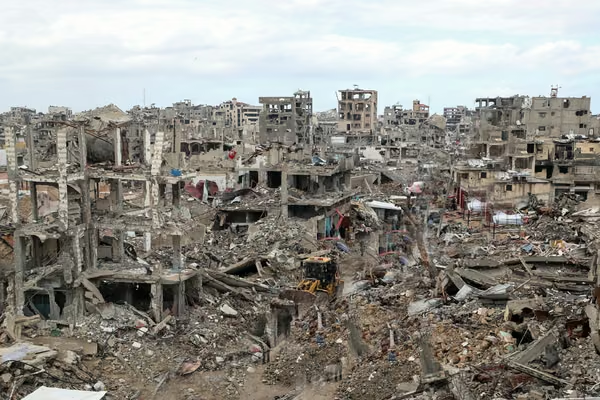
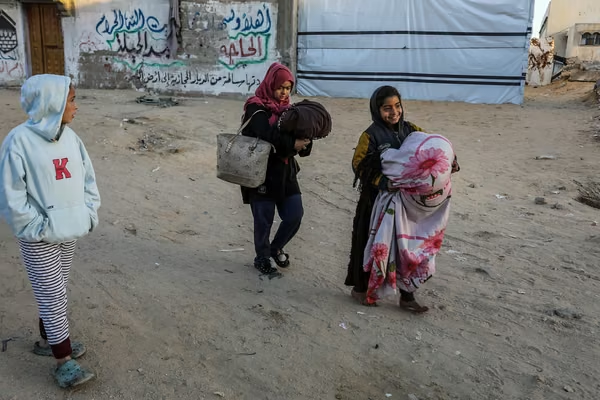
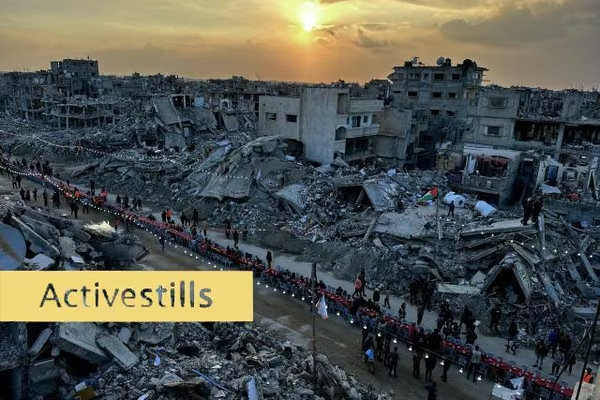
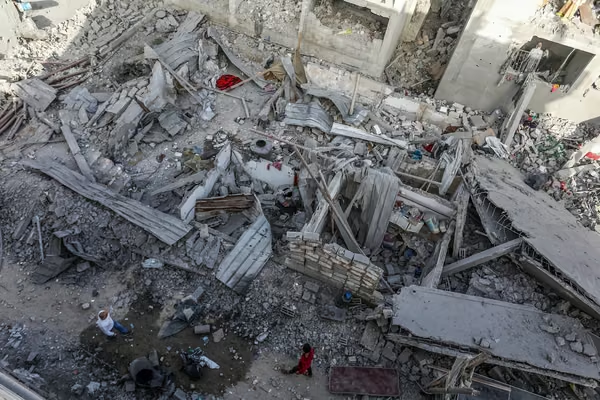
Comments are now closed.