
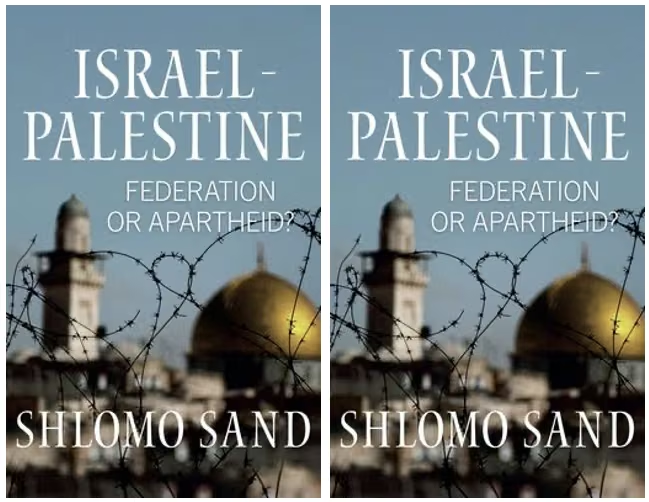
“Israel-Palestine: Federation or Apartheid?” by Shlomo Sand – a review
JVL Introduction
Deborah Maccoby provides a very helpful overview of Shlomo Sands’ new book on ideas of binationalism in the Zionist movement from the early C20th onwards. Some critical comments on it are included in the endnotes.
Early binational Zionists advocated a Jewish cultural and spiritual centre in cooperation with the Palestinian Arabs and warned against Political Zionism’s goal of an exclusively Jewish ethnic nation-state.
Never a political force of much weight, binationalism is nonetheless an option that is appealing once again to growing numbers of those who struggle for equality and human rights for all affected by Israel’s ethnonationalist project.
In what Maccoby describes as a deeply pessimistic book Sands is honest – and deeply sceptical – about the very binational solution he advocates. But he nonetheless refuses to give in to despair and carries on “struggling in the dark, perhaps apparently against all hope” against what looks set to become “another great catastrophe, the prelude to yet more waves of emigration”.
RK
Israel-Palestine: Federation or Apartheid? by Shlomo Sand
translated by Robin Mackay, Polity Press, Cambridge, 2024, 205pp.
Reviewed by Deborah Maccoby
The aim of this book, Shlomo Sand states in his Preface, is “to reflect on ideas of binationalism” (p. 10). The book is partly a meditation on nationalism and binationalism; but it is also a history of the binationalist strand within the Zionist movement and in Israeli-Jewish and Palestinian-Arab thinking, up to the present day, when, as Sand writes in his first chapter, the idea is “back in the public arena, both in Israel and in the United States, but also – unlike in the distant past – among a growing number of Palestinian intellectuals” (p. 20).
Sand admits frankly that, even though the idea is re-emerging at the present time, the concept is not in any way a political force; indeed, he writes in the very last sentence of his Afterword: “at present, there are no political options in sight, to prevent another impending disaster” (p. 205). Nonetheless, he concludes, near the end of his final chapter:
It is up to each and every one of us who wants to guarantee the future of our children and our grandchildren in the Middle East to begin struggling in the dark, perhaps apparently against all hope, for equality and fundamental rights for others, for those who live next to and opposite us. And perhaps, like our ancestors, on both sides of the confrontation, to prepare for another great catastrophe, the prelude to yet more waves of emigration (p. 201).
In other words, this is a deeply pessimistic book that is extremely sceptical that the solution it advocates can happen in the foreseeable future, or indeed ever (the alternative being “another great catastrophe” for both peoples), but nonetheless, refuses to give in to despair and carries on “struggling in the dark, perhaps apparently against all hope”.
Sand is equally frank about the role of binationalism in early Zionism. He points out that mainstream Zionism leaders often flirted with ideas of binationalism, but this was only tactical, while Jews were in a minority. The mainstream interest in binationalism was never meant seriously, because the
stalling tactics … were always subject to a condition sine qua non – the achievement of a dominant Jewish majority as a prerequisite for any solution of statal coexistence — along with a staunch refusal to establish a political structure based on the democratic principle of ‘one person, one vote’, which would risk impeding Jewish colonization (p. 17).
So Sand admits that the first genuine proponents of a binational state – figures such as Martin Buber, Hugo Bergmann, Judah Magnes and Hans Kohn — renowned thinkers though they were, played a very marginal role in the early Zionist movement. But, as he points out, this does not lessen the significance of their warnings, which have proved to be right:
The fact that the binational paradigm was once the aspiration of critical Jewish intellectuals, but they never succeeded in bringing it to dominate the political landscape does not diminish its value, particularly in view of today’s distressing reality. Although writers and artists cut off from politics tend towards the metaphysical, their analyses can often be prophetic (p. 20).
These early binational Zionists, who were influenced by the universalist vision of the Hebrew Prophets, wanted a Jewish cultural and spiritual centre in cooperation with the Palestinian Arabs,[1] and warned against Political Zionism’s goal of a Jewish State on the model of the 19th century Eastern and Central European ethnic nation-state that belonged to one ethnic group, not to all its citizens. To take just one example of the many warnings that Sand quotes, Hans Kohn predicted that such a state would be “armed to the teeth” and “a hotbed of exaggerated nationalism” (p. 57).
Sand devotes the first five chapters to these early binationalists, then, in Chapter 6, discusses the short-lived political adherence to binationalism on the part of left-wing parties, in particular the Marxist movement Hashomer Hatzair and the Palestine Communist Party. Before 1948, Hashomer Hatzair was committed to binationalism; yet this did not prevent the group from joining the kibbutz movement, which excluded Arab labour, and from also being committed to the principle of a Jewish majority in “Eretz Israel”. After 1948, Hashomer Hatzair abandoned binationalism altogether. The Palestinian Communist Party (PCP) at first included both Jews and Arabs; but the Arabs broke away to found the National Liberation League (NLL). The PCP at first denied the existence of an Israeli-Jewish nationality but came to support a binational state that recognised a Jewish national identity; in contrast, the NLL supported a single unitary state. The Soviet Union briefly came out in favour of binationalism; it is a little-known fact, unearthed by Sand, that, before he gave his speech at the United Nations General Assembly in support of partition, Andrei Gromyko, the Soviet Foreign Minister at the time, made a speech at the UN in favour of a binational state (p. 112).[2] But, after the Soviet Union came out in support of partition, “the PCP and the National Liberation League … accepted the Soviet directive and united under a new name: the Israeli Communist Party” (p. 113).
Sand’s tracing of the binational strand takes him next to the “Canaanites” of the 1950s, who regarded Israel as a new “Hebrew” nation distinct from Judaism and Diaspora Jewry. Sand writes, with his typical honesty, that there was little Palestinian national consciousness (as apart from consciousness of themselves as Arabs) before the 1950s; but a left-wing faction of the “Canaanites” – a faction that included Uri Avnery as one of its most prominent members — founded a group called Semitic Action in the 1950s, which was particularly receptive to the Palestinians’ growing sense of themselves as a nation:
Avnery and the other members of Semitic Action were among the first to introduce this new identity to the Israeli public. The demand for the recognition of a Hebrew people distinct from the Jews of the world made it easier for members of the group to begin to identify the Arab population living in Eretz Israel as a specific Palestinian people (p. 125).
Avnery developed a vision of a “Jordan Union”, which would gradually move from a federal structure between states to a unified state (p. 127). Semitic Action, however, disbanded before 1967.
In the next two chapters, Sand returns to his comment in the first chapter that the idea is “back in the public arena, both in Israel and in the United States, but also – unlike in the distant past – among a growing number of Palestinian intellectuals” (p. 20). In Chapter 9, which is about Arab attitudes towards binationalism, he admits (p. 171) that most Palestinian Arab intellectuals support a unitary “secular and democratic state” and that, although
most supporters of the secular and democratic state admit formally that all the Jewish-born residents of Israel should be able to continue to live in the common state … they do not see fit to address the legitimacy of their retaining specific collective rights as part of an overall solution (p. 172).
One of the exceptions is the Israeli-Palestinian academic As’ad Ghanem, a lecturer in Political Science at the University of Haifa, who, Sand writes:
incisively criticises those who advocate the creation of a ‘secular and democratic’ state on the grounds that they underestimate the strength of national feeling among the two peoples. This oversight can only exacerbate antagonisms, and will not contribute to advancing the compromises needed to achieve equality between the two communities (p. 173).
Sand mentions some other Palestinian Arab intellectuals, such as Azmi Bishara (p. 174) and Ali Abunimah[3], who have advocated a binational state; and in Chapter 8, Sand points out the growing interest in binationalism among prominent Israeli Jewish and US Jewish intellectuals, such as Tony Judt (d. 2010), A. B Yehoshua (d.2022) and Peter Beinart today.
Throughout the book, Sand argues that the two-state solution for the Israel/Palestine conflict, though still the international consensus, has become “hollow, abstract political discourse” to which “the world pays lip service” (p. xi) but which no-one really expects to be achieved. Indeed, Sand argues that “demanding separation and the creation of an independent Palestinian state amounts to an alibi that preserves the status quo, allowing for uncontrolled colonisation” (p. 148). Moreover, he points out (p. 192) that “it is hardly plausible that any government can simply remove 850,000 settlers from the heart of the historic homeland”.[4]
The reality, as Sand argues in his Preface (p. xi), is that Israel/Palestine has become one apartheid binational state, in which the two peoples are inextricably entwined. The task, therefore, is to transform this reality into a binational state in which there are equal rights for the two peoples. Hence the book’s title: Israel-Palestine: Federation or Apartheid?
In his last chapter, Sand examines three alternatives that are currently being put forward to the two-state solution: a unitary “secular democratic state”; a confederation between two states; and a federal binational state. The first is very popular among Palestinian solidarity activists, but Sand argues that it involves the problem articulated by As’ad Ghanem: the lack of any provision for Israeli-Jewish collective identity, a lack that “can only exacerbate antagonisms”.
Another proposed solution is that of a confederation. Sand clarifies the distinction between a confederation and a federal binational state (two ideas that are often confused). Unlike Israeli and Palestinian supporters of the federal binational option, who, Sand stresses, “have not organised themselves into a political or ideological movement” (p. 152), Israeli and Palestinian backers of the confederal plan have united in a movement called “A Land for All”, initiated in 2012 by Meron Rapoport and the Fatah activist Mawni al-Rashni – a movement that, according to its leaders, now has several thousand supporters (p. 152). According to this confederal solution, citizens of two confederated states would be able to live and work anywhere in the whole land but will vote only in their home states. But Sand argues against this plan that the confederation would have to be between two already existing states, so the problems attendant on the two-state solution would apply to the confederation. He criticizes a public lecture given on the confederal solution by Oren Yiftachel, who cited as successful examples of confederal states the United Kingdom, Canada and Switzerland. Sand points out that:
in these three successful cases, unlike in his Israeli-Palestinian project, the entire binational or multinational population benefits not only from ‘the freedom to come and go’ across the various regions … but also from a single, common and egalitarian citizenship (p. 153).
Sand argues against Yiftachel that the UK, Canada and Switzerland are federal binational or multinational states. Thus, in the UK, despite the devolved parliaments of Wales, Scotland and Northern Ireland, we are all British citizens.[5] Moreover, Sand points out (p. 154) that some advocates of the confederal solution envisage a demilitarised Palestinian state that will continue to be patrolled by the Israeli army.
The option advocated by Sand in this book is a federal binational state, which he defines in his final chapter as follows:
a federation of two or more national entities, as in Belgium, Canada, Switzerland, Great Britain, Spain, India, Bosnia-Herzegovina, and other countries, which have a common sovereignty and citizenship but have maintained cultural and linguistic particularities, autonomous governance bodies, elected assemblies attached to a supreme parliament and so forth. This is the scheme at the heart of the vision of eminent intellectuals on the fringes of the Zionist movement. Similar ideas are increasingly found today on the critical fringes of Israeli political commentary, as well as in current Palestinian thought(pp. 198-199).
To try to sum up: without illusions, and with clarity and honesty, this Israeli historian goes back into the past to pick up a strand of internal critique within the Zionist movement itself that has always been marginal but has never gone away and the warnings of which have been proved right in the current catastrophic situation. This marginal strand is now re-emerging, with a possibility, very remote though it seems, that it could become a very slender Ariadne’s thread of hope to guide the two peoples, through the present dark and ominous labyrinth, towards an alternative future.[6]
Endnotes
[1] It is typical of the honesty of this book that Sand does not flinch from addressing the “völkish” racism that formed part of the attitudes of some of these thinkers, especially Martin Buber, whose writings, profound and brilliant though they are, include mystical references to “blood”; an attitude that, Sand points out was “by no means exceptional at the time” (p. 16). Having been portrayed as non-European and “Semitic” by European antisemites, the binationalists embraced the idea of being Semites together with their Semitic Arab cousins, taking a completely opposite approach to that of mainstream Political Zionists, who inherited from Eastern and Central Europe both the idea of the ethnic nation-state that belongs to one ethnic group and an arrogant colonialist attitude of being “a rampart of Europe against Asia, an outpost of civilisation as opposed to barbarism”, in the words of Theodor Herzl (quoted on p. 27). Sand writes of pacifist binationalist groups such as Brit Shalom and its main successor Ihud: “The concept of race … fuelled not only the arrogant separatism that has left its mark upon the entire history of the conflict, but also visions of coexistence, integration, and even fusion with the other in the promised land” (p. 16).
[2]. Another little-known fact that Sand unearths is that in 1977, after becoming Prime Minister, Menachem Begin, presented to the Knesset a plan according to which residents of the West Bank and Gaza could choose freely between Jordanian and Israeli citizenship. But his plan “never even got off the ground” and “his successors entirely marginalised this idea” (p. 140). It is highly unlikely, however, that Begin meant this plan seriously; the likelihood is that it was for show, to disguise the fact that Begin had no intention of allowing a Palestinian State. Weirdly, Sand describes Begin as “a firm liberal” (p. 138). The strangest thing about this description is that Sand ignores a famous letter to the New York Times denouncing Begin as a fascist: “The public avowals of Begin’s party are no guide whatever to its actual character. Today they speak of freedom, democracy and anti-imperialism, whereas until recently they openly preached the doctrine of the fascist state.” The signatories of this letter include Hannah Arendt and Albert Einstein, two of the early binationalist Zionists who are the main focus of Sand’s book, featuring strongly in it. Sand never mentions this letter.
[3] Sand claims (p. 172) that in his book One Country: A Bold Proposal to End the Israeli-Palestinian Impasse (2007), Abunimah advocates for a unitary state; but this book actually recommends a binational state. In his later book The Battle for Justice in Palestine: The Case for a Single Democratic State in Palestine (2014), Abunimah has changed his position and does indeed advocate for a unitary state.
[4] Sand does not think the present disastrous situation was inevitable. He recognises that there was a “pragmatism of reasonable Zionism” (p. 197) that could have led to a successful two-state solution. But, in his analysis, this was overwhelmed by the ethnic nation-state paradigm that demanded the whole land and by the Zionist philosophy of “one more dunum, one more goat” that made all governments reluctant to stop the expansion of settlements (p. 188). The result, as he emphasizes, is that Israel is already in a binational reality.
[5] On page 13, Sand writes of federal binational and multinational states: “Despite friction and sometimes acute conflict, these plurinational frameworks have survived”. On the same page, he compares the UK with France, where “the languages and cultural particularities of Occitania and Brittany were crushed under the steamroller of state centralism”, whereas in the UK “the Welsh, the Scots and the Irish retained their pre-modern integrity, contributing to the existence of a hybrid multinational state”. He leaves out of account, however, the extent to which the UK is still a centralized unitary state in which England, which historically defeated and dominated the other nations, still dominates them; but, with devolution, the UK has at least been moving in the direction of “a hybrid multinational state”.
[6] My main problem with the book is not chiefly concerned with the book itself; this problem relates mainly to the Preface and the Afterword, which, it is clear, were written after the book was completed. In the Preface, Sand writes of “Israel’s war of revenge, without any clear political objectives and arguably just as cruel as the October 7 attack” (p. xi); and in the Afterword he writes of “Hamas’s violent uprising in Gaza and Israel’s crushing military response, which has been equally devastating” (p. 203). It should be pointed out that the book under review is an English translation of a French translation of the original Hebrew text; the Preface and Afterword appear to have been written just after October 7, in the early days of Israel’s genocidal onslaught on Gaza. Even so, it was surely clear from the beginning that Israel’s retaliation would be of a far greater order of magnitude than the massacre of October 7. But this Israeli historian, “struggling in the dark”, was probably caught up in the Israeli mass hysteria of the time and may even have fallen for the discredited fabrications about beheaded babies etc. (which is not to deny that October 7 was a brutal massacre; but Israel’s revenge is a genocide). Also Sand writes (pp. 193-196) of the possibility that Israel may engage in another mass “transfer” of Palestinians, without taking into account that originally, after October 7, Israel sought to expel the Gazan population into the Sinai Desert; when this proved impossible because Egypt refused to open the border, Israel turned to destruction of Gaza and genocide. See Norman Finkelstein’s analysis here.







Thanks, very interesting, although when I heard Sand in discussion some years ago with the philosopher Brian Klug, I wasn’t greatly impressed with the clarity of Sand’s thought.
Incidentally, there’s a link missing where Deborah cites Norman Finkelstein’s contribution.
Perhaps the editor could post the link? Many thanks.
Thank you Brian for pointing out the “missing link”. It should have been fixed now.
I have not read the book, but think this is an excellent exposition of the book and its flaws, albeit that it is ‘struggling in the dark’. It deals with many of the dilemmas that I think are crucial to the current debates eg a binational or a federal binational or multinational state that need to be foregrounded today.
Sand seems to be a humane academic who (oddly for a historian) refuses to allow nasty realities to shape his thinking about what futures are POSSIBLE for Israel and Palestine.
“The option advocated by Sand in this book is a federal binational state, which he defines in his final chapter as follows: a federation of two or more national entities, as in Belgium, Canada ..”.
In Belgium, Canada etc, neither of the nationalities in the new binational states had repeatedly and recently massacred and expropriated the other before they became citizens of a larger whole. Nor was there such a total imbalance between the military and civil power of one nationality and that of the other. Nor had one community learnt from kindergarten (if not before) that it only its “rights” mattered and should prevail.
One day Palestine and Israel may have good relationships with each other (as a loose association of states or as a confederacy) … but that future is very far off. Any progress towards a binational state is more likely to start with a free, independent State of Palestine on the UN-legitimised 1967 borders.
The majority of Israelis can’t and won’t accede to losing so much of the lands they’ve expropriated since 1967 UNLESS Israel’s circumstances become so adverse they have no better choice.
Israel MAY be sufficiently weakened to allow the conditions for peace – agreeing to a Palestinian state governed by whomsoever the Palestinians elect – but that requires a whole lot of “IFs” to happen. Just a few examples of the necessary “IFs” … IF their wealth-creating citizens continue to leave Israel at the current rate … IF Israel nears insolvency due to the direct and indirect costs of its wars…
Just call it Palestine and make it law that all who reside there are Palestinian and have equal rights, regardless of religion or ethnicity, and do away with this narrow and exclusive thing called ‘Israel’. It doesn’t fit into the modern MENA and people aren’t keen on it, along with Egypt, Jordan, and the Gulf states being America’s guard dogs.
Only socialists would argue for binationalism. It is not an acceptable concept to Jewish nationalists. Two State solution is a nonsense – where would the Palestinian State be located, especially now? The Israelis will not give up an inch of the country (whether or not ‘occupied territory’). We can see them planning to take over Gaza and the settlers are forcing their way into all part of the West Bank. Surely there is little doubt that the Israeli government and vast majority of the Jewish people in Israel want the Palestinians out – frankly not caring whether dead or alive. We are witnessing a cruel genocide of the Palestinian people. This was almost the fate of Jews in Nazi Europe, Armenians by Turkey, Uyghurs by Chinese, and by conquering Western Europeans the Native Americans, First Nation People, Aboriginal people, etc etc. What will happen to the millions of Palestinian refugees?