
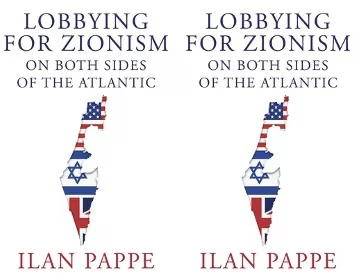
Lobbying for Zionism on both sides of the Atlantic – a review
JVL Introduction
Ilan Pappe, renowned Israeli historian, tries a new tack in his book “Lobbying for Zionism on Both Sides of the Atlantic”.
He hypothesises that the Zionist leaders knew subconsciously from the start that their project was inherently unjust. So they were not too bothered to win over public hearts and minds but saw success, rather, in winning over elites to their cause, especially those with a Christian evangelical background.
In the process a dense institutional network of lobbying organisations was developed from very early on, one that has taken on a life of its own.
This book is the story of the sheer ruthlessness, efficiency and power of this Israel Lobby, though its limitations from time to time are acknowledged.
Peter Oborne has been fulsome in his praise for this book.
But Deborah Maccoby does not follow him, arguing that it tells the same story over and over again with no real historical development, no narrative thrust (and no real sense of why Israel is so obsessed with “delegitimisation”).
Pappe’s conclusions are tacked on and in no sense follow from his analysis and his assertion that the anti-Zionist movement is united around the concept of a single state is simply not the case, says Maccoby.
And, if we are going there, if Pappe wants to say that “basic civil rights of the Palestinians are rooted in international law” surely he can’t ignore the fact that Israel’s right to exist within the pre-1967 borders is also “rooted in international law”.
But that is another discussion…
RK
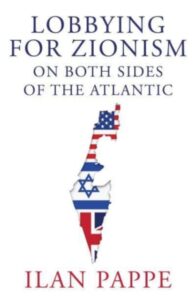 “Lobbying for Zionism on Both Sides of the Atlantic”
Ilan Pappe, Oneworld Publications, 2024, pp.521.
reviewed by Deborah Maccoby
Ilan Pappe writes in his Preface that he wrote this book in order to test out an assumption, three hypotheses and an “obvious observation”. The assumption, he writes, offers an answer to a riddle or conundrum, which is: why are Israel and its Lobby so intent on opposing “delegitimization”? As he puts it: “Why does this Jewish state still crave recognition of its legitimacy in the West?”:
“Why does Israel still lobby for its legitimacy more than 75 years after its establishment, especially given its objective political and economic power?… I offer one assumption… that the key to this riddle can be found by looking at what’s hidden in the human consciousness. Those who led the Zionist movement and later Israel were intuitively aware of the inherent injustice of the project, or at least the immoral dimensions of the seemingly ‘noble’ solution to the problem of anti-Semitism in Europe… I know that there’s no smoking gun document that unveils these subconscious motivations – I am not going to try to produce one. But I hope a detailed historical analysis of the lobby from its inception until today will show this assumption is correct (p. xi).”
I will come to the “obvious observation” later, because it needs a lot of parsing. The three hypotheses are as follows (I have summarized the first two):
- Because “those who led the Zionist movement and later Israel were intuitively aware of the inherent injustice of the project” they needed to counteract this awareness by convincing themselves consciously that the project was “morally unique”and “a noble endeavour” (pp. xi-xii);
- despite having convinced itself consciously of Zionism’s moral uniqueness and superiority, the Zionist movement was still riven by subconscious self-doubt, and so from early on stopped caring too much about winning over public hearts and minds and concentrated instead on elites: “from very early on, because of its self-doubt, the Zionist movement dispensed with moral arguments and with engaging with societies at large and invested all its efforts in elites: an enterprise that required money, connections and efficient advocacy” (p. xii; I will come back to this hypothesis later);
- “the political clout accumulated for galvanising elites created very powerful lobbies on both sides of the Atlantic, which represented institutions in their own right, with their own vested interests. Occasionally, they acted primarily to preserve their own power, and not necessarily for the sake of the Israeli cause” (p. xii).
In Chapter 1, Pappe concentrates on the beginnings of Zionism among 19th century evangelical Christians in the UK and US. Christian Zionism is a major theme in the book; in later chapters we find that, in the UK, support for Zionism progressed through elite figures such as Lord Balfour, David Lloyd-George, Harold Wilson, Tony Blair and Gordon Brown, who all had an evangelical Christian background. In the US, American Presidents such as Truman and Clinton seem to have been influenced in their support for the Israel Lobby by their Baptist upbringing. And in the US, much support for the Israel Lobby progressed through the powerful Christian Zionist movement, which today forms a major part of the US Israel Lobby.
After Chapter 1, the early chapters of the book concentrate on elites in Britain, the superpower that came to acquire a Mandate over Palestine. Chapters 2, 3 and 4 are about lobbying for the Balfour Declaration and lobbying in Britain during the Mandate. In 1947, Britain decided to withdraw from Palestine, throwing the whole intractable problem into the lap of the United Nations. The United States by this time had become the new world superpower; the next chapters focus on the US. Two chapters take us back to the early days of Zionist lobbying in the US and to American Zionism during the Holocaust; then – after a brief return to the UK (in a chapter about Zionism in Post-War Britain) – we spend three chapters, dealing with events from 1947 to the current day, in the United States; then back to Britain for a chapter about the UK Israel Lobby in the 21st century; then a Conclusion and an Afterword about October 7.
The book consists of story after story that, taken all together, demonstrate overwhelmingly the sheer ruthlessness, efficiency and power of the Israel Lobby. The cumulative effect of the Lobby’s pressure upon American Presidents helps to explain why President Biden has automatically given support to Israel’s genocidal onslaught against Gaza.
At the same time, Pappe brings out the limitations on the Lobby’s ability to influence US policy. Examples of such failures are Obama’s insistence on signing the Iran deal in despite of a virulent campaign by AIPAC, and Biden’s revival of the Iran deal – but Pappe points out that, though US Presidents will fight against AIPAC on issues concerning the wider Middle East, US Presidents have generally given in on Palestine.[1] A notable exception is the Oslo Accords, which Pappe cites as an AIPAC failure, even though the Accords had no potential to provide the Palestinians with a viable state. Though the Oslo Accords were clearly to Israel’s advantage, they were strongly opposed by AIPAC – which Pappe cites as an example of his third hypothesis: that occasionally Zionist organisations act only to preserve their own power, not the interests of Israel (or at least Israel’s interests as perceived by itself; they are by no means Israel’s real interests).[2]
But what about Pappe’s “assumption” or answer to the “riddle” or “conundrum” that he poses in his Preface: why does Israel campaign so virulently for its own legitimacy? In the book’s penultimate chapter, about Britain in the 21st Century, Pappe describes events of the summer of 2018, in which attacks on Corbyn for his alleged antisemitism reached their hysterical crescendo. Pappe cites comments made by the then-President of the Board of Deputies, Marie van der Zyl, in an interview in August 2018 for the right-wing Israeli news channel i24NEWS. She declared in this interview: “Jeremy Corbyn has made war on the Jews at home”. Pointing out Corbyn’s support for a two-state solution, Pappe comments:
“When we grasp the gulf between van der Zyl’s hysterical reaction to Corbyn and his real position, we are getting very close to solving the conundrum posed at the beginning of this book. Defenders of Israel are constantly beset by self-doubt about the state’s legitimacy, and this fuels the campaign to justify a project and later a state that could only be founded and sustained by the constant oppression of another nation (p. 473).”
Of course, we cannot look into the murky depths of Marie van der Zyl’s psyche; but my guess is that it does not harbour many doubts about the legitimacy of Israel. She wrote, in an article in the Jewish Chronicle in November 2018: “It has been said of me that ‘the only difference between me and a Rottweiler is that a Rottweiler eventually lets go’. I take that as a compliment”.[3] It is hard to imagine a super-Rottweiler like van der Zyl even subconsciously nurturing much inner self-questioning.
To go back to the “obvious observation” that Pappe put forward in his Preface, together with his Assumption and his three Hypotheses: his “Obvious Observation” is that settler-colonial states such as the United States and Australia do not suffer from a subconscious awareness of their own illegitimacy – and therefore do not need constantly to advocate for this legitimacy against the threat of “delegitimization” – because they have crushed the Native Americans and the Australian Aborigines so much that they no longer pose any threat, unlike the Palestinians, who remain a living people, having not (until the recent onslaught on Gaza) been subjected to the genocide suffered by the Native Americans or the Australian Aborigines:
“Israel’s consciousness of its illegitimacy and the consequent necessity of constant advocacy are the result of Zionism’s failure to complete the settler-colonial project it began in 1882, when the first Jewish settlers arrived in Palestine. Unlike other settler-colonial movements, such as those colonising North America and Australia who demonstrated inhuman efficiency, it could not eliminate the native inhabitants of historical Palestine (p. xiii).”
I have two problems with this “obvious observation” which doesn’t seem obvious to me. My first difficulty is that Pappe seems to be saying that the United States and Australia have achieved legitimacy by committing genocide, whereas Israel within the pre-1967 borders is illegitimate because it didn’t commit genocide in 1948; a distinction that I find morally problematic. My second problem with Pappe’s formulation is that, for all the injustice of its founding, Israel’s existence within the pre-1967 borders is enshrined in international law. Pappe cannot argue for “basic civil rights of the Palestinians that are rooted in international law” – the right of return, the right of Palestinians in the West Bank and Gaza not to be occupied and the right of Palestinian citizens of Israel not to be discriminated against (p. 395) – and ignore the fact that Israel’s right to exist within the pre-1967 borders is also “rooted in international law”. Moreover, the Palestinians have mostly accepted Israel within the pre-1967 borders – even Hamas has signalled many times that it is willing to do so. It is indeed Israel apologists who argue that Hamas “refuses to accept Israel’s right to exist”, as Hadley Freeman has written – see my review of her pamphlet Blindness.[4] This is why I don’t think it is true that Israel suffers from a subconscious awareness of its illegitimacy within the pre-1967 borders. Israel and its Lobby do suffer from a very conscious awareness of Israel’s illegal settlements, its land-grabbing Wall, its blockade of Gaza, its illegitimacy, in recent years, as an apartheid state across the whole land, and its many other injustices and atrocities against the Palestinians, culminating in its genocidal onslaught on Gaza –and the main reason it adopts the “delegitimization” rhetoric is surely to deflect attention from all this and portray itself as a victim.
I also find Pappe’s second Hypothesis – that from very early on Zionism has put its efforts into targeting elites rather the general public – very problematic. In the whole of the book of 500 pages, Pappe never uses the Hebrew word hasbara (“explaining”); it is not in the index and I cannot remember reading it. Surely hasbara has always been a fundamental part of advocacy for Israel and has always been aimed at the general public? As for Israel “from very early on” dispensing with moral arguments directed at the general public (see the second “hypothesis” at the beginning of this review): Israel disseminated, for instance, for many years the moral (though completely false) argument of the “Arab broadcasts” to explain the Nakba – a fiction that was eventually exposed by “New Historians” such as Benny Morris and Pappe himself.
Pappe’s Assumption, Hypotheses and Obvious Observation are far too nebulous, flimsy and problematic to form a credible over-arching thesis. Only the third Hypothesis stands up to scrutiny. My main problem with this book is that, though it is held together by themes such as the targeting of elites or the significance of Christian Zionism, it does not have any real overall analysis. Instead, it consists of a cumulative piling-up of stories making the same point over and over again – the ruthlessness, persistence and power (even if limited) of the Israel Lobby. We meet many different characters – often interesting in themselves — and there are engaging descriptions of the opulent buildings in which conferences and meetings are held; also there is an entertaining section (in Chapter 10) about Israel’s decision (pp. 407-8) to “abandon trying to win the argument with facts, information or moral points of view” and instead to “brand Israel and market it like a product”.[5] But the book has no big, comprehensive story that can create a real narrative drive.
To return to Pappe’s comments about Corbyn’s support for a two-state solution: Pappe writes: “At the time of his election, this position made him an outlier among the Palestine Solidarity Campaign, and the wider anti-Zionist movement, who supported the one-state solution” (p. 471). Peter Oborne, in his review of Pappe’s book, repeats Pappe’s claim that PSC supports a one-state solution.[6] But in fact PSC has never supported a one-state solution. Its current position is not to take a position on either one or two states but only to advocate for equal rights for all in the area of historic Palestine.[7] This indeed seems at present to be the only viable formula for the creation of a broad public coalition against Israeli apartheid and genocide. In all his detailed account of early Zionism, Pappe never once mentions the alternative bi-nationalist Zionist movement that was opposed to the creation of a Jewish state and instead advocated for a federated state that would allow for equal collective rights for both national groups, as well as equal individual rights for all its citizens – a concept that is being revived among some Israelis[8] and seems far more workable than Pappe’s advocacy of a unitary Palestinian state, with no recognition of the national rights of Israeli Jews – a vision that feeds into the Israeli rhetoric of “delegitimization”.
To conclude: if you like to read history as a cumulative record of stories making the same point over and over again, you will enjoy this book. If, like myself, you prefer to read history in terms of one main coherent story that explains the many little stories – that is, in terms of a real thesis and analysis — you will find this 500-page book at times engaging and informative, but deeply flawed in its basic premises and difficult to read.
Footnotes
[1] Pappe points out “a tacit understanding between AIPAC and the White House, which had existed since Gerald Ford’s time, that AIPAC could and should influence policy on the Palestine issue, but it could not wield decisive power over America’s policy towards the Middle East region” (pp. 402-3).
[2] See p. 324: “AIPAC was not interested in the peace process…. It was focused on maintaining its own power” and p. 332: “America’s endorsement of the Oslo Accords was not a milestone on the road to peace for AIPAC, but a testimony to its own failure to influence America’s policy”.
[3] Marie van der Zyl, Engagement does not mean concessions, Jewish Chronicle, 18 Nov 2018
Pappe also writes that van der Zyl “came to Britain in the famous Kindertransport” (p. 472). In fact, it was her grandfather who did so.
[4] Blindness: October 7 and the Left, by Hadley Freeman, The Jewish Quarterly, Issue 256, May 2024. Reviewed by Deborah Maccoby, 16th June 2024
[5] This “new idea” (p. 404) surely brings out the fact that previously Israel had tried to win over the general public with “facts, information [and] moral points of view” (in contradiction of Hypothesis 2).
[6] Peter Oborne, Why Ilan Pappe’s new book on the Israel lobby is a must-read.
[7] See this link on the PSC website:
“PSC does not take a position either in support or against a one state or two state solution, but insists that any solution must be based on the protection of human rights and upholding the collective rights of the Palestinian people as recognised under international law.”
Pappe also writes, in relation to the EHRC report, that Corbyn “refused to accept the report’s conclusions – and was promptly suspended by the new Labour leader, Keir Starmer”. In fact, Corbyn was not suspended for refusing to accept the report’s conclusions, but for saying that the scale of antisemitism in the Labour Party had been “dramatically overstated for political motives” (a comment that did not refer directly to the report but to the campaign against Labour’s alleged “antisemitism crisis”). See Corbyn’s statement on Facebook and a BBC report.
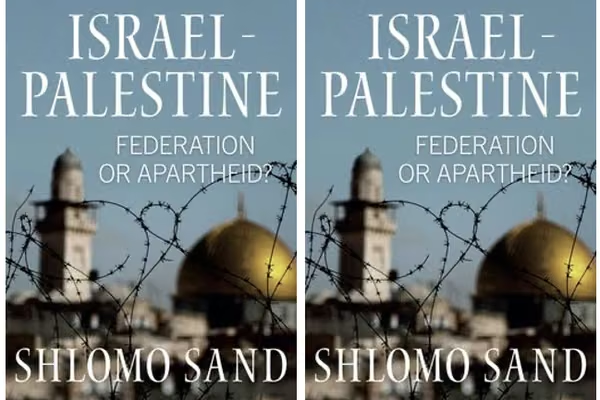
[8] See Shlomo Sand’s forthcoming book (English version) on the idea of a binational federation in Israel/Palestine: Israel-Palestine: Federation or Apartheid?
Reviewed by Adam Shatz in the LRB, June 20, 2024, under the French title Deux peoples pour un etat? Relire l‘histoire du sionisme. Pappe argues (p. 504) that Judaism is a religion and not a national identity; this raises many questions about the meanings of “nation”, “people”, “cultural group” the existence of secular Jews – all of which could be endlessly debated; but surely – despite all the injustice of Israel’s founding — a national group of Israeli Jews with a collective identity has arisen there.




“He hypothesises that the Zionist leaders knew subconsciously from the start that their project was inherently unjust.’
I would go further. They knew from the start that their project was to ethnically cleanse Palestine and do it in the name of Judaism for which they had no great adherence. They rode on the back of Judaism so that they could use the nuclear weapon of antiSemitism against anyone, including Jews, who stood in their way.
Pappe seems to be talking, however, about a subconscious guilty conscience on the part of Zionist leaders — a subconscious awareness of how wrong and unjust their project was. I think this is unlikely — and far too flattering towards Zionist leaders. In any case, it is much too nebulous and flimsy a theory to form a thesis for a book of 500 pages.
The Pappe book ignores the historical and geographical contexts of the various genocides (as Pappe is such a notable historian that’s odd).
The brutal occupation and mass slaughter of the Palestinians began happening slowly from the 1920s onward in a world that increasingly sets its face against imperialism and the destruction of defenceless indigenous populations by well-armed foreign forces.
Our mindsets and sympathies are rooted in the WW2 Holocaust (and the Nuremburg Trials); the civil rights struggles in the American South; and the ending of Apartheid in South Africa. We can see almost as soon as it happens the horrible suffering and destruction in Gaza and elsewhere.
By contrast, the European colonialists responsible for the genocides (from the 17th century onwards) against the indigenous people of America and Australia came from societies where brutal treatment of very many differently vulnerable groups (eg slaves, children, social and religious “deviants” and the masses of the very poor) was NORMAL. Governments and the public knew little and had almost no influence over their colonists even on the rare occasions they wanted to exercise it, communications and enforcement mechanisms being so slow and feeble.