
“Blindness” reviewed – and insight offered
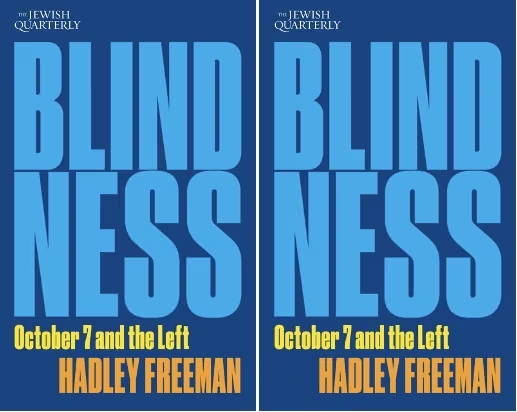
JVL Introduction
Hadley Freeman opens her extended essay Blindness: October 7 and the Left by writing: “October 7 was horrific. Hamas terrorists stormed into southern Israel to rape, kidnap and kill Jews.”
Leaving aside whether these were their intentions in breaking out of their open-air prison, it is the target that is striking: “Jews”.
Not their oppressors, not their occupiers, not their blockaders, not those who have launched four murderous assaults on Gaza already this century – simply “Jews”.
Freeman’s analysis is determined from the outset by this assumption about Hamas and she sees what she calls “the progressive left” as sharing this “hatred of Jews”.
In this careful review of Blindness Deborah Maccoby shows the weaknesses, inconsistencies and contradictions in Freeman’s presentation, an extended rant not a considered analysis.
RK
Updated 20 June 2024
Blindness: October 7 and the Left, by Hadley Freeman, The Jewish Quarterly, Issue 256, May 2024, 85 pp
Reviewed by Deborah Maccoby, 16th June 2024
Whenever Israel is under heightened international condemnation, there is an outbreak of mass hysteria about antisemitism. As Norman Finkelstein has pointed out:
The purpose behind these periodic, meticulously orchestrated media extravaganzas is not to fight anti-Semitism but rather to exploit the historical suffering of Jews in order to immunize Israel against criticism.[1]
Israel is currently faced with unprecedented levels of international condemnation, as a result of the unprecedented depths of barbarity into which it has descended with its genocidal onslaught against Gaza. So the Antisemitism Industry is working overtime.[2]
Since February 2024, the Jewish Quarterly has changed its format so that “each issue will now feature a single long-form essay by a world-class writer”. The current issue of May 2024 consists of an 85-page essay called Blindness: October 7 and the Left, by the author and columnist Hadley Freeman. By “the Left” of her subtitle, Freeman means what she calls “the progressive left” (also “the far left”), as opposed to the “centre or liberal left”, to which she herself subscribes. The essay is divided into four parts: “October 8” (the day after, when, according to Freeman on page 1, “Jews understood how hated they really are”); “Israel”; “the progressive left”; and “the future”. This gives the pamphlet some kind of structure; but – “world-class writer” though Freeman is advertised by the JQ to be – the overall impression is of a rant.
David Baddiel has claimed that, in the eyes of what Freeman calls “the progressive left”, “Jews Don’t Count”. Freeman goes much further here. She believes that “the progressive left” actively hates Jews and wants to see them dead.
Burnishing her centre/liberal left credentials, Freeman tells us on page 23 that she is “sympathetic to the Palestinian cause” and implies at this point that the only factor that stops her from joining the marches for Gaza is the chant “From the river to the sea/Palestine will be free”, which she interprets as calling for the eradication of Israel:
I didn’t feel like these were marches I could attend. They felt like marches not so much in favour of Palestinian rights and statehood but against anyone who believes Israel has a right to exist.
According to interviews carried out by the Observer, most of the demonstrators view the slogan “From the river to the sea/Palestine will be free” as simply meaning equal rights for Israeli Jews and Palestinian Arabs in the area of historic Palestine, between the Jordan and the Mediterranean, whether in two states, one state or anything in between. There is no particular political agenda; some of those interviewed support a two-state solution. The salient point for most of the demonstrators is that Israeli Jews will no longer dominate and Palestinian Arabs will not be subordinate and confined to ghettos.[3]
Nonetheless, there is a valid point to be made here about strategy: that abandoning or changing the “From the river to the sea” chant would make the marches less open to misinterpretation and render their appeal to the public even wider.[4]
This valid point, however, does not apply to Freeman, who makes it clear that she is not only opposed to the “From the river to the sea” chant; she is against the central and crucial demand and slogan of the marches: “Ceasefire Now”. On page 7, she quotes, with evident approval, Anthony Julius (one of several “centre-left” people she interviewed while working on the essay): “’There’s an ellipsis at the end of that demand …. What those people are really saying is “Ceasefire now … while Hamas re-arm”’” (the second ellipsis is in the original). In other words: according to Julius and Freeman, the purpose of the huge marches across the world is not to stop Israel from massacring and starving the people of Gaza. No, according to Julius and Freeman, the demonstrators, driven as they are by hatred of Jews, are marching so that Hamas will be able to rearm, break into Israel again and kill more Jews. It is difficult – indeed, impossible — to imagine a more perverse interpretation of the “Ceasefire Now” slogan, which, like all the best slogans, is perfectly simple, clear and unambiguous.
Freeman never explains why, if the demonstrators hate Jews so much, the Jewish Blocs on these marches (over 1,000 at times in the national demonstrations in London) are accorded the warmest possible welcome, as anyone “openly Jewish” on these marches can attest. Presumably, if she had mentioned the Jewish Blocs, she would have argued that we are welcomed as “self-haters” who want to see more Israeli Jews murdered (perhaps even she would have baulked at this last point, which is maybe why she doesn’t include us). Freeman grew up in New York and often goes back there (pp. 30-31); yet she never mentions the large numbers of US Jews demonstrating against Israel’s onslaught against Gaza.[5] Adam Shatz points out, in an article in the current London Review of Books, that “Jewish students have made up an unusually high number of the protesters on campus”.[6] To include any of this would interfere with Freeman’s black-and-white picture of Jews versus rabidly antisemitic demonstrators. She entirely conflates Jews and Israel – a message that can only fuel antisemitism.
Freeman also makes many factual errors. To mention just some examples: in support of her claim that the marches are “demonstrations of support for the October 7 pogrom” (p. 54), she repeatedly states – “this cannot be repeated enough” (p. 7) — that the marches began before Israel had started to retaliate. But as the Irish former MEP Clare Daly points out in a chapter in the recently published book Deluge: Gaza and Israel from Crisis to Cataclysm:
Even before the end of that first day [i.e., October 7] … Israel had retaliated with airstrikes on Gaza which according to the Gaza Health Ministry had killed at least 230 Palestinians, wounding 1,610. Israeli Prime Minister Benjamin Netanyahu that evening vowed a “mighty vengeance” and pledged that Israel would “turn into ruins” all of the places that “Hamas hides in,” which in traditional Israeli parlance means the entirety of Gaza.[7]
It was in protest against this “mighty vengeance” that had already started that the first marches were immediately organised.
Freeman writes in connection with the “Ceasefire Now” slogan that “Hamas will never honour a ceasefire”. In June 2008, a ceasefire came into operation between Israel and Hamas. Between June and November 2008, Hamas did not fire a single rocket (a small number of rockets were fired by Islamic Jihad and other groups). But on November 4, 2008, when the eyes of the world were on the election of Obama as President of the United States, Israel broke the ceasefire, invading Gaza and killing six Hamas militants; a provocation that predictably led to Hamas rockets, giving Israel a casus belli to launch Operation Cast Lead.
Why did Israel want to launch Operation Cast Lead? One of the reasons gives the lie to another erroneous claim by Freeman: that Hamas “refuses to accept Israel’s right to exist” and is “dedicated to its extermination” (p. 82). On the contrary, among Israel’s reasons for provoking Hamas rockets and attacking Gaza in 2008-2009 was the need to scupper Hamas’s “peace offensive”, in the “telling phrase”, as Norman Finkelstein puts it in his book Gaza: An Inquest into its Martyrdom, of the Israeli strategic analyst Avner Yaniv. To quote Finkelstein:
A 2009 study by a US government agency concluded that Hamas had been “carefully and consciously adjusting its political program for years” and had “sent repeated signals that it is ready to begin a process of co-existing with Israel”. Just a few months before Cast Lead, Khalid Mishal, the head of Hamas’s politburo, stated in an interview that “most Palestinian forces, including Hamas, accept a state on the 1967 borders”.[8]
There was a prospect that the new Obama administration intended to impose a solution that would force Israel into giving up enough land to provide the Palestinians with a viable state. To prevent this scenario, Finkelstein goes on: “Israel needed to provoke Hamas into resuming its attacks”.[9]
Khaled Hroub, Professor of Middle Eastern Studies at Northwestern University/Qatar and author of two books on Hamas, writes in a chapter in Deluge that, in May 2017, Hamas
published a “Document of General Principles and Policies” to replace its (in practice long defunct) 1988 Charter. The main element of the new document was a reaffirmation of Hamas’s acceptance of a Palestinian state on the 1967 borders…. Israel’s response was categorical rejection, with Prime Minister Benjamin Netanyahu theatrically tossing a copy of the document into a trashcan…. The path from there to the explosion of October 7, 2023, was short and direct. Even Israeli intelligence could connect the dots. In 2016, Israel’s military intelligence chief observed that “the humanitarian condition in Gaza is progressively deteriorating” and warned that “if it blows up it will be in Israel’s direction”.[10]
Another of Freeman’s errors is the hoary claim that Corbyn accused British Jews of not understanding “English irony”: “Complaining about ‘Zionists’ is the euphemistic way of complaining about Jews” (p. 38). Corbyn referred not to Jews, nor even to all Zionists, but to two right-wing Zionist individuals who had accused the Palestinian Ambassador of antisemitism after he had made a wry joke. Freeman writes of the current situation: “this feels different to other brushes with antisemitism we’ve seen in the West in recent years, from the Jeremy Corbyn scandal in the UK to the murders in the Tree of Life Synagogue in Pittsburgh” (p. 14). Her bizarre juxtaposition of the democratic socialist Corbyn and the fascist white supremacist Robert Bowers (who carried out the Pittsburgh murders) serves to bolster her depiction of “progressive left”, Corbyn-supporting demonstrators as bloodthirsty antisemites.
A major problem for Freeman in her attempt to put Jewish victimhood centre-stage is the discrepancy in scale between 1,200 Israelis killed by Hamas and 31,000 Gazans killed by Israel (the figure at the time she finished the book). She only mentions this statistic twice and both times attempts to minimize it by comparing it with a much greater number. On page 49, she combines this tactic with “whataboutery”:
as I write, about 31,000 Palestinians in Gaza have reportedly been killed by Israeli forces since October 7. This is devastating. It’s strange, though, that the same people who march and tweet and shout about the oppression of Palestinians don’t also do so about the 1-3 million Uyghurs currently held in concentration camps by the Chinese government, or the genocide of the Rohingya people by the Myanmar government.
Freeman does not mention that the US and UK governments are not sending arms to the Chinese or Myanmar governments, nor are the US and UK governments saying that the Chinese or Myanmar governments have “a right to self-defence” in attacking the Uyghurs or Rohingyas; nor are the UK and US governments tightly bound to China and Myanmar as they are so visibly to Israel, to the dismay of vast numbers of British and US citizens. The demonstrators are marching, tweeting and shouting because it has been left to civil society to defend the people of Gaza by bringing pressure to bear on the US and UK governments; pressure that, in this election year, has been having some effect.
On pages 59-60, Freeman, addressing South Africa’s genocide case against Israel, plays her trump card: The Holocaust:
accusing Israelis and Jews of genocide … means any guilt about the Holocaust can melt away. The Jews have done it too, so World War II is cancelled out – that’s the thinking, I guess. The far left — in ways very similar to the far right –- has never wanted to accept that Jews have, throughout history, been terrorised, because to accept that means they cannot hate them. And so they erase Jewish history by …insisting that the war in Gaza is literally the same as Auschwitz, when one is a bitter war of retribution and the other was a specifically designed death camp. One has resulted in – so far – 31,000 Palestinian deaths, according to Hamas figures, including a contested number of militants. The other was the industrial annihilation of 6 million Jews.
Jews can all breathe again; 31,000 pales into insignificance in comparison with 6 million, so we are top in the victimhood stakes after all.
Freeman is aware that she has laid herself wide open to the accusation of “a skewing of priorities”. She tries to pre-empt this criticism at the beginning of the essay:
By now, several months into the conflict, with Gaza destroyed, thousands on thousands of Palestinian children orphaned and killed and the Palestinians in desperate need of food and aid, I know that some people will say that to focus on October 7 is wrong. That it reveals a skewing of priorities, a perverse narcissism, a fetishisation of Jewish victimhood (p. 4).
Her response (pp. 4-5) is to stress the opposition of “centre-left” Jews and Israelis like herself to the Netanyahu government, and their concern with the plight of the Palestinians — and then to dwell in harrowing detail on the sexual violence against women alleged to have taken place on October 7, the implication being that this justifies Israel’s onslaught against Gaza. The graphic details have the effect of triggering a visceral emotional response that blurs rational thought. Obvious questions — such as: can Hamas be eradicated? Will the onslaught really provide security for Israel? Won’t it create a new generation that hates Israel? Is it the best way to bring back the hostages safe and sound, rather than by negotiation? – are simply not asked. Freeman uses the word “demonic” to describe Hamas (p. 5) –- a highly telling word that has the same dehumanizing effect as “human animals”.
As Norman Finkelstein points out in his forensic analysis of the UN report on sexual violence committed on October 7, there is no definitive evidence that Hamas employed a systematic policy of rape.[11] An article in the Times of London, published on June 7, has come to the same conclusion.[12] Freeman spends several pages attacking Owen Jones for his video review of the IDF-made film Bearing Witness, which shows Hamas footage; but he is correct to say that “if there was rape and sexual violence committed, we don’t see that on camera” (p. 74). And he makes it clear in the video that – like most of what Freeman calls “the progressive left” — he accepts that Hamas carried out a brutal massacre of Israelis and that nothing can justify the killing of civilians.[13]
Freeman ends by complaining:
after spending two months working on this piece, I end it feeling as confused as when I began; why is it impossible for so many on the left to feel enormous compassion for the Palestinians and also to understand that Israel cannot live alongside a terrorist group dedicated to its extermination?… What is the point of calling for a ceasefire when Hamas refuses to accept Israel’s right to exist? (p. 82).
What is the point of feeling “enormous compassion” for the Palestinians, while attacking those who call for a ceasefire? The main point of Freeman’s essay is to accuse the “progressive left” of supporting “Islamist fascists” (p. 77). But a) Hamas is the kind of terrorist organisation that, like the IRA, has legitimate and rational political aims; and so its political wing can be negotiated with, just as the UK negotiated a permanent peace with Sinn Fein, the political wing of the IRA – indeed, as we have seen, it was precisely Hamas’s “peace offensives” that led to Israel adopting the fatal policies that led to the explosion of October 7; and b) the demonstrators do not support Hamas; they support the people of Gaza; and the call for “Ceasefire Now” is a call for peace and justice. It is in fact Freeman who is supporting fascists. For all her “liberal centre-left” wringing of her hands over Israeli brutality — she agrees with President Biden in wanting Israel to kill fewer civilians and allow more food in (p. 85) — Freeman’s pamphlet is essentially an apology for a genocide committed by a fascist government. “Blindness” is a very appropriate title for her essay; but the blindness is hers.
Freeman’s title and her support for Israel’s exploitation of October 7 — as well as her exploitation of historical antisemitism and the Holocaust — to justify genocide remind me of a 2002 poem by the Israeli poet Meir Wieseltier (who died on March 30, 2023, a little over six months before October 7): “Against Making Blood Speak Out” (which includes the lines “a steel heart/That thinks it’s driving out the Amorites/And destroying the Amalekites”). To end with the poem’s first seven lines (for “northern” substitute “southern” in line 2):
If I die one day from the bullet of a young killer,
A Palestinian who crosses the northern border,
Or from the blast of a hand grenade he throws,
Or in a bomb explosion while I’m checking the price
Of cucumbers in the market, don’t dare say
That my blood permits you to justify your wrongs —
That my torn eyes support your blindness.[14]
Endnotes
[1] Beyond Chutzpah: On the Misuse of Anti-Semitism and the Abuse of History, Verso, 2008, pp. 21-22.
[2] This is not to deny that there is always a genuine rise in antisemitism every time Israel attacks Gaza. See CST stands against anti-Jewish hate. But there is a very simple and obvious solution: for Israel to stop attacking Gaza.
[3] Observer, 21st October 2023, From the river to the sea…
[4] See Norman Finkelstein here on the need for clear and unambiguous slogans
See also Adam Shatz, “Israel’s Descent” in the current London Review of Books, June 20, 2024, p. 8, reposted here: “Like ‘defund the police’, ‘from the river to the sea’ is appealing in its absolutism, but also dangerously ambiguous, fuel for right-wing adversaries looking for evidence of calls for ‘genocide’ against Jews”.
[5] See ‘Not in our name’: Jewish peace activists across the US call for immediate ceasefire and justice for Palestinians, CNN 23rd October 2023
[6] London Review of Books, June 20, 2024, p. 6. Reposted here
[7] Deluge: Gaza and Israel from Crisis to Cataclysm, edited by Jamie Stern-Weiner, Or Books, London, 2024, pp. 231-232.
[8] Gaza: An Inquest into its Martyrdom, University of California Press, 2018, p. 31.
[9] Ibid., p. 33.
[10] Deluge, pp. 141-142.
[11] See Finkelstein’s Evidence -v- propaganda; sexual violence on October 7th
Finkelstein, who, like Owen Jones (see footnote 13) accepts that Hamas committed the war crime of the killing of Israeli civilians, writes at the end that he has no doubt that some individual acts of rape occurred, probably in the third, civilian, wave from Gaza.
[12] See https://twitter.com/zei_squirrel/status/1799119035491295443/photo/1
Freeman claims (pp. 5-6 and p. 76) that Hamas video footage shows evidence of rapes: “Israel collected the evidence from Hamas’s own cameras” (p. 5). But the Times article states: “In all the Hamas video footage that Patten’s team had watched and all the photographs they had seen, there were no depictions of rape. We hired a leading Israeli dark-web researcher to look for evidence of these images, including footage deleted from public sources. None could be found”. Freeman writes (p. 5): “We know, from video footage and the accounts of first responders, that an Israeli woman had nails in her vagina; another had her breasts sliced off”. There is no video footage of these allegations. Her first story comes from a New York Times article that has been widely criticised here; her second (which she repeats on p. 74: “terrorists cutting off a woman’s breast and playing with it in the road”) is from one witness report that again raises many questions about its credibility.
[13] Jones says (on YouTube here, about 2 minutes in): “Hamas committed war crimes…. No cause on earth justifies the killing of civilians – a basic point of principle which of course I will always believe in”.
[14] Sonnet: Against Making Blood Speak Out
Many years ago I used to like Freeman. She produced great articles exposing health gurus and explaining why their expertise is a sham, but then the Labour Party AS allegation crisis came and she, along with the other G——– journalists went straight for it !
I would argue she is perpetrating the same in-self denial identity poltics that DB has about Antisemitism. Sadly, given the traits which ZIonists share in their behaviour, a lot of people aren’t falling for it.
In time I bet there will be many academic papers analysing the current events and how the biased mainstream media along with celebrities inadvertently ended Israel’s zionist era due to their double standards regarding prejudice and ethics
Excellent as usual by Deborah Maccoby. My only observation is that I don’t think Hadley Freeman is worth such time. We know what is in her article without reading it!
It’s amazing that the old canard about Corbyn’s saying that Jews don’t understand irony is still wheeled out, even though he was specifically referring to a couple of noisy, disruptive ultra-Zionists at a meeting. A distortion bordering on a lie has become part of received wisdom. Who was it who said that if a lie is repeated sufficiently, people will believe it as the truth?
I support Norman Finkelstein’s contention that a simple editing of the slogan to “From the river to the sea, Palestinians will be free” would be a sensible and strategic reframing.
Thank you for the introduction to Meir Wieseltier, Deborah — a fine poem. And thank you for your analysis of the Hadley Freeman essay. She was ridiculous in the Guardian in 2014 when the Tricycle cinema asked the Jewish Film Festival to give back funding it had received from the Israeli embassy in London (an episode which saw the Tricycle threatened with loss of its Arts Council funding), and she hasn’t changed — just has access to a higher word-count…
So, from her very high place she can see into the tiny minds of all those people objecting to genocide and it all just anti-Semitism.
Similarly, are objections to financialised capitalism anti-Semitism, as we were told? All critical talk of neo Liberalism and neo conservativism – that was all coded anti-Semitism as well if I remember correctly. Oh and objecting to the Iraq war. And any qualms about the housing hyper inflation and subsequent impoverishment caused by the fiat credit magic wand. Anything else that needs silencing and a handy scapegoat when the pitchforks finally appear? Those “Friends” – I wouldn’t be so sure.
Deborah Maccoby could also have mentioned Azadeh Moaveni’s article on sexual violence in wartime in the May edition of the London Review of Books. Like most reputable commentators Moaveni concludes, after a careful review, that there is compelling though mostly circumstantial evidence of sexual violence against Israeli women on and after 7th October but none that this was part of a deliberate strategy. She also places this in the context of gender-based violence more generally, including the treatment of Palestinian women by Israel.
Freeman’s whataboutery in saying that people protesting about Gaza ought to be protesting about Myanmar or Xinjiang instead is absurd for many reasons, in addition to those given. One might as well argue that it is wrong to make such a fuss about 7th October because it was a fairly normal atrocity by world standards. Worse things are happening in Sudan, for example, all the time but few people in Europe or the USA care.
In fairness to Freeman her description of Gaza as ‘a bitter war of retribution’ is a real advance on the persistent claim that Israel is acting in self-defence, though in other parts of her article she does not quite seem to have abandoned this argument.