
Immigration, racism and the 2024 general election

JVL Introduction
A Runnymede Trust report by Aurelien Mondon and Aaron Winter, “Creating a crisis: Immigration, racism and the 2024 general election”, published in January this year passed beneath our radar. We’re pleased to draw it to the attention of our readers.
It shows how the mainstreaming of far-right ideas and narratives is predicated on the exclusion of people of colour, and is harming UK democracy.
The authors say:
“We aim to highlight that the wider discourse about immigration, and its implications in terms of policy-making, are constructed, legitimised and promoted in a top-down manner, and have been deeply racialised, structurally and at every stage.”
We post here Runnymede’s short website summary as well as the Introduction and Conclusion to the full report.
RK
Creating a crisis: Immigration, racism and the 2024 general election
Aurelien Mondon and Aaron Winter, Runnymede Trust, 26 January 2024
The run-up to the 2024 general election will be riddled with political debate on immigration, based on racialised ideas of who is welcome and who belongs.
When people are asked what matters to them personally, they point to the everyday realities of their lives: their economic and social situation at a local level. Yet politicians and the media continue to construct immigration as a matter of public concern, using misleading and partial polling data to justify policies which, whether directly or indirectly, harm people of colour.
If political and media elites continue down this regressive, divisive path without addressing key issues, they will further erode public confidence in the political system, and undermine democracy itself. We’re calling for a politics that addresses the issues, that deals equitably with the desperate economic situation and the need for public services and community infrastructures that can rebuild our communities.
The stakes are high, and they must be measured not just in electoral turnouts and majorities but in the very health and functioning of our democratic system.
In this report, authored by Aurelien Mondon and Aaron Winter, we show how the mainstreaming of far-right ideas and narratives is predicated on the exclusion of people of colour, and is harming UK democracy.
Introduction
We must recognise that, although the scheme purports to relate solely to employment and to be non-discriminatory, its aim is primarily social and its restrictive effect is intended to and would, in fact, operate on coloured people almost exclusively.
Rab A. Butler, then home secretary,
on the Commonwealth Immigrants Act 1962
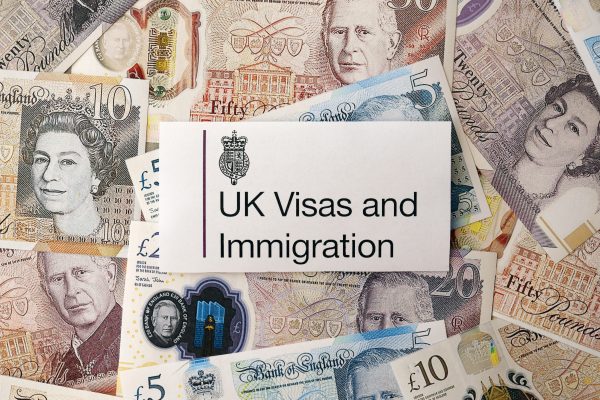
Hardly a day goes by without a headline, front page or article focusing on immigration, asylum and refugees. Political debate about immigration and asylum regularly conflate the two, and generally, mainstream media coverage is either acquiescent to or passive in the negative discourse, pointing to the allegedly harmful effects of immigration on the nation and its economy, security, culture and ‘people’, and thereby propagating discourses that serve to fuel xenophobia and racism.
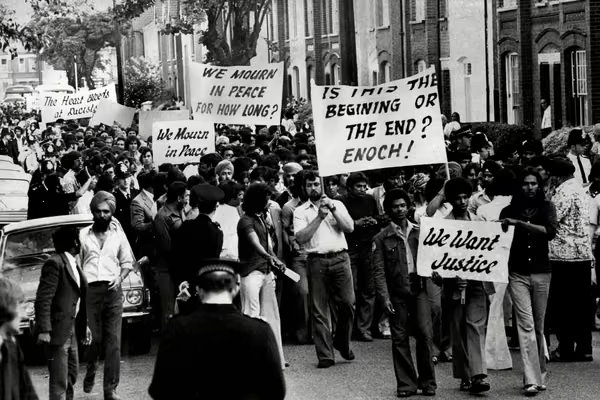
As home secretary Rab Butler’s 1962 words show, debates about immigration are often presented as revolving around ‘neutral’ policies that have no racialised intent. But the reality is that, both historically and contemporarily, immigration debates in the UK have always borne the markers of racism. (1) They construct the unwelcome Other in ways that suggest immigrants as inferior or dangerous and their presence as a threat to either economic security or cultural identity. Butler stated in the discussions about the Commonwealth Immigrants Act 1962 that the ‘great merit’ of the legislation was that ‘it can be presented as making no distinction on grounds of race or colour’, but the impact was fully intended to be one of privileging white commonwealth immigrants while controlling ‘coloured people’.
Our point here is not to argue whether individuals concerned about immigration are racist: what we are concerned with are racialised systems, processes and politics. We aim to highlight that the wider discourse about immigration, and its implications in terms of policy-making, are constructed, legitimised and promoted in a top-down manner, and have been deeply racialised, structurally and at every stage.
Migration debates and their implications for policy are racialised as they are built on a colonial foundation and have often privileged white migrants and disproportionately targeted those who are racialised and from the Global South. And while the Brexit debate about immigration was often linked to white Eastern and Central European migrants, the Windrush scandal, a focus on Muslim migrants and the privileging of the ‘white working class’ have exposed the racial undertones and implications for racialised people.
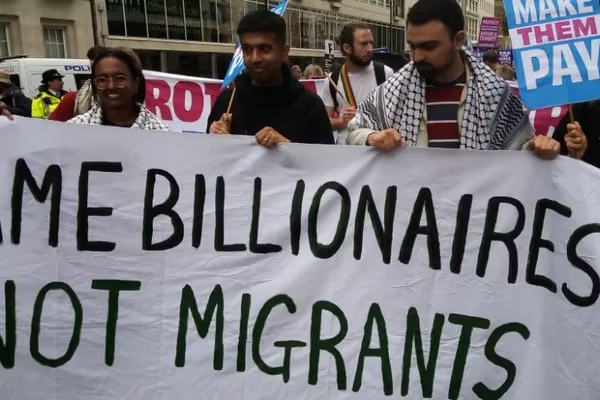
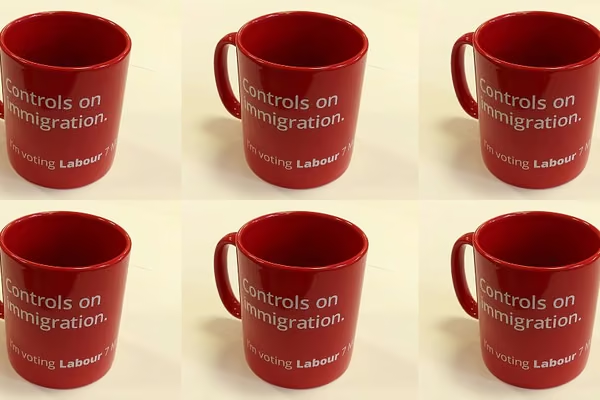
The issue of immigration is likely to once again be prominent in the upcoming general election. This can already be witnessed in the way that the Conservative government is attempting to use it as a wedge issue, particularly in relation to ‘small boats’ narratives. But it can also be seen in the Labour Party’s response, which, rather than critiquing the policy, articulates the Conservatives’ failure to tackle what is increasingly accepted as a ‘crisis’. Even political defences of immigration tend to paint it in a way that seeks to artificially separate ‘good’ immigration from ’bad’. While this is ostensibly linked to financial criteria, it disproportionately condemns migrants from particular countries, often in the Global South and former colonies, and thus is deeply racialised.
Immigration discourse and the far right
Anti-immigration discourse has always been a key element in the arsenal of the far right. As biological racism became increasingly taboo in public discourse in the aftermath of the Second World War and immigration from the colonies and former colonies was needed to rebuild much of Europe, far-right intellectuals adapted their ideological matrix to fit their new environment and needs: the exclusion of the Other was no longer premised on a superiority/ inferiority relationship, but rather on irreducible cultural differences that should be protected by controlling immigration.(2) It was also clear that controlling immigration was not just about the numbers of people coming into a country but also about the racialised profiles of those communities.(3)<>/a>The negative construction of the Other has often served to split working-class interests, with racialised immigrants painted as responsible for a lack of jobs, low wages or poor work conditions rather than this being understood as a result of an economic system based on labour exploitation.(4) While mainstream political actors had at first accepted, if not welcomed, immigration because the need for cheap labour to rebuild Europe was the priority, the breakdown of the post-war settlement and the growing unrest created by the neoliberal turn and austerity policies has revived the mainstream’s tendency to blame hardships on those who are deemed not to belong.
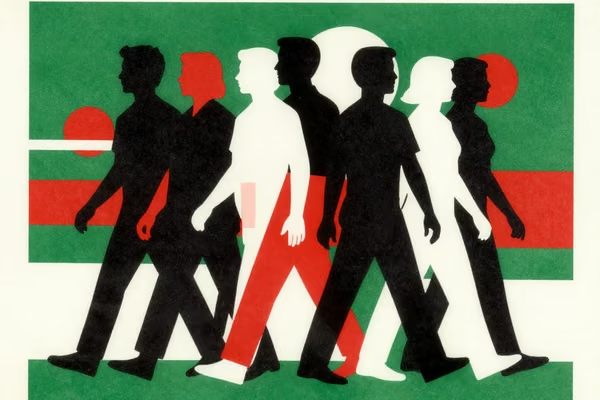
This report contends that current immigration debates rely on racialised Othering, often in euphemistic and indirect ways,(5) and that the representation of immigration as an urgent issue of concern is not natural and inevitable, driven by ‘popular’ and thus ‘democratic’ grievances, but is actually cultivated and nourished by political and media elites.(6) We argue that far from simply responding to the people’s demands, these political and media elites are playing a key role in constructing such demands and making them central to our current political discourse, thus taking attention away from other issues. Moreover, the positioning of opposition to immigration as a popular demand serves to legitimise far-right politics, the further mainstreaming of racist ideologies and the Othering of people of colour. In particular, recent discussions around immigration have served the far-right agenda by splitting the working class into a racialised Other and a constructed ‘white working class’ whose interests are made to match those of the reactionary economic elite, in spite of the fact that those interests are in no way aligned and the latter’s support for the former is far from obvious.(7)
We argue that rather than the simplistic bottom-up process which is often used to justify the coverage and attention given to immigration, with the blame put on ‘popular’ reactionary and racist views, the focus is in fact fuelled by predominantly top-down effects, where public concerns about immigration are mediated by those with power and privileged access to shaping public discourse.(8)
It is important to reiterate that while discussions often rage about whether it is racist to support anti- immigration policies, our conclusion is that anti- immigration policies in the UK have generally been used as a proxy for articulating racist intent and outcome. The logics of exclusion that anti-immigration policies advocate are unequal in both their direct application and the collateral damage they inflict on communities of colour, whether they are settled or new. The pernicious impact of these policies recently found its maximum expression in the events and harms exposed by the Windrush scandal, but evidence of their detrimental effects can equally be seen in areas such as housing, safeguarding from crime and access to health, among others.(9,10) This paper sets out how political and media elites operate interactively to manufacture ‘crisis issues’, inflate the credibility of poorly evidenced conclusions, and damage our democratic conversation by mainstreaming far-right ideas that are racialised, regressive and dangerous.
Conclusion
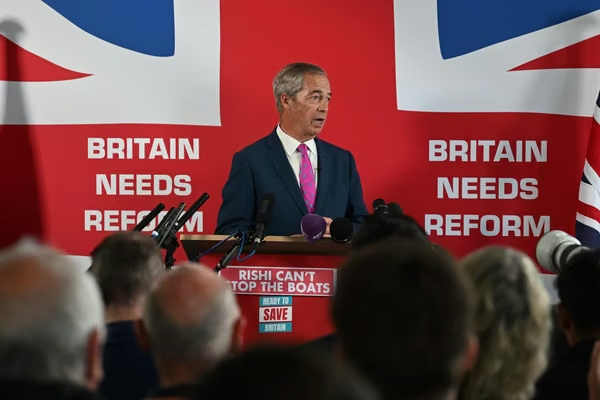
Nigel Farage spent the autumn of 2023 splitting his time between navigating ever closer to the Conservative Party and ‘funwashing’ his image through his participation in I’m a Celebrity, Get Me Out of Here. Celebrating leaders like Farage through reality TV shows or coverage of their hobbies rather than their politics serves only to normalise them.
Rather than lamenting the rise of the far right, public actors and institutions – notably those that are part of the political and media establishment – have a real role to play when it comes to setting the agenda and driving the discussion towards more positive and progressive horizons and outcomes. This is more difficult than hyping up the far right or merely asserting a centrist consensus. But a failure to do it is not only a failure to uphold democratic standards; it is a direct threat to democracy itself, as what is being normalised is its antithesis – one which does great harm to people who require representation, as well as to the values and rights that are so often asserted as fundamental to democracy.
As the general election approaches and political campaigns ramp up, it is already clear that immigration, and reactionary stances on wider issues, will play a key part in the electoral battle. As stated earlier, whether individuals who express concern about immigration are racist is not our focus: our concern is with the design, delivery and execution of immigration policy at the systemic level. The markers of racism are self- evident even if they are denied, whether in Home Office documents revealing the intent to present policy as neutral while celebrating its ability to restrict and operate almost exclusively on people of colour, or in more recent references to ‘invasions’ of migrants crossing the Channel.
Both the Conservatives and Labour have made clear that anti-immigration policies will be a key pillar of their strategy and that much of their campaign attention will be on competition to appear the strongest and most effective in enforcing border controls and limiting the number of migrants. In doing this, they validate the issue as one worthy of attention and one whose solution is to be found in harsher anti- immigration policies and stances. We can thus expect the issue to be high on the agenda of the parties, but also of pollsters, pundits and the media more generally. However, it is disingenuous to manufacture a ‘popular agenda’ and trade on ever harsher policies and claim that there is no racialised intent or impact.
It is essential for those who seek a more progressive way out of the many crises we face to understand how issues are mediated and legitimated by an uncritical representation of data. Our analysis of the EU referendum result and Eurobarometer data has demonstrated the power of agenda-setting and the need for people to rely on processes of mediation to make sense of the world. While we can feel a certain degree of confidence that we understand the immediate world around us and our own personal needs, making judgements or decisions about a wider imagined community demands from us that we rely on trusted accounts of what that community is, needs and believes in. This is where elite actors like politicians and the media, with privileged access to the ability to shape public discourse, play a key part in the democratic process.
The run-up to the 2024 general election looks like it is stuck in a groove where we exaggerate, endorse and give urgency to debates about ever tougher immigration policies that too often rely on racialised Othering. The parameters of these conversations often depend on representations of polls and electoral strength that are not tied to critical questioning of the numbers. We need to ensure that political elites take responsibility for and are held accountable for the ways that public opinion and assent is collected, curated and narrated – and to make it clear that these are not politically neutral activities. The media plays a critical role in this agenda-setting process. Journalists (and academics too) cannot claim to simply be reporting on facts: there are clear editorial choices made, and these choices are political ones which bring certain issues to the fore and relegate others to the private realm.
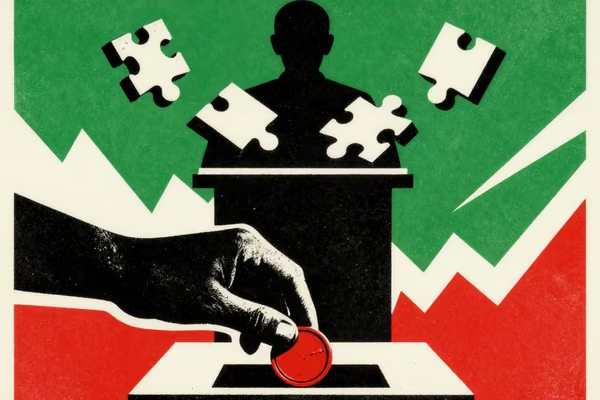
When people are asked what matters to them personally, they point to the everyday realities of their lives, including their economic and social situation at a more local level. Instead of mainstreaming far-right politics of division and racialised hostility directed at minoritised groups, we call for an electoral politics that deals with the desperate economic situation and the need for public services and community infrastructures that can rebuild our communities.
Our democracy is in peril; people will lose confidence in the political system if we continue to allow it to be hijacked by political theatre over manufactured crises, with all of the serious consequences this entails, and ignore the very real political and economic issues that shape our lives and communities.
Footnotes
1. Brown, K., Mondon, A. and Winter, A. (2021) ‘The far right, the mainstream and mainstreaming: Towards a heuristic framework’, Journal of Political Ideologies 28(2): 162–179;
Mondon A. and Winter A. (2020) Reactionary Democracy: How Racism and the Populist Far Right Became Mainstream, London: Verso2. Mondon and Winter, Reactionary Democracy.
3. Smith, E. and Marmo, M. (2014) ‘The myth of sovereignty: British immigration control in policy and practice in the nineteen-seventies’, Historical Research 87(236): 344–369.
4. Roediger, D. R. ( 2007) The Wages of Whiteness: Race and the Making of the American Working Class, London: Verso.
5. Masocha, S. (2015) ‘Asylum seekers in media and parliamentary discourses’, in Asylum Seekers, Social Work and Racism, UK: Palgrave Macmillan .
6. Mondon, A. (2022) ‘Populism, public opinion, and the mainstreaming of the far right: The “immigration issue” and the construction of a reactionary “people”’, Politics, online first,
23 June.
7. Mondon, A. and Winter, A. (2018) ‘Whiteness, populism and the racialisation of the working-class in the United Kingdom and the United States’, Identities: Global Studies in
Culture and Power 26(5): 510–528.
8. Wodak, R. (2021) The Politics of Fear: What Right-Wing Populist Discourses Mean, 2nd edition, Los Angeles: Sage.
9. York, S. (2018) ‘The “hostile environment”: How the Home Office immigration policies and practices create and perpetuate illegality’. Journal of Immigration, Asylum and
Nationality Law, 32(4).
10. Grant, S. and Peel, C. (2015) ‘No Passport Equals No Home’ : An Independent Evaluation of the ‘Right to Rent’ Scheme, London: Joint Council for the Welfare of Immigrants
(JCWI) ; Qureshi, A., Morris, M. and Mort, L. (2020) Access Denied: The Human Impact of the Hostile Environment, London: Institute for Public Policy Research (IPPR).Download the full report here.










I see that David Blunkett is using all the fuss about people coming in on boats to argue for identity cards for all.
Shameless opportunism.