
The Tories are toast. But…
JVL Introduction
We can all celebrate the implosion of the Tory Party we have witnessed but it’s too early for a definitive judgment.
Here are a few articles and pointers. There will no doubt be much more to follow soon but for now:
- This was an anti-Tory move of major proportions. It was their election to lose, and they did so big time.
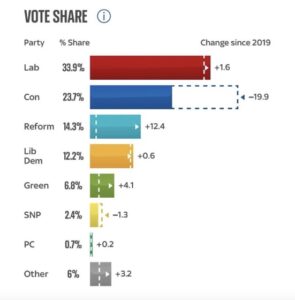
- Reform split the right-wing vote in the country, amplifying the scale of the defeat and allowing for a massive Labour landslide on fewer votes that under Corbyn’s 2017 and 2019 performances.
- The electoral system does not reflects the popular vote except for showing the very large majority who want change. Labour won almost 2/3rds of the seats on little more than 1/3 of the votes.
- The Greens and Lib Dems successes on manifestoes to the left of Labour’s on almost every front has given expression both to the prevailing anti-Tory sentiment and to the desire for change
- Sentiment runs high against Labour’s inability to come out strongly for a ceasefire in Gaza and contributed to Andrew Feinstein’s creditable performance in Keir Starmer’s constituency (where Starmer received little more than half those he received in 2019) and by the success of eight pro-Palestinian candidates, including, of course Jeremy Corbyn.
- The Labour party to date while recognising many of these problems, seems committed to delaying tackling them until after a sustained, and highly speculative growth in the economy, has first been achieved
- The high vote for Reform with their racist, anti-immigration policies is a real threat, much of it an angry and warped response to the years of austerity and collapse of social, health, housing and educational services
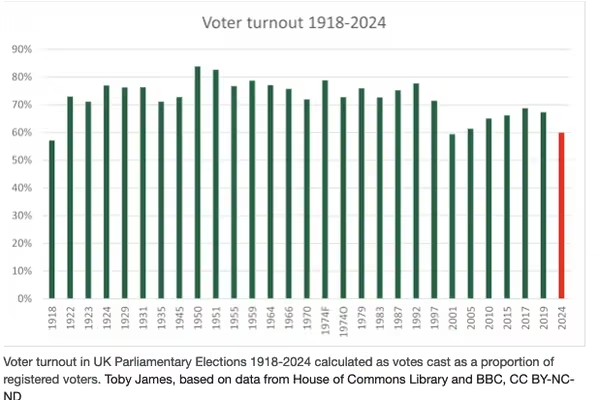
- The near historically low turn out of just 60% shows the level of disengagement in the formal political process.
Below are:
- Some stats
- Labour wins on fewer votes than in 2019
- On electoral ambivalence
- A Tory implosion
WebTeam
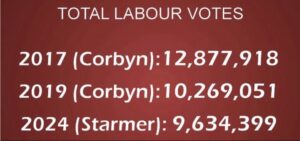
Starmer’s ‘triumph’ saw him receive 600k fewer votes than Corbyn’s ‘disaster’ of 2019
Skwawkbox, 05/07/2024
Tory collapse and Reform party dividing right-wing vote gifted Starmer a landslide but fawning media are spinning fall in popularity as master tactics
The fawning ‘mainstream’ media have been spinning Keir Starmer’s landslide win in last night’s general election vote as a masterclass in strategy, claiming that he and his team ‘spread the vote’ across the seats they needed to win.
This spin seems to be a means of dismissing, or usually ignoring entirely, the fact that Starmer’s ‘triumph’ involved the party receiving 600,000 fewer votes than Labour received in 2019, which the media at that time claimed – falsely – was ‘the worst Labour performance since 1939’.
In reality, Starmer was gifted the win by the Reform party standing in seats where the fascist party either beat the Tories, in four seats, or more commonly split the Tory vote and allowed an unpopular Labour candidate to come through on the inside. If you were, say, a security state boss looking to engineer a victory for an unpopular but pliant placeman, this would have been how to do it.
The left, meanwhile, saw a number of notable victories over Starmer’s colluders – four right-wing Labour MPs lost their seats to candidates standing against Starmer’s complicity in Israel’s genocide and other war crimes in Gaza. The Greens, now well to the left of Starmer’s authoritarian and racist project, had their best ever general election performance and now have four seats compared to their previous one, including a stunning victory for Carla Denyer over the awful Thangam Debbonaire. The LibDems, disgraced for their collusion in the first Cameron government – including their betrayal on tuition fees and their boasting of agreeing to draconian Tory benefit cuts in return for a tax on plastic shopping bags – still managed to defeat the Tories in enough seats to increase their MP count to a predicted seventy-one, in many cases also aided by Reform.
Corbyn’s huge victory over his Labour health privatiser opponent and the massive collapse in Starmer’s vote count in Holborn and St Pancras – again spun away or ignored entirely by the ‘msm’ – are a cause for hope and renewed determination by the left to unify and organise against the fascists and fascist enablers celebrating this morning, as it has done this month in France. Starmer’s woeful personal popularity ratings – despite the softest of media treatment since he conned his way into the Labour leadership – are only going to fall as people see the reality of his love for even greater austerity, NHS privatisation and war, and his addiction to breaking promises.
On electoral ambivalence.
Francesca Newton, The Pickle/Vashti, 5th July 2024
2009, the year of my bat mitzvah, was the last Britain saw out with a Labour government, which means that today’s election results mark a first in my entire legal adult life and most of my Jewish adult one. It isn’t just a victory for Labour. Despite a loss to Jeremy Corbyn, despite a Green victory in Bristol, despite a slice taken out of Keir Starmer’s vote share in his constituency (in large part thanks to independent candidate and anti-Zionist Jew Andrew Feinstein) and the party as a whole being on track at time of writing to enjoy a smaller number of votes than they won in 2017, the parliamentary majority still gives Keir Starmer and those around him the power to do what they like for the next parliamentary term.
So what will that be? The record gives socialists plenty of cause for fear. Starmer’s leadership has demonstrated a hostility to the left inside Labour’s ranks, a disdain for party democracy (a bad sign for national democracy), a tendency to lie, brazenly and often, a distaste for the kinds of policies that could make a material difference to the lives of the majority in Britain, an enthusiasm for big business (including private healthcare), resentment towards the organised labour movement, a doggish readiness to attack transgender people and migrants as the right demands, and a willingness to circumvent procedure entirely to avoid backing an end to an Israeli bombardment that has now claimed close to 40,000 Palestinian lives. As I’ve written in Tribune, on a national scale, Labour has gone to great lengths to make clear that despite the landslide nothing substantial will change.
The potential consequences of all that go further than a maintenance of a grim status-quo. Macron’s unfolding nightmare with Marine Le Pen proves that centrist rule, typified by the incapability or unwillingness to take seriously the manifold crises humanity now faces, only increases the political dissatisfaction on which the far-right feeds. The groundswell of support for Reform in this election, including to Labour’s detriment, is likely to dictate the Conservatives’ position in the coming years; opposition will give those Conservatives the time and space to indulge their most fascistic fantasies. If Starmer fails to note France’s warning (sense would suggest he couldn’t; history suggests he will), the Tories – or Reform itself – may well return renewed and worsened in 2029 when public frustration sees Labour’s exercise in political nothingness collapse.
And yet – because I still think it is worth saying yet – this is the first time in fourteen years that the party in power is one with socialists in it. Despite the Labour machine’s best efforts, a few of those re-elected under its banner are people who have spoken at Palestine Solidarity Campaign rallies, people who have stood on picket lines alongside striking workers, people who have spent recent years working to inch our politics in the direction of redistribution and justice. In this, the new government represents an opportunity of the kind the last one never did. Of course ‘opportunity’ is not enough: support for strikes and an opposition to genocide is the bare minimum we should demand of Labour candidates. But even the presence of a small minority of people who fit those criteria in the party of government represents a rupture with the last fifteen years.
I could not stop thinking, in the run-up to this election, of all those whose lives have been lost needlessly in Britain because of the policies of the Conservative party since 2010, both in horrific, highly-visible catastrophes like Grenfell and Covid and in the smaller, everyday catastrophes of hunger and mental health crisis and cold. One study from 2022 linked austerity to 330,000 excess deaths. The only thing to be unhappy about in the removal of the Conservatives from Britain’s highest offices is that it took liberal outrage at the party’s apparent failures of political politesse to do it – that simple human anger at their casual disdain for human life was not enough.
In the knowledge that the bulk of the Tories’ replacements are doing what they can to limit their own ability to be better, however, I know I’m not the only person who’s been tempted by a complete collapse into cynicism. The British political system seems destined to crush any efforts to improve the lives of those it governs, and the world at large seems locked into a spiral that can only produce more violence and deprivation. What stops me is the knowledge that cynicism delights those who benefit from us believing all this is inevitable — that instead of being neutral, apathy is, to them, a gift.
To me, a better response today is ambivalence. Ambivalence is a word often – but wrongly – used in the place of indifference; it more accurately refers to a state of strong but conflicting emotion. Judaism is a religion almost uniquely familiar with ambivalence. It’s key to some of the stories fundamental to Jewish life – the Exodus into Egypt, for example, which celebrates the leaving-behind of one horror but is fraught with fear about the uncertainty that lies ahead – and in Jewish writing the word is used to refer to feelings about everything from identity and Israel to religious practice itself.
Thinking about a Jewish response to the election for the Pickle this week led me to the Shehecheyanu – the Jewish prayer said when something is done for the first time, or done for the first time in its relevant cycle, like the start of an annual festival. The English translation I learned growing up goes as follows: “Blessed are you, Lord our God, king of the universe, who has kept us alive, and sustained us, and brought us to this season.” (One secular alternative I’ve found expresses gratitude to the prior generations that have sustained us; another blesses “the goodness which we have encountered in the world”.)
I’m not the first to tie the Shehecheyanu to the occasion of an election, but in many ways it feels like an appropriately ambivalent prayer for this election in particular. As I understand it, the prayer expresses thanks – to God or goodness or whatever you like – for seeing the speaker to a point of change. The “season” in question is not qualified as good or bad, and that means it can be both – it is only defined as a season, with all the transience and variety the term implies.
To be clear, I’m no rabbi. Maybe after this is published Vashti will be met with comments about my failure to understand the Shehecheyanu properly. Other readers might feel that writing about hope and faith at this moment is all very nice but inadequate to the threat Starmerism poses, an injustice to the people who are likely to suffer worst under his rule. Unfortunately part of the burden – and joy — of being on the left is continuing to believe in the possibility of serious material change, of liberation, even in the most unlikely circumstances. Resistance and hope are not mutually exclusive. They are dependent on one another.
Today, when hope alone feels too simplistic, I’m taking comfort from the prayer above and the ambivalence it allows: relief that the last season is passing, and resolve for the struggle – in the Labour party and in every workplace, housing block, community centre, place of worship, and household in the country – that must come next. ▼
 Francesca Newton is an editor at Vashti.
Reposted with Vashti’s permission
There’s no corporation or big advertisers behind Vashti – we’re a workers’ cooperative and rely on small donations to keep running. Support our journalism to help break the consensus.
To donate once, click here. To donate monthly, click here.
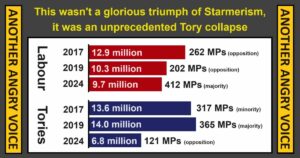
This wasn’t a triumph for Starmerism, it was a Tory implosion
Keir Starmer won an astonishing 3.2 million fewer votes than Corbyn did in 2017, yet the collapse of the Tory party and our deeply disproportional voting system delivered him an enormous majority.
Another Angry Voice, 5th July 2024
If anyone was under the illusion that the general election represents an ideological triumph for Starmerism, rather than an unprecedented disintegration of the Tory party, the numbers make it absolutely clear what’s actually happened, and what a stupidly unrepresentative voting system we’re lumbered with.
Labour won an absolutely massive parliamentary majority (412 MPs so far) with 9.7 million votes. That’s 600,000 votes fewer than the 10.3 million Jeremy Corbyn got in the 2019 rout (202 MPs), and an astonishing 3.2 million fewer than Labour won in 2017 (262 MPs).
To put it another way, Keir Starmer attracted 3.9 million fewer voters than Theresa May did in 2017. He’s just won an unprecedentedly large majority over the Tories, while May ended up losing the Tory parliamentary majority!
Labour’s vote has collapsed by over 3 million since 2017, and the only explanation for this falling popularity handing them a huge majority is the astonishing collapse of the Tory party.
The Tories cratered from 14 million votes in 2019 to just 6.8 in 2024, meaning over half of the people who endorsed Boris Johnson and his shambolic Brexit bodge in 2019 decided not to bother voting Tory in 2024.
Labour were not the only beneficiaries of this astounding Tory collapse under our wildly unrepresentative voting system. The Lib-Dem vote fell by about 100,000 from the 3.6 million Jo Swinson achieved in 2019, yet their MP count soared from just 11 back then, to 71!
To be fair to the Lib-Dems 71 out of 650 seats is much closer to a fair and proportional representation of their share of the vote than 11 was, but it’s taken the unprecedented implosion of the Tory party for this proportionality to happen.
The Green Party doubled their expected seats in the exit poll to get four, while Reform’s 4 is well short of the 14 predicted by the exit poll.
Both parties have a strong case that the disproportionality of the voting system has worked against them.
The disproportional voting system seriously harmed the Greens election campaign because millions of potential Green voters had to hold their noses and vote for pro-austerity, pro-privatisation parties like Starmer’s Labour or the Lib-Dem to oppose the Tories, because a Green vote in most constituencies amounts to little more than a protest vote.
If we had a system in which all votes matter, far more people would have supported them (especially a lot of the 3.2 million who have abandoned Labour since 2017, and those who decided to hold their noses to endorse Starmer’s hard-right version of the Labour Party as the “lesser of two evils”).
Apparently Reform got 4 million votes, which is several hundred thousand more than the Lib-Dems, yet they get 4 seats, while the Lib-Dems got 71.
Many would argue that it’s a good thing that Farage’s mob didn’t get dozens of seats, but it’s a dangerous attitude to cheer for an absurdly disproportional voting system when it delivers unfair results that you like, when there’s the obvious danger that next time it could deliver unfair results that you really hate, especially if the capitalist media propaganda hacks begin pushing Farage as hard as they can for the next five years, and/or Farage and the Tories cook up an extreme-right electoral alliance at the next election.
Whatever your feelings on the general election result, two things are absolutely beyond doubt:
Starmer won his massive majority not because of the popularity of his more of the same” agenda, but because the Tory vote spectacularly imploded.
Britain’s electoral system is absurdly disproportional, and desperately in need of modernisation.
Another Angry Voice is a reader-supported publication. To receive new posts and support more content, you can set up a free or paid subscription.










This election seems to represent a strange hiatus in basically two-party politics (notwithstanding the periodic surges in Lib/Lib Dem support).
‘Britain’s electoral system is disproportional and desperately in need of modernisation.’ – Obviously the leading advocates of PR are now the Farageists. A few years ago it was UKIP railing against the SNP.
(Versions of) PR certainly served Mussolini and Hitler well from 1919. I am not arguing either for against, but who is going to formulate the best system, with political stability in mind?
Labour votes since 1945 (approx. numbers):
1945 – 11.9 M
1950 – 13.2 M
1951 – 13.9 M (Tory winners – 13.7 M) – electorate 34.5 M
1955 – 12.4 M
1959 – 12.2 M
1964 – 12.2 M
1966 13.1 M
1970 – 12.2 M
1974 – 11.6 M
1979 – 11.5 M
1983 – 8.4 M (Lib 7.8 M)
1987 – 10 M
1992 – 11.6 M (Lib 6M)
1997 – 13.5 M
2001 – 10.7 M
2005 – 9.5 M
2010 – 8.6 M (258 seats)
2015 – 9.4 M (232 seats)
2017 – 12.9 M (262 seats*)
2019 – 10.3 M (202 seats)
2024 – 9.7 M (411 seats*) – electorate 46 M
Reform’s high aggregate of votes is due largely to scoring well over 20% in most of the former coalfield and industrial constituencies, but nowhere near enough to take any of the seats.
Re the fall in voter turnout in 2024 compared with 2019 from 67.3% to 59.9%, it equates to an 11.1% percent reduction and 3,260,338 less people voting.
2019 = 32,014,110
2024 = 28,753,772
I don’t know about the MSM in general, but contrary to what it says in the Skwawkbox article about the media spin, this Independent article – at least! – that I came across (whilst trying to find out how many people voted on Thursday) mentions that JC got more votes in 2019 than Starmer did, albeit referring to ‘Labour’:
Due to lower turnout, Labour won fewer votes than at the last election, at 9.7 million compared to 10.3 million in 2019.
https://www.independent.co.uk/news/uk/politics/general-election-swing-results-vote-numbers-b2574629.html
Just came across this Yahoo! News article headlined ‘How does voter turnout compare with previous Westminster elections?’, in which it says the following:
While Labour have won 412 seats at Westminster, the party scooped up 34% of the popular vote, just a 1.6 percentage point increase from the party’s share in 2019 and a six percentage point fall from the 40% won under Jeremy Corbyn in 2017.
The lower overall turnout means that despite increasing Labour’s vote share, the party secured just 9,686,329 overall votes in 2024, compared with a total of 10,295,912 under Jeremy Corbyn in 2019 – a result deemed a catastrophic failure by many.
And THAT of course was after years of being relentlessly smeared and demonised and vilified on an almost daily basis, but Labour under JC also got more votes than Ed Milliband in 2015, and way more than Gordon Brown in 2010 and Blair in 2005.
Apart from checking out stats on several occasions over the years I’d never actually read the wikipedia entries for the 2017 and 2019 GEs, but, in just doing so, I discovered that the 2017 entry has a comprehensive section about the ‘Media coverage’ of the election, which is well worth checking out, as is the (briefer) section in the 2019 entry, in which it says the following:
A large proportion of the newspaper coverage of Labour was negative.[253] Writing in the British Journalism Review, James Hanning said that, when reporting and commenting on Johnson, Conservative supporting newspapers made little mention of “a track record that would have sunk any other politician”.[175] In the Loughborough analysis, during the first week of the campaign, for example, the Conservatives had a positive press coverage score of +29.7…. Meanwhile, Labour, had a negative score of -70…
Yes, I know we know about the negative coverage, but it’s good to see that it’s mentioned in the wikipedia entries.
https://en.wikipedia.org/wiki/2019_United_Kingdom_general_election
At the very top of the column on the right-hand side there’s a link to the 2017 entry.
In order to consider the relative enthusiasm or disillusion of the electorate with a PARTICULAR party (or constituency candidate) when comparing the results of one election with those of another, there is a natural measure which, possibly because of the dysfunctional nature of our electoral system, never seems to be used. That measure is the PROPORTION OF THE TOTAL ELECTORATE WHICH VOTED FOR THE PARTY (OR CANDIDATE). This is a BETTER measure than the actual number of votes cast because it is relatively stable under minor changes of the size of the electorate (or of constituency boundaries).
When this measure is applied at constituency level the results are very revealing in illustrating the loss of Labour party support. Take the example of my own constituency, Manchester Withington. In 2015 Labour’s Jeff Smith had the support of 36.2% of the total electorate. In 2017 under Corbyn, Smith won the support of no less than 51.5% of the electorate. In 2019 that figure dropped to 47.1%, but in 2024 it crashed to 31.5%. In other words the proportion of the electorate willing to vote for Jeff Smith fell by some 39% from 2017 to 2024.
It is worth using this measure because instead of measuring the change in vote relative to other parties, it takes into account the voting record of that portion of the electorate which fails to vote.
It paints a very different political picture from that presented by the hordes of rather dim-witted official pundits.
So the Tories have been voted out….now to remove the current incumbent Tories, aka Starmer’s Labour Party. They talked about and “promised” (For what that is worth) change, but the only change that is apparent is a change of Jacket from Blue to pinky red. But they are talking of a continuation of the Tory policies that were rejected at the ballot. So, back to action and campaigning
Thank you for this bag of illuminating articles.
We now have a government built upon rotten foundations.
Many of its members are MPs of low character who actively campaigned against the Labour Party whilst Jeremy Corbyn was our elected leader (whereas Keir Starmer’s election was of course fraudulent).
Coincidentally, Starmer and Streeting have recently used the clapped-out cliche of ‘broken’, showing their feeble mental ability. Starmer and Streeting also have much lower majorities in their previously Labour constituencies, despite the media-trumpeted Labour ‘landslide’ across the country.
Of course, the Conservatives actually created the general ekection result by choosing irresponsible Boris Johnson and incompetent Liz Truss.
The changed for the worse Labour Party is a big swindle.
Britain deserves better.
Yesterday I watched “Can Jeremy Corbyn Make His Own Way? – After 40 years with Labour, he is taking them on” with Mohammed Hassan from Middle East Eye [https://www.middleeasteye.net/video/after-40-years-labour-corbyn-taking-them]. Jeremy postulates eloquently, how Labours move to the right, will leave a “space” for progressive socialist politics in a relatively short space of time. He elaborates by pointing out that, those who have “hope” in Starmers Government may soon realise the same politics of division, austerity and war are embedded in its DNA. “Hope” will soon turn to disappointment and disaffection and, put pressure on Starmers Government to deliver. That will be the point where Starmers neoliberal politics will start to unravel. It’s a very interesting interview – made two days before the election and Jeremy’s land-slide victory.
https://newleftreview.org/sidecar/posts/majority-without-a-mandate Richard Seymour ‘There will be no honeymoon. Labour and its leader are deeply unpopular; just less so than the Conservatives for now.’