
The child benefit cap – it’s no game
JVL Introduction
Many on the left are not particularly concerned about the minutiae of how business in parliament is managed.
Maybe it is time to sit up and take notice.
Labour’s move to suspend seven MPs who voted against it on the 2-child benefit cap is not just heavy-handed but unprecedented.
Phil Edwards digs deep, dismantling the arguments that “we can’t afford it”, or the rebels broke the rules so were duly punished.
In so doing he shows that, with extremely rare exceptions (in situations where it could be argued that their vote really mattered), MPs have always been able to vote according to their conscience without being sanctioned.
And for good democratic reasons. If every MP automatically voted for its party leadership line on everything there really would be no point in having MPs at all.
It may be that British parliamentary governments really are “elective dictatorships” – but they have seldom acted brazenly as if they were. Starmer is moving us into unchartered territory…
RK
It’s no game
Loading article text…




Letter from me to my local paper, sent yesterday:
Alan Jackson praises Keir Starmer for his “strong leadership” (July 26) and for “not caving in” to those Labour MPs who called for the scrapping of the two-child benefit cap.
Allowing those MPs to express their views and vote with their consciences would not have been “caving in,” but showing some respect for democracy. Until Starmer became leader, the Labour Party prided itself on being a “broad church,” where different opinions could be heard, and debate could flourish. It was once a democratic socialist party. It is no more.
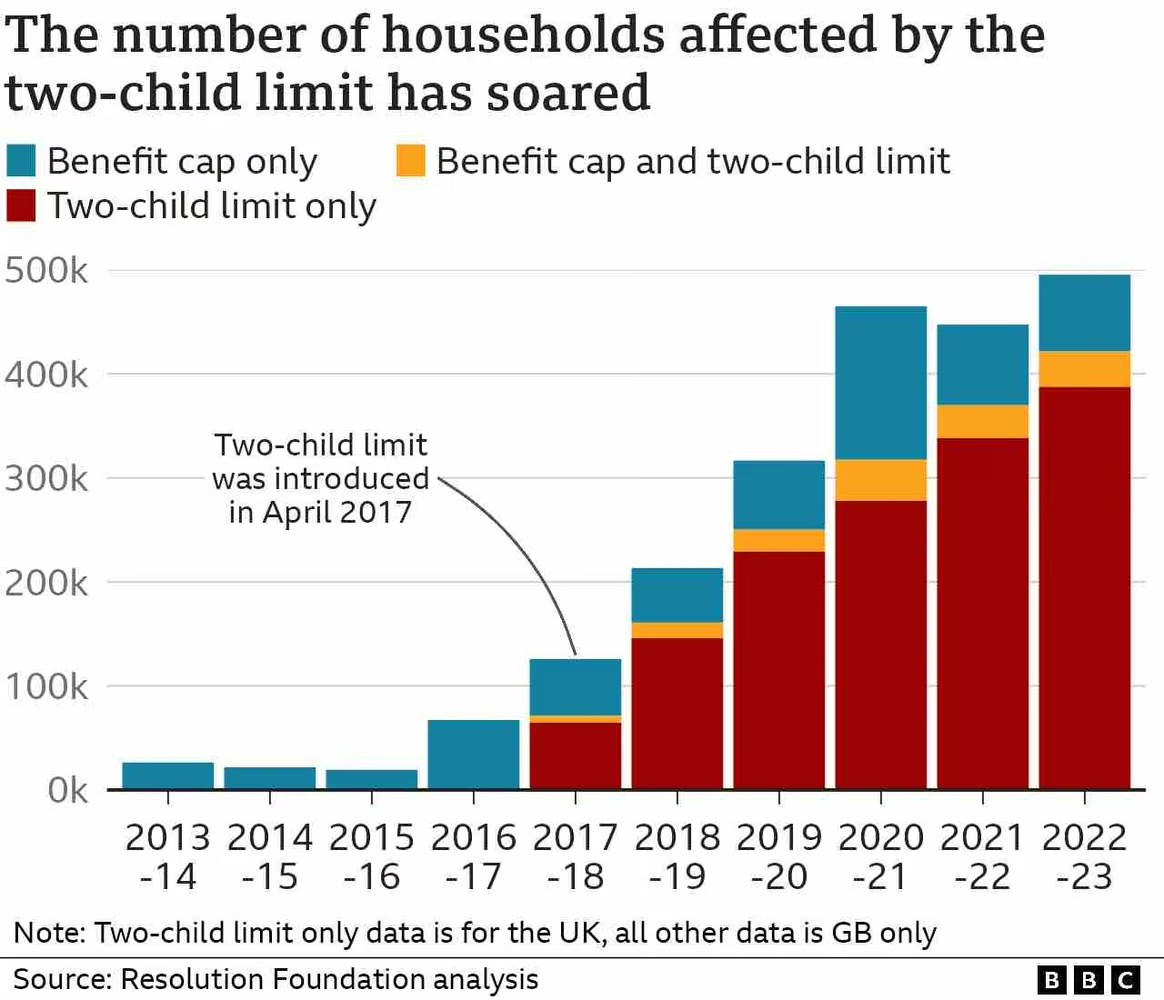
Scrapping the cap would be the quickest and most cost-effective way of reducing child poverty, lifting 300,000 children above the breadline and pulling 700,000 more out of extreme poverty. It would cost an estimated £1.7 billion a year. Starmer says we can’t afford this, but he is wrong.
There are many ways the money could be raised, for example taxing capital gains at the same rate as income would net the Treasury £12 billion a year.
The Child Poverty Action Group argues that, in any case, scrapping the cap would quickly pay for itself. Child poverty has a significant effect on the future health, educational and employment prospects of children affected. The cost of this deprivation is estimated at £39 billion a year. Reducing child poverty would create a healthier population, alleviating pressure on public services, and boosting economic growth.
Starmer is not showing “strong leadership” but rather displaying the typical weakness of a dictator who lacks confidence in his own argument, and prefers to use threats and intimidation to silence those who disagree with him.
Pete Winstanley
Phil Edwards is correct in pointing out that the penalty imposed on the seven MP’s who defied the whip is draconian in its context and, in that sense, a departure from precedent. However I think he underestimates the extent to which the (extended) principle of collective responsibility (PCR) corrupts the behaviour of all elected representatives and not just of ministers. It is a fact that the vast majority of MP’s very rarely defy the party whip; and the reason for this is surely not because they are all party clones in their opinions, but because of the power of patronage of the party leadership which is so overwhelming that it requires considerable personal courage to resist.
The PCR has an interesting history dating back more than 200 years and it is an essential characteristic not only of modern parliamentary democracy, but reaches a logically extreme form in parties organised on Leninist principles. It is however seriously incompatible with freedom of information and modern communications: in the absence of total media control those who obey its dictates instantly appear dishonest and insincere. This phenomenon facilitates the rise of political demagogues and charlatans.In a world where the vast majority of politicians lie about their true beliefs, those who lie most colourfully have a great advantage.
Finally, how else other than through nostalgia for patronage can one explain the predominant attitude of those who have lost the whip? Instead of rejoicing at their liberation they seem to yearn for the restoration of the familiar lashes of political slavery.
Excellent Post .. not only is the argument :
“Either ignore or come down heavily” flawed –
The question Starmer should have put to himself is
“Having used up the severest disciplinary measure –
– what do I do the next time individuals rebel?”
Not only that – the “Two Child benefit cap”
is (in my opinion) not consistent with Christian beliefs – or with the beliefs of most world religions.
I am a Catholic and last Sundays’ New Testament reading was :
“The Feeding of the Five thousand” ( John 6:1-15).
This was preceded by an Old Testament reading on the feeding of the Israelites in the desert (Exodus 16)
Now there is much discussion among scholars as to the underlying meaning of the New Testament reading – it is much easier to state what Jesus (or Moses) in Exodus) did NOT say :
That the food distribution be limited in any way. – indeed the New Testament states the food was distributed to all “as much as they wanted” .
We can help to reduce Starmer’s power by targeting for defeat anyone who seeks to benefit from a Labour candidate being sacked by him.
This would include the two Labour councillors who were shortlisted to take over as candidate from Jeremy Corbyn in Islington North and the councillor who took over after Faiza Faheen was sacked as candidate in Chingford and Woodford Green.
The next London Borough elections will take place in 2026.
And the Green Party probably has a good chance next time in Brighton Kemptown where the incumbent Labour MP was sacked at the last general election. The new MP is Chris Ward who is now PPS to Sir Keir Starmer.
Let us see how Starmer’s party manages if it struggles to get a candidate to replace someone who has been sacked.
Pete Winstanley (above post)
– is quite correct in that looking after children is
not only their human right but an investment
for the future.
Starmer reckons he wants growth so the best way
is to look after our most important resource – our children.